
Wristwatches · Wristwatch
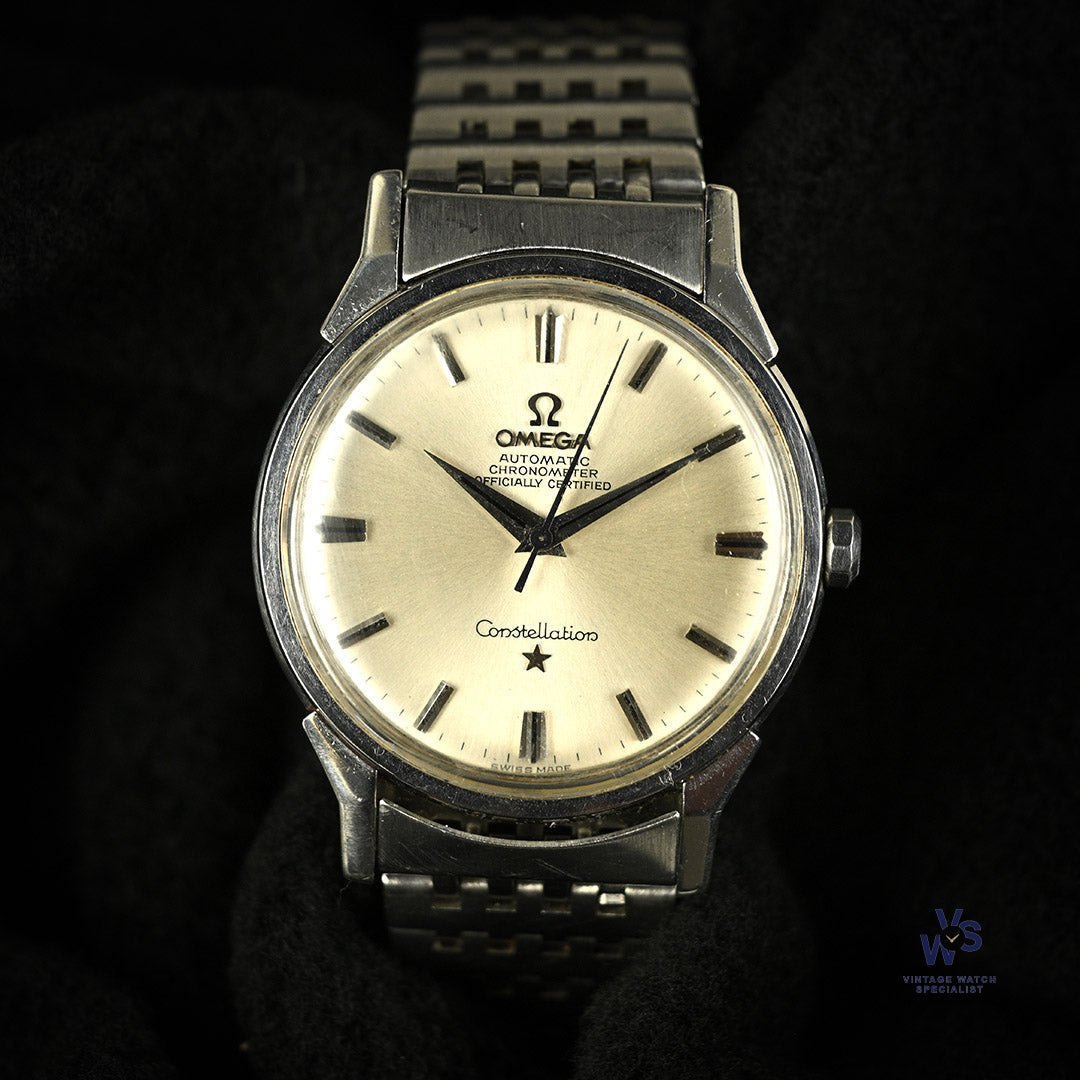
Omega Constellation Automatic Chronometer, ref. 167.005, circa 1966
- Maker / attribution
- Omega (maker)
- Date
- c. 1966
- Historical period
- Modern Mechanical Horology (1945 – 1969)
- Country of origin
- Switzerland
- Object type
- Wristwatch
- Dimensions
- Case 34 mm
- Stock no.
- vws4406cs
- Credit line
- Dealer listing, Vintage Watch Specialist (vws4406cs)
- Catalogue title (original)
- Omega - Constellation Automatic Chronometer - Reference 167.005 - c.1966 (English)
View the source record (dealer listing) ↗ (opens another website in a new tab)Suggest a correction
Record summary
Catalogued by Vintage Watch Specialist (dealer), United Kingdom (stock number vws4406cs), this is a wristwatch by Omega, made in Switzerland, dated c. 1966. The Atlas places it in the Modern Mechanical Horology period (1945 – 1969) of its Wristwatches collection. Recorded dimensions: Case 34 mm. The record is illustrated with 6 photographs.
Assembled from the source record's structured fields. Dates and attributions are given as the source states them; where a field is missing the Atlas leaves it blank rather than estimating.
Catalogue description
Dealer description — Vintage Watch Specialist
Introduced in 1952, the Omega Constellation became the marque’s flagship chronometer collection, bringing together precision mechanical watchmaking and a more refined approach to everyday wristwatches. By the 1960s, the Constellation had developed many of the details now associated with the classic line: officially certified automatic movements, applied dial furniture and the distinctive observatory medallion on the caseback. Reference 167.005 belongs firmly to this celebrated mid-century generation of Omega chronometers. What's on Offer We are delighted to offer for sale this handsome Omega Constellation Automatic Chronometer, Reference 167.005, dating from approximately 1966, so perfect for a 60th Birth-year watch! Housed in a 34mm stainless steel case, this example has the beautifully defined, angular (dog leg) lugs characteristic of the reference, giving the watch a particularly elegant profile. The proportions are quintessentially mid-century Omega, with the relatively slim bezel allowing the dial to occupy much of the watch's face. The silver-white dial is exceptionally attractive, with applied baton hour indices featuring fine black onyx inserts that provide a wonderful contrast against the lighter dial. These are complemented by a pair of Dauphine hands with corresponding onyx inserts, together with a slender central sweep seconds hand. The dial is signed Omega Automatic Chronometer Officially Certified beneath 12 o'clock, while the elegant Constellation script and applied star sit above 6. A fine outer minute track completes what is a beautifully balanced and unmistakably 1960s Omega dial. Protecting the dial is its Omega-signed Plexiglass crystal, another pleasing detail to find on a vintage example of this age. The watch also retains its Omega-signed crown. Turn the watch over and the stainless steel caseback carries one of the Constellation's defining features: the observatory medallion surrounded by eight stars, an enduring emblem of the precision timekeeping credentials upon which the Constellation collection was built. Inside is Omega's automatic Calibre 551, a 24-jewel chronometer movement with an approximate 50-hour power reserve. The serial number supplied with the watch supports its dating to circa 1966. The watch is fitted to an Omega stainless steel bracelet, Reference 1193 with 725 end pieces, finished with an Omega-signed folding clasp. The multi-link bracelet suits the case beautifully and gives this example a pleasingly complete period appearance. The stainless steel case and bracelet display surface marks and signs of wear commensurate with age, while the dial remains particularly attractive, with its onyx-set furniture providing excellent definition. Altogether, this is a very handsome example of the classic 1960s Omega Constellation and a superb representation of the marque's celebrated chronometer watches of the period.
Historical context
Modern Mechanical Horology (1945 – 1969)
Tool watches for divers, pilots and astronauts; electric watches anticipate the electronic age.
The classic era of the mechanical wristwatch: dive watches, chronographs for motor racing and space flight, GMT watches for jet travel, slim dress watches, automatic calendars, and the rise of Japanese manufacturers alongside Swiss, American, German and Soviet industries.
Read the period in the timelineMore wristwatches from this periodEarlier: Golden Age of Mechanical Watchmaking
Atlas type guide
Automatic (self-winding) watches
Self-winding watches use the wearer's motion to wind the mainspring. Abraham-Louis Perrelet and Breguet made 'perpétuelle' pocket watches with oscillating weights in the late eighteenth century, but the principle only became practical in the wristwatch. John Harwood patented a bumper automatic in 1923; Rolex's Perpetual rotor (1931) winding in one direction, and later bidirectional rotors (Eterna, Felsa Bidynator), established the modern form. Micro-rotors (Universal Genève, Buren) and peripheral rotors made automatic watches thinner.
What to look for
- A semicircular rotor turning 360° over the movement, or a 'bumper' weight that rebounds between springs.
- 'Automatic', 'Perpetual' or 'Self-winding' on the dial.
- A sealed screw-back case, since automatic watches are wound less often by the crown.
Dating clues
- Bumper automatics: 1923–c. 1955.
- Full rotors: from 1931 (Rolex); widespread after c. 1950.
- Micro-rotors: from 1954–1958.
General guidance written by the Atlas editors about this kind of object. It is not a statement about this particular piece; for that, rely on the source record above and on physical examination.
Related records

Instruments · 1950–1976
Omega Megaquartz 2400 marine chronometer, 1950–1976
Science Museum Group, London

Instruments · 1960–1979
Stopwatch / timer by Omega, 1960–1979
Science Museum Group, London

Instruments · 1960–1979
Stopwatch / timer by Omega, Switzerland, 1960–1979
Science Museum Group, London

Instruments · 1960–1979
Stopwatch by Omega, Swiss made, single-button type reading 0 - 60 seconds in fifths and 0 - 5 minutes in minutes on subsidiary dial, 1960-79.
Science Museum Group, London

Wristwatches · 1945
Wristwatch by Eterna, 1945
Museum Rotterdam

Wristwatches · c. 1945
Breitling Premier, ref. 790, c. 1945
Antiquorum auction archive, Geneva

Wristwatches · c. 1945
Universal Genève Uni-Compax, ref. 22492, c. 1945
Antiquorum auction archive, Geneva

Wristwatches · c. 1950s
Baume & Mercier wristwatch, c. 1950s
Antiquorum auction archive, Geneva