
Wristwatches · Wristwatch
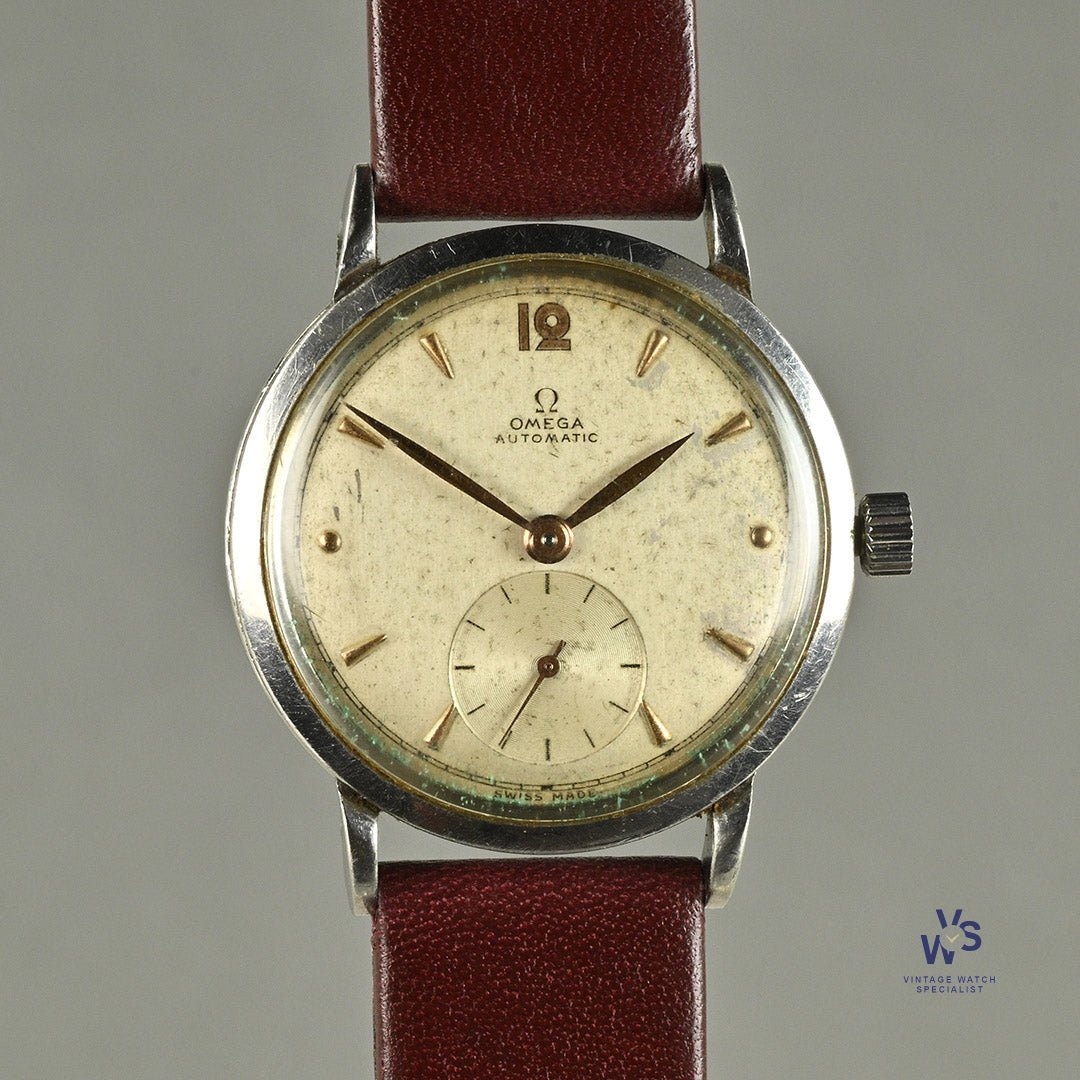
Omega Automatic Bumper, Steel Cased Dress Watch, circa 1948
- Maker / attribution
- Omega (maker)
- Date
- c. 1948
- Historical period
- Modern Mechanical Horology (1945 – 1969)
- Country of origin
- Switzerland
- Object type
- Wristwatch
- Materials / technique
- steel
- Dimensions
- Case 33 mm
- Stock no.
- vws4380cs
- Credit line
- Dealer listing, Vintage Watch Specialist (vws4380cs)
- Catalogue title (original)
- Omega Automatic Bumper - Steel Cased Dress Watch - c.1948 (English)
View the source record (dealer listing) ↗ (opens another website in a new tab)Suggest a correction
Record summary
Catalogued by Vintage Watch Specialist (dealer), United Kingdom (stock number vws4380cs), this is a wristwatch by Omega, made in Switzerland, dated c. 1948. The Atlas places it in the Modern Mechanical Horology period (1945 – 1969) of its Wristwatches collection. Materials and techniques recorded by the source: steel. Recorded dimensions: Case 33 mm. The record is illustrated with 6 photographs.
Assembled from the source record's structured fields. Dates and attributions are given as the source states them; where a field is missing the Atlas leaves it blank rather than estimating.
Catalogue description
Dealer description — Vintage Watch Specialist
A 1948 Omega Automatic Bumper with a Stainless-Steel Case, Gilt Dial Furniture and Stunning Gilt-Leaf hands. Calibre 342 movement - Reference CK 2402 This Omega takes us back to the formative years of the automatic wristwatch, when self-winding technology was still developing and the familiar full-rotor system had yet to become the industry norm. Omega introduced its first automatic wristwatches in the early 1940s, using what collectors now commonly call a "bumper movement". Rather than making a complete rotation, the oscillating weight travels through a limited arc before meeting sprung buffers at either end. The gentle movement of the weight can often be felt on the wrist, giving these early automatics a mechanical character quite unlike their modern descendants. Dating from around 1948, this example comes from a particularly interesting moment in Omega's history. Its restrained case proportions and subsidiary seconds retain the look of a traditional 1940s wristwatch, while the automatic movement inside points towards the direction watchmaking would increasingly take during the following decade. What’s On Offer Here we have a fantastic early Omega Automatic, reference CK 2402, dating from circa 1948. The stainless-steel case measures approximately 33mm across and 40mm from top to bottom, with an attractive stepped profile and gently curved lugs. These are authentic 1940s proportions, but the relatively long lug-to-lug measurement helps give the watch a little more presence on the wrist. The dial is where much of this watch's vintage character lies. What would originally have been a much lighter surface has developed a warm cream tone, with extensive age-related patina and subtle crazing across the finish. It is visibly an old dial and, rather wonderfully, looks like one. 12 o’clock is marked with a singular Art Deco-style gilt Arabic numeral, with gold dots at 3 and 9, and spearheads marking the hours between. At 6 o'clock is a recessed subsidiary seconds dial, giving the watch the balanced appearance common with watches of this era. Golden leaf hands and a subtle railway-style minute track around the outer edge complete the dial. Inside is the Omega Calibre 342, a 17-jewel automatic bumper movement with an approximate power reserve of 42 hours. The watch is fitted to a brown leather strap with an adjustable fit. There is no original box or paperwork. Should you prefer to have the watch professionally serviced before delivery, this can be arranged through our watchmaker at an additional cost. Simply add a note when placing the watch in your basket, and we will contact you to discuss the available servicing options.
Historical context
Modern Mechanical Horology (1945 – 1969)
Tool watches for divers, pilots and astronauts; electric watches anticipate the electronic age.
The classic era of the mechanical wristwatch: dive watches, chronographs for motor racing and space flight, GMT watches for jet travel, slim dress watches, automatic calendars, and the rise of Japanese manufacturers alongside Swiss, American, German and Soviet industries.
Read the period in the timelineMore wristwatches from this periodEarlier: Golden Age of Mechanical Watchmaking
Atlas type guide
Automatic (self-winding) watches
Self-winding watches use the wearer's motion to wind the mainspring. Abraham-Louis Perrelet and Breguet made 'perpétuelle' pocket watches with oscillating weights in the late eighteenth century, but the principle only became practical in the wristwatch. John Harwood patented a bumper automatic in 1923; Rolex's Perpetual rotor (1931) winding in one direction, and later bidirectional rotors (Eterna, Felsa Bidynator), established the modern form. Micro-rotors (Universal Genève, Buren) and peripheral rotors made automatic watches thinner.
What to look for
- A semicircular rotor turning 360° over the movement, or a 'bumper' weight that rebounds between springs.
- 'Automatic', 'Perpetual' or 'Self-winding' on the dial.
- A sealed screw-back case, since automatic watches are wound less often by the crown.
Dating clues
- Bumper automatics: 1923–c. 1955.
- Full rotors: from 1931 (Rolex); widespread after c. 1950.
- Micro-rotors: from 1954–1958.
General guidance written by the Atlas editors about this kind of object. It is not a statement about this particular piece; for that, rely on the source record above and on physical examination.
Related records

Instruments · 1950–1976
Omega Megaquartz 2400 marine chronometer, 1950–1976
Science Museum Group, London

Instruments · 1960–1979
Stopwatch / timer by Omega, 1960–1979
Science Museum Group, London

Instruments · 1960–1979
Stopwatch / timer by Omega, Switzerland, 1960–1979
Science Museum Group, London

Instruments · 1960–1979
Stopwatch by Omega, Swiss made, single-button type reading 0 - 60 seconds in fifths and 0 - 5 minutes in minutes on subsidiary dial, 1960-79.
Science Museum Group, London

Wristwatches · 1945
Wristwatch by Eterna, 1945
Museum Rotterdam

Wristwatches · c. 1945
Breitling Premier, ref. 790, c. 1945
Antiquorum auction archive, Geneva

Wristwatches · c. 1945
Universal Genève Uni-Compax, ref. 22492, c. 1945
Antiquorum auction archive, Geneva

Wristwatches · c. 1950s
Baume & Mercier wristwatch, c. 1950s
Antiquorum auction archive, Geneva