
Wristwatches · Wristwatch
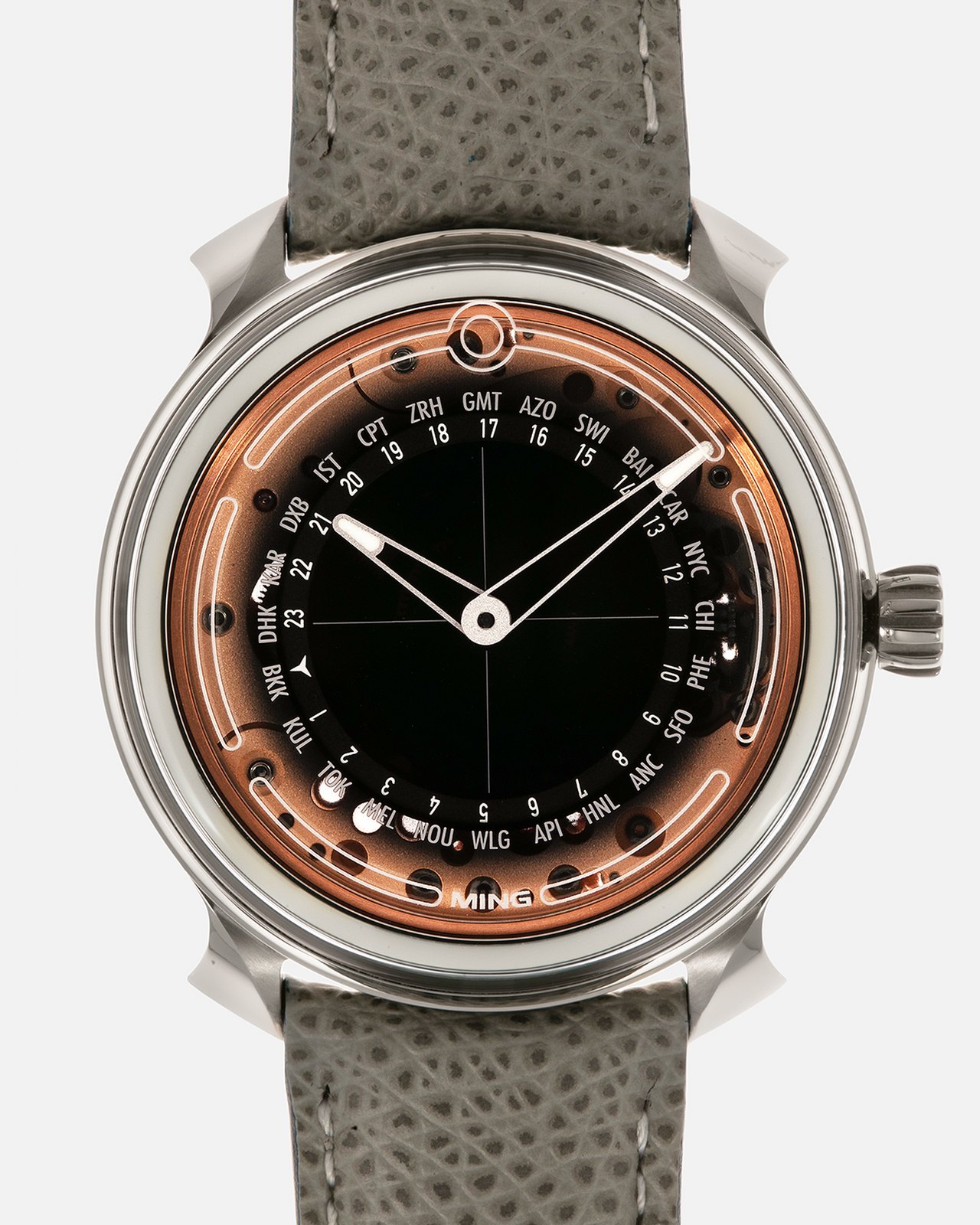
Ming 19.02 World Time, 2020
- Maker / attribution
- MING (maker)
- Date
- 2020
- Historical period
- Contemporary Horology (2010 – Present)
- Country of origin
- Unrecorded in source
- Object type
- Wristwatch
- Dimensions
- Case 39 mm
- Stock no.
- Product 7450330759255
- Credit line
- Dealer listing, S.Song Watches (product 7450330759255)
- Catalogue title (original)
- Ming 19.02 World Time (English)
View the source record (dealer listing) ↗ (opens another website in a new tab)Suggest a correction
Record summary
Catalogued by S.Song Watches (dealer), Seattle (stock number Product 7450330759255), this is a wristwatch by MING, dated 2020. The Atlas places it in the Contemporary Horology period (2010 – Present) of its Wristwatches collection. Recorded dimensions: Case 39 mm. The record is illustrated with 6 photographs.
Assembled from the source record's structured fields. Dates and attributions are given as the source states them; where a field is missing the Atlas leaves it blank rather than estimating.
Catalogue description
Dealer description — S.Song Watches
Growing from relative obscurity, MING has become one of the most talked-about and sought-after independent watchmakers in the market thanks to their minimal supply, design cohesiveness, and unparalleled value for money. Released in 2019 as their most complicated watch yet, the 19.02 World Timer expanded MING’s horological offering into the upper echelons of Swiss watchmaking. With the World Timer's revered position amongst high-level complications for its genuine practicality, unique impact on dial design, and general complexity to accomplish, the 19.02 announced MING onto the world stage, a position they rightfully deserve. As is the case with so many of MING's designs, the 19.02's most distinct feature is its beautiful dial. Featuring MING’s signature hand and chapter ring design, the 19.02 sports a stunning gradient effect that fades from black at its centre to a sandy undertone along the periphery as it exposes the movement that lies below and the chapter ring that lies on top. Placed beneath the chapter ring, written in their corresponding airport codes, are the 24 cities that represent each of the world's 24 major time zones and provide the 19.02 its eponymous utility. Highlighted by a titanium disk that rotates below them, a star placed between the ‘1’ and ‘23’ indicators can be used to highlight the wearer's home time. Found amongst its list of 24 cities is MING's hometown of Kuala Lumpur, a rarity amongst world-timers and thus a celebration of MING's heritage and sense of pride as they go on to represent Malaysia on the world's horological stage. Beyond its dial, the 19.02 sports a 39mm titanium case design with MING's iconic flared 'pagoda' lug design with a blend of polished and brushed surfaces across its construction and an entirely luminous bezel. Powered by the stunning Schwarz-Etienne Cal. ASE220.1 micro-rotor movement designed exclusively for MING, the 19.02's exhibition caseback displays an assortment of partially-skeletonised rose gold-plated bridges with bead blasting and hand-polished anglage . This remarkably attractive movement complements a watch that is both technically and aesthetically exceptional. With the 19.02, MING successfully asserts its place on the world stage, earning the recognition it rightfully deserves.
Historical context
Contemporary Horology (2010 – Present)
Silicon components, connected watches, optical-lattice research clocks and a thriving independent scene.
Smartwatches became the world's best-selling watches, while mechanical watchmaking focuses on craft, innovation (silicon components, new escapements) and independent makers.
Read the period in the timelineMore wristwatches from this periodEarlier: Mechanical Renaissance
Atlas type guide
Military, pilot and travel watches
The wristwatch owes much of its adoption by men to warfare and aviation. Wristlets — small pocket watches soldered with lugs and worn on a strap — were used in colonial campaigns and became standard equipment in the First World War, with protective grilles over the crystal ('shrapnel guards'). Louis Cartier's Santos (1904), designed for the aviator Alberto Santos-Dumont, is often cited as an early purpose-made pilot's watch.
In the Second World War governments specified watches in detail: the German B-Uhr observation watches, the American A-11, and the British 'W.W.W.' (the 'Dirty Dozen' set of 1945). After the war, jet travel brought GMT and world-time watches, which show two or more time zones at once — Louis Cottier's world-time mechanism and the Rolex GMT-Master (1955) are examples.
What to look for
- Military markings on the case back: broad arrow, issue numbers, 'W.W.W.', 'A.T.P.'
- High-legibility black dials with luminous Arabic numerals; oversized crowns for gloved hands.
- 24-hour hands and rotating 24-hour bezels or city rings on GMT/world-time watches.
- Wire lugs on early wristlets converted from pocket watches.
Dating clues
- Wire-lug wristlets: c. 1900–1925.
- Military specifications of the Second World War: 1939–1945.
- GMT and world-time wristwatches: mainly after 1950.
General guidance written by the Atlas editors about this kind of object. It is not a statement about this particular piece; for that, rely on the source record above and on physical examination.
Related records
Wristwatches · 2022
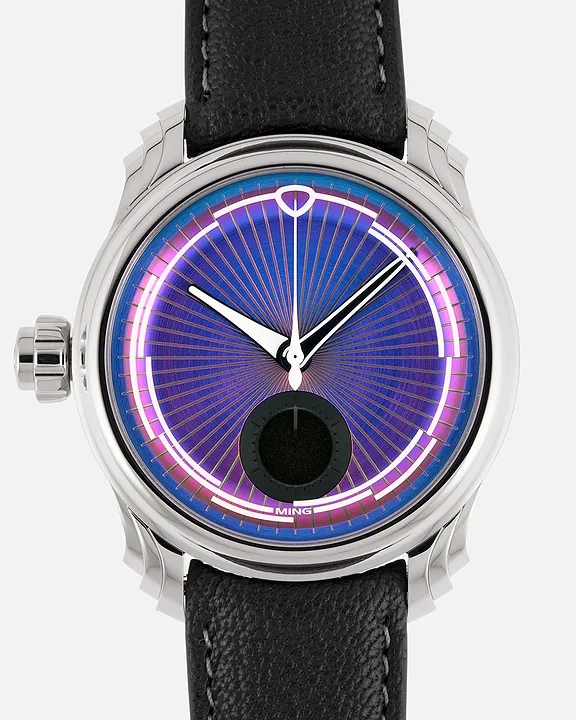
Ming 57.04 Iris Monopusher Chronograph, 2022
S.Song Watches (dealer), Seattle
Wristwatches · 2023
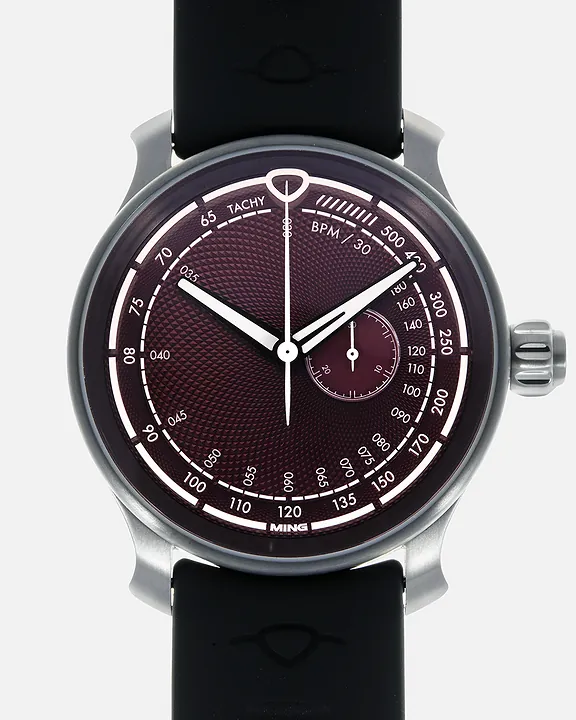
Ming 37.04 Monopusher Chronograph Tantalum, 2023
S.Song Watches (dealer), Seattle
Wristwatches · 2022
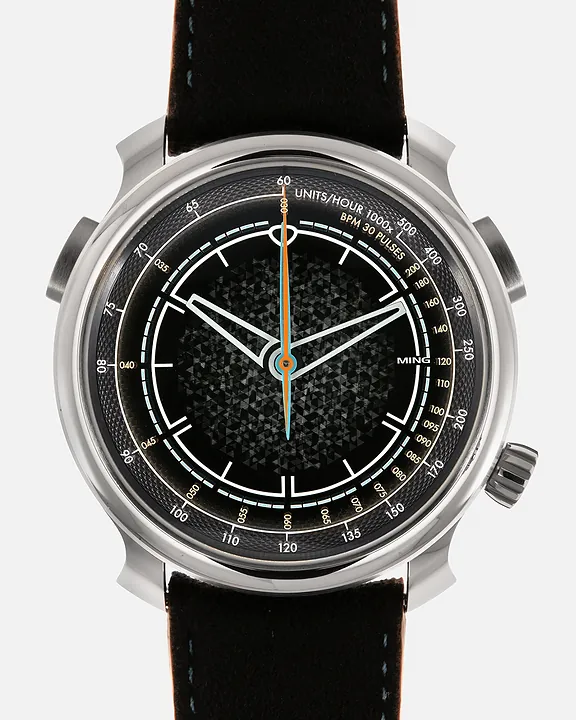
Ming 20.01 Series II Agengraphe Chronograph Special Projects Cave, 2022
S.Song Watches (dealer), Seattle
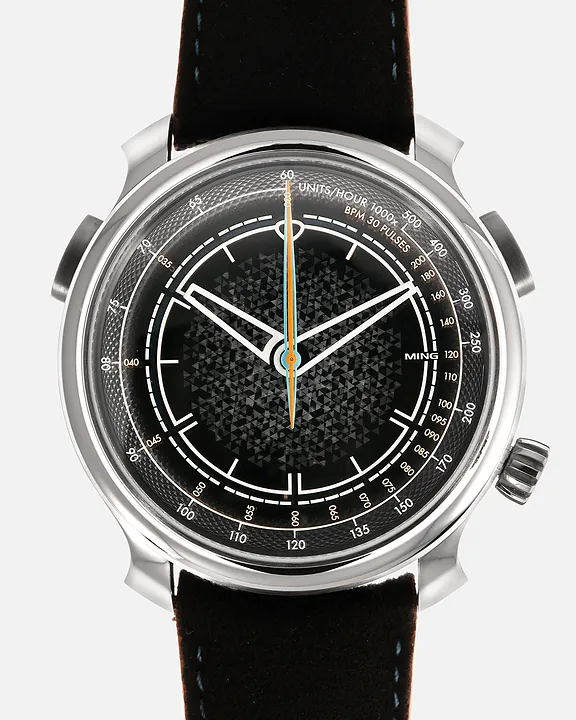
Wristwatches · 2022
Ming 20.01 Series II Agengraphe Chronograph Special Projects Cave, 2022
S.Song Watches (dealer), Seattle
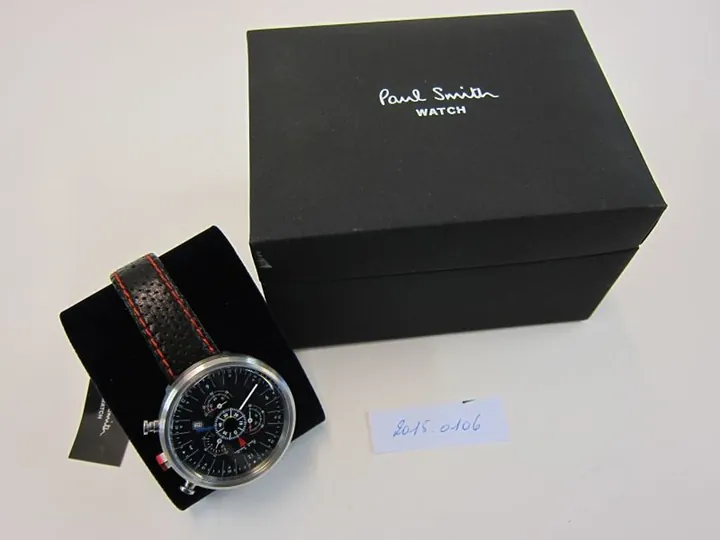
Wristwatches · 2010
Wristwatch, 2010
Modemuseum Hasselt
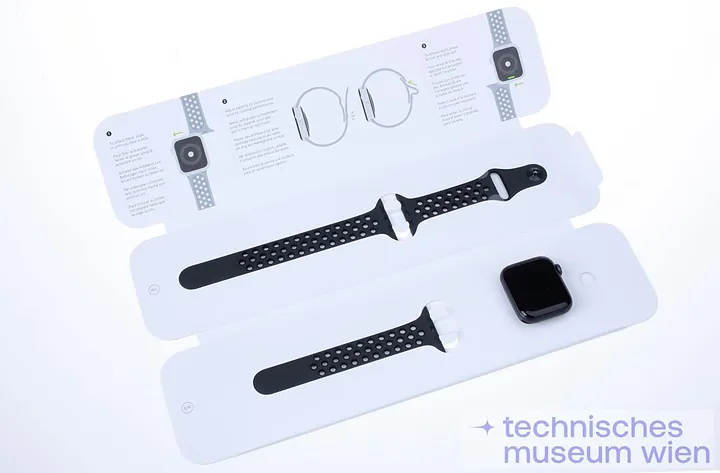
Wristwatches · 2018 (Series 4 released in September 2018; '1977' in the source is the model number A1977)
Apple Watch Series 4 (GPS, 40 mm, model A1977), 2018
Vienna Museum of Science and Technology
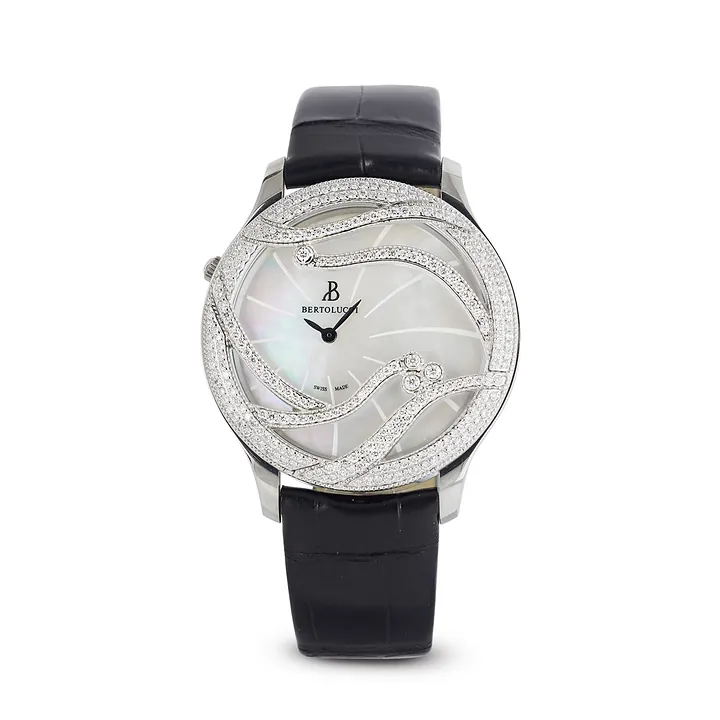
Wristwatches · c. 2010s
Bertolucci Stria III, ref. 11513.50.45.B88.6C1.501, c. 2010s
Antiquorum auction archive, Geneva
Wristwatches · c. 2010s
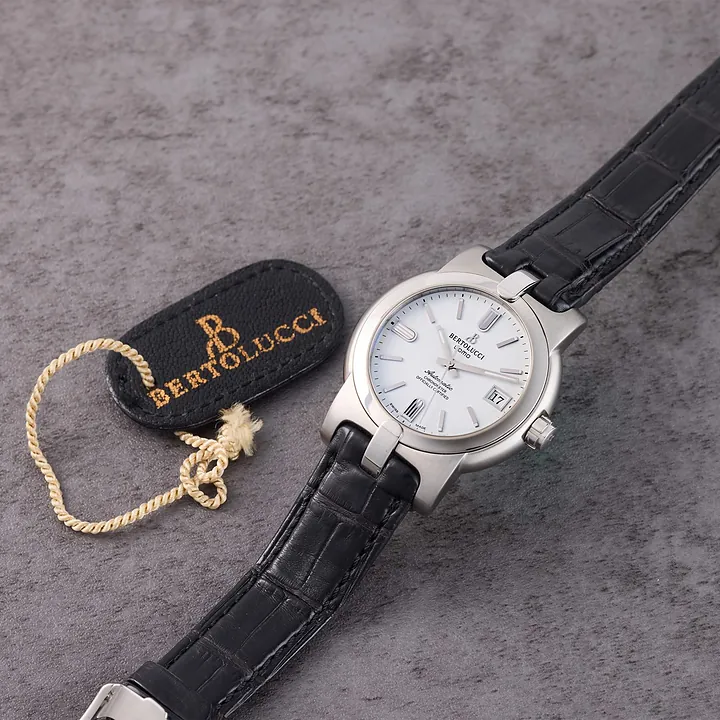
Bertolucci Uoma, ref. 824.51.41.10B, c. 2010s
Antiquorum auction archive, Geneva