
Wristwatches · Wristwatch
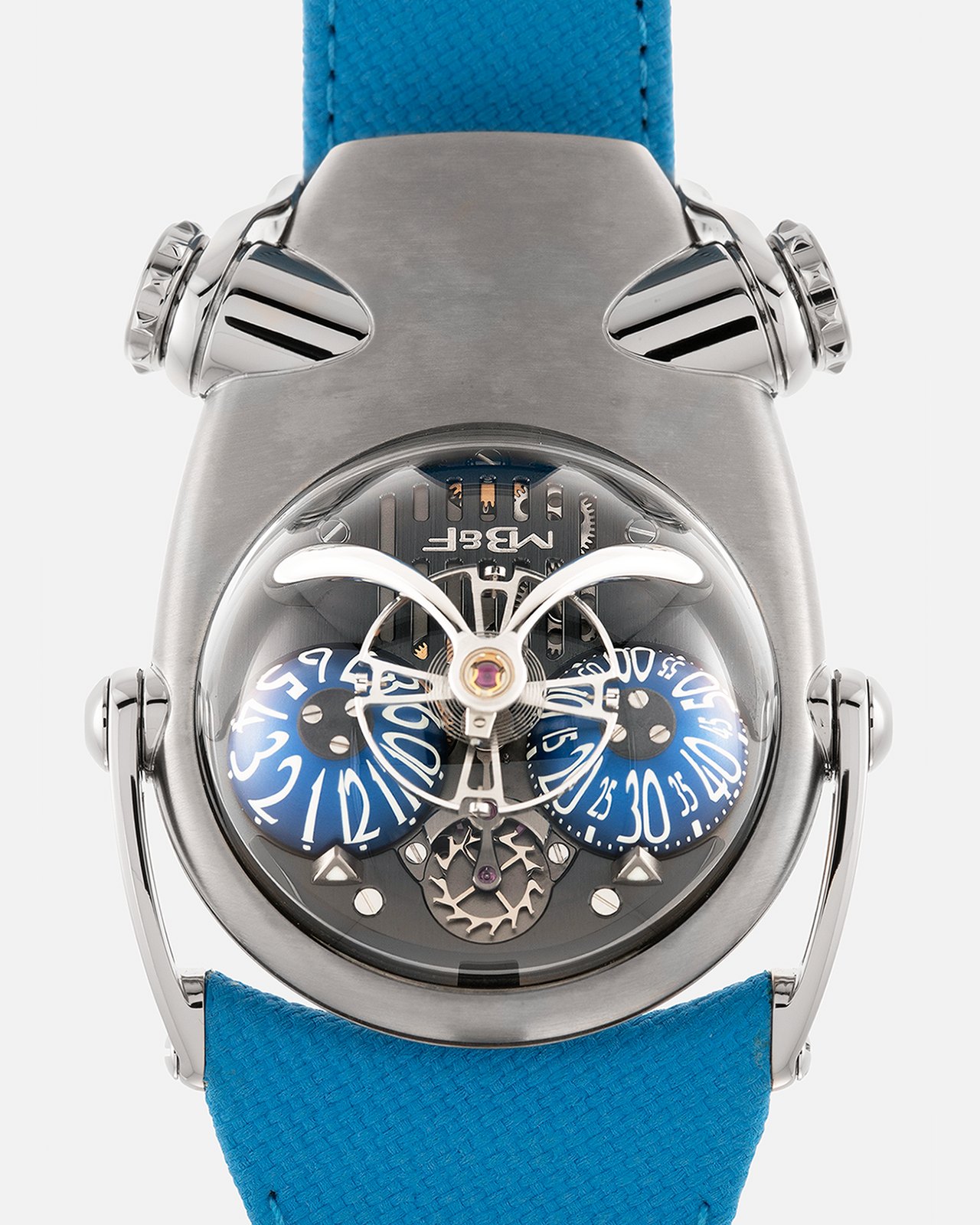
MB&F HM10 Bulldog Titanium, 2022
- Maker / attribution
- MB&F (maker)
- Date
- 2022
- Historical period
- Contemporary Horology (2010 – Present)
- Country of origin
- Switzerland
- Object type
- Wristwatch
- Materials / technique
- titanium
- Dimensions
- Case 14 mm
- Stock no.
- Product 7592651391063
- Credit line
- Dealer listing, S.Song Watches (product 7592651391063)
- Catalogue title (original)
- MB&F HM10 Bulldog Titanium (English)
View the source record (dealer listing) ↗ (opens another website in a new tab)Suggest a correction
Record summary
Catalogued by S.Song Watches (dealer), Seattle (stock number Product 7592651391063), this is a wristwatch by MB&F, made in Switzerland, dated 2022. The Atlas places it in the Contemporary Horology period (2010 – Present) of its Wristwatches collection. Materials and techniques recorded by the source: titanium. Recorded dimensions: Case 14 mm. The record is illustrated with 6 photographs.
Assembled from the source record's structured fields. Dates and attributions are given as the source states them; where a field is missing the Atlas leaves it blank rather than estimating.
Catalogue description
Dealer description — S.Song Watches
Maximillian Büsser and Friends, or as we more familiarly know it, MB&F, is one of the most exciting and avant-garde independent watch brands on the scene today. Known famously for its ethos of collaborating and acknowledging other master watchmakers in the industry, it is helmed by Max Büsser, who, together with others have created some of the most radical and out-there watch designs. The brand is divided into two distinct segments: the HM series, which stands for Horological Machine, and features their most unconventional and audacious timepieces, and the LM series, which stands for Legacy Machine, representing watches that embody the style of a century ago. This structure of the brand is remarkable as it signifies a deep respect for the past, drawing inspiration from it, while simultaneously forging ahead with futuristic and innovative designs. It's a beautiful balance between honouring tradition and creating original, forward-looking horological machines. What we have here is a watch from the HM collection: the MB&F HM10 Bulldog in grade 5 titanium. Released in 2020 as the tenth instalment of the Horological Machine series and in true MB&F fashion, it refuses convention at every turn. This is a watch that is anything but normal, and that is precisely the point. According to Büsser, the idea for the HM10 came to him during a trip to Japan. It was the first time he vividly imagined a watch design fully formed in his mind, just as it would end up being. The design draws on familiar MB&F themes, mixing mechanical showmanship with a fun, quirky style. That said, beyond its whimsical form, the HM10 embodies and perfectly captures the brand’s creative identity: defiant, thoughtful, and unapologetically unique. Like the canine breed it’s named after, this watch is not for everyone, but it demonstrates MB&F’s commitment to pursuing independent watchmaking on their own terms. Like many of Büsser’s creations, the HM10 hits you hard the first time you see it in the metal. Its wealth of moving parts, meticulous finishing, and distinct components form a machine that barely resembles a traditional watch, and its unconventional orientation can puzzle those seeing it for the first time. True to its namesake, the case is crafted from grade 5 titanium and houses a sizable sapphire dome. On the topside, two blue aluminium “eyes” display the time, adjustable via rear-side crowns with a fun, studded collar-like grip—the 1:00 collar for setting, and the 11:00 collar solely for winding. Between the eyes at 6:00 sits the escapement, secured by an anchor-shaped bridge that subtly evokes a nose. Hovering above the display, the suspended 14 mm-wide balance wheel completes the watch’s striking visual. While we’re discussing the movement, powering the HM10 from within is a bespoke, in-house manual-winding calibre beating at 18,000 vph. At the bottom half of the sapphire dome, you’ll see that the bridges are ruthenium-plated and decorated with intricate Côtes de Genève , accompanied by some finely-polished bevels. Comprising 301 components, the movement offers a 45-hour power reserve from a single barrel, which is indicated via a unique hinged-jaw mechanism located at the front lower half of the massive sapphire dome. Cleverly integrated into the bulldog-inspired design, the jaw not only reinforces the creature’s theme but also signals when the watch needs winding (when the jaw is closed). The movement is engineered to minimize energy consumption, channelling the mainspring’s full torque to drive the suspended balance and the revolving hour and minute domes. How cool is that? Completing the look is a stylised name plaque on the rear-end of the HM10, which somehow reminds me of a retro Chevrolet car emblem from the ‘50s—perhaps even hinting at the Bulldog’s own name, like what you’d typically see on a dog collar. The caseback also features a playful engraving: “Forget the dog, beware of the owner”, a witty nod to the Bulldog’s character and a fun little reminder for its wearer. In terms of wearability, I’d say that the HM10 isn’t for every wrist, thanks to its bold and highly sculptural design, but it’s undeniably a head-turner and a conversation starter. It is no doubt a fun watch to wear, and it commands attention in the room wherever it goes. Despite its imposing 54mm x 45mm x 24mm titanium case, the watch remains surprisingly light and comfortable, thanks to its articulating “legs” that are engineered to hug the wrist perfectly. I have to hand it to MB&F, they’ve done it again, taking a bold idea and pushing the boundaries of horology further than anyone else. There’s just nothing else like it on the market, and this embodies everything we love about independent watchmaking: fearless creativity with no limits. As a whole, the HM10 Bulldog is a stunning work of mechanical art and yet another strong testament to MB&F’s vision. As the saying goes, you can’t teach an old dog new tricks, unless it’s MB&F, in which case, anything is possible.
Historical context
Contemporary Horology (2010 – Present)
Silicon components, connected watches, optical-lattice research clocks and a thriving independent scene.
Smartwatches became the world's best-selling watches, while mechanical watchmaking focuses on craft, innovation (silicon components, new escapements) and independent makers.
Read the period in the timelineMore wristwatches from this periodEarlier: Mechanical Renaissance
Atlas type guide
Wristwatches
Bracelet watches were worn by women from the early nineteenth century — Breguet made one for Caroline Murat, Queen of Naples, in 1810–12 — but the wristwatch only became a man's instrument with military use and aviation in the early twentieth century. Between the World Wars it overtook the pocket watch; the 1920s and 1930s brought rectangular Art Deco cases, water-resistant cases and the first automatic winding systems.
After 1945 the wristwatch became a carrier of identity — dress watches, sports and dive watches, chronographs, calendars — produced by Swiss, American, Japanese, German, Soviet and Chinese industries. The quartz revolution after 1969 and the mechanical renaissance since the 1990s, including the rise of independent watchmakers, complete the story.
What to look for
- The reference number (between the lugs or inside the case back) and serial number, the starting point for dating.
- The calibre: its maker and number are often stamped under the dial or on the bridge.
- Originality of dial, hands and crown — refinished ('redial') dials are common.
- Case material marks: 18K/750, 14K/585, stainless steel, gold-filled, plated.
Dating clues
- Wire-lug cases: before c. 1925.
- Water-resistant screw-down cases: from 1926.
- Quartz movements: from 1969; sapphire crystals widespread after c. 1980.
General guidance written by the Atlas editors about this kind of object. It is not a statement about this particular piece; for that, rely on the source record above and on physical examination.
Related records
Wristwatches · c. 2022
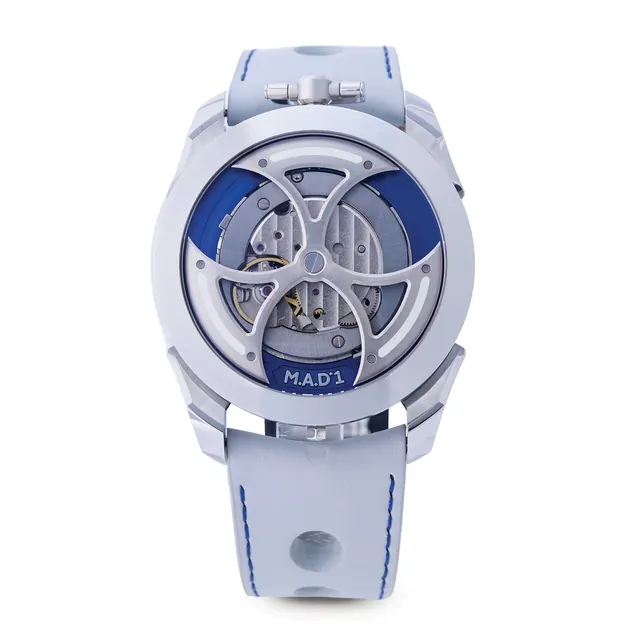
MB&F wristwatch, M.A.D 1 Blue M.A.D.Editions, circa 2022
Antiquorum auction archive, Geneva
Wristwatches · 2025
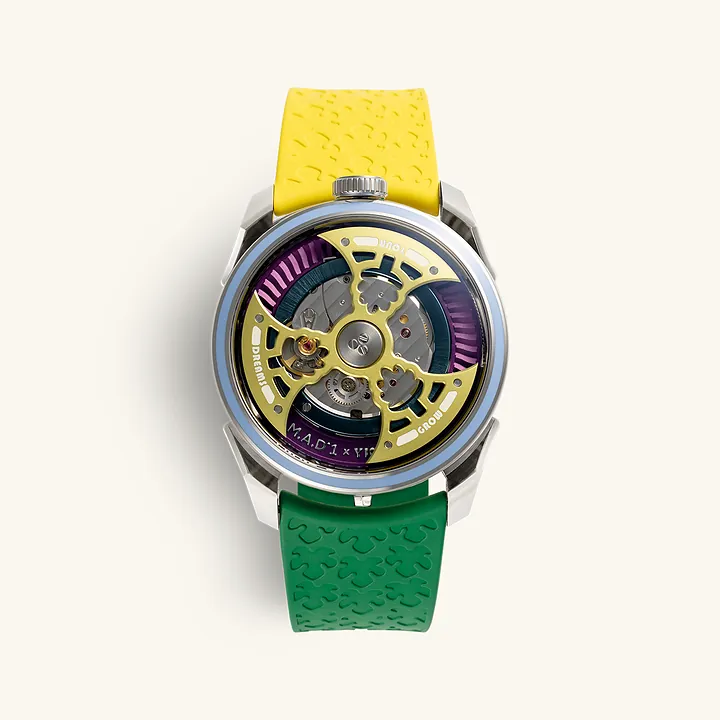
MB&F M.A.D Editions Yinka Ilori “Grow Your Dreams’ Sun Edition, 2025
Watches of Knightsbridge (dealer), London
Wristwatches · 2021
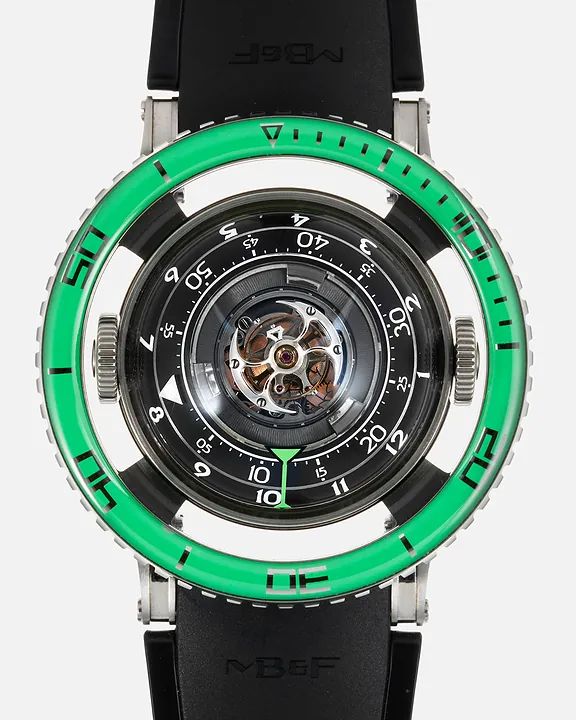
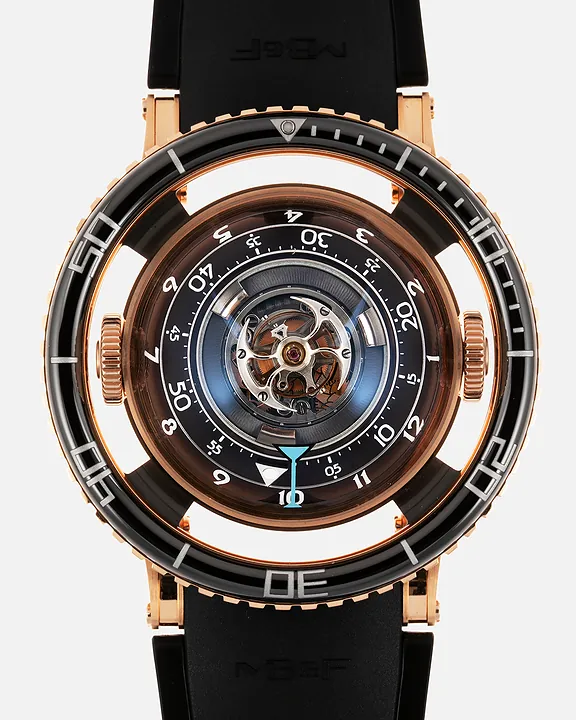
MB&F HM7 Aquapod Flying Tourbillon, 2021
S.Song Watches (dealer), Seattle
Wristwatches · 2021
MB&F HM7 Aquapod Flying Tourbillon, 2021
S.Song Watches (dealer), Seattle

Wristwatches · c. 2010s
Breguet Type XXI, ref. 3810, c. 2010s (Antiquorum Lot 381-24)
Antiquorum auction archive, Geneva

Wristwatches · c. 2010s
Breguet Type XXI, ref. 3810, c. 2010s (Antiquorum Lot 386-229)
Antiquorum auction archive, Geneva

Wristwatches · Sold in September 2010
Breitling Cosmonaute, ref. A 22322, Sold in September 2010
Antiquorum auction archive, Geneva

Wristwatches · c. 2010
Corum Bubble Chrono, ref. 396.150.20, c. 2010
Antiquorum auction archive, Geneva