
Wristwatches · Wristwatch
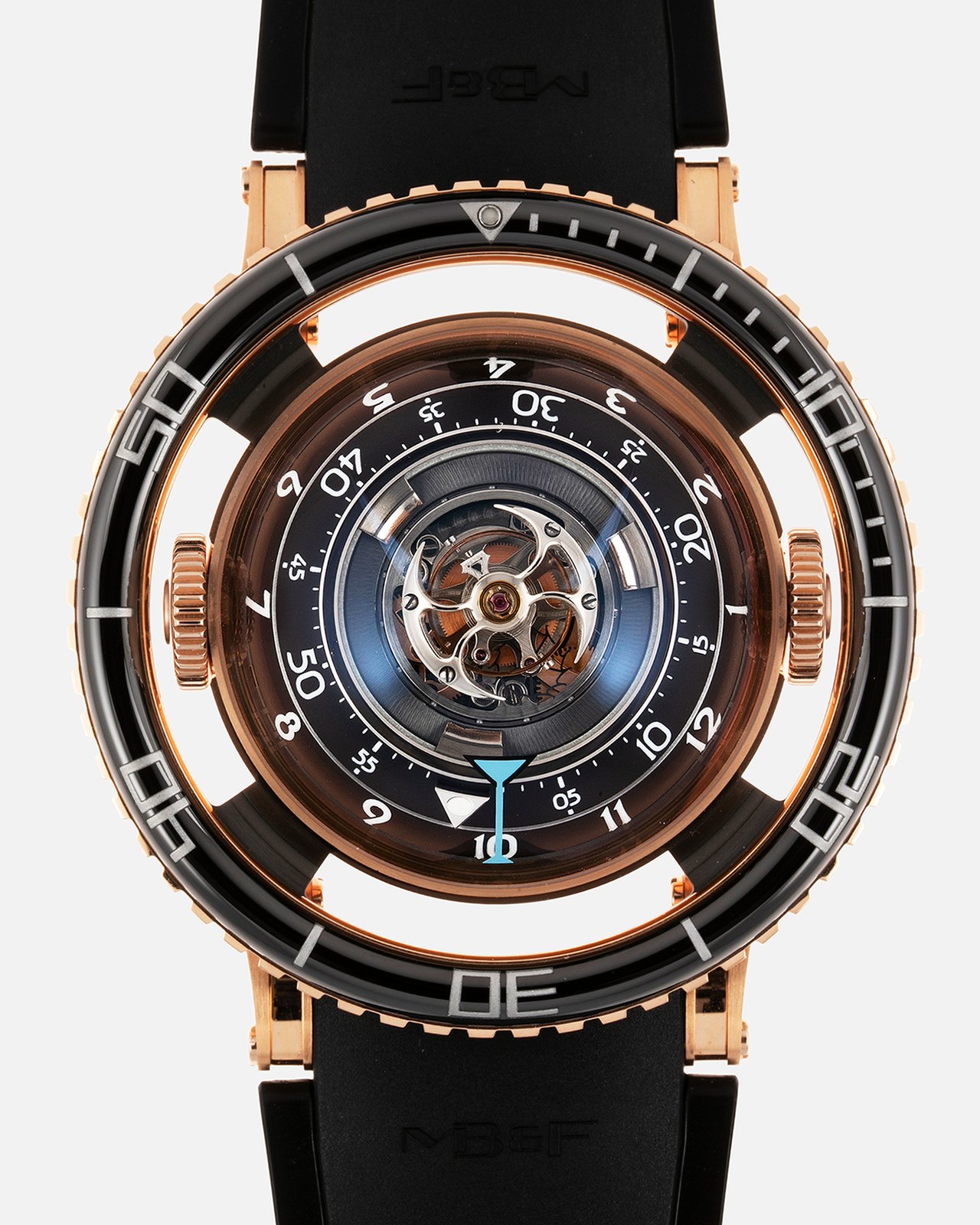
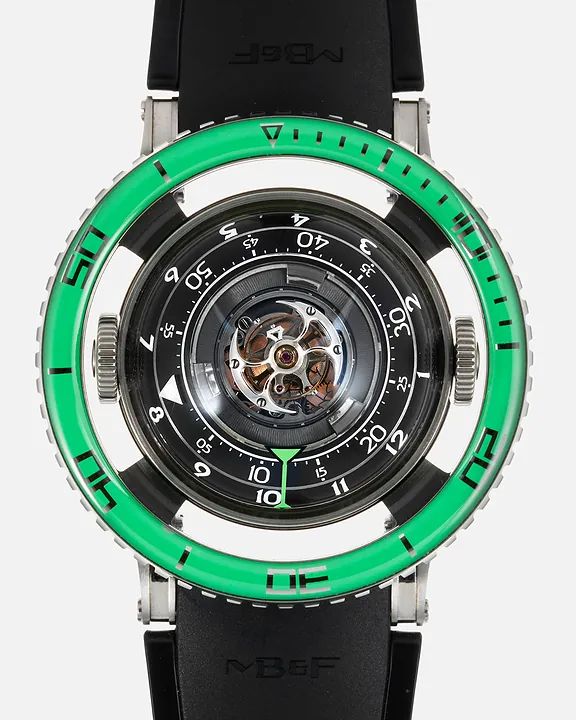
MB&F HM7 Aquapod Flying Tourbillon, 2021
- Maker / attribution
- MB&F (maker)
- Date
- 2021
- Historical period
- Contemporary Horology (2010 – Present)
- Country of origin
- Switzerland
- Object type
- Wristwatch
- Dimensions
- Case 53.8 mm
- Stock no.
- Product 6799310127191
- Credit line
- Dealer listing, S.Song Watches (product 6799310127191)
- Catalogue title (original)
- MB&F HM7 Aquapod Flying Tourbillon (English)
View the source record (dealer listing) ↗ (opens another website in a new tab)Suggest a correction
Record summary
Catalogued by S.Song Watches (dealer), Seattle (stock number Product 6799310127191), this is a wristwatch by MB&F, made in Switzerland, dated 2021. The Atlas places it in the Contemporary Horology period (2010 – Present) of its Wristwatches collection. Recorded dimensions: Case 53.8 mm. The record is illustrated with 6 photographs.
Assembled from the source record's structured fields. Dates and attributions are given as the source states them; where a field is missing the Atlas leaves it blank rather than estimating.
Catalogue description
Dealer description — S.Song Watches
Perhaps one of the most beloved independent watchmakers amongst collectors today, MB&F has grown from Maximillian Büsser's passion project following his successful Opus collection with Harry Winston into one of the biggest names in independent horology since brands like F.P. Journe, Daniel Roth, and Franck Muller burst onto the scene in the 1990s. Taking a collaborative approach to horology like what he championed with Harry Winston, Maximillian Büsser & Friends – hence MB&F, has developed into a brand that creates timepieces celebrating Max's talents as a creative leader and watchmakers from across the globe. The MB&F brand has two separate yet distinct segments, the LM series, which stands for Legacy Machine and represents watches they would’ve created 100 years ago, and the HM series, which stands for Horological Machine and represents out-of-the-box, Avantgarde pieces they make. What we have on here today is the HM7 Aquapod in rose gold, which was first introduced at the Salon de la International Haute Horlogerie 2017 (SIHH). Yes, it is a crazy-looking watch, in fact, crazy isn’t even half of it, let us tell you why. The idea for the HM7 originated from Max’s childhood memories of beach holidays which included an unpleasant encounter with a jellyfish. However, that encounter alone planted a seed in Max’s mind for a three-dimensional timepiece with a jellyfish as its core inspiration. When you first lay eyes on the HM7, there is a lot to take in – so many moving parts, finishing, and individual components which contribute to the biomorphic visual monster that is the HM7. The domed, AR-treated sapphire crystals on both the front and the back of the HM7 are presented in hemispheres. These crystals are then joined by the rose gold case band at the midsection. While the HM7 is not a traditional dive watch by any means, it is still a watch that is designed to be comfortable with water, which is why MB&F added a unidirectional, black ceramic bezel. The bezel structure itself looks visually stunning, as they do not form part of the case, but in fact, a separate structure on its own. The ceramic insert is also marked in 5-minute intervals with alternate Arabic numerals and bars which are quite intriguing to look at. They are first engraved using a laser and then filled with metalized titanium. The HM7 also features a dual crown system, one for setting the time whilst the other on the left side for winding the movement. They sit in between the bezel and the mid-section of the case, which in turn creates a symmetrical visual which is extraordinary and captivating to look at. Another notable component of the HM7 lies in the flying tourbillon movement (which they endearingly call the “engine”) encased within the mid-section, which consists of 303 parts, and operates at 18,000 BPH with a respectable 72-hour power reserve. Turn over the HM7 and you will find the insane-looking titanium automatic rotor and a platinum weight peeking right back at you, which are obviously inspired by jellyfish tentacles. When it comes to wearability, I would go as far as to say that the HM7 commands the attention in any room, no matter where you are. Of course, while the proportions of the HM7 comes in at a whopping 53.8mm x 21.3mm case size, it still manages to feel comfortable on the wrist, thanks to its ingenious articulating lugs design which are designed to hug any wrist nicely. In typical MB&F fashion, Max and his team love pushing horological boundaries- they managed to steal the show when the brand first introduced the HM7 back in 2017, and for good reason. It was unlike anything the independent watch world has seen in the market at the time. To me, the HM7 is a supreme work of horological art, and a fun watch to wear and experience. I am in absolute awe of how Max can take a simple inspiration/concept and to develop it to such extent because like the other MB&F watches that come before the HM7, they are each unique and phenomenal in their own way.
Historical context
Contemporary Horology (2010 – Present)
Silicon components, connected watches, optical-lattice research clocks and a thriving independent scene.
Smartwatches became the world's best-selling watches, while mechanical watchmaking focuses on craft, innovation (silicon components, new escapements) and independent makers.
Read the period in the timelineMore wristwatches from this periodEarlier: Mechanical Renaissance
Atlas type guide
Wristwatches
Bracelet watches were worn by women from the early nineteenth century — Breguet made one for Caroline Murat, Queen of Naples, in 1810–12 — but the wristwatch only became a man's instrument with military use and aviation in the early twentieth century. Between the World Wars it overtook the pocket watch; the 1920s and 1930s brought rectangular Art Deco cases, water-resistant cases and the first automatic winding systems.
After 1945 the wristwatch became a carrier of identity — dress watches, sports and dive watches, chronographs, calendars — produced by Swiss, American, Japanese, German, Soviet and Chinese industries. The quartz revolution after 1969 and the mechanical renaissance since the 1990s, including the rise of independent watchmakers, complete the story.
What to look for
- The reference number (between the lugs or inside the case back) and serial number, the starting point for dating.
- The calibre: its maker and number are often stamped under the dial or on the bridge.
- Originality of dial, hands and crown — refinished ('redial') dials are common.
- Case material marks: 18K/750, 14K/585, stainless steel, gold-filled, plated.
Dating clues
- Wire-lug cases: before c. 1925.
- Water-resistant screw-down cases: from 1926.
- Quartz movements: from 1969; sapphire crystals widespread after c. 1980.
General guidance written by the Atlas editors about this kind of object. It is not a statement about this particular piece; for that, rely on the source record above and on physical examination.
Related records
Wristwatches · c. 2022
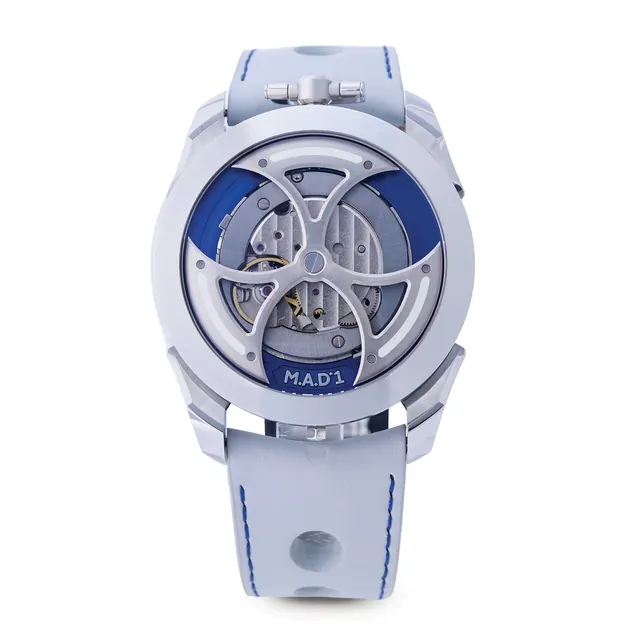
MB&F wristwatch, M.A.D 1 Blue M.A.D.Editions, circa 2022
Antiquorum auction archive, Geneva
Wristwatches · 2025
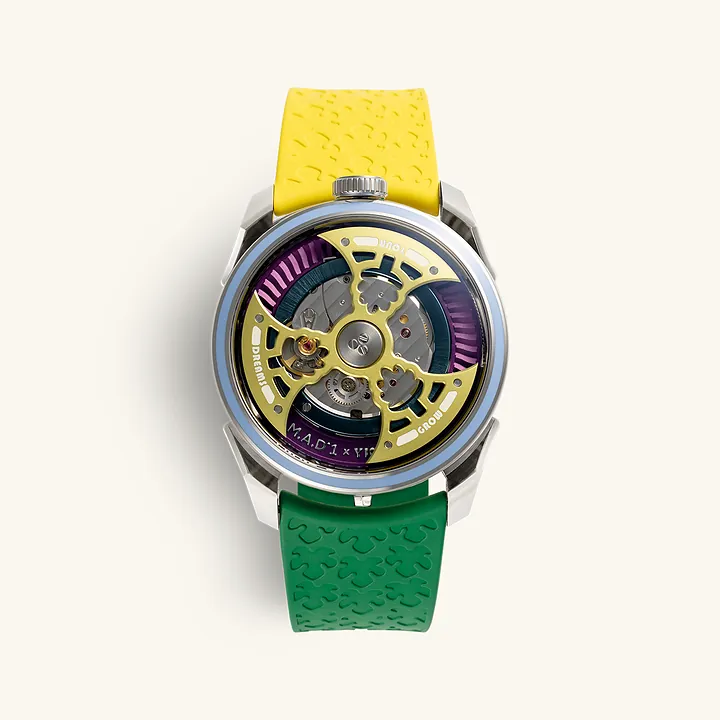
MB&F M.A.D Editions Yinka Ilori “Grow Your Dreams’ Sun Edition, 2025
Watches of Knightsbridge (dealer), London
Wristwatches · 2022
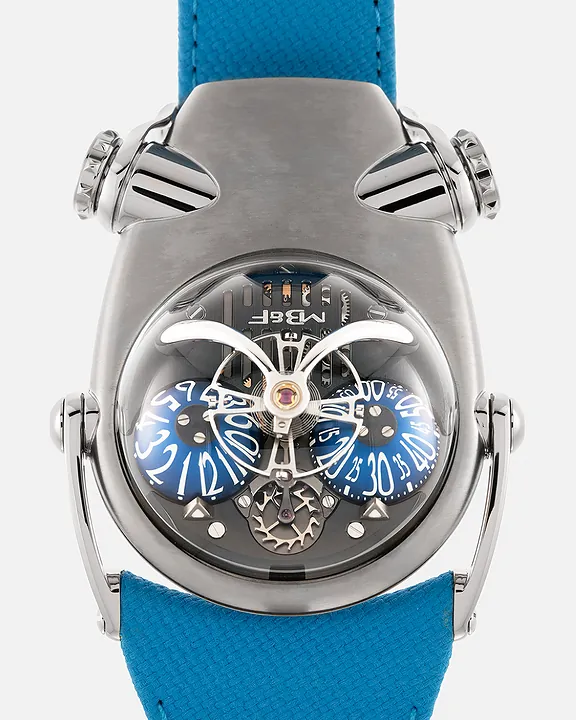
MB&F HM10 Bulldog Titanium, 2022
S.Song Watches (dealer), Seattle
Wristwatches · 2021
MB&F HM7 Aquapod Flying Tourbillon, 2021
S.Song Watches (dealer), Seattle

Wristwatches · c. 2010s
Breguet Type XXI, ref. 3810, c. 2010s (Antiquorum Lot 381-24)
Antiquorum auction archive, Geneva

Wristwatches · c. 2010s
Breguet Type XXI, ref. 3810, c. 2010s (Antiquorum Lot 386-229)
Antiquorum auction archive, Geneva

Wristwatches · Sold in September 2010
Breitling Cosmonaute, ref. A 22322, Sold in September 2010
Antiquorum auction archive, Geneva

Wristwatches · c. 2010
Corum Bubble Chrono, ref. 396.150.20, c. 2010
Antiquorum auction archive, Geneva