
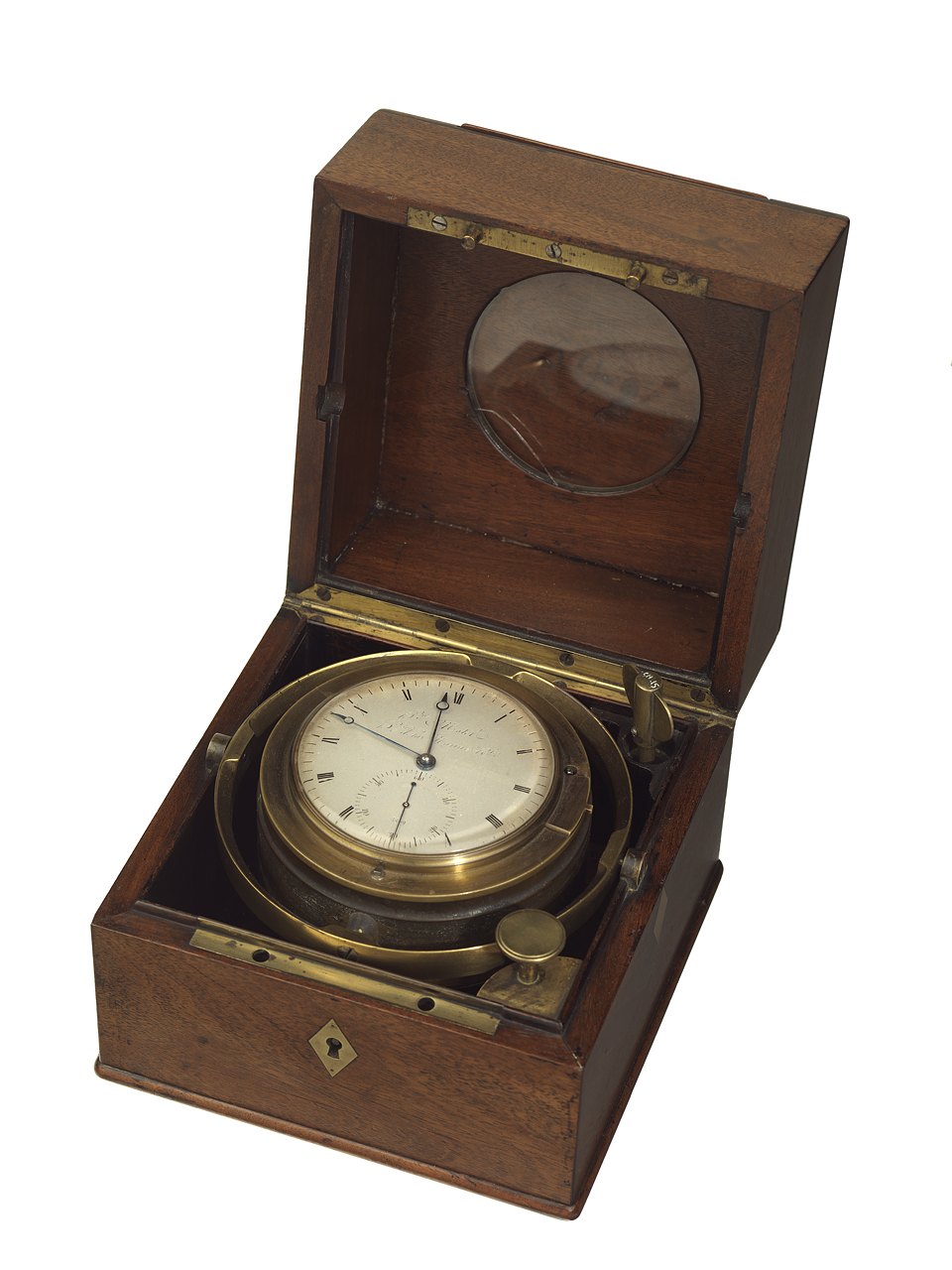
Instruments · Marine chronometer
Marine chronometer no. 59 by Henri Motel
- Maker / attribution
- Henri Motel (maker)
- Date
- c. 1800
- Historical period
- Precision & Scientific Horology (1750 – 1850)
- Country of origin
- Unrecorded in source
- Object type
- Marine chronometer
- Materials / technique
- mahogany; brass; metal: steel
- Dimensions
- Overall: 133 x 163 x 163 mm
- Holding institution
- Royal Museums Greenwich
- Accession / object no.
- ZAA0016
- Credit line
- National Maritime Museum, Greenwich, London, Caird Collection
- Catalogue title (original)
- 59 (English)
View the source record ↗ (opens another website in a new tab)Suggest a correction
Record summary
Held and catalogued by Royal Museums Greenwich (object number ZAA0016), this is a marine chronometer by Henri Motel, dated c. 1800. The Atlas places it in the Precision & Scientific Horology period (1750 – 1850) of its Instruments collection. Materials and techniques recorded by the source: mahogany; brass; metal: steel. Recorded dimensions: Overall: 133 x 163 x 163 mm. The record is illustrated with 2 photographs.
Assembled from the source record's structured fields. Dates and attributions are given as the source states them; where a field is missing the Atlas leaves it blank rather than estimating.
Catalogue description
Catalogue description — Royal Museums Greenwich
Motel, Paris c.1820 No.59 2 day marine chronometer in mahogany box Motel…….. Description Box/Mounting Plain, two-tier mahogany box, 135mms high, 165mms wide and 165mms deep, with a sliding dovetailed lid inset into the top.The lid slides off forward to reveal a porthole, glazed in a brass bezel, enabling the dial to be viewed. The top of the lid has a brass, diamond inlay in the centre, engraved: “N.39” and “M” and is scratched: “79” on the underside. The box has an inlaid brass diamond escutcheon on front, and diamond-shaped brass inserts in the sides supporting the gimbal bearings inside. The box has a half-round beading as a dust seal at the joint, a full-length, butt-type hinge which is stamped: “24”, and a two-pronged, double throw lock. The bottom of the box projects beyond the sides forming a half-round beading to the base. Standard, lacquered brass gimbals, stamped on the back part of the gimbal ring: “24”, with a later, English, rising-ratchet winding key, stamped: “1533” mounted in a shelf on the rear right. The gimbals have a deep bevel on the upper inside edge and have Motel’s own locking arrangement in which a cradle rises up under the owl to secure the whole assembly. A quarter turn clockwise of the locking knob in the front right of the box causes the knob and its arbor to move down. The lower end of the arbor pushes down a ‘see-saw’, the other end of which terminates in a circular cup, and this rises up and embraces a cone on the rounded base of the bowl, centering and securing it. A spring reverses the action of the see-saw when the locking is turned back. The arrangement for housing the movement also includes a number of special features associated with Henri Motel, including a stop/start device, a front-winding arrangement and Motel’s ‘secret locking’ to prevent casual access to the movement. The movement is screwed into a separate straight-sided brass drum of 96.8mm, which sits snugly in the bowl, the inside of the bowl being lined with green velvet (the side lining now missing). A projecting screwhead, on the upper-rear of the movement drum, locates in a notch on the top edge of the bowl, at XII o’clock position, to ensure the movement is correctly disposed in the bowl. This secondary drum has a flanged bezel with a slightly domed glass, fixed over movement with three side screws. At the ‘6 o’clock’ position on the bezel there is a steel square, actuated with the winding key, for stop/start function. Engraved next to this control is “A” (Arrêt) and an anti-clockwise arrow, for stopping the balance, and a clockwise arrow and “M” (Marche) for starting it running again. On the underside of the bezel this control has a fork which embraces a short lever on the movement between the dial and the pillar plate. Between ‘2 & 3 o’clock’ on the bezel is a sliding shutter, covering the square for front winding of the chronometer. Inside the movement drum is the gearing for this, which consists of a brass spur wheel mounted on an arbor with the winding square, the arbor angled at approximately 10 and run in a potence inside the drum and a hole in the upper edge. When the movement is in place, this wheel meshes with a bevel wheel mounted on the fusee arbor. With the bezel off, the brass edge which retains the dial is exposed. This is engraved around the side: “N59 HRE MOTEL HGER DE LA MARINE RLE”. In its fitting to the drum, the movement employs Motel’s secret locking, based on the designs of Louis Berthoud. When being fitted, the movement, held by the brass edge, is lowered into the drum about 10° anti-clockwise from its proper position, and then rotated clockwise to the position where the winding wheels mesh correctly. Here, rotation is stopped by a projection of the potence plate meeting a steel stop pin inside the drum. At the same time a spring-loaded brass bolt drops into a notch in the edge of the drum, preventing the movement from being rotated back the other way. Once locked in this way, the only way to get the movement out of the drum is to release the brass bolt by pushing a tiny pin into a hole in the side of the brass edge, next to the bolt, whilst turning the movement anti-clockwise. There is an arrangement for disabling the secret locking device; a pin can be inserted through the pillar plate which, if aligned with one in the brass bolt, secures it back in the unlocked position. The underside of the box is plain, without covering. Dial & Hands The 79.0mm matt-silvered brass dial has roman hour numerals and a seconds dial in the lower half marked with Arabic ten-seconds intervals. The dial is signed: “H ri Motel / H ger de la Marine R le“ in the upper half and: “N59” in the seconds dial. Two pins attach the dial to the movement, the edge of the dial fitting in the brass edge which is scrwede to the pillar plate. The rear of the dial is stamped: “59” and is scratched: “1556”. The whole of the area across the middle of the dial has been ‘knocked out’ from behind, apparently to enable the signature to be re-engraved in the current position. The hands are all finely polished blued steel, the hour and minute of demi-lune type and the seconds a straight pointer with counter poise. Movement Louis Berthoud type, one-day full plate fusee movement with four highly polished steel pillars, the pillars having a tapering foot and cross-drilled ‘capstan’ screws with blued steel washers, all dot marked for correct location. The movement is highly finished throughout, the plates, all brass movement parts and the wheels all having a fine, neat curled decoration all over. The upper plate is engraved on top: “Construite par / Hri Motel / N.59” and the pillar plate is stamped: “59” on the underside. The mainspring set-up is on the pillar plate under the dial. The mainspring was braced in the barrel about 100 round from the hook (brace now missing) and is an unsigned, 20th century replacement. . The fusee has Harrison’s maintaining power. Conventional four-wheel train plus great wheel,
Historical context
Precision & Scientific Horology (1750 – 1850)
Harrison solves longitude; Mudge invents the lever; Breguet's Paris workshop defines the modern watch.
The longitude problem was solved by the marine chronometer and lunar distance methods; dividing engines made precision scales possible, and observatories set time by transit instruments.
Read the period in the timelineMore instruments from this periodEarlier: Early Modern Horology
Atlas type guide
Marine chronometers
A marine chronometer is a precision timekeeper carried at sea to find longitude: the navigator compares local noon, observed with a sextant, with the time at a reference meridian kept by the chronometer. Each hour of difference corresponds to fifteen degrees of longitude. John Harrison proved the method in the 1760s; Pierre Le Roy, Ferdinand Berthoud, John Arnold and Thomas Earnshaw then developed the detent escapement and the compensation balance that made chronometers practical to manufacture.
By the nineteenth century London, Liverpool, Le Locle and Glashütte supplied navies and merchant fleets. A typical box chronometer has a spring-detent escapement, a fusee to equalise mainspring torque, a bimetallic compensation balance with a helical balance spring, and is mounted in gimbals inside a wooden box so that it stays level.
What to look for
- Gimbals and a three-tier wooden box with a glazed inner lid.
- A power-reserve ('up and down') indicator on the dial, usually showing 56 hours on two-day instruments.
- Spring-detent escapement and a cylindrical (helical) balance spring visible through the movement.
- Admiralty or navy marks (broad arrow), and rating certificates from observatories.
- The maker's number on the dial and movement; many makers' registers survive, allowing dating.
Dating clues
- Earnshaw-type spring-detent chronometers became standard after about 1800.
- Auxiliary compensation devices on the balance appear from the mid-nineteenth century.
- Quartz and radio time signals ended routine use of mechanical chronometers in the 1970s and 1980s.
General guidance written by the Atlas editors about this kind of object. It is not a statement about this particular piece; for that, rely on the source record above and on physical examination.
Read next:Spring detent (chronometer) escapementBalance spring (hairspring)Detent escapement
Related records
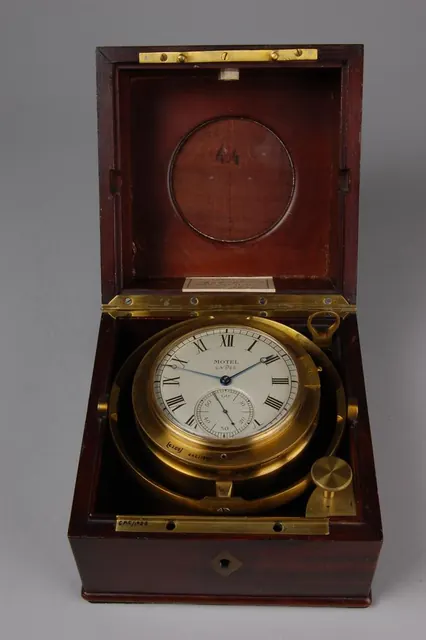
Instruments · 1821-1831; 1917 (retailed)
Marine chronometer by Henri Motel
British Museum
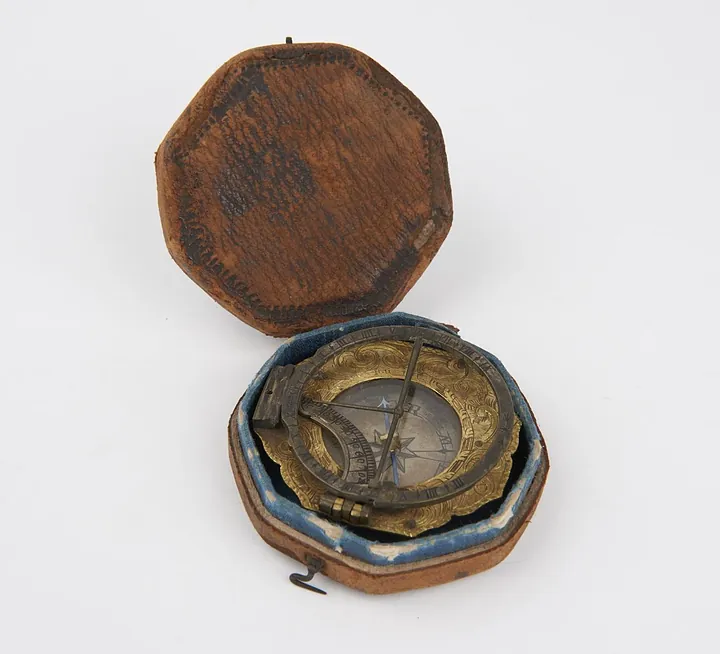
Instruments · 1726–1775
Universal equinoctial sundial of the Augsburg type, signed on the base "L T M" (Ludwig Theodatus Muller). In original case. German, mid 18th century. (B1670)
Science Museum Group, London
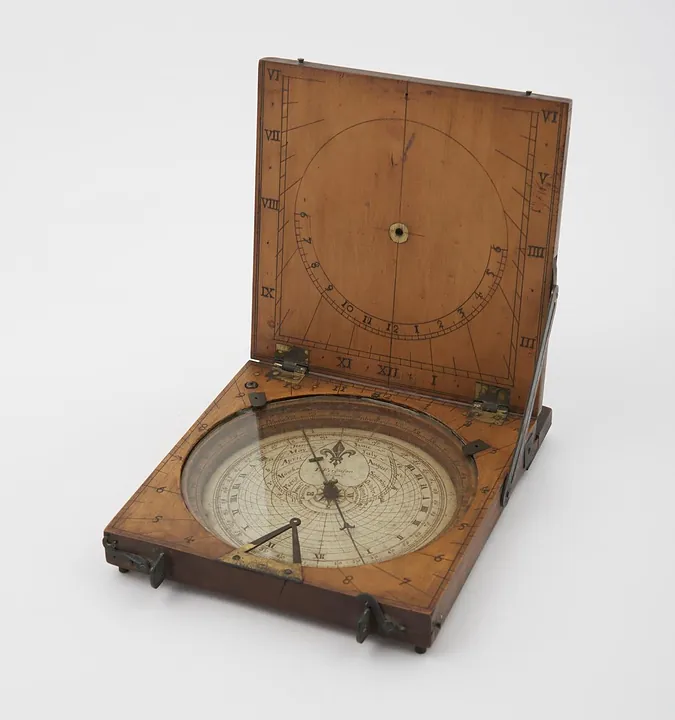
Instruments · 1731–1776
Azimuth compass sundial by James Ferguson, London, England, 1731–1776. Could also be used as a tablet sundial - string gnomon is missing (see note).
Science Museum Group, London
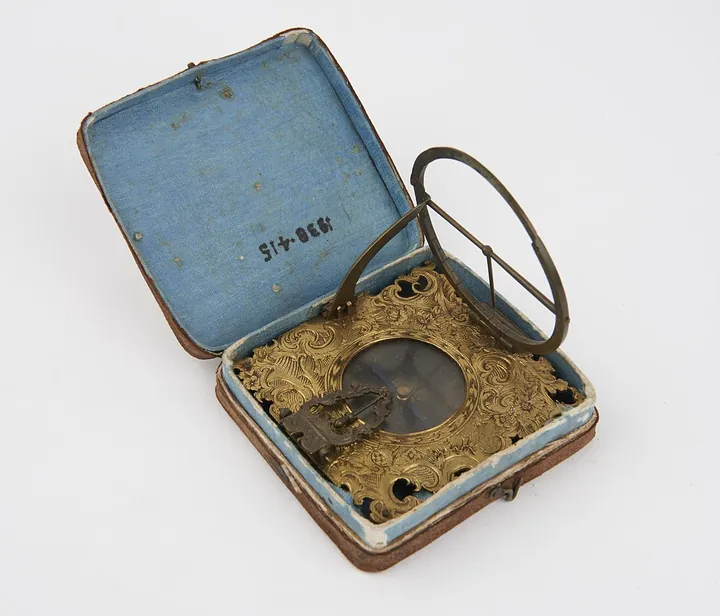
Instruments · 1734–1770
Sundial by Ludwig Theodatus Muller, Germany, 1734–1770 (no. 1938-415)
Science Museum Group, London
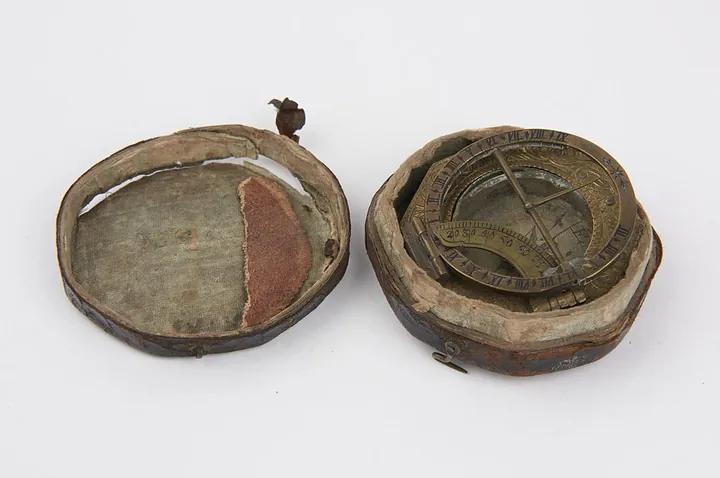
Instruments · 1734–1770
Sundial by Ludwig Theodatus Muller, Germany, 1734–1770 (no. 1991-138)
Science Museum Group, London
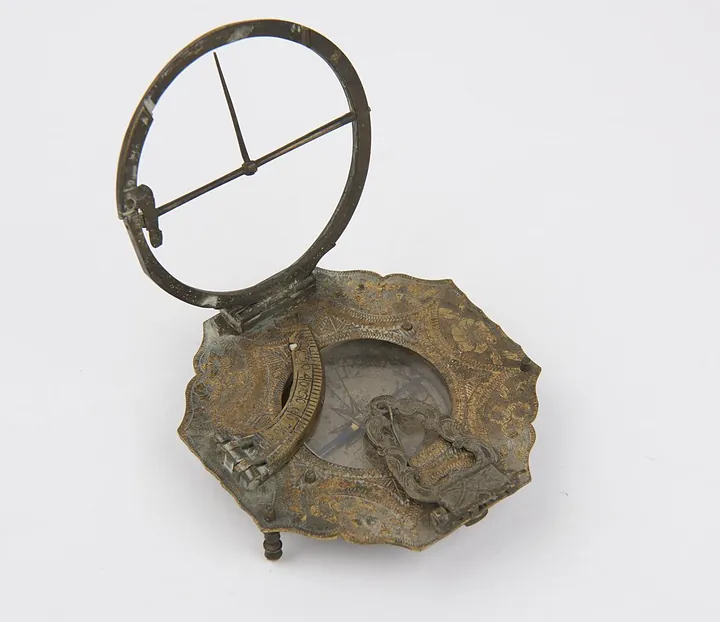
Instruments · 1734–1770
Sundial by Ludwig Theodatus Muller, Germany, 1734–1770 (no. 1991-192)
Science Museum Group, London
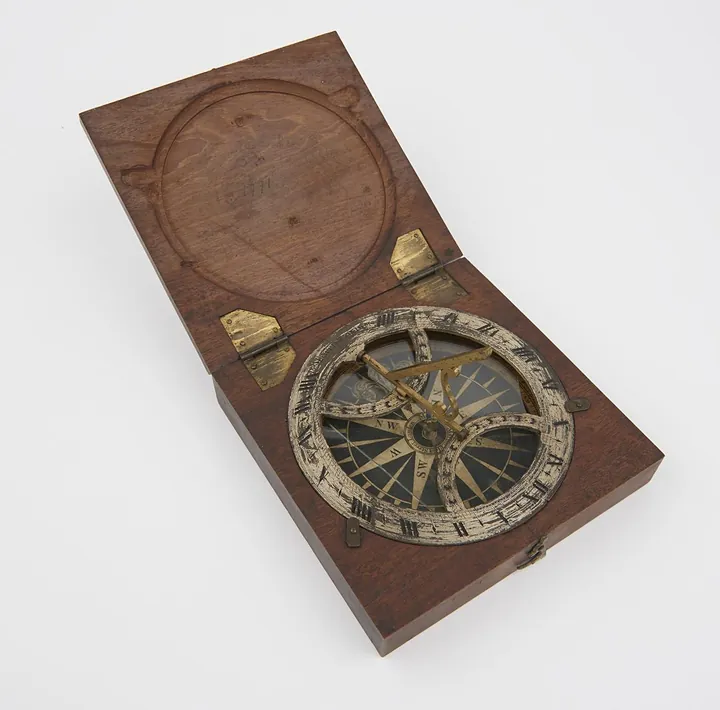
Instruments · 1738–1777
Azimuth sundial 4 3/8" diam, with folding gnomon fitted in mahogany case, made by B. Martin
Science Museum Group, London
Instruments · 1745–1755
Magnetic Sundial with six loose hour rings
Science Museum Group, London