
Instruments · Marine chronometer
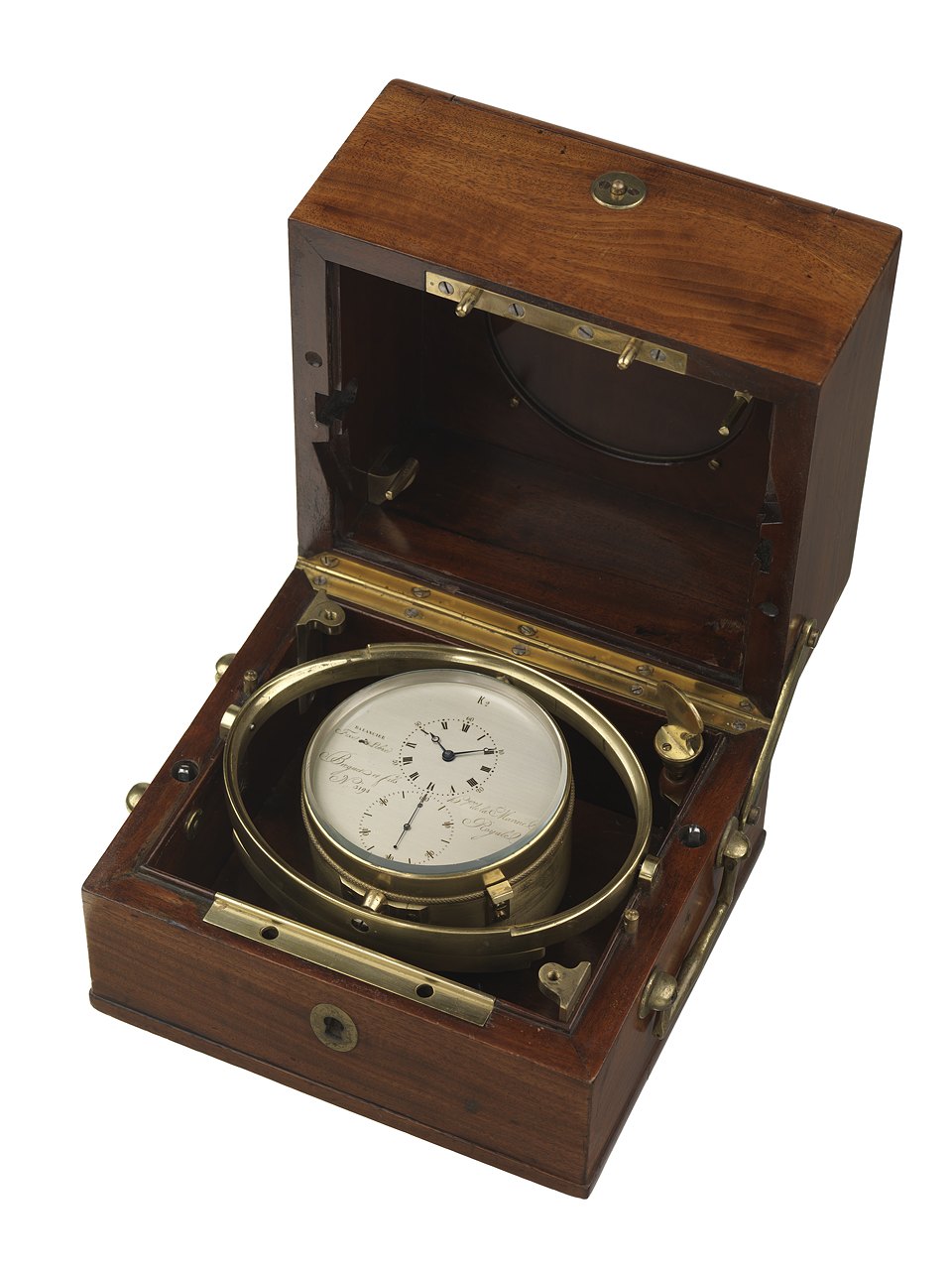
Marine chronometer no. 3194 by Abraham Louis Breguet & Fils
- Maker / attribution
- Abraham Louis Breguet & Fils (maker)
- Date
- c. 1823
- Historical period
- Precision & Scientific Horology (1750 – 1850)
- Country of origin
- France
- Object type
- Marine chronometer
- Materials / technique
- mahogany; brass; steel
- Dimensions
- Overall: 174 x 230 x 195 mm
- Holding institution
- Royal Museums Greenwich
- Accession / object no.
- ZAA0229
- Credit line
- National Maritime Museum, Greenwich, London
- Catalogue title (original)
- 3194 (English)
View the source record ↗ (opens another website in a new tab)Suggest a correction
Record summary
Held and catalogued by Royal Museums Greenwich (object number ZAA0229), this is a marine chronometer by Abraham Louis Breguet & Fils, made in France, dated c. 1823. The Atlas places it in the Precision & Scientific Horology period (1750 – 1850) of its Instruments collection. Materials and techniques recorded by the source: mahogany; brass; steel. Recorded dimensions: Overall: 174 x 230 x 195 mm. The record is illustrated with 2 photographs.
Assembled from the source record's structured fields. Dates and attributions are given as the source states them; where a field is missing the Atlas leaves it blank rather than estimating.
Catalogue description
Catalogue description — Royal Museums Greenwich
Breguet et Fils, Paris, c.1821 No.3194 2 day marine chronometer in mahogany box For biographical details of the firm of Breguet of Paris, see pp.xxx Box/Mounting Two-tier, plain mahogany box measuring 175mm high, 225mm wide, and 192mm deep. The top of the box has an inset lid with side-pin hinges allowing it to open to about 120°. The lid is inlaid with a brass, diamond-shaped plaque, engraved: “3194”, and opens to a circular glazed panel retained with narrow brass bezel, screw-fixed from the underside. The front of the upper half has a push button brass catch for the lid with brass, circular escutcheon and brass spring inside the upper half to ‘jump’ the lid open when the button is pressed. The lock on the lower half (usual French-type with double bolts and pins), has an oval, brass escutcheon. The box has a full-width, ‘butt’-type, hinge and a brass strut on the right hand side, restraining the upper half to 90°opening. There is a raised step running around the inside of the junction on the lower half, mating with a rebate in the junction of the upper half and forming a dust seal when closed. The box fittings are similar to the standard French type, with brass drop handles on the sides and lacquered brass gimbals. A narrow, straight-sided bezel is retained with two side screws and has a concave, silvered-brass sight ring and beveled flat glass over the dial. It is scratched inside: “3194” and “3200”. The centre body of the movement-housing doubles as the brass edge of the movement and has a barleycorn knurled beading running round the outside. Both bezel and bowl are fixed to it with a pair of screws. The thick, oval gimbal ring has a concave inner edge to the upper surface, and two flat brass arms can be swung in from the rear left and front right corners of the box to engage with blocks on the bowl, securing the gimbals (original arms now missing). When these arms are in place and the lid is closed, cast brass pegs fixed up inside the upper half of the box prevent them from swinging open. When these arms are not in use they are swung out and stowed on little brass pillars on the edge of the box. The heavy brass bowl has an upstanding beading on the base, the two winding holes within both engraved with direction of wind arrows. There is a small plain hole drilled into the edge of the beading, with no apparent function. The later, English-type ratchet key (rising ratchet now pinned solid) is stowed in a standard, Breguet-type boxwood socket in the rear right of the box, the original retaining fork fixed up inside the upper half which secured the original key in place now missing. In the right and left sides of the lower half of the box there are vertical holes going through to the base with Breguet-type wood screws to fix the box to a wooden surface when in use on board ship. The underside of the box is plain, without baize covering. Dial and hands The 98.5 mm Ø, engraved and wax-filled, now English-silvered dial is fitted snugly in a rebate in the front of the brass edge, fixed with one screw at the top of the seconds dial, into the train bridge beneath. At the 6 o’clock position, a locating pin projects through the brass edge and engages with a notch in the edge of the dial. The movement is attached to the brass edge with three steel screws from the inside. The subsidiary hours and minutes dial has roman hour numerals and arabic ten-minute figures with a large seconds dial below having arabic ten second figures and with straight batons at five-second intervals. The dial is signed across the centre: “Breguet et fils Hgers de la Marine / Royale / No.3194 ”. Above the upper dial is engraved: “K2”. On the left of the upper dial is a balance locking lever (now inoperative) marked: “BALANCIER / Fixe / Libre”. Pencilled on the back of the dial is “87/8523”. It is also scratch marked “3194”; “DENT/762”; “87/8523”, and above this “S,2,93”; There is a blind hole drilled behind the 8 o’clock position on the dial, and near the center of the dial there is a shallow, turned sink, about 4 mm in diameter, with a raised button not quite in its centre. Blued steel demi-lune hands with a fine, blued steel pointer seconds hand with a solid counter-poised tail. Movement Breguet Grande Horloge Marine format double-barrel calibre movement with the train mounted under a bridge (fabricated from three parts) on the front of a central brass plate. The going barrels have all associated parts marked with one dot (on the barrel nearer the escapewheel), and two dots (on that nearer the balance cock foot). The barrels are mounted on a large double-cock on the rear of the plate. Although this casting is of rather poor quality, with a large number of small blow-holes evident, the general level of finish of the movement is high, with most movement parts flat-polished. The back of the main plate is stamped “3194” near the foot of the barrel cock and is scratched with “#” near the 1 dot barrel pivot and “ x 4511”[?]. The going barrels have spring-clicks alongside the ratchet wheels on the cocks, and brass and steel Breguet-type stopwork mounted on the caps of both barrels, the steel bearing of the stopwork forming the pivot in the cock. There is a four-wheel train, the greats on the barrels both meshing with the second (‘centre’) wheel in a straight line. All the train holes, including barrel arbor holes in the plate and cock, have been plugged and repositioned during manufacture. The rear pivot of the second wheel is carried by a sub-cock fixed by two screws to the underside of the barrel cock and has a steel coquerette. The rear pivots of the third and fourth wheels both have a steel endplate fixed to the main plate and the fourth wheel pivot hole is a separate brass bush, fixed in the plate. The wheels are all brass with the fourth wheel run in a cock on its lower pivot. There is a meshing inspection hole by the 2nd/3rd pivot in the main plate and by the 3rd / 4th pivot in the bridge. The top surface of the barrel co
Historical context
Precision & Scientific Horology (1750 – 1850)
Harrison solves longitude; Mudge invents the lever; Breguet's Paris workshop defines the modern watch.
The longitude problem was solved by the marine chronometer and lunar distance methods; dividing engines made precision scales possible, and observatories set time by transit instruments.
Read the period in the timelineMore instruments from this periodEarlier: Early Modern Horology
Atlas type guide
Marine chronometers
A marine chronometer is a precision timekeeper carried at sea to find longitude: the navigator compares local noon, observed with a sextant, with the time at a reference meridian kept by the chronometer. Each hour of difference corresponds to fifteen degrees of longitude. John Harrison proved the method in the 1760s; Pierre Le Roy, Ferdinand Berthoud, John Arnold and Thomas Earnshaw then developed the detent escapement and the compensation balance that made chronometers practical to manufacture.
By the nineteenth century London, Liverpool, Le Locle and Glashütte supplied navies and merchant fleets. A typical box chronometer has a spring-detent escapement, a fusee to equalise mainspring torque, a bimetallic compensation balance with a helical balance spring, and is mounted in gimbals inside a wooden box so that it stays level.
What to look for
- Gimbals and a three-tier wooden box with a glazed inner lid.
- A power-reserve ('up and down') indicator on the dial, usually showing 56 hours on two-day instruments.
- Spring-detent escapement and a cylindrical (helical) balance spring visible through the movement.
- Admiralty or navy marks (broad arrow), and rating certificates from observatories.
- The maker's number on the dial and movement; many makers' registers survive, allowing dating.
Dating clues
- Earnshaw-type spring-detent chronometers became standard after about 1800.
- Auxiliary compensation devices on the balance appear from the mid-nineteenth century.
- Quartz and radio time signals ended routine use of mechanical chronometers in the 1970s and 1980s.
General guidance written by the Atlas editors about this kind of object. It is not a statement about this particular piece; for that, rely on the source record above and on physical examination.
Read next:Spring detent (chronometer) escapementFuseeBalance spring (hairspring)Detent escapement
Related records
Instruments · c. 1822
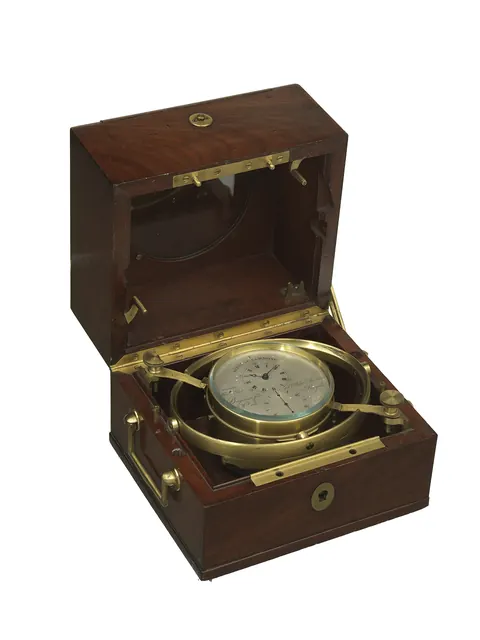
Chronometer no. 3157 by Abraham Louis Breguet & Fils
Royal Museums Greenwich
Instruments · 19th century
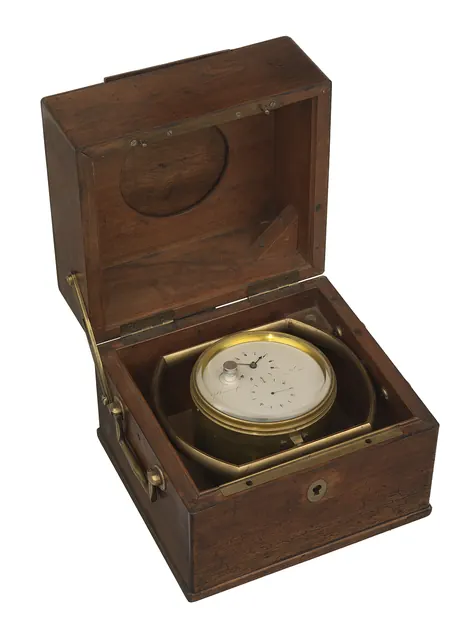
Marine chronometer no. 4489 by Abraham Louis Breguet & Fils
Royal Museums Greenwich
Instruments · 1751–1850
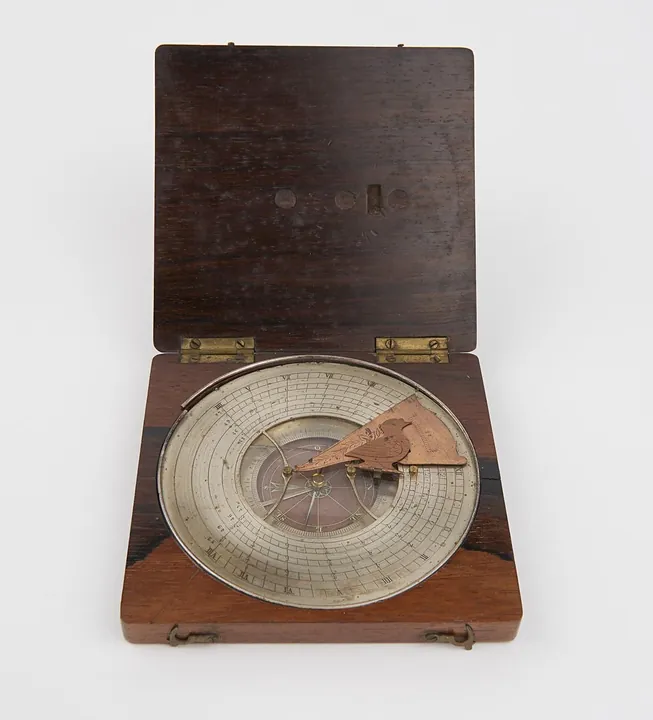
Horizontal compass sundial for latitudes 43 degrees, 46 degrees, 49 degrees, 52 degrees, in rosewood case French, c.1800 Cover glass cracked.
Science Museum Group, London
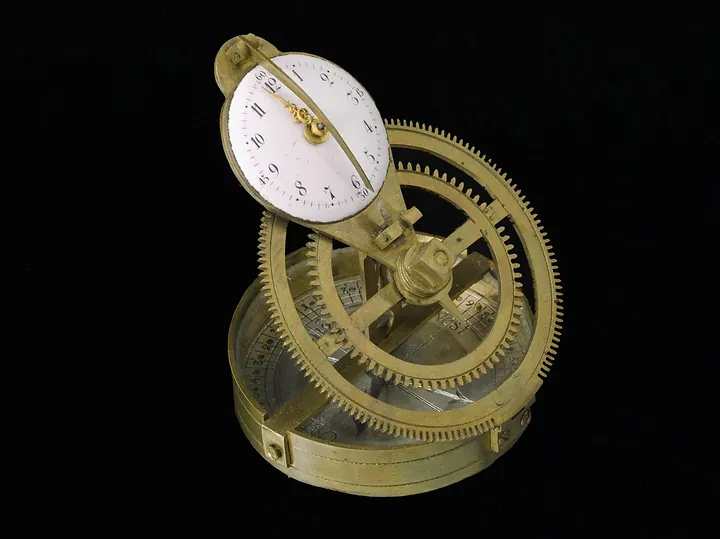
Instruments · 1751–1850
Mechanical equinoctial sundial for latitude 52 degrees, in original card case, one sight missing. French, c.1800
Science Museum Group, London
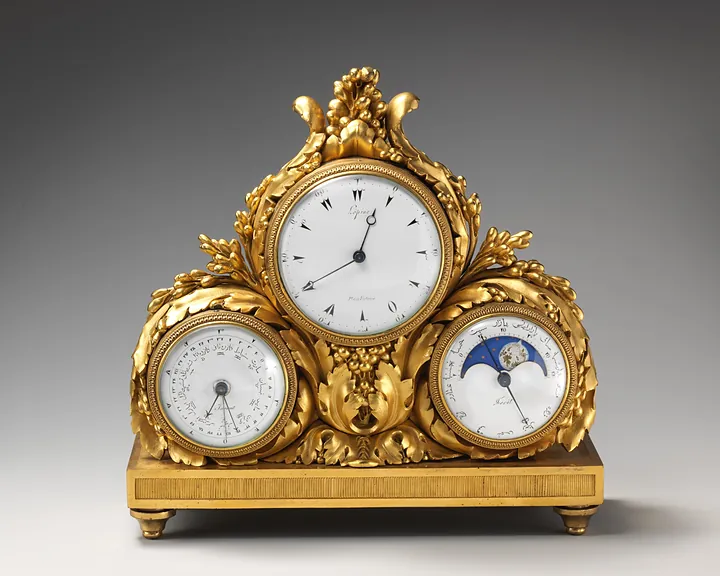
Instruments · last quarter 18th century
Clock by Jean Antoine Lépine, France, last quarter 18th century
The Metropolitan Museum of Art, New York
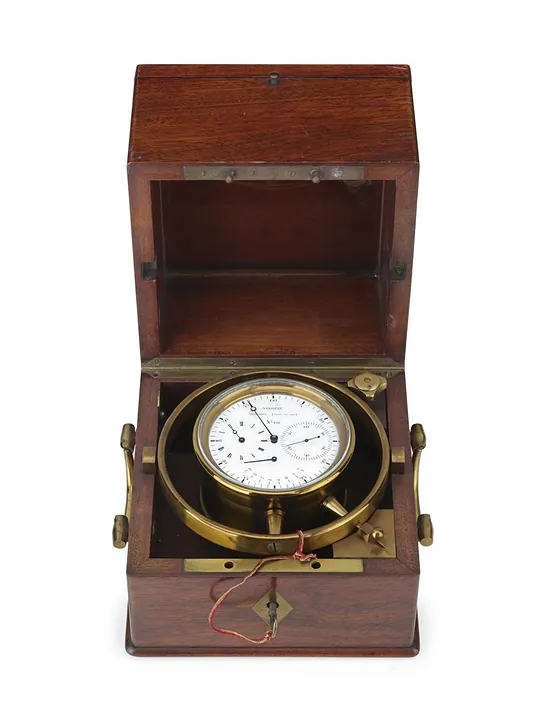
Instruments · 1780–1799
Marine chronometer by Vissière, France, 1780–1799
Science Museum Group, London
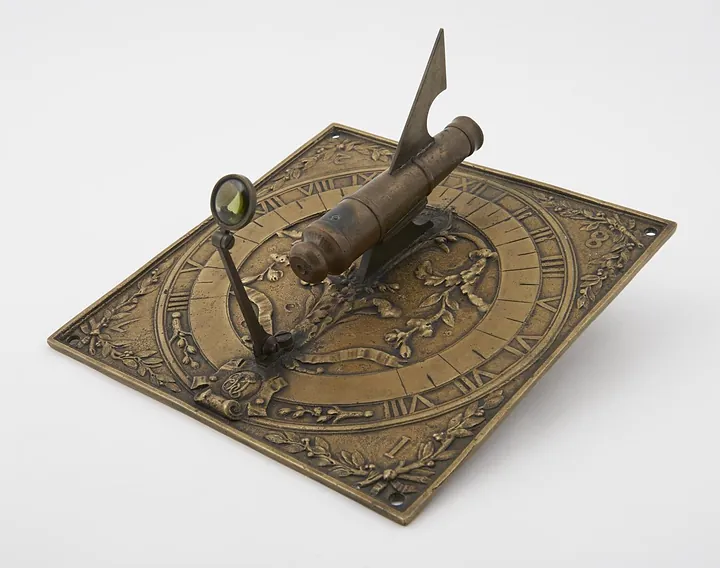
Instruments · 1782
Sundial, gnomon fixed on a cannon over touch hole of which a lens is fixed on a square base, unsigned, French, 1782
Science Museum Group, London
Instruments · 1790
Orrery clock by Louis Thouverez, France, 1790
The Metropolitan Museum of Art, New York