
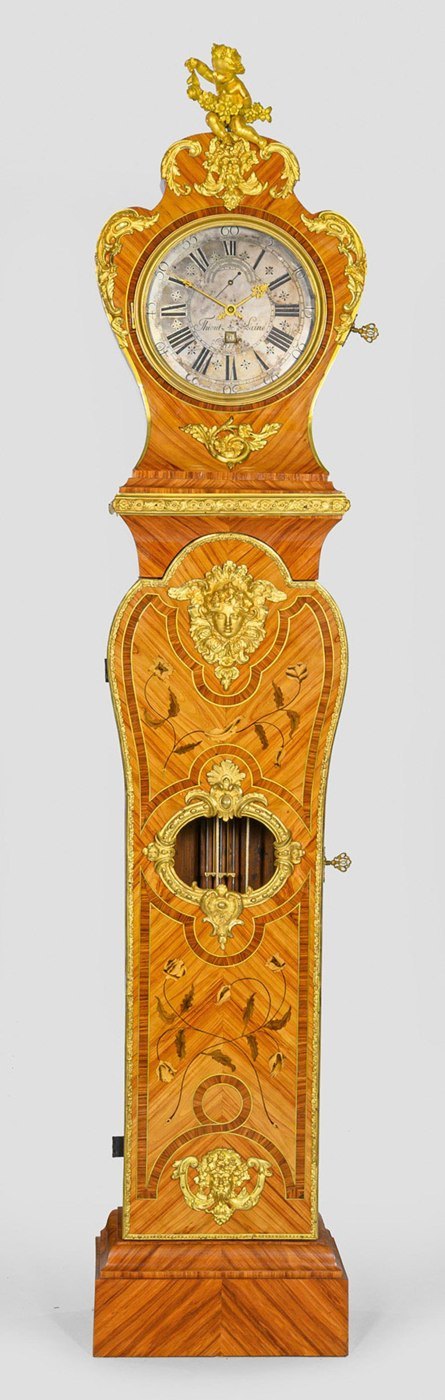
Clocks · Long case clock
Louis XV Long Case Clock by Antoine Thiout
- Maker / attribution
- Antoine Thiout (source attribution)
- Date
- 18th century
- Historical period
- Early Modern Horology (1600 – 1750)
- Country of origin
- France
- Object type
- Long case clock
- Materials / technique
- Rosewood veneer, exotic woods, gilded bronze
- Dimensions
- Height 208 cm
- Auction house
- Kunstauktionshaus Schloss Ahlden (via Invaluable)
- Lot
- 1535
- Credit line
- Kunstauktionshaus Schloss Ahlden (via Invaluable)
- Catalogue title (original)
- Höfische Louis XV-Bodenstanduhr von Antoine Thiout (English)
View the source record (auction lot) ↗ (opens another website in a new tab)Suggest a correction
Record summary
Catalogued by Kunstauktionshaus Schloss Ahlden (via Invaluable) (lot 1535), this is a long case clock attributed to Antoine Thiout, made in France, dated 18th century. The Atlas places it in the Early Modern Horology period (1600 – 1750) of its Clocks collection. Materials and techniques recorded by the source: Rosewood veneer, exotic woods, gilded bronze. Recorded dimensions: Height 208 cm. The record is illustrated with 1 photograph.
Assembled from the source record's structured fields. Dates and attributions are given as the source states them; where a field is missing the Atlas leaves it blank rather than estimating.
Catalogue description
Original object description
This 18th-century French longcase clock is attributed to Antoine Thiout (Thiout l'aîné, 1694–1761), a Parisian horologist who attained master status in 1724 and royal appointment to the Duke of Orleans in 1751. Standing on a molded plinth, the baluster-profiled case is clad in rosewood veneers with exotic wood marquetry panels, accented by chased and gilt bronze mounts and crowned by a cast putto finial on the hood. A glazed window on the waist door affords a view of the oscillating pendulum. Behind the protective front glass, the dial incorporates calendar functions, an interrupted 30-second sector, and the signature 'Thiout L'ainé, Paris.' Chimes for both the hours and half-hours are struck on a bell by the mechanical movement. Auction records document that the clock originates from a dispersed private collection, noting that the piece has sustained earlier restorations and features later additions.
Historical context
Early Modern Horology (1600 – 1750)
Huygens' pendulum and balance spring transform accuracy; English makers develop the anchor and deadbeat escapements.
Huygens's pendulum (1656–57) improved clock accuracy from about a quarter of an hour to under a minute a day. The anchor escapement (c. 1670) and the long seconds pendulum created the longcase clock; London makers such as Fromanteel, Knibb, Tompion and Quare led European clockmaking, and French makers created the Boulle pendule.
Read the period in the timelineMore clocks from this periodEarlier: Renaissance Horology
Atlas type guide
Longcase (tall-case or grandfather) clocks
The longcase clock was born from two seventeenth-century innovations: Christiaan Huygens's pendulum (1656–57) and the anchor escapement (c. 1670). A long seconds pendulum, nearly a metre long, swings with a small arc, and enclosing it together with the driving weights in a tall wooden case protected the mechanism and created a new piece of furniture. London makers such as Ahasuerus Fromanteel, Thomas Tompion and Joseph Knibb set the pattern.
By the eighteenth century longcase clocks were made throughout Britain, the Netherlands, Scandinavia (the Swedish Mora clock), France (the Comtoise from the Franche-Comté), Germany and colonial America. Eight-day movements with two weights became standard in better clocks; thirty-hour clocks with one weight and a rope or chain were cheaper alternatives.
What to look for
- Winding holes in the dial: two (eight-day, going and striking) or none (thirty-hour, pulled up by a chain).
- Brass dials with applied chapter rings (earlier) versus painted iron 'white' dials (after c. 1770 in Britain).
- Moon-phase arches, date apertures, seconds dials and maker's name on the dial.
- Case woods and style: ebonised, walnut marquetry, lacquer, oak or mahogany; regional styles from London, Lancashire, Scotland or America.
- Whether the movement and dial match the case — 'marriages' are common.
Dating clues
- Square brass dials suggest c. 1670–1720; arched brass dials c. 1715–1790.
- Painted (white) dials were made by Birmingham dial-makers from about 1772.
- Comtoise clocks with repoussé pendulums are mostly nineteenth century.
General guidance written by the Atlas editors about this kind of object. It is not a statement about this particular piece; for that, rely on the source record above and on physical examination.
Read next:Anchor (recoil) escapementDeadbeat escapementAnchor escapement
Related records
Clocks · 1725–1750
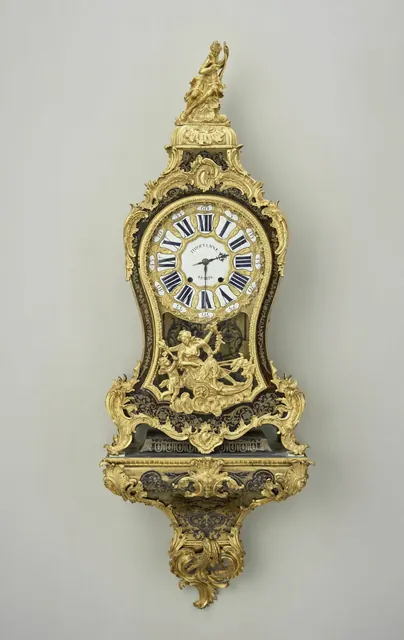
Mantel clock by André-Charles Boulle, France, 1725–1750
Musée du Louvre, Paris
Pocket Watches · 1725–1750
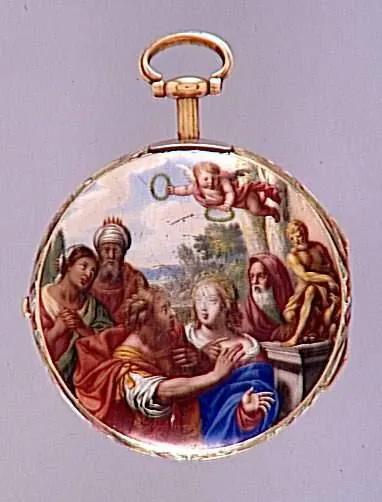
Watch by Antoine Thiout, France, 1725–1750
Musée du Louvre, Paris
Clocks · 1590–1610
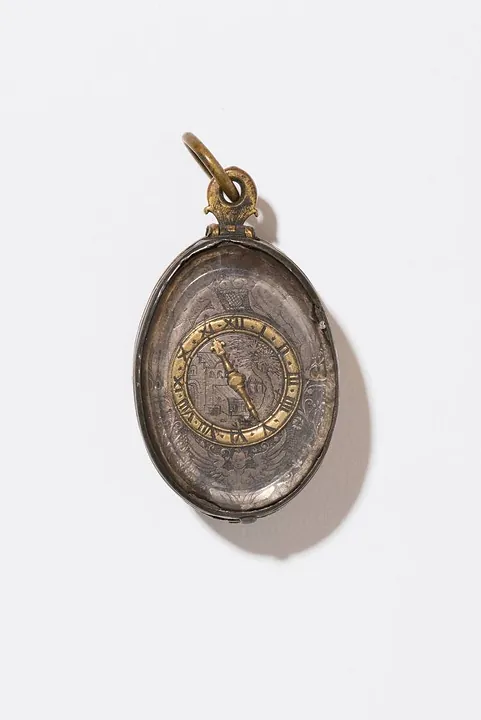
Clock, France, 1590–1610
MAK – Museum of Applied Arts
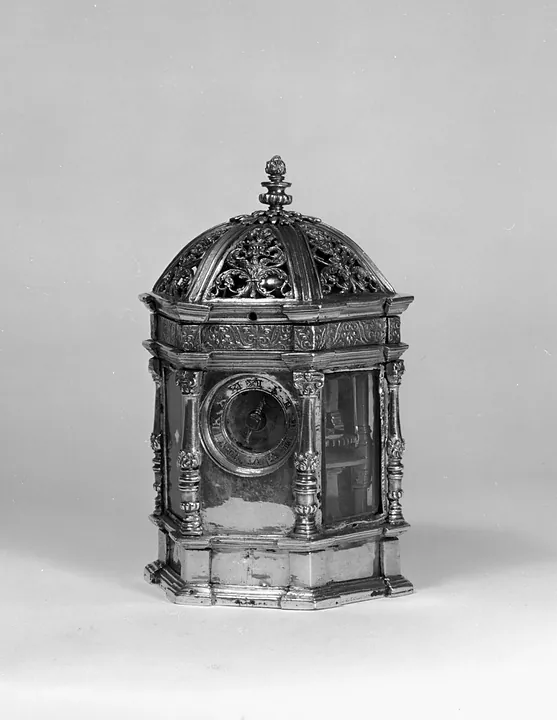
Clocks · c. 1600
Table Clock, sheet brass, engraved, pierced and gilt, Paris, ca.1600, signed 'B(?) Pichard, à Paris'
Victoria and Albert Museum, London
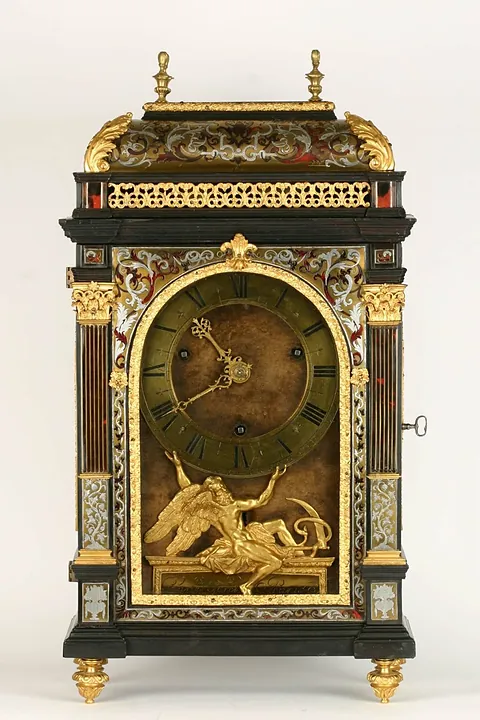
Clocks · 1600–1699
Table clock by Charles Goret, France, 1600–1699
German Clock Museum
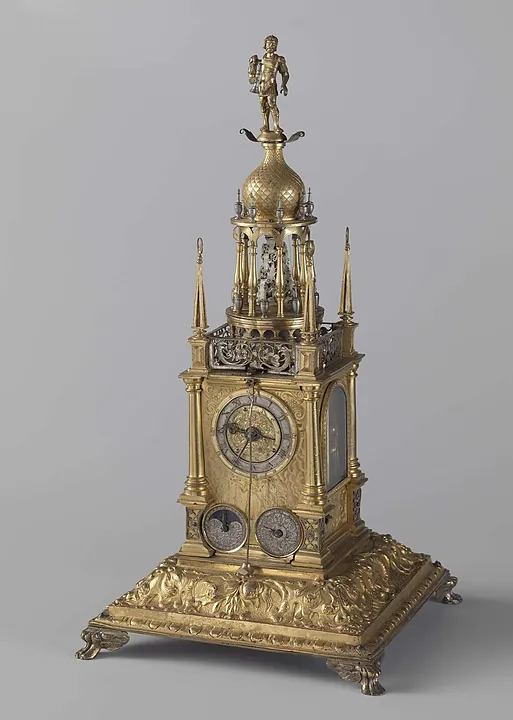
Clocks · 1640
Table clock, France, 1640
Rijksmuseum
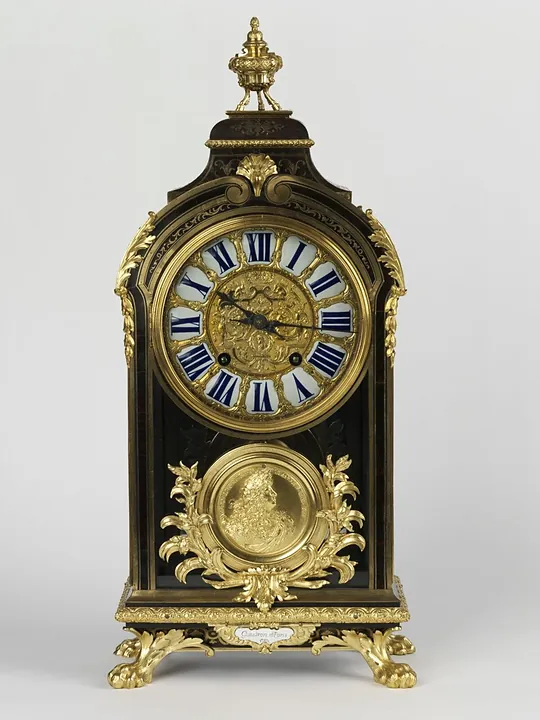
Clocks · late 17th century
Clock with case of tortoiseshell inlaid with brass, Paris, late 17th century
Victoria and Albert Museum, London
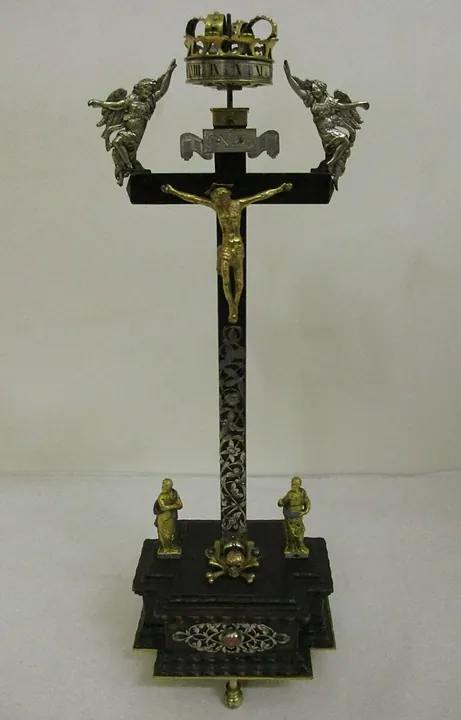
Clocks · 1650
Crucifix Clock, signed W. H. Arnstad, mid- 17th century.
Victoria and Albert Museum, London