
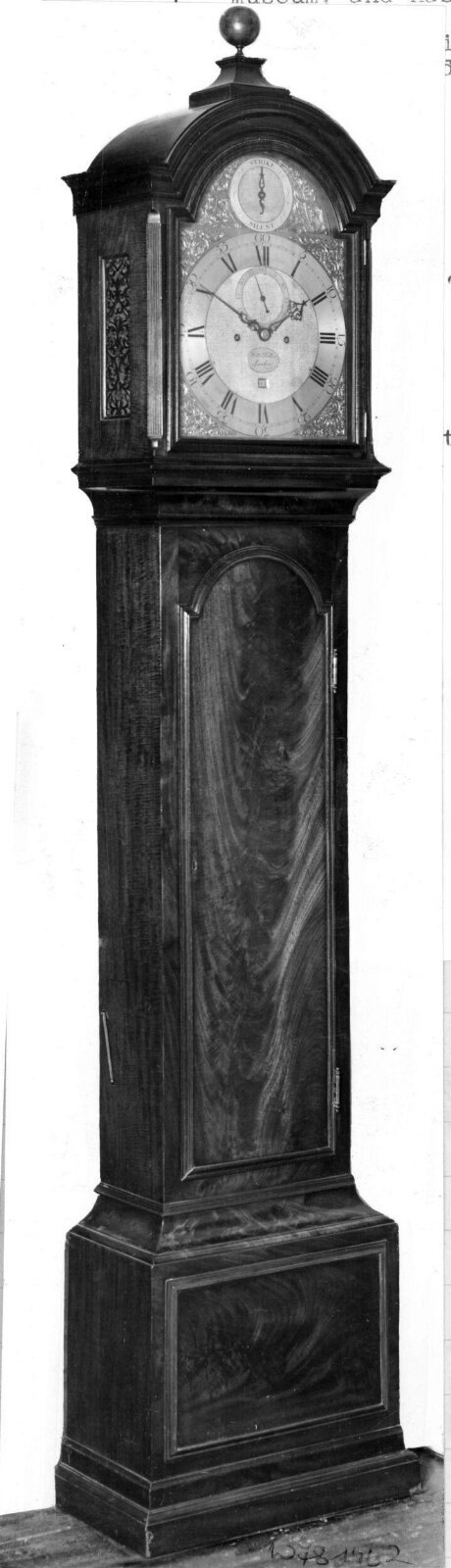
Clocks · Longcase clock
Longcase clock by William Dutton, England, c.1746
- Maker / attribution
- William Dutton (made)
- Date
- c.1746
- Historical period
- Early Modern Horology (1600 – 1750)
- Country of origin
- England
- Place
- London
- Object type
- Longcase clock
- Materials / technique
- mahogany veneer on oak, brass and steel movement
- Dimensions
- Height: 223.5 cm; Width: 48.5 cm; Depth: 25.9 cm; Weight: 5.65 kg (w.78:5 weight 10/10/2025 NH)
- Holding institution
- Victoria and Albert Museum, London
- Accession / object no.
- W.78-1962
- Credit line
- Bequeathed by C. D. Rotch
View the source record ↗ (opens another website in a new tab)Suggest a correction
Record summary
Held and catalogued by Victoria and Albert Museum, London (object number W.78-1962), this is a longcase clock by William Dutton, made in London, England, dated c.1746. The Atlas places it in the Early Modern Horology period (1600 – 1750) of its Clocks collection. Materials and techniques recorded by the source: mahogany veneer on oak, brass and steel movement. Recorded dimensions: Height: 223.5 cm; Width: 48.5 cm; Depth: 25.9 cm; Weight: 5.65 kg (w.78:5 weight 10/10/2025 NH). The record is illustrated with 2 photographs.
Assembled from the source record's structured fields. Dates and attributions are given as the source states them; where a field is missing the Atlas leaves it blank rather than estimating.
Catalogue description
Summary — Victoria and Albert Museum
William Dutton, was apprenticed to Graham and afterwards partner with Mudge at 148 Fleet Street from 1746-1794. He was a member of the Clockmakers' Company in 1746 and a liveryman in 1766. The dial of silvered brass has two winding holes for going & striking. The spandrels are decorated with floral rococo ornament. Maintains power & dead-beat escapement. This clock was formerly on loan to the Natural History Museum.
Physical description — Victoria and Albert Museum
Case: Mahogany veneer on oak carcass. Break-arch trunk door with moulded border. Concave moulding below hood. Arch top, with concave section below cornice to sliding hood, surmounted by a single ball finial on a square pedestal. Break-arch glazed front door with moulded border; chamfered, fluted corners to hood front. Hood sides with rectangular blind sound frets. Rectangular base with moulded edged panel. Double plinth with straight bottom edge. Label on trunk door of collection "C.D. Rotch, No.119" Dial: Brass, break-arch, total height 165/8 inches, central portion 12 inches square. Centre matted. Rectangular calendar aperture with bevelled edges is located below oval silvered brass plaque pinned to the dial plate, engraved Willm Dutton / London . Rococo style spandrels, each secured by a pair of screws located at dial plate corners. Flanking a silvered brass ring in the break-arch, engraved Strike/Silent are rococo arch spandrels. Pinned to the dial plate is the silvered brass chapter ring with an engraved minute band, having small triangles and Arabic minute numerals each at intervals of five; Roman hour numerals. Pinned to the dial plate below "XII" is the subsidiary seconds ring of silvered brass engraved with engraved seconds band and Arabic seconds numerals at intervals of five; its diameter is such that at the top it cuts into underside of main chapter ring, whilst at the bottom its lower portion is partially cut away to clear central hole for the hands. A silvered brass ring with engraved Arabic numerals for the date (1-31) runs behind the dial. Four dial feet are attached to movement front plate by pinning. Hands: Pierced steel hour and minute; seconds hand with tail. Located in the centre of the strike/silent scale is substantial steel hand which selects strike, or silent. Movement: Well finished and executed to a high standard. Brass and steel, weight driven, hour striking of 8-day duration with dead beat escapement, pendulum regulated. Five pillars, each with a central knop, riveted to the backplate, pinned to the front. Hour striking on bell, controlled by rack and snail, with strike / silent operating on lifter. Brass train wheels with four predominantly semicircular crossings but whose almost straight spokes taper towards circumference, except escape wheel, with its six, straight, tapering crossings. Double profiled wheel collets consisting of two cylindrical sections each of different diameter, larger adjacent to wheel. Minute wheel colleted to its arbor, the whole located on front plate by a cock. Steel arbors with very slight barrel-shape; elongated pinion heads. Harrison maintaining power. Straight-armed steel dead beat pallets embrace 8½ teeth of escape wheel; semicircular backs to its wheel teeth. Both pallets and crutch screwed to the pallet arbor. Crutch ‘j’ shaped with crutch fork in form of single pin mounted on a short, pivoted piece. Substantial backcock occupies over half width of backplate. Front pallet arbor pivots run in a small rectangular cock screwed to inside of front plate, adjacent to which is one vacant hole. Great wheel clicks are of the type separate from their screws. Movement secured to seatboard by fine threaded screws going into threaded holes in the two knops of the lower pillars; seatboard fits case precisely and is located by pins. Massive pendulum, consisting of a wooden rod, lozenge-sectioned lead disc forming the bob, knurled nut and brass regulating ball with engraved Arabic calibration numerals. Description and notes by Francis Brodie, c. 2008
Brief description — Victoria and Albert Museum
LONG CASE CLOCK Mahogany veneer on oak carcase Inscribed 'William Dutton. London.', made about 1746
Provenance
Bequeathed by Claude Rotch Longcases appearing during the last quarter of the eighteenth century associated with such makers as Thomas Mudge, William Dutton and John Holmes were reckoned to be the finest mahogany London longcase clocks (Neale, J.A., Joseph and Thomas Windmills: Clock and Watchmakers, 1671-1737, Wadhurst, 1999). Characteristic of such cases is the arch top with the single finial in the centre. W.78-1962 has a well executed case, a perfectly fitting seatboard and movement particularly well finished. The origin of the design of this case is not clear. Penney believes that Thomas Mudge was the originator, evolving the case as he succeeded Graham as a stamp of his individuality (Neale, J.A., More Tilting at Windmills, Antiquarian Horology, Vol.17, No.6, Winter 1988, pp563-582). However, Tuck suspects that Holmes was generally involved in the design of Mudge and Dutton’s work, although no reason is given (St Edmundsbury Borough Council Museum’s Service, The John Gershom Partington Time Measurement Instruments, Bury St Edmunds, 1979). It has been stated that most cases for Holmes were made by William Rich although Penney disputes this attribution (Neale, J.A., More Tilting at Windmills, Antiquarian Horology, Vol.17, No.6, Winter 1988, pp563-582; Dawson, P.G., Longcase Clocks of a Distinctive Design, Antiquarian Horology, Vol.16, No.5, March 1987, pp479-481). Although there are similarities, Penney believes W.78-1962 is a Dutton and not a Holmes. Dutton details inclu
Historical context
Early Modern Horology (1600 – 1750)
Huygens' pendulum and balance spring transform accuracy; English makers develop the anchor and deadbeat escapements.
Huygens's pendulum (1656–57) improved clock accuracy from about a quarter of an hour to under a minute a day. The anchor escapement (c. 1670) and the long seconds pendulum created the longcase clock; London makers such as Fromanteel, Knibb, Tompion and Quare led European clockmaking, and French makers created the Boulle pendule.
Read the period in the timelineMore clocks from this periodEarlier: Renaissance Horology
Atlas type guide
Longcase (tall-case or grandfather) clocks
The longcase clock was born from two seventeenth-century innovations: Christiaan Huygens's pendulum (1656–57) and the anchor escapement (c. 1670). A long seconds pendulum, nearly a metre long, swings with a small arc, and enclosing it together with the driving weights in a tall wooden case protected the mechanism and created a new piece of furniture. London makers such as Ahasuerus Fromanteel, Thomas Tompion and Joseph Knibb set the pattern.
By the eighteenth century longcase clocks were made throughout Britain, the Netherlands, Scandinavia (the Swedish Mora clock), France (the Comtoise from the Franche-Comté), Germany and colonial America. Eight-day movements with two weights became standard in better clocks; thirty-hour clocks with one weight and a rope or chain were cheaper alternatives.
What to look for
- Winding holes in the dial: two (eight-day, going and striking) or none (thirty-hour, pulled up by a chain).
- Brass dials with applied chapter rings (earlier) versus painted iron 'white' dials (after c. 1770 in Britain).
- Moon-phase arches, date apertures, seconds dials and maker's name on the dial.
- Case woods and style: ebonised, walnut marquetry, lacquer, oak or mahogany; regional styles from London, Lancashire, Scotland or America.
- Whether the movement and dial match the case — 'marriages' are common.
Dating clues
- Square brass dials suggest c. 1670–1720; arched brass dials c. 1715–1790.
- Painted (white) dials were made by Birmingham dial-makers from about 1772.
- Comtoise clocks with repoussé pendulums are mostly nineteenth century.
General guidance written by the Atlas editors about this kind of object. It is not a statement about this particular piece; for that, rely on the source record above and on physical examination.
Related records
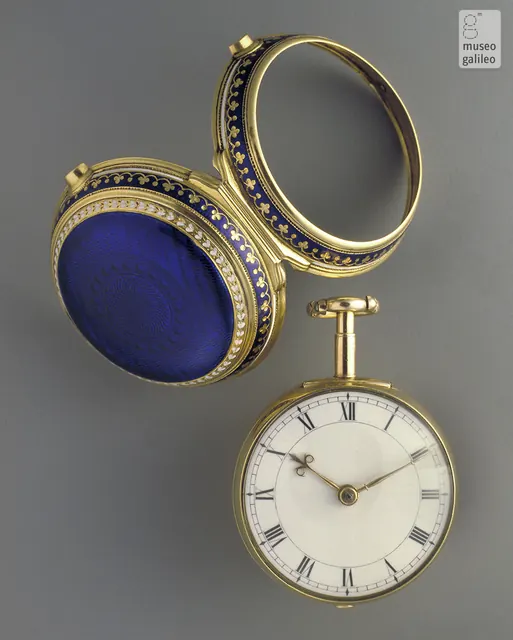
Pocket Watches · 1788
Double-case watch by Thomas Mudge, England, 1788
Museo Galileo, Florence
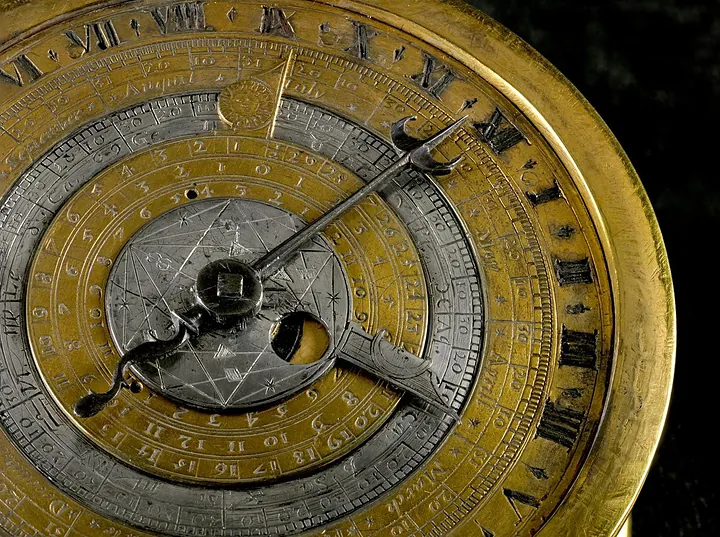
Clocks · 1598–1603
Circular table-clock with calendrical and lunar indications made by Nicholas Vallin in London between 1598 and 1603.
Science Museum Group, London
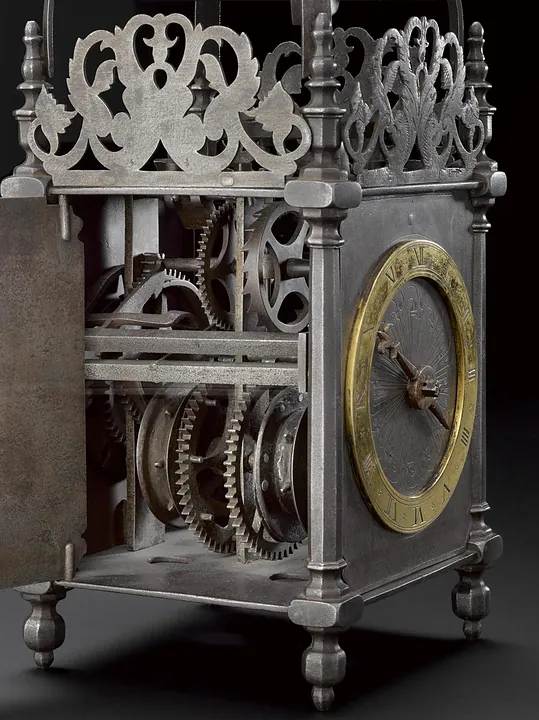
Clocks · 1611
English iron lantern clock, with wheel balance, by John Holloway, Market Lavington, Wiltshire, England, 1611.
Science Museum Group, London
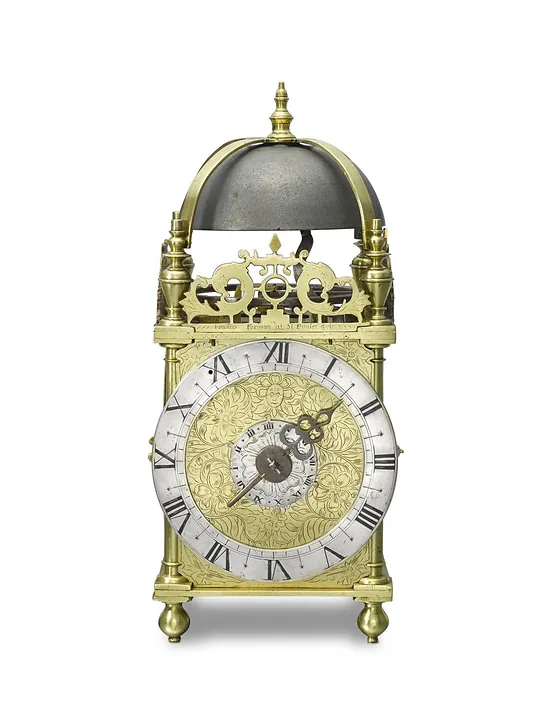
Clocks · 1630
Lantern clock by Francis Forman, England, 1630
Science Museum Group, London
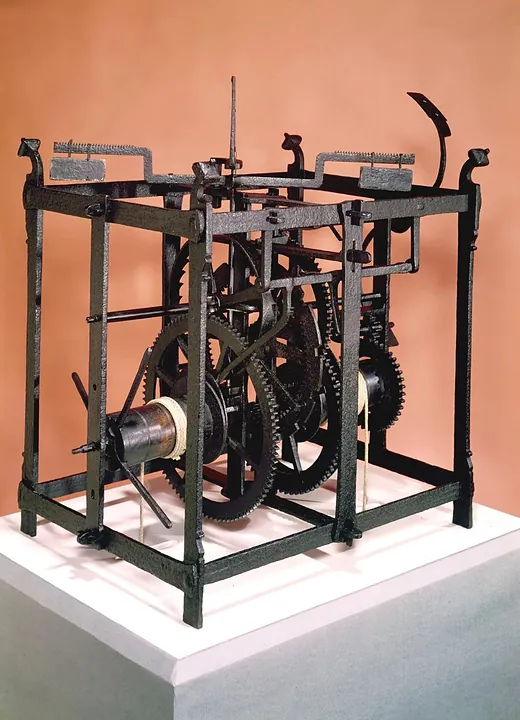
Clocks · 1632–1640
Turret clock, England, 1632–1640
Science Museum Group, London
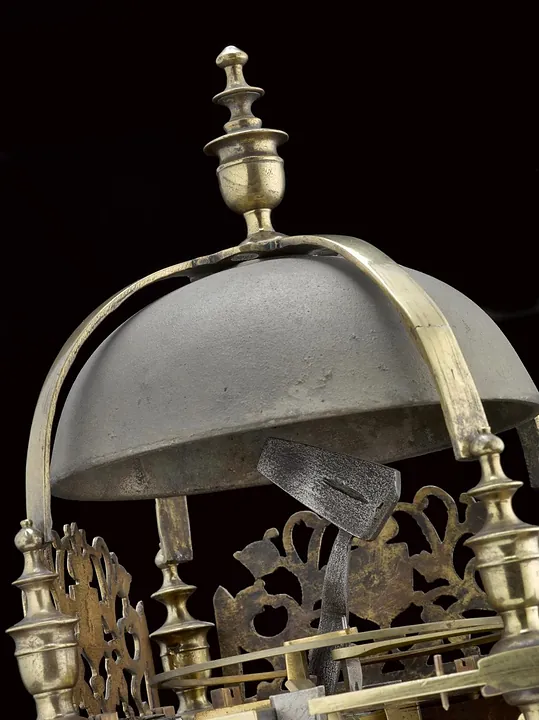
Clocks · 1645–1655
Balance-wheel brass lantern clock, with two driving weights and one counterweight, by Thomas Knifton, Cross Keys, Lothbury, London, England, 1645–1655.
Science Museum Group, London
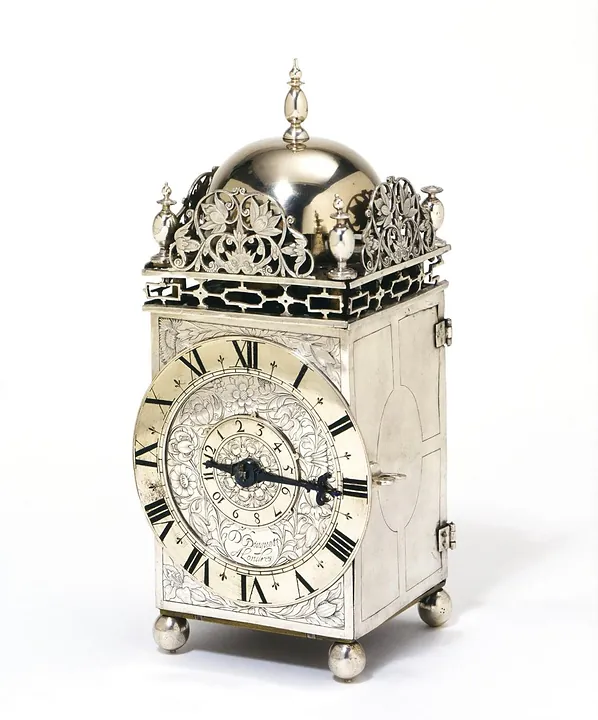
Clocks · c. 1650
Lantern alarm clock, silver, by David Bouquet, circa 1650
Victoria and Albert Museum, London
Clocks · 1650–1660
Lantern clock by Peter Closon, England, 1650–1660
Science Museum Group, London