
Clocks · Longcase clock
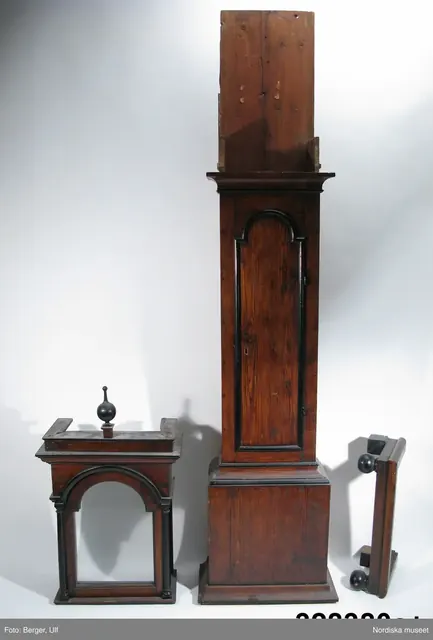
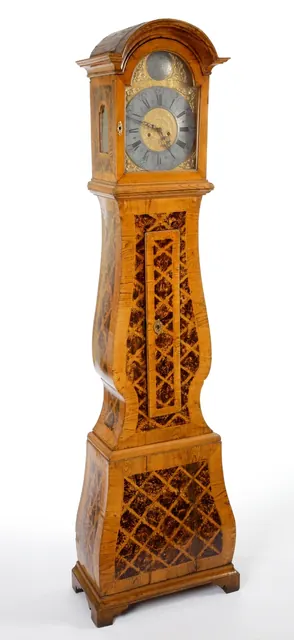
Longcase clock by Olof Rising, Sweden, 1747–1780
- Maker / attribution
- Olof Rising (Maker)
- Date
- 1747–1780
- Historical period
- Precision & Scientific Horology (1750 – 1850)
- Country of origin
- Sweden
- Place
- Sverige
- Object type
- Longcase clock
- Materials / technique
- Gravering, Betsning Tenn Furu
- Dimensions
- Djup 29.0 cm Bredd 54.0 cm
- Holding institution
- Nordic Museum Foundation
- Accession / object no.
- NM.0328380A-G
- Credit line
- Nordic Museum Foundation
- Catalogue title (original)
- Golvur (Swedish)
View the source record ↗ (opens another website in a new tab)Suggest a correction
Record summary
Held and catalogued by Nordic Museum Foundation (object number NM.0328380A-G), this is a longcase clock by Olof Rising, made in Sverige, Sweden, dated 1747–1780. The Atlas places it in the Precision & Scientific Horology period (1750 – 1850) of its Clocks collection. Materials and techniques recorded by the source: Gravering, Betsning Tenn Furu. Recorded dimensions: Djup 29.0 cm Bredd 54.0 cm. The record is illustrated with 6 photographs.
Assembled from the source record's structured fields. Dates and attributions are given as the source states them; where a field is missing the Atlas leaves it blank rather than estimating.
Catalogue description
Catalogue description from Nordic Museum Foundation
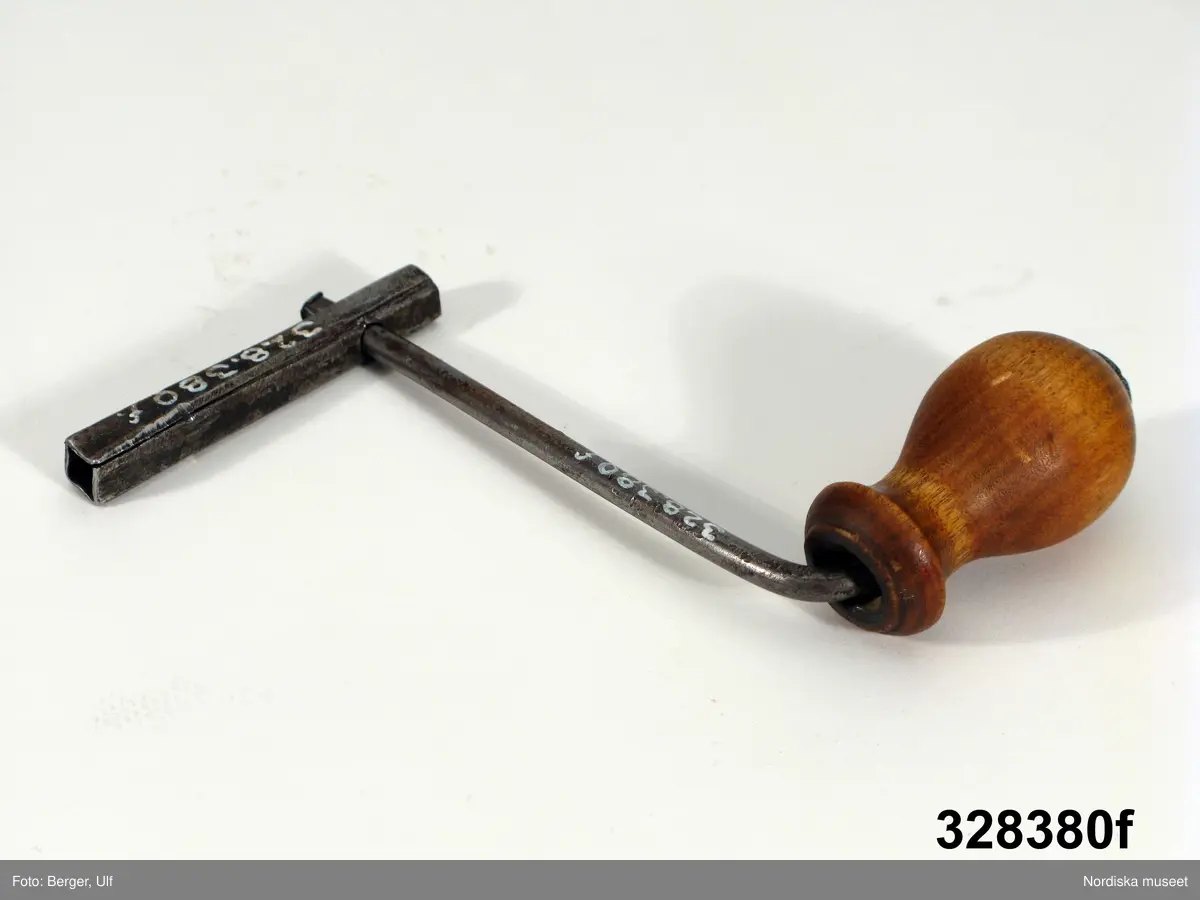
a-g: Golvur, med urtavla signerad "Olof Rising / Götheborg". a+Fodral med rak senbarock form, sekundärt brunbetsat med svartmålade lister och detaljer. Lös golvsockel med två kulfötter. Glasad huv med högt uppdraget krön som avslutas med tre svarvade spiror på socklar. b+Kvadratisk urtavla av bronserat järn, med halvrunt överstycke. Sifferring m m av tenn. Svickelornament i form av de fyra årstiderna. I urtavlans halvrunda överstycke finns en graverad bild av ålderdomen och ungdomen - en gammal och en ung man - och mellan dem ett bevingat timglas, en dödskalle och benknotor. Överst graverat: "ACK AT WI KUNDE WAKNA OPP! OCH STADNA MED WÅRT SYNDA LOPP; KANSIE I DAG WÅR TID ÄR ALL AT WI MED DÖDEN FÖLJA SKALL". Framför bilden, kopplad till pendeln, svänger Döden - i form av en grinande benrangelsman - med sin lie fram och tillbaka. Urverk. Lodlina (sekundär) med 2 st trissor, diameter 6,5 cm (trä) resp 4,5 cm (mässing). c) Pendel, längd 110 cm. d-e) Lod, 2 st f) Vev (urnyckel), järn med svarvat trähandtag, längd 13 cm, bredd 12 cm. g) Nyckel till fodralet, mässing. Längd 6,2 cm. /Anna Womack 2006-03-03 Olof Rising (1718-83) gick i lära hos urmakaren Anders Fredman i Stockholm, och blev mästare 1747. Samma år flyttade han till Göteborg och var verksam där till 1780. Hantverket i Göteborg påverkades i hög grad av engelska influenser. Under hela 1700-talet bibehöll de engelskpåverkade golvursfodralen den raka senbarocka formen. På svenska liksom på engelska urtavlor inskränker sig vanligen hänvisningen till döden till någon latinsk sentens, till exempel "Tempus fugit irreparabile" - tiden flyr ohjälpligt. Ur med förgängelsesymbolik är vanligare i Central- och Syderuropa. På samtida franska ur personifieras döden inte sällan av en dödsängel med lie. Rising kan ha gesällvandrat på kontinenten och hämtat sin förlaga därifrån. Det är inte otänkbart att det rör sig om hans mästerstycke. Med tanke på den starka dödssymboliken och fodralets ansenliga höjd är det sannolikt att golvuret har haft sin plats i en kyrka. Ett av Olof Risings golvur står i Vänersborgs kyrka. Den för dåtidens människa närvarande kopplingen mellan tiden och döden uttrycks på Risings urtavla på ett mycket markant sätt. Det visar att liemannen som dödssymbol fortfarande var gångbar under 1700-talet. /Anna Womack 2006-03-03 Döden.
Shown in the original language of the source catalogue. An editor-reviewed English translation has not yet been published; we do not publish machine translations as authoritative text.
Historical context
Precision & Scientific Horology (1750 – 1850)
Harrison solves longitude; Mudge invents the lever; Breguet's Paris workshop defines the modern watch.
The age of the deadbeat escapement, compensated pendulums and observatory regulators. Domestic clocks spread through the middle classes: English longcase and bracket clocks, French gilt-bronze mantel clocks, Viennese Biedermeier wall clocks, Black Forest painted-shield clocks, and the first American shelf clocks.
Read the period in the timelineMore clocks from this periodEarlier: Early Modern Horology
Atlas type guide
Longcase (tall-case or grandfather) clocks
The longcase clock was born from two seventeenth-century innovations: Christiaan Huygens's pendulum (1656–57) and the anchor escapement (c. 1670). A long seconds pendulum, nearly a metre long, swings with a small arc, and enclosing it together with the driving weights in a tall wooden case protected the mechanism and created a new piece of furniture. London makers such as Ahasuerus Fromanteel, Thomas Tompion and Joseph Knibb set the pattern.
By the eighteenth century longcase clocks were made throughout Britain, the Netherlands, Scandinavia (the Swedish Mora clock), France (the Comtoise from the Franche-Comté), Germany and colonial America. Eight-day movements with two weights became standard in better clocks; thirty-hour clocks with one weight and a rope or chain were cheaper alternatives.
What to look for
- Winding holes in the dial: two (eight-day, going and striking) or none (thirty-hour, pulled up by a chain).
- Brass dials with applied chapter rings (earlier) versus painted iron 'white' dials (after c. 1770 in Britain).
- Moon-phase arches, date apertures, seconds dials and maker's name on the dial.
- Case woods and style: ebonised, walnut marquetry, lacquer, oak or mahogany; regional styles from London, Lancashire, Scotland or America.
- Whether the movement and dial match the case — 'marriages' are common.
Dating clues
- Square brass dials suggest c. 1670–1720; arched brass dials c. 1715–1790.
- Painted (white) dials were made by Birmingham dial-makers from about 1772.
- Comtoise clocks with repoussé pendulums are mostly nineteenth century.
General guidance written by the Atlas editors about this kind of object. It is not a statement about this particular piece; for that, rely on the source record above and on physical examination.
Read next:Anchor (recoil) escapementDeadbeat escapementAnchor escapement
Related records
Clocks · 1747–1780
Longcase clock by Olof Rising, Sweden, 1747–1780
Nordic Museum Foundation
Clocks · 1814
Clock by Ola Svensson, Sweden, 1814
Skansen
Clocks · 1833
Clock, Sweden, 1833
Skansen
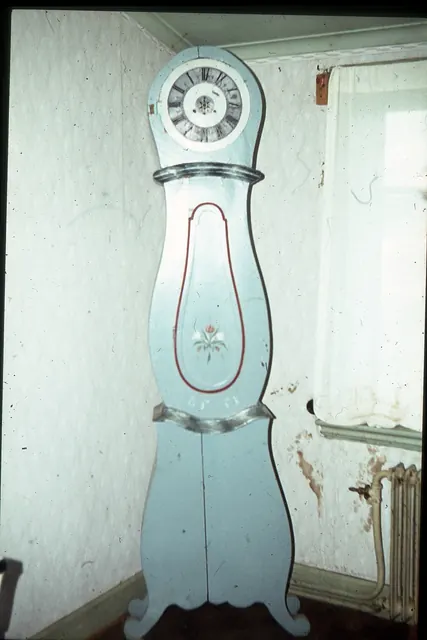
Clocks · 1775
Longcase clock, Sweden, 1775
National Association of Swedish Handicraft Societies
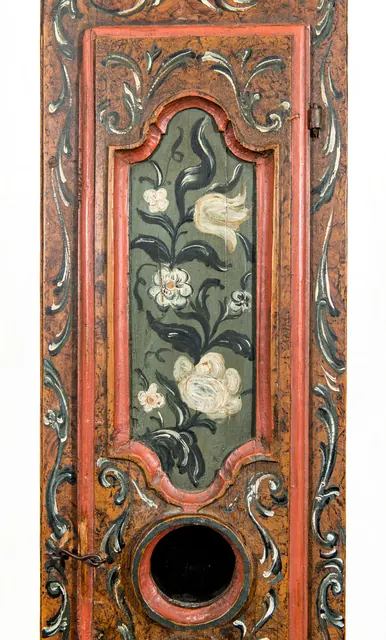
Clocks · 1772
Longcase clock, Sweden, 1772
Skelleftea museum
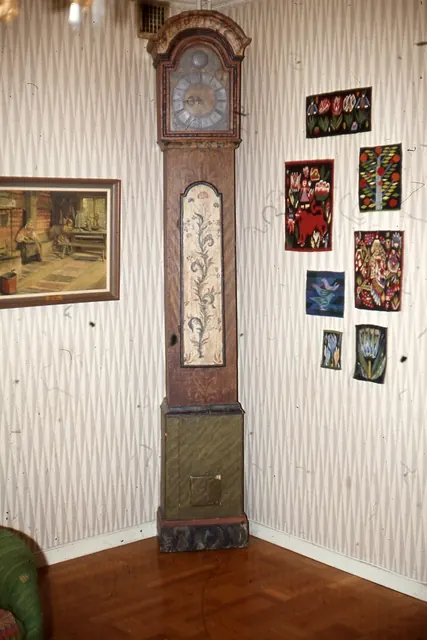
Clocks · 1775
Longcase clock, Sweden, 1775
National Association of Swedish Handicraft Societies
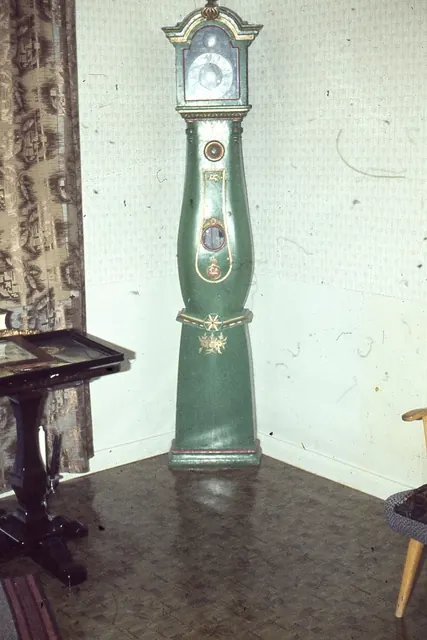
Clocks · 1799
Longcase clock, Sweden, 1799
National Association of Swedish Handicraft Societies
Clocks · 1766
Longcase clock by Sven Fogelberg, Sweden, 1766
Kulturparken Småland