
Clocks · Longcase clock
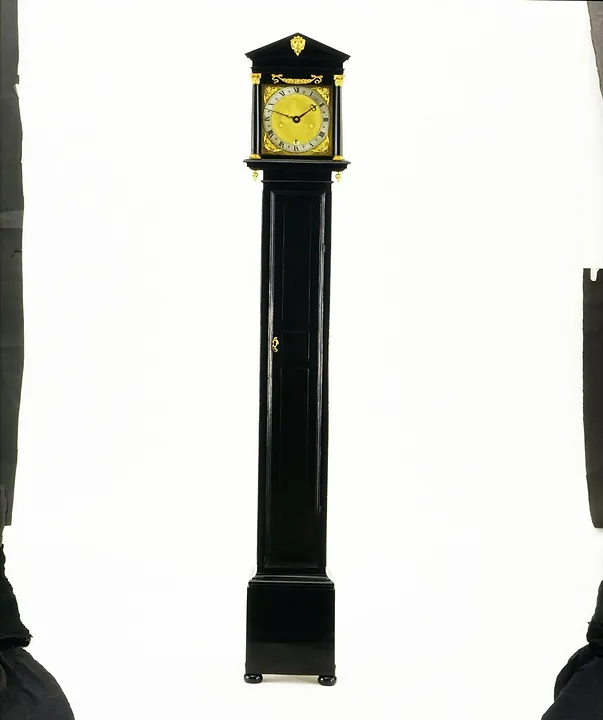
Longcase clock by Henry Poisson, England, c. 1710
- Maker / attribution
- Henry Poisson (made)
- Date
- c. 1710
- Historical period
- Early Modern Horology (1600 – 1750)
- Country of origin
- England
- Place
- London
- Object type
- Longcase clock
- Materials / technique
- walnut, brass, steel, Marquetry
- Dimensions
- Height: 242 cm; Width: 50 cm; Depth: 26 cm; Weight: 10.6 kg (4618:2 Brass weight 10/10/2025 NH); Weight: 10.7 kg (4618:3 Brass weight 10/10/2025 NH)
- Holding institution
- Victoria and Albert Museum, London
- Accession / object no.
- 4618:1-1858
View the source record ↗ (opens another website in a new tab)Suggest a correction
Record summary
Held and catalogued by Victoria and Albert Museum, London (object number 4618:1-1858), this is a longcase clock by Henry Poisson, made in London, England, dated c. 1710. The Atlas places it in the Early Modern Horology period (1600 – 1750) of its Clocks collection. Materials and techniques recorded by the source: walnut, brass, steel, Marquetry. Recorded dimensions: Height: 242 cm; Width: 50 cm; Depth: 26 cm; Weight: 10.6 kg (4618:2 Brass weight 10/10/2025 NH); Weight: 10.7 kg (4618:3 Brass weight 10/10/2025 NH). The record is illustrated with 1 photograph.
Assembled from the source record's structured fields. Dates and attributions are given as the source states them; where a field is missing the Atlas leaves it blank rather than estimating.
Catalogue description
Summary — Victoria and Albert Museum
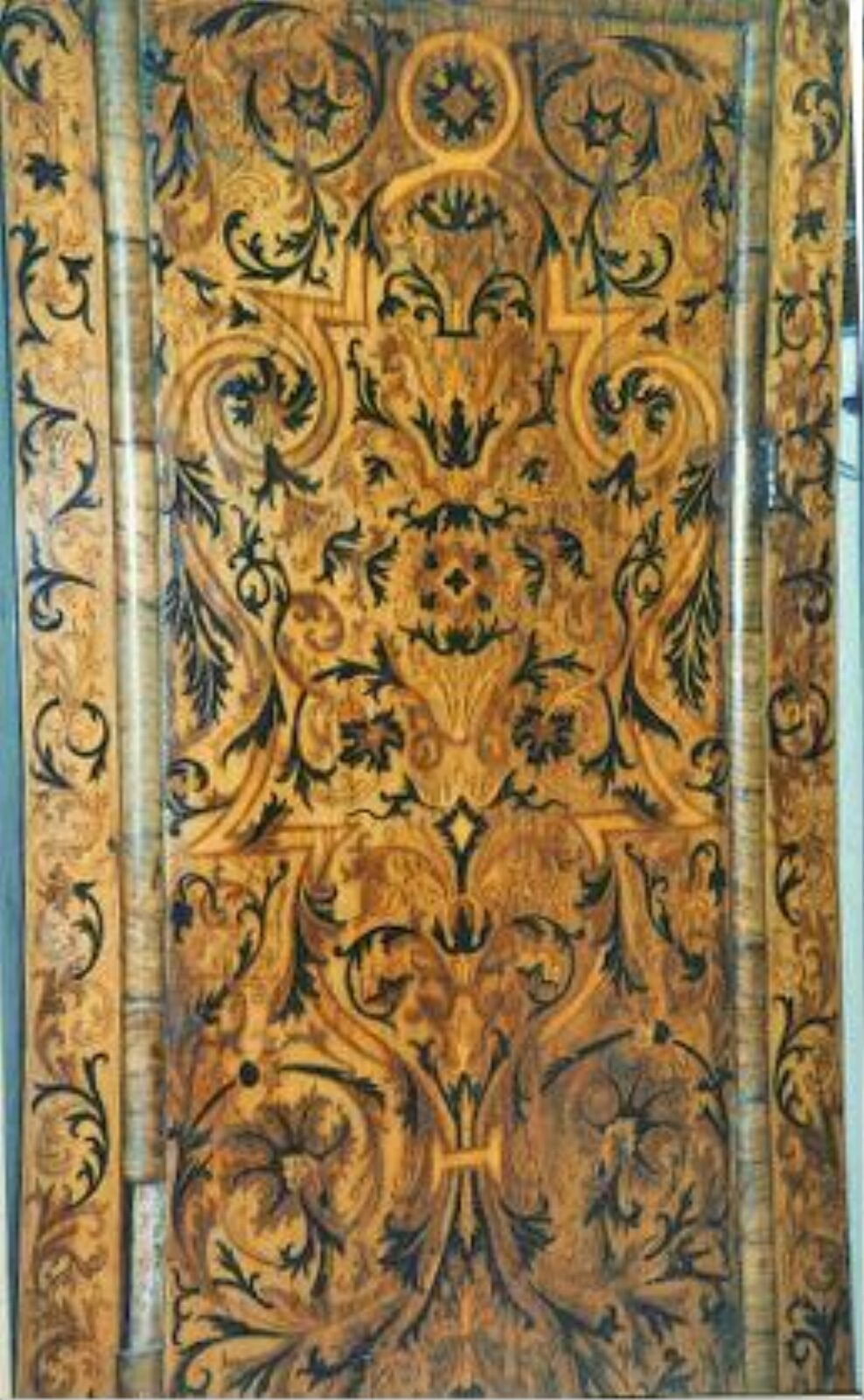
Henry Poisson worked in London between about 1695 and 1720. His son, Henry, also became a clockmaker, but changed his surname to “Fish”, presumably to reflect the fact that the family now lived in England. They were almost certainly of French Huguenot origin. The marquetry on the clock case is of an arabesque design, and was described by F.J. Britten in Old Clocks and Watches and Their Makers as a “particularly fine” example of the arabesque style of English marquetry. This decoration of abstracted organic forms is in contrast to the naturalistic flowers and birds thought to be typical of Dutch style marquetry. Marquetry decoration on long case clocks became fashionable in around 1685, the earliest long cases were plain. In London, craftsmen specialising in marquetry included recent immigrants working in Soho, although there were also specialist marquetry workshops in the City of London. This was the first long case clock acquired by the Museum, and at least one copy was sold at Maples in New York at the turn of the 20th Century. The brass and steel weight-driven two-train movement winds anticlockwise. It has a rack striking train, and there is a slot at the top of the backplate to allow the pallet system to be removed.
Physical description — Victoria and Albert Museum
Dial: Twelve inch square. Brass dial plate with ringed winding holes and seconds aperture, matted centre with square calendar aperture bordered by a form of double wheatear engraving behind which is silvered calendar ring. Twin cherubs with crown spandrels are screwed to corners of dial plate, silvered chapter ring and subsidiary seconds ring pinned at back of dial plate. Minute divisions are set in from edge of chapter ring by a plain scale having Arabic five minute numbers and arrow head half quarter marks. Roman hour numerals. Quarter hour divisions with engraved half hour marks. Signed between VII and V on the chapter ring Henry Poisson London . Seconds ring with relatively broad Arabic five seconds numerals occupies considerable part of upper dial space between inside of chapter ring and top of hour hand. Dial attached to front plate by four dial feet pinned to movement. Down one side of back of dial is a line of hammer marks. Hands: Pierced steel hour and minute hands and small seconds hand, its centre ringed echoing the pattern surrounding the winding holes. Movement: Month going, brass and steel, weight driven, two train movement. Hour striking on bell controlled by snail on the hour wheel with steel rack and associated levers mounted externally on the frontplate. Locking is on warning wheel by means of upper striking lever. On frontplate adjacent to the striking levers are three vacant holes and a larger, threaded fourth. Going train with recoil anchor escapement. Five pillar movement, each pillar having fins and semi-circular central knop. Pillars riveted to backplate, four pinned to front plate, the bottom central fifth secured by a substantial latch. Collets where used to mount wheels to arbors are mostly semi-circular in profile; arbors swell towards centres, pinion heads short; an exception is that of the gathering pallet, where collet is of double sectioned profile. Additionally, vestiges of the pinion leaves extend into the arbor. Where visible without dismantling, scribe lines present on wheel faces. Pallet frame, embracing 8½ escape wheel teeth, is split at its top and soldered onto pallet arbor. Pallets with deep drop to arms have distinctive, small pads, one of which emerges from a 'v' shaped notch in lower arm. Back cock with a pair of pivot holes. Asymmetric hour wheel bridge of distorted lenticular shape with one foot bulbous, the other tending to a point. Dial: Twelve inches typical of the early 18th century, smaller sizes being superseded. The arrangement of the minute scale became common by ca.1690, whilst its relative thicknesses are indicative of early 18th century practice. The type of spandrel found on the dial appears to have come into use typically ca.1700; retaining screws appear original. Although wheatear engraving had appeared in the 1680s its presence as a double border around the calendar aperture tends to suggest late 17th or early 18th century work. Hands: With the exception of the seconds hand with its ‘ringed’ centre, the styles of the hands differ in date from the dial, being rather later 18th century, as seen in the way a considerable proportion of the minute hand has been pierced. Movement: Features commonly associated with the late 17th century, for example the pillars, arbors, semi-circular wheel collets and scribe lines on the wheels are juxtaposed with the presence of later details, notably rack striking. Although this form of striking had been devised in the last quarter of the 17th century, it appears not to have been widely adopted in London longcase clocks until ca.1710. Early versions of this striking method had the rack mounted between the plates, whereas in the Poisson, the rack lies outside the front plate. The arrangement of levers in this clock is not typical of the usual, later layout, indicative of a transitional design, hence the locking on the warning. The unused holes on the front plate could be part of a mechanism to allow the last hour to be repeated by pulling on a cord; a hole does run through the seatboard through which such a line could have passed. That the collet on the gathering pallet wheel is of a double section implies that the arbor was replaced at a later date. Of interest, pallets appear to be of a relatively early style; the absence of plugged or later holes in the front plate is a good sign. The back cock does have one set of unused holes, although it is possible that as the escapement became worn in use, the assembly was simply lowered. Finally the single latch fixing of the lower central pillar is unusual, not because of its style but owing to its rather large size. Description and notes by Francis Brodie, c. 2008
Brief description — Victoria and Albert Museum
MONTH-GOING LONG CASE CLOCK Marquetry of walnut and other woods Made by Henry Poisson, London, about 1710
Provenance
Purchased in 1858 for £12 (no information about vendor in the acquisition papers) Henry Poisson is recorded as working ca.1695-1720 (G.H. Baillie, "Watchmakers and Clockmakers of the World", 1982, N.A.G. Press, London). Description and notes by Francis Brodie, c. 2008 Some marquetry missing (28/6/1982)
Historical context
Early Modern Horology (1600 – 1750)
Huygens' pendulum and balance spring transform accuracy; English makers develop the anchor and deadbeat escapements.
Huygens's pendulum (1656–57) improved clock accuracy from about a quarter of an hour to under a minute a day. The anchor escapement (c. 1670) and the long seconds pendulum created the longcase clock; London makers such as Fromanteel, Knibb, Tompion and Quare led European clockmaking, and French makers created the Boulle pendule.
Read the period in the timelineMore clocks from this periodEarlier: Renaissance Horology
Atlas type guide
Longcase (tall-case or grandfather) clocks
The longcase clock was born from two seventeenth-century innovations: Christiaan Huygens's pendulum (1656–57) and the anchor escapement (c. 1670). A long seconds pendulum, nearly a metre long, swings with a small arc, and enclosing it together with the driving weights in a tall wooden case protected the mechanism and created a new piece of furniture. London makers such as Ahasuerus Fromanteel, Thomas Tompion and Joseph Knibb set the pattern.
By the eighteenth century longcase clocks were made throughout Britain, the Netherlands, Scandinavia (the Swedish Mora clock), France (the Comtoise from the Franche-Comté), Germany and colonial America. Eight-day movements with two weights became standard in better clocks; thirty-hour clocks with one weight and a rope or chain were cheaper alternatives.
What to look for
- Winding holes in the dial: two (eight-day, going and striking) or none (thirty-hour, pulled up by a chain).
- Brass dials with applied chapter rings (earlier) versus painted iron 'white' dials (after c. 1770 in Britain).
- Moon-phase arches, date apertures, seconds dials and maker's name on the dial.
- Case woods and style: ebonised, walnut marquetry, lacquer, oak or mahogany; regional styles from London, Lancashire, Scotland or America.
- Whether the movement and dial match the case — 'marriages' are common.
Dating clues
- Square brass dials suggest c. 1670–1720; arched brass dials c. 1715–1790.
- Painted (white) dials were made by Birmingham dial-makers from about 1772.
- Comtoise clocks with repoussé pendulums are mostly nineteenth century.
General guidance written by the Atlas editors about this kind of object. It is not a statement about this particular piece; for that, rely on the source record above and on physical examination.
Read next:Deadbeat escapementAnchor escapement
Related records
Clocks · 1598–1603
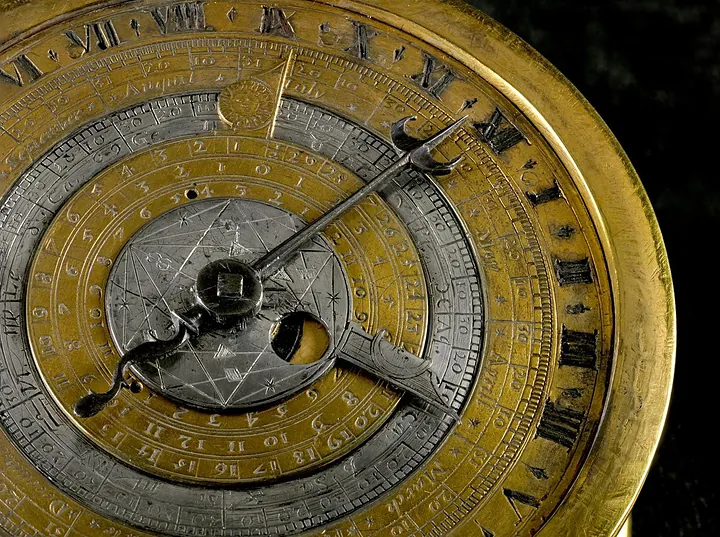
Circular table-clock with calendrical and lunar indications made by Nicholas Vallin in London between 1598 and 1603.
Science Museum Group, London
Clocks · 1611
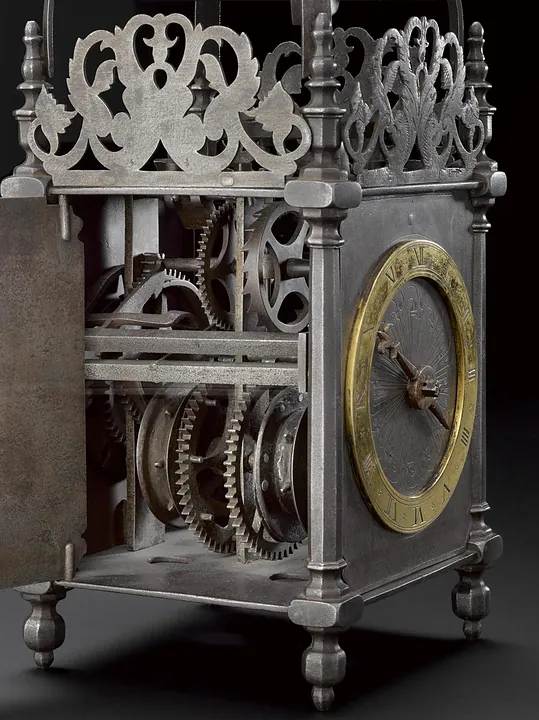
English iron lantern clock, with wheel balance, by John Holloway, Market Lavington, Wiltshire, England, 1611.
Science Museum Group, London
Clocks · 1630
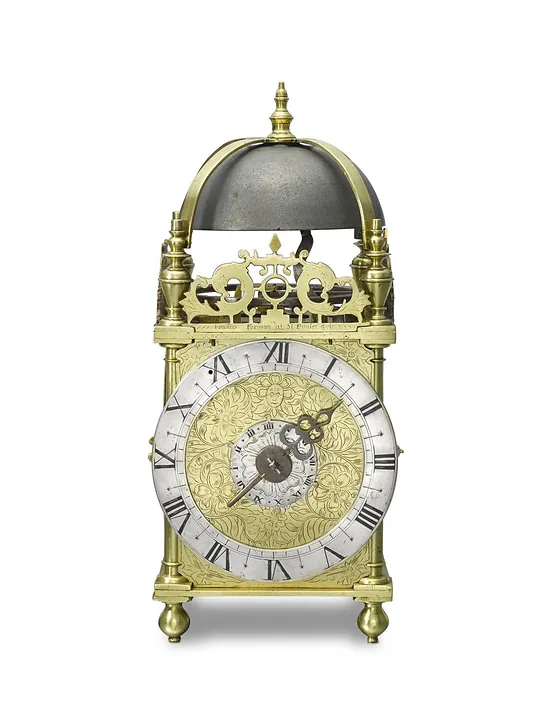
Lantern clock by Francis Forman, England, 1630
Science Museum Group, London
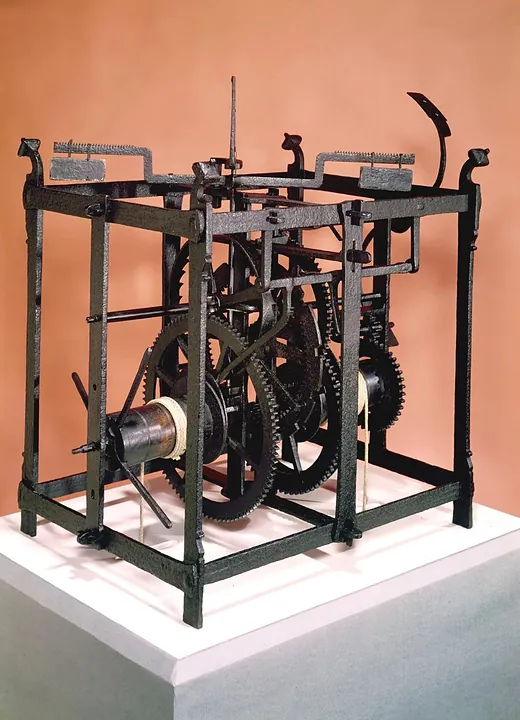
Clocks · 1632–1640
Turret clock, England, 1632–1640
Science Museum Group, London
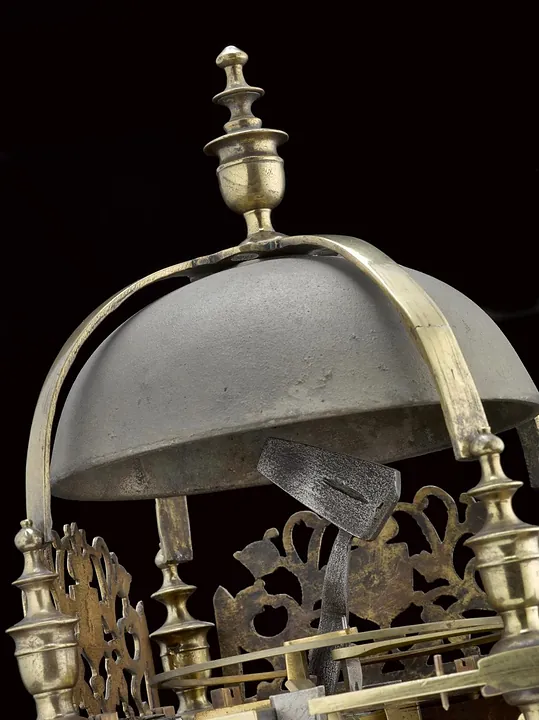
Clocks · 1645–1655
Balance-wheel brass lantern clock, with two driving weights and one counterweight, by Thomas Knifton, Cross Keys, Lothbury, London, England, 1645–1655.
Science Museum Group, London
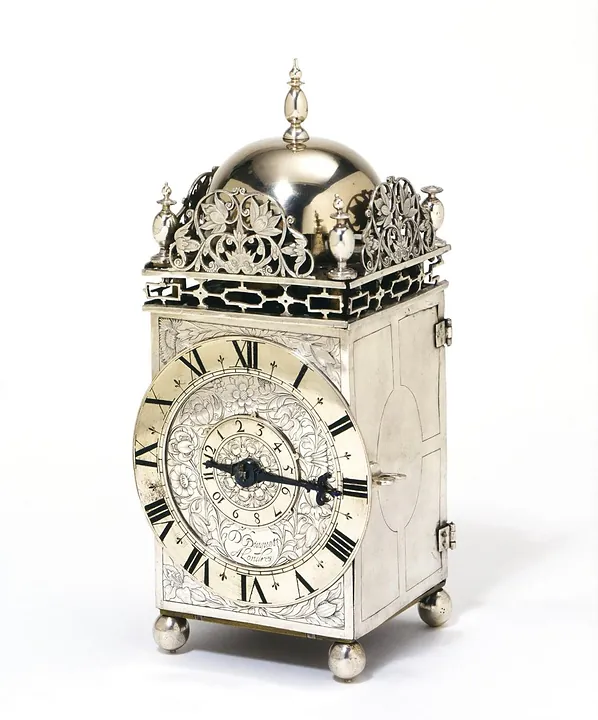
Clocks · c. 1650
Lantern alarm clock, silver, by David Bouquet, circa 1650
Victoria and Albert Museum, London
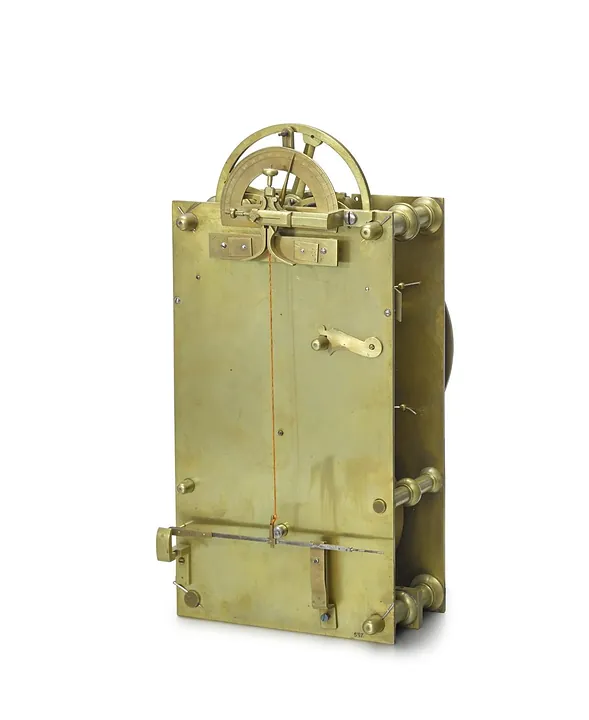
Clocks · 1650–1660
Lantern clock by Peter Closon, England, 1650–1660
Science Museum Group, London
Clocks · c. 1660
Longcase clock, c. 1660, English, made by Ahasuerus Fromanteel
Victoria and Albert Museum, London