
Wristwatches · Power reserve wristwatch
LeCoultre Power Reserve Wristwatch
- Maker / attribution
- LeCoultre (source attribution)
- Date
- c. 1950s
- Historical period
- Modern Mechanical Horology (1945 – 1969)
- Country of origin
- Switzerland
- Object type
- Power reserve wristwatch
- Materials / technique
- Stainless steel
- Dimensions
- 34 mm
- Holding institution
- Zamanito
- Accession / object no.
- lecoultre-power-reserve-wristwatch-643a36ba6d
- Credit line
- Zamanito
- Catalogue title (original)
- ساعت مچی LeCoultre Power Reserve استیل وینتیج، دهه ۱۹۵۰ (English)
View the source record ↗ (opens another website in a new tab)Suggest a correction
Record summary
Held and catalogued by Zamanito (object number lecoultre-power-reserve-wristwatch-643a36ba6d), this is a power reserve wristwatch attributed to LeCoultre, made in Switzerland, dated c. 1950s. The Atlas places it in the Modern Mechanical Horology period (1945 – 1969) of its Wristwatches collection. Materials and techniques recorded by the source: Stainless steel. Recorded dimensions: 34 mm. The record is illustrated with 1 photograph.
Assembled from the source record's structured fields. Dates and attributions are given as the source states them; where a field is missing the Atlas leaves it blank rather than estimating.
Catalogue description
Original object description
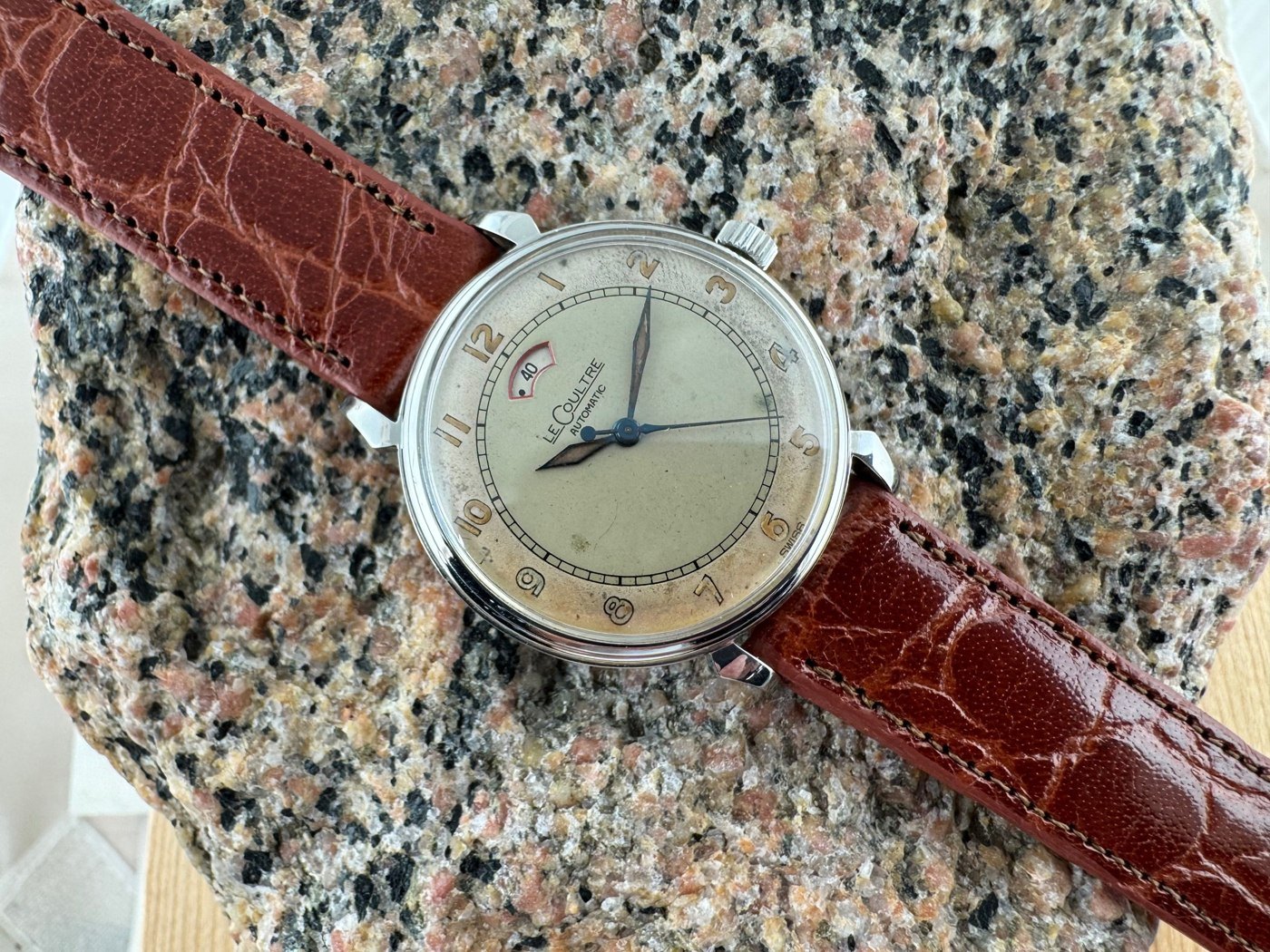
Produced around the 1950s, this stainless steel LeCoultre wristwatch spans 34 mm in diameter and 40 mm lug-to-lug. It is powered by a 17-jewel Swiss bumper automatic caliber 481 movement providing a 40-hour power reserve. At 12 o'clock, an aperture reveals the state of the mainspring, shifting to red when winding is depleted. Applied Arabic numerals accent the two-tone silvered dial, which shows organic age patina. The watch is presented on a modern crocodile-pattern calfskin strap; it reportedly keeps accurate time, though prior service history is unrecorded, original packaging and papers are missing, and light wear including scratches is visible on the case.
Original object description
The polished steel case measures 34 mm across and 40 mm from lug tip to lug tip, bearing faint scratches and gentle surface wear from prior use. Behind an acrylic crystal of vintage style, the dual-tone silver dial shows a warm tropical patina. The hands and display components are reported to be original, accompanied by applied Arabic numerals. At the 12 o'clock position, the power reserve indicator disc turns red to warn of unwound spring tension.
Original object description
A Swiss-made caliber 481 bumper automatic movement with 17 jewels operates the time and power-reserve displays. Delivering a 40-hour running duration, the movement ran accurately during cataloguing observations, though it is offered as found without maintenance documentation.
Original object description
The watch is fitted with an aftermarket brown leather strap embossed with a crocodile pattern and includes a non-original travel pouch; factory papers and boxes are not present. The catalog describes the watch as in excellent vintage condition, noting wear and dial age as normal traces of its service life, while stating that these condition evaluations are based on vendor representations without external confirmation.
Historical context
Modern Mechanical Horology (1945 – 1969)
Tool watches for divers, pilots and astronauts; electric watches anticipate the electronic age.
The classic era of the mechanical wristwatch: dive watches, chronographs for motor racing and space flight, GMT watches for jet travel, slim dress watches, automatic calendars, and the rise of Japanese manufacturers alongside Swiss, American, German and Soviet industries.
Read the period in the timelineMore wristwatches from this periodEarlier: Golden Age of Mechanical Watchmaking
Atlas type guide
Wristwatches
Bracelet watches were worn by women from the early nineteenth century — Breguet made one for Caroline Murat, Queen of Naples, in 1810–12 — but the wristwatch only became a man's instrument with military use and aviation in the early twentieth century. Between the World Wars it overtook the pocket watch; the 1920s and 1930s brought rectangular Art Deco cases, water-resistant cases and the first automatic winding systems.
After 1945 the wristwatch became a carrier of identity — dress watches, sports and dive watches, chronographs, calendars — produced by Swiss, American, Japanese, German, Soviet and Chinese industries. The quartz revolution after 1969 and the mechanical renaissance since the 1990s, including the rise of independent watchmakers, complete the story.
What to look for
- The reference number (between the lugs or inside the case back) and serial number, the starting point for dating.
- The calibre: its maker and number are often stamped under the dial or on the bridge.
- Originality of dial, hands and crown — refinished ('redial') dials are common.
- Case material marks: 18K/750, 14K/585, stainless steel, gold-filled, plated.
Dating clues
- Wire-lug cases: before c. 1925.
- Water-resistant screw-down cases: from 1926.
- Quartz movements: from 1969; sapphire crystals widespread after c. 1980.
General guidance written by the Atlas editors about this kind of object. It is not a statement about this particular piece; for that, rely on the source record above and on physical examination.
Related records
Wristwatches · c. 1960s
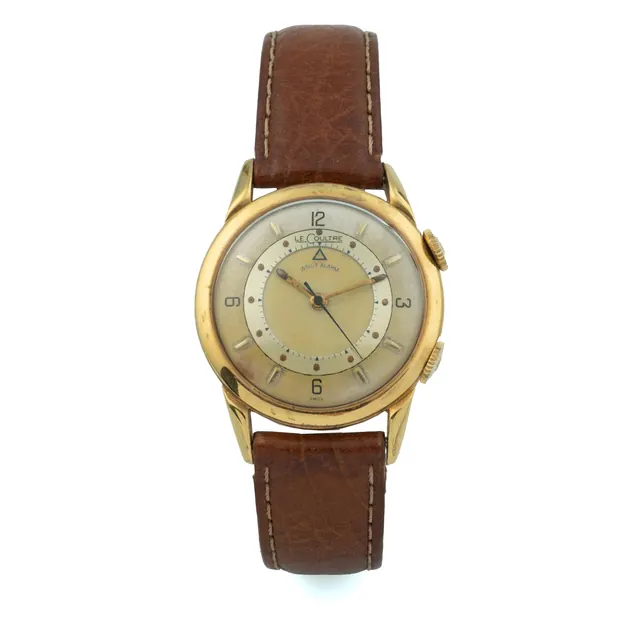
LeCoultre wristwatch, Memovox, circa 1960's
Antiquorum auction archive, Geneva
Wristwatches · c. 1960s
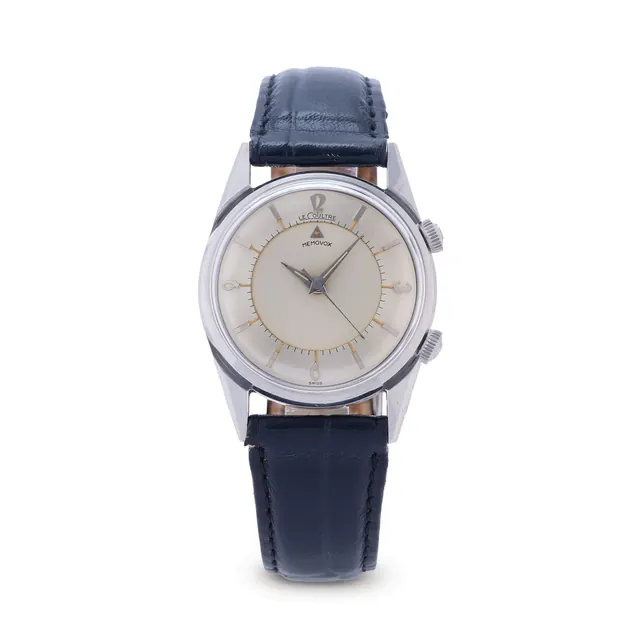
LeCoultre wristwatch, ref. 2404, Menovox Alarm, circa 1960’s
Antiquorum auction archive, Geneva
Clocks · c. 1960-1970s
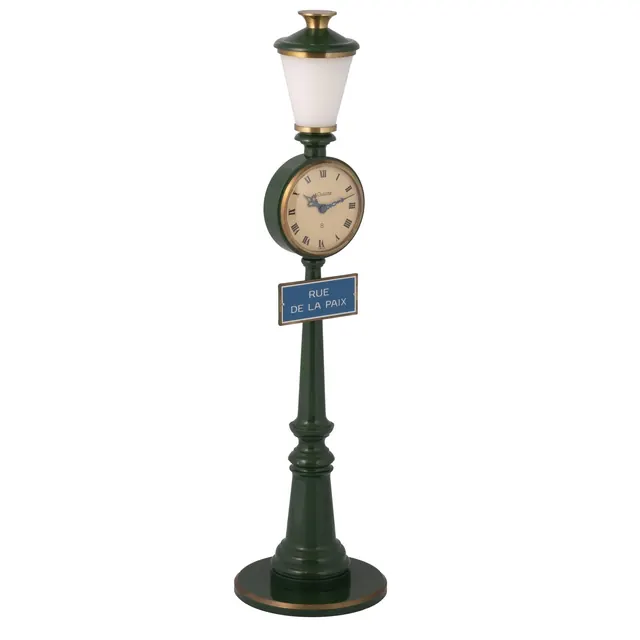
LeCoultre table clock, ref. 397, Rue de la Paix Gilt Brass, circa 1960-1970s
Antiquorum auction archive, Geneva
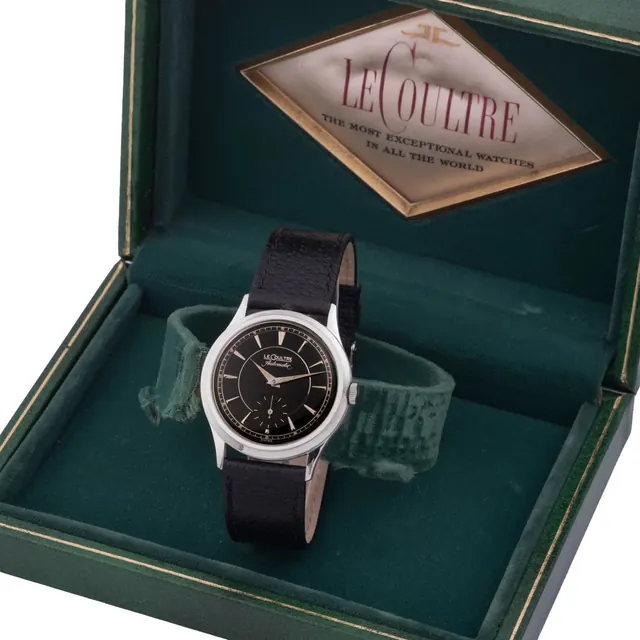
Wristwatches · c. 1956
LeCoultre wristwatch, circa 1956
Antiquorum auction archive, Geneva

Wristwatches · 1945
Wristwatch by Eterna, 1945
Museum Rotterdam

Wristwatches · c. 1945
Breitling Premier, ref. 790, c. 1945
Antiquorum auction archive, Geneva

Wristwatches · c. 1945
Universal Genève Uni-Compax, ref. 22492, c. 1945
Antiquorum auction archive, Geneva

Wristwatches · c. 1950s
Baume & Mercier wristwatch, c. 1950s
Antiquorum auction archive, Geneva