
Wristwatches · Wristwatch
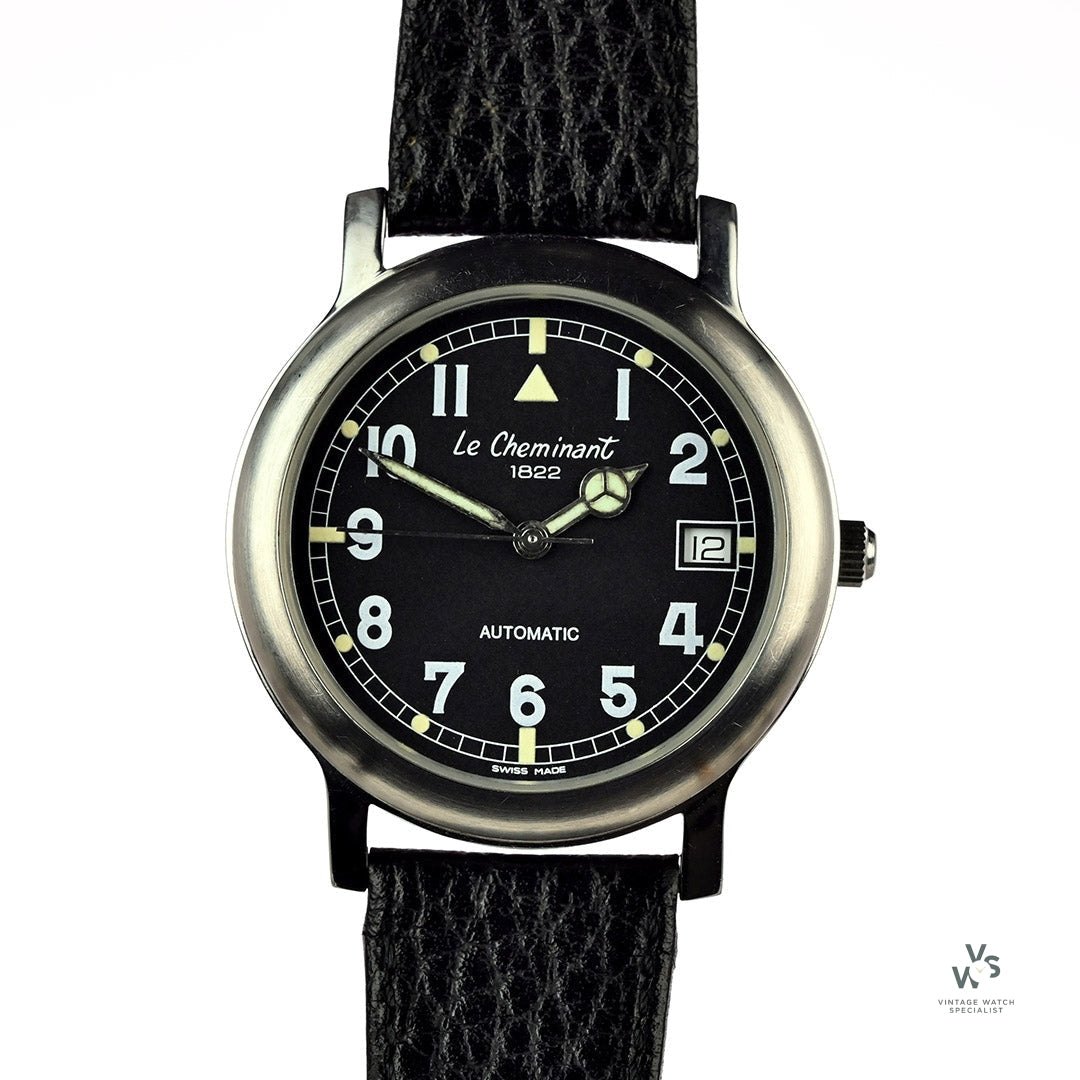
La Cheminant Field Watch- Automatic Calendar, circa 1982
- Maker / attribution
- Unrecorded in source
- Date
- c. 1982
- Historical period
- Quartz Revolution (1969 – 1990)
- Country of origin
- Unrecorded in source
- Object type
- Wristwatch
- Dimensions
- Case 36 mm
- Stock no.
- vws2913
- Credit line
- Dealer listing, Vintage Watch Specialist (vws2913)
- Catalogue title (original)
- La Cheminant Field Watch- Automatic Calendar - c.1982 (English)
View the source record (dealer listing) ↗ (opens another website in a new tab)Suggest a correction
Record summary
Catalogued by Vintage Watch Specialist (dealer), United Kingdom (stock number vws2913), this is a wristwatch, dated c. 1982. The Atlas places it in the Quartz Revolution period (1969 – 1990) of its Wristwatches collection. Recorded dimensions: Case 36 mm. The record is illustrated with 6 photographs.
Assembled from the source record's structured fields. Dates and attributions are given as the source states them; where a field is missing the Atlas leaves it blank rather than estimating.
Catalogue description
Dealer description — Vintage Watch Specialist
A Very Well Preserved Le Cheminant Automatic Field Watch with a Calendar Function, Superb Condition, c.1982 The known references for Le Cheminant begin in February, 1847, when Mr. Le Cheminant, a jeweller, has a shop at 72 Wimpole Street, London. Although John Le Cheminant, “watchmaker and jeweller” died on 1 February 1876, the name continued, with Le Cheminant appearing in trade directories as ‘watch maker‘ at the same address, 72a Wimpole Street, in 1884. By 1915 Le Cheminant has an address at 81 Wigmore Street, in the same London district, and was inscribing this address on its timepieces. At this time Le Cheminant was among several companies which supplied precision timepieces to the British Royal Navy. By 1923 Le Cheminant had become Le Cheminant and Co, at 97 Wigmore Street on the corner of Duke Street. Classified ads appeared frequently with this address in The Times until December 1933, offering the reassuring information in 1927 that they had been established 100 years and, in 1929, that Le Cheminant had been established in 1822, significant because this date became a strong feature of the brand in later years. What’s On Offer This La Cheminant Field Watch has been very well preserved, at approximately 40 years old, it has barely a sign of previous wear and it has clearly been meticulously looked after. Reminiscent of tool watches used during WW2, the black dial boasts bold Arabic numerals and an outer minute track with luminous pips on the hour. The more contemporary additions include a date aperture and 'Mercedes Hands' which are also luminous, and great for visibility in low light. This watch looks almost like new old stock, and at 36mm is a nice mid-size which is super comfortable on the wrist. The watch is paired with a simple black strap, however, you could definitely style it out with a bolder colour for a sharper look. A robust yet stylish piece that is perfectly adapted to both casual and more formal wear - we love it! Additional information Made from Case: Stainless Steel Dial: Black Crystal: Acrylic Bracelet: Technical specifications Winding: Automatic Movement Type: Mechanical Calibre: ETA 2824-2 Jewels: 25 Waterproof: Power reserve: 40hrs Purchase details Condition: Superb Model Reference: Unknown Date of issue: c.1982 Dimensions Width (without crown): 36mm Lug width: 18mm Lug height: (lug to lug) 41mm Wrist size: Adjustable
Historical context
Quartz Revolution (1969 – 1990)
Seiko's Astron begins mass quartz timekeeping; traditional industries contract sharply.
Quartz and digital watches transformed the market after 1969. Swiss employment collapsed, Japanese and Hong Kong production soared, and the Swatch (1983) helped the Swiss industry recover; mechanical watches survived as luxury goods.
Read the period in the timelineMore wristwatches from this periodEarlier: Modern Mechanical Horology
Atlas type guide
Calendar, moon-phase and perpetual calendar watches
Calendar complications range from a simple date to the perpetual calendar, which automatically allows for months of different lengths and leap years until 2100. Pocket watches with perpetual calendars were made in the eighteenth and nineteenth centuries; Patek Philippe made the first perpetual calendar wristwatch in 1925, and series production followed in 1941. The annual calendar (Patek Philippe, 1996) needs correction only once a year.
Moon-phase displays use a disc with two moons and 59 teeth advanced daily, approximating the 29.5-day lunation; more precise trains reduce the error to one day in over a century.
What to look for
- Apertures or subsidiary dials for day, date, month and leap year.
- Moon disc under a 'bosom' shaped aperture.
- Recessed correctors on the case band for setting the calendar.
Dating clues
- Triple-date wristwatches: popular c. 1940–1955.
- Perpetual calendar wristwatches: from 1925 (unique) and 1941 (series).
General guidance written by the Atlas editors about this kind of object. It is not a statement about this particular piece; for that, rely on the source record above and on physical examination.
Related records

Wristwatches · 1970
Wristwatch by Heno, Switzerland, 1970
Museum Rotterdam
Wristwatches · 1970s
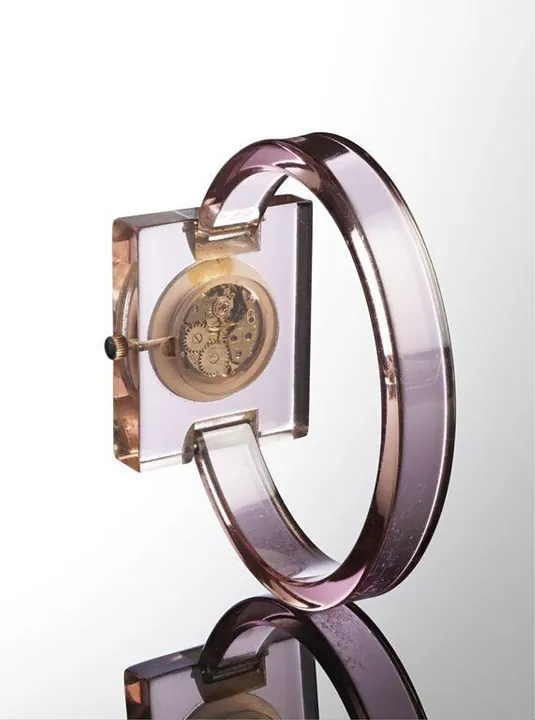
Wristwatch, plastic, by Gucci; Italy, 1970s.
Victoria and Albert Museum, London
Wristwatches · 1978
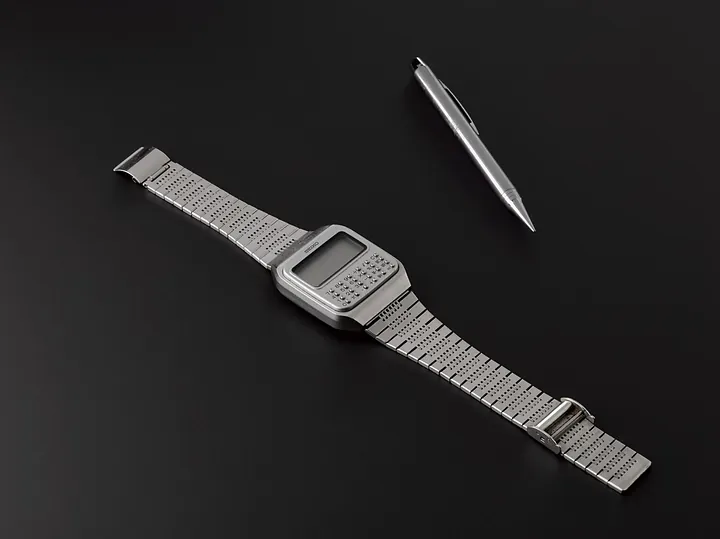
Calculator wristwatch by Suwa Seikosha Co. Limited, Japan, 1978
Science Museum Group, London

Wristwatches · 1980
Wristwatch, 1980 (no. 71413)
Museum Rotterdam
Wristwatches · 1980
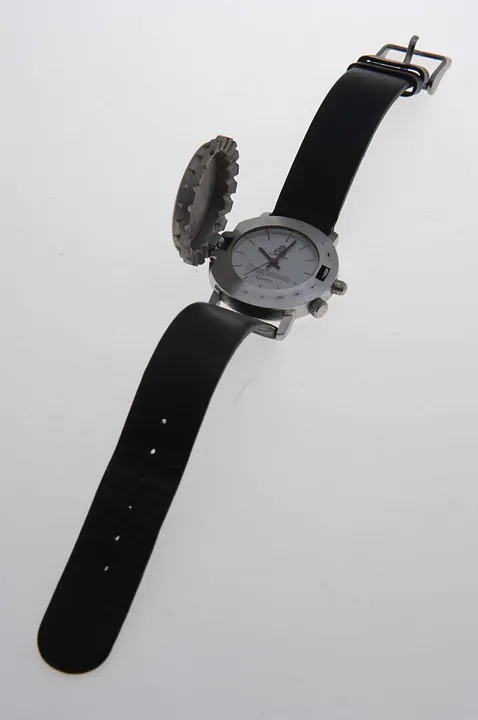
Wristwatch, 1980 (no. 91477)
Museum Rotterdam
Wristwatches · 1980–1982
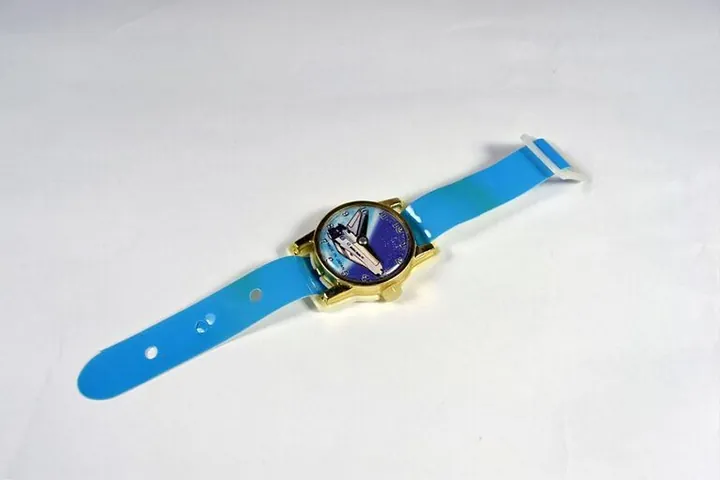
Wristwatch, Space Shuttle; plastic, Japan, 1970-1979?
Victoria and Albert Museum, London
Wristwatches · 1949–1992
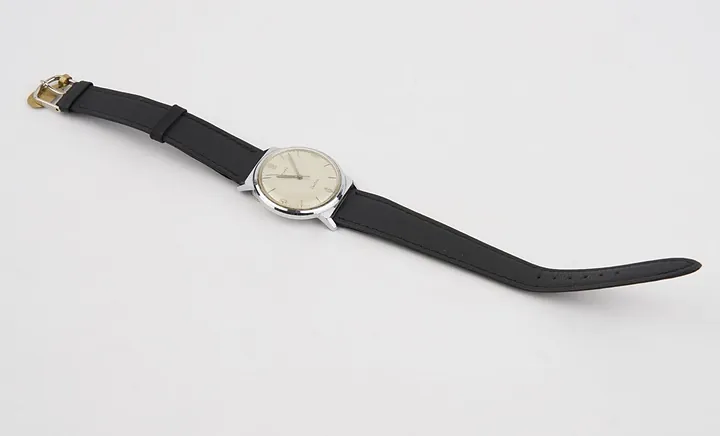
Timex `Electric' wristwatch, with electrically operated balance wheel mechanism, United States, 1949–1992
Science Museum Group, London

Wristwatches · 1960–1986
'Tri-Compax' calendar chronograph wristwatch in gold case, by Universal, Geneva, Switzerland, 1960–1986.
Science Museum Group, London