
Clocks · Vienna regulator wall clock
Josef Lorenz Vienna regulator wall clock
- Maker / attribution
- Josef Lorenz (source attribution)
- Date
- c. 1870 (movement); late 20th century (case)
- Historical period
- Quartz Revolution (1969 – 1990)
- Country of origin
- Austria
- Object type
- Vienna regulator wall clock
- Dimensions
- 77in x 22in x 10in
- Auction house
- Schmitt Horan & Co.
- Lot
- 194
- Credit line
- Schmitt Horan & Co.
- Catalogue title (original)
- Sold at Auction: Josef Lorenz, In Wien, large Vienna regulator movement and dial, in later c (English)
View the source record (auction lot) ↗ (opens another website in a new tab)Suggest a correction
Record summary
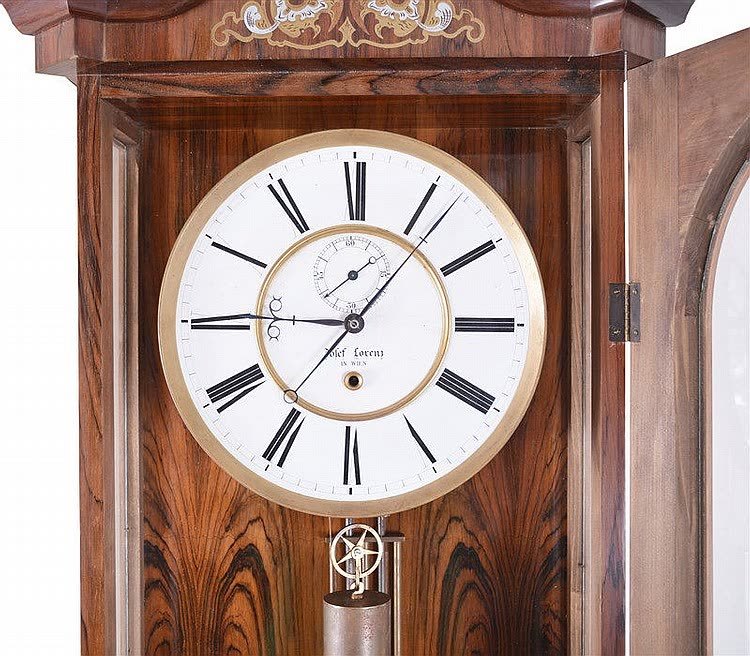
Catalogued by Schmitt Horan & Co. (lot 194), this is a vienna regulator wall clock attributed to Josef Lorenz, made in Austria, dated c. 1870 (movement); late 20th century (case). The Atlas places it in the Quartz Revolution period (1969 – 1990) of its Clocks collection. Recorded dimensions: 77in x 22in x 10in. The record is illustrated with 1 photograph.
Assembled from the source record's structured fields. Dates and attributions are given as the source states them; where a field is missing the Atlas leaves it blank rather than estimating.
Catalogue description
Original object description
Combining a weight-driven brass movement from circa 1870 with a custom late-20th-century case, this Vienna regulator wall clock stands 77 inches high, 22 inches wide, and 10 inches deep. The rosewood-veneered housing includes pewter and brass inlays spanning into the crest; the auctioneer rates the cabinetry as high quality while citing areas of lifting veneer and inlay work. Glazing to the front reveals a gridiron pendulum alongside a long, brass-finished cylindrical weight. The time-only movement runs for 30 days and is documented as needing a cleaning. Inscribed 'Josef Lorenz IN WIEN' below the center arbor, the white enamel dial exhibits Roman hour numerals, a winding arbor hole, and an upper subsidiary seconds chapter.
Historical context
Quartz Revolution (1969 – 1990)
Seiko's Astron begins mass quartz timekeeping; traditional industries contract sharply.
Quartz movements and digital displays made accurate clocks cheap and ubiquitous after the early 1970s. LED and LCD clocks, clock radios and radio-controlled clocks appeared, while traditional mechanical clockmaking contracted sharply in Germany, France and Britain.
Read the period in the timelineMore clocks from this periodEarlier: Modern Mechanical Horology
Atlas type guide
Regulators, wall and Vienna clocks
A regulator is a precision pendulum clock used as a time standard in observatories, workshops and railway offices. Typical features are a deadbeat or Graham escapement, a temperature-compensated pendulum (mercury jar, gridiron or later invar), maintaining power and a regulator dial that separates hours, minutes and seconds. George Graham's deadbeat escapement (c. 1715) and his mercury pendulum, together with Harrison's gridiron, set the pattern for two centuries.
Wall clocks span a much wider range: the elegant Viennese Laterndluhr and Dachluhr of the Biedermeier period, the Dutch stoelklok and staartklok, English 'dial' clocks used in schools, offices and railway stations, and mass-produced spring and weight wall clocks from Germany (Gustav Becker, Junghans, Kienzle) and America.
What to look for
- Deadbeat escapement and compensated pendulum (gridiron rods, mercury jar or wood rod).
- A regulator dial with a large central minute hand and separate hour and seconds dials.
- Vienna regulators: glazed cases, slender pendulum, small weights, enamel two-piece dials.
- German factory trademarks stamped on the backplate (e.g. Gustav Becker anchor and crown, Junghans star).
Dating clues
- Graham-type deadbeat regulators: from c. 1720.
- Viennese Laterndluhr: c. 1800–1850.
- German factory 'Vienna-style' regulators: c. 1870–1930; Gustav Becker serial numbers allow close dating.
General guidance written by the Atlas editors about this kind of object. It is not a statement about this particular piece; for that, rely on the source record above and on physical examination.
Read next:Deadbeat escapementAnchor (recoil) escapementGrasshopper escapement
Related records
Clocks · late 20th century
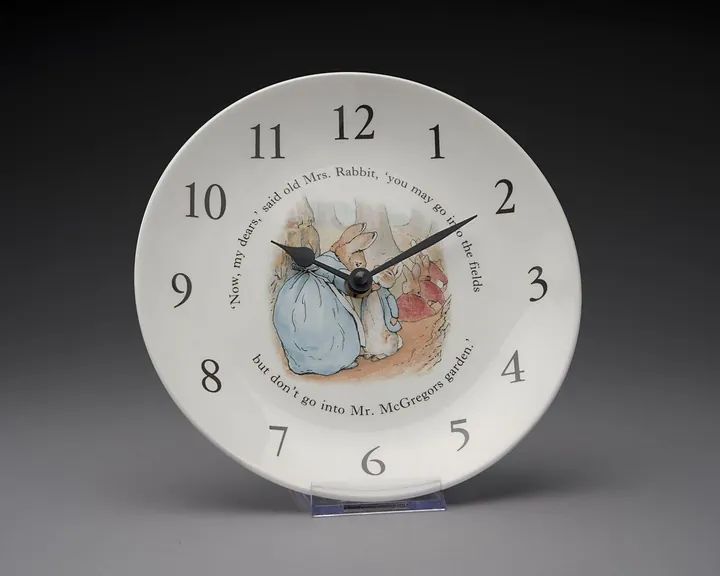
Clock, 'Peter Rabbit', Queen's ware, transfer printing, Josiah Wedgwood and Sons, Barlaston, late 20th century (V&A WE.17466-2014)
Victoria and Albert Museum, London
Clocks · late 20th century
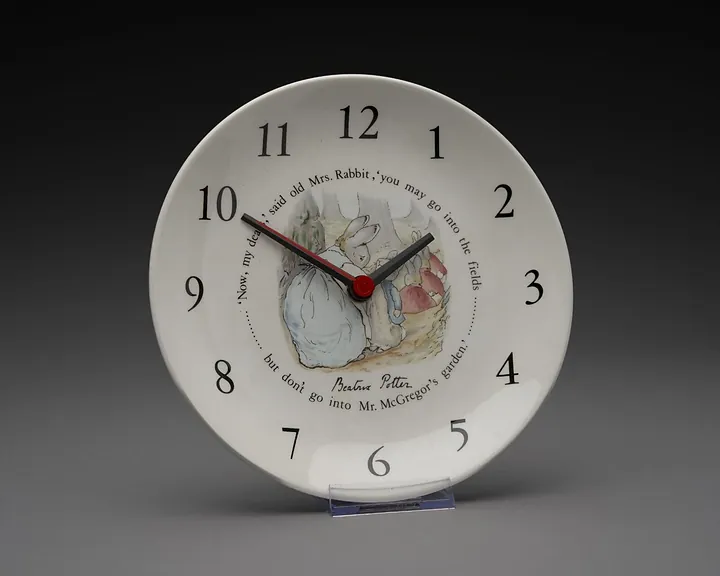
Clock, 'Peter Rabbit', Queen's ware, transfer printing, Josiah Wedgwood and Sons, Barlaston, late 20th century (V&A WE.18029-2014)
Victoria and Albert Museum, London
Clocks · late 20th century
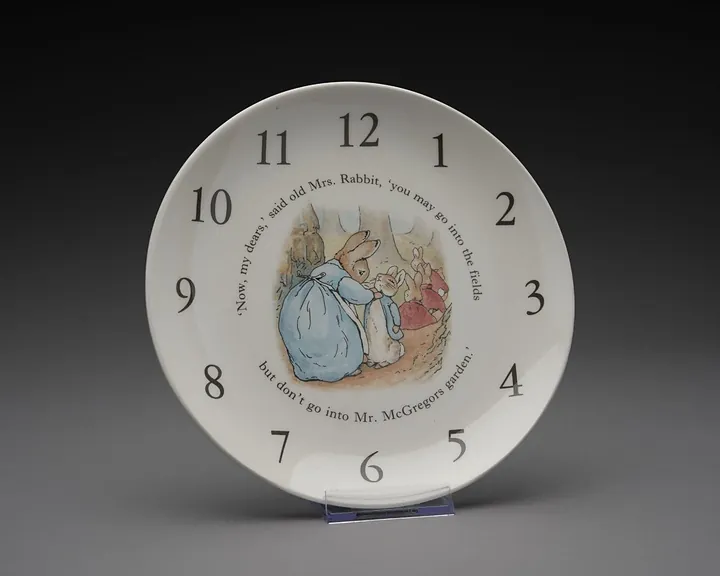
Clock, 'Peter Rabbit', glazed earthenware, transfer printing, Josiah Wedgwood and Sons, Barlaston, late 20th century
Victoria and Albert Museum, London
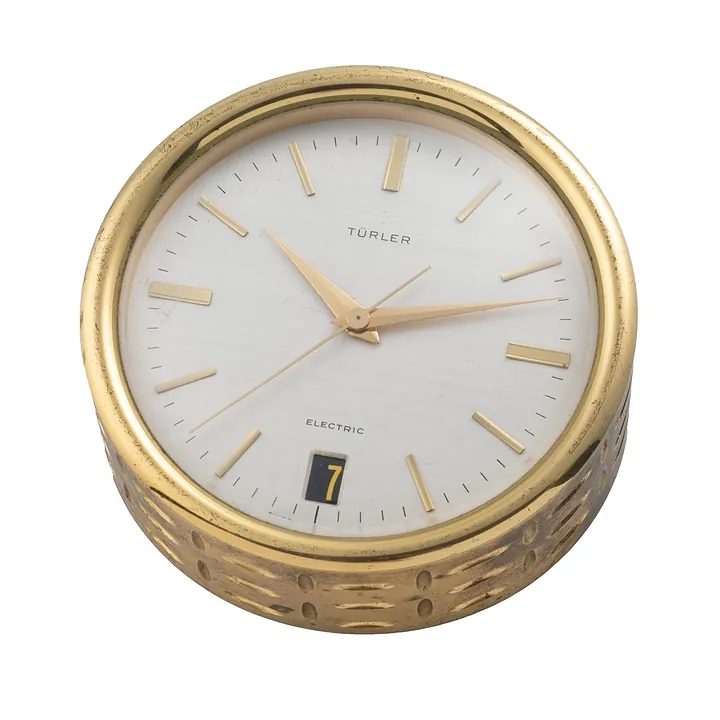
Clocks · c. 1960-1970s
Anonymous clock, c. 1960-1970s
Antiquorum auction archive, Geneva
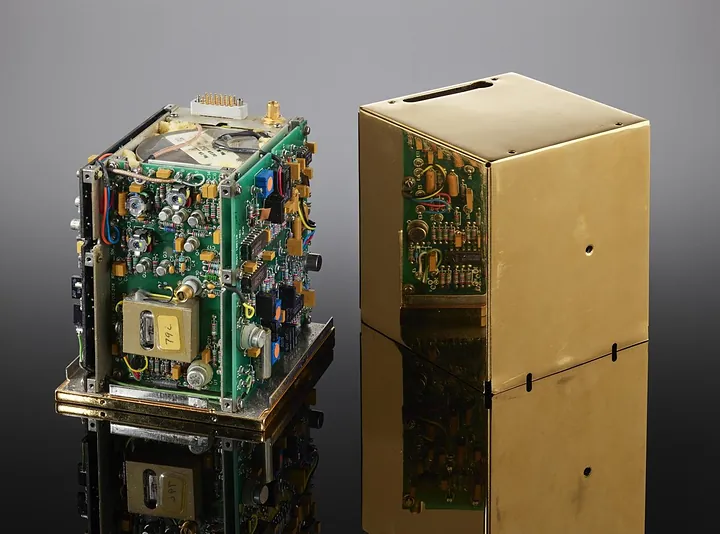
Clocks · 1960–1996
Electric clock by Efratom GmbH, Germany, 1960–1996
Science Museum Group, London
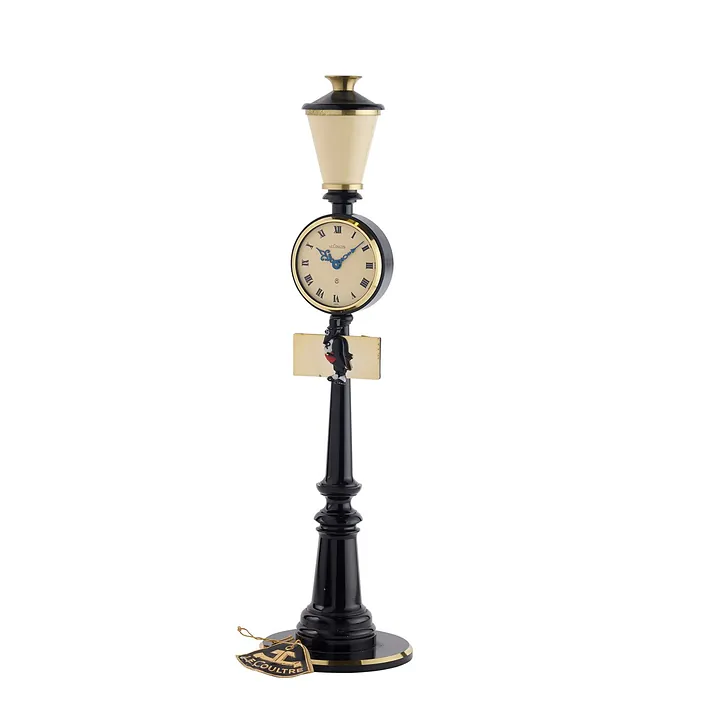
Clocks · c. 1960-1970s
Lecoultre Street Light Lamp, ref. 397, c. 1960-1970s
Antiquorum auction archive, Geneva
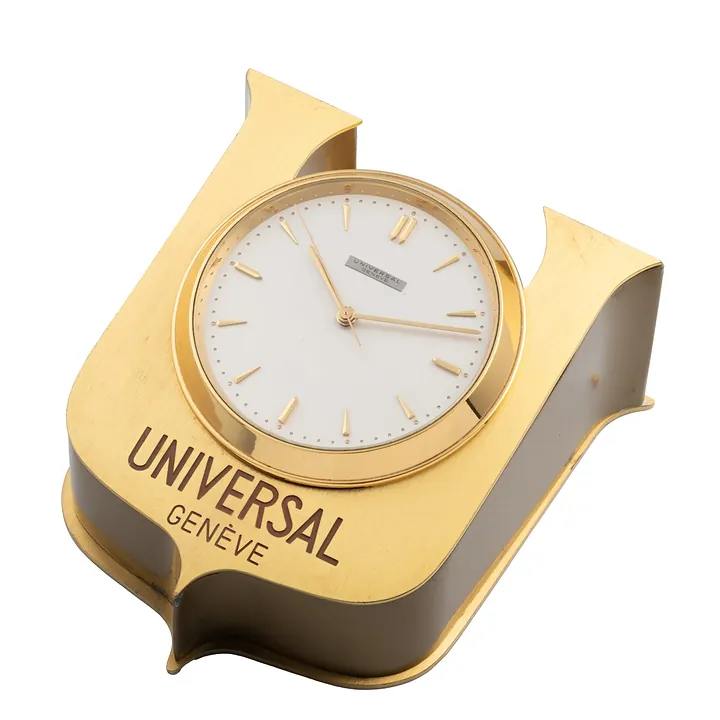
Clocks · c. 1960-1970s
Universal Genève clock, ref. 999.116.01, c. 1960-1970s
Antiquorum auction archive, Geneva
Clocks · 1964–1988
The clock from BBC children's television series 'Playschool', c 1977
Science Museum Group, London