
Wristwatches · Wristwatch
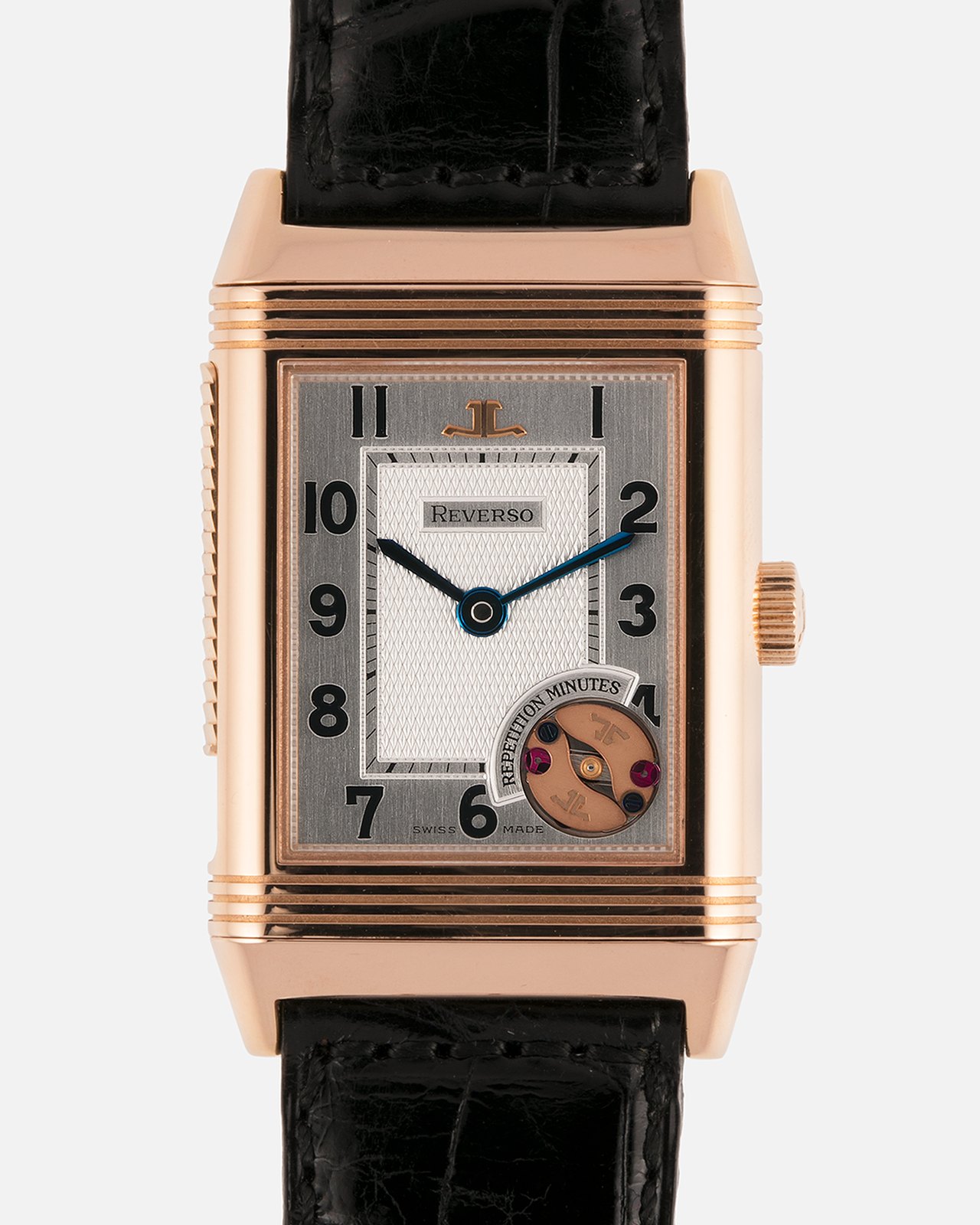
Jaeger-LeCoultre Reverso Minute Repeater 270.2.73, 1994
- Maker / attribution
- Jaeger-LeCoultre (maker)
- Date
- 1994
- Historical period
- Mechanical Renaissance (1990 – 2010)
- Country of origin
- Switzerland
- Object type
- Wristwatch
- Dimensions
- Case 42 mm
- Stock no.
- Product 7773283483735
- Credit line
- Dealer listing, S.Song Watches (product 7773283483735)
- Catalogue title (original)
- Jaeger-LeCoultre Reverso Minute Repeater 270.2.73 (English)
View the source record (dealer listing) ↗ (opens another website in a new tab)Suggest a correction
Record summary
Catalogued by S.Song Watches (dealer), Seattle (stock number Product 7773283483735), this is a wristwatch by Jaeger-LeCoultre, made in Switzerland, dated 1994. The Atlas places it in the Mechanical Renaissance period (1990 – 2010) of its Wristwatches collection. Recorded dimensions: Case 42 mm. The record is illustrated with 6 photographs.
Assembled from the source record's structured fields. Dates and attributions are given as the source states them; where a field is missing the Atlas leaves it blank rather than estimating.
Catalogue description
Dealer description — S.Song Watches
The 1990s represented one of the most important periods in the modern history of Jaeger-LeCoultre. Emerging from the quartz crisis, the manufacture began to reassert the technical capabilities that had established its reputation as one of Switzerland's great movement makers. Central to this revival was the Reverso, which Jaeger-LeCoultre transformed from a relatively simple Art Deco wristwatch into a platform for some of its most ambitious complications. Beginning with the Reverso Soixantième in 1991, Jaeger-LeCoultre created a series of six complicated Reversos under the direction of Günter Blümlein, Henry-John Belmont and designer Janek Deleskiewicz. Produced between 1991 and 2000, the series would eventually encompass the Soixantième, Tourbillon, Minute Repeater, Retrograde Chronograph, Géographique and Perpetual Calendar. Each was produced exclusively in rose gold and limited to just 500 pieces, collectively demonstrating what the manufacture was capable of at a particularly important moment in its history. Introduced in 1994, the Ref. 270.2.73 was the third complicated watch within this series and arguably one of its most technically ambitious. It was Jaeger-LeCoultre's first minute-repeating wristwatch, requiring the manufacture to fit one of watchmaking's most demanding complications within the narrow rectangular confines of the Grande Taille Reverso case. The result was the manually wound Calibre 943, developed by Eric Coudray specifically for the watch. Comprising 306 components, it became the first rectangular minute repeater movement ever produced, rather than adapting an existing round calibre to fit the case. Two gongs sound the hours, quarters and minutes when the slide integrated into the left side of the case is activated, while a centrifugal governor controls the speed of the striking mechanism. Rather unusually, Jaeger-LeCoultre chose to make part of this mechanism visible from the dial. A circular aperture between 4 and 5 o'clock exposes the governor, which begins to rotate as soon as the repeater is activated. The rest of the dial remains distinctly classical, with a silvered guilloché centre, vertically brushed outer section, oversized black Arabic numerals and blued steel hands. The small opening provides just enough mechanical theatre without overwhelming what is otherwise a remarkably restrained design. The proportions make the achievement even more impressive. Its rose gold Grande Taille case measures approximately 42mm by 26mm including the lugs, dimensions shared with the other complicated Reversos from the series. Creating a minute repeater within such a confined rectangular space was considerably more difficult than simply placing the complication inside a larger round case, particularly while retaining the Reverso's swivelling construction. The present example is particularly appealing for retaining its complete original set. These complicated Reversos were delivered in elaborate wooden presentation boxes, accompanied by their corresponding certificate, booklets and accessories. The box itself feels very much part of the presentation of the series, with dedicated compartments and a level of detail appropriate to what were then some of Jaeger-LeCoultre's most important watches. For me, the Reverso Minute Repeater 270.2.73 represents exactly what made this period of Jaeger-LeCoultre so important. Rather than simply reviving an established design after the quartz crisis, the manufacture used the Reverso to demonstrate its technical ability, developing an entirely new rectangular minute repeater calibre specifically around the architecture of the watch. Limited to 500 pieces and preserved here as a full set, it is both an important part of the six-watch complicated Reverso series and one of the clearest examples of Jaeger-LeCoultre's mechanical resurgence during the 1990s.
Historical context
Mechanical Renaissance (1990 – 2010)
Mechanical watches return as cultural objects; independent watchmaking flourishes.
Mechanical watches returned as cultural and luxury objects. Complications, tourbillons and new materials proliferated; independent watchmakers such as George Daniels, F.P. Journe and Philippe Dufour revived artisanal watchmaking; collecting vintage watches became a major field.
Read the period in the timelineMore wristwatches from this periodEarlier: Quartz Revolution
Atlas type guide
Repeating watches
Before electric light, telling the time in the dark was a real problem. Repeating watches strike the time on demand when a slide or push-piece is operated: quarter repeaters sound hours and quarters, minute repeaters hours, quarters and minutes. Edward Barlow and Daniel Quare disputed the invention in London in the 1680s. Early repeaters struck on a bell inside the case; Abraham-Louis Breguet introduced the gong (a coiled steel wire) around 1780, allowing thinner watches.
Repeaters require a separate train with racks, snails and a governor to control the striking speed, and are among the most demanding complications to make and adjust. Swiss makers of the Vallée de Joux specialised in repeating ébauches in the nineteenth century.
What to look for
- A slide on the case band or a push-piece through the pendant.
- Gongs encircling the movement (after c. 1780) or a bell in the case (earlier); pierced case for sound.
- The racks, snails and governor visible under the dial or on the movement.
- Terms such as 'Minutes', 'Quarts' or 'Répétition' on the dial or cuvette.
Dating clues
- Bell-striking quarter repeaters: c. 1690–1800.
- Gong repeaters and dumb repeaters (striking on the case): after c. 1780.
- Minute repeaters became more common after c. 1830 with Vallée de Joux ébauches.
General guidance written by the Atlas editors about this kind of object. It is not a statement about this particular piece; for that, rely on the source record above and on physical examination.
Read next:Minute repeater
Related records
Clocks · 1937–1938
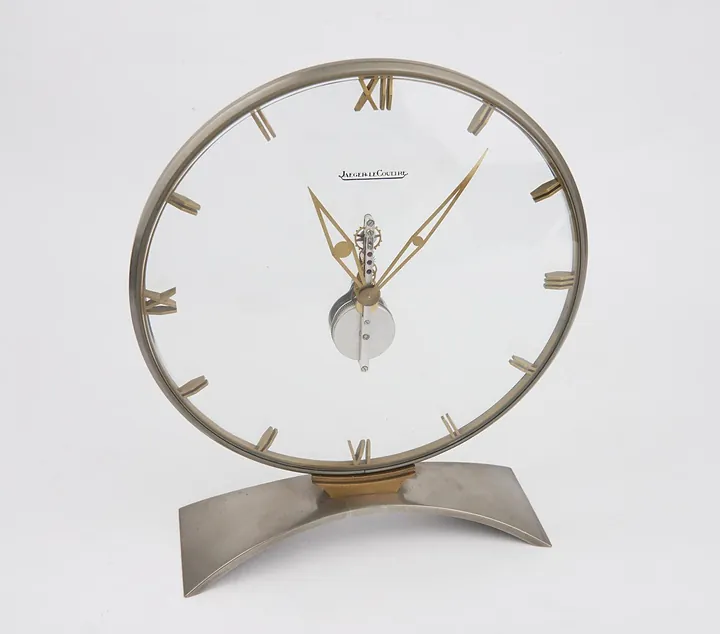
Skeleton clock by Jaeger-LeCoultre, Switzerland, 1937–1938
Science Museum Group, London
Movements & Components · 1953
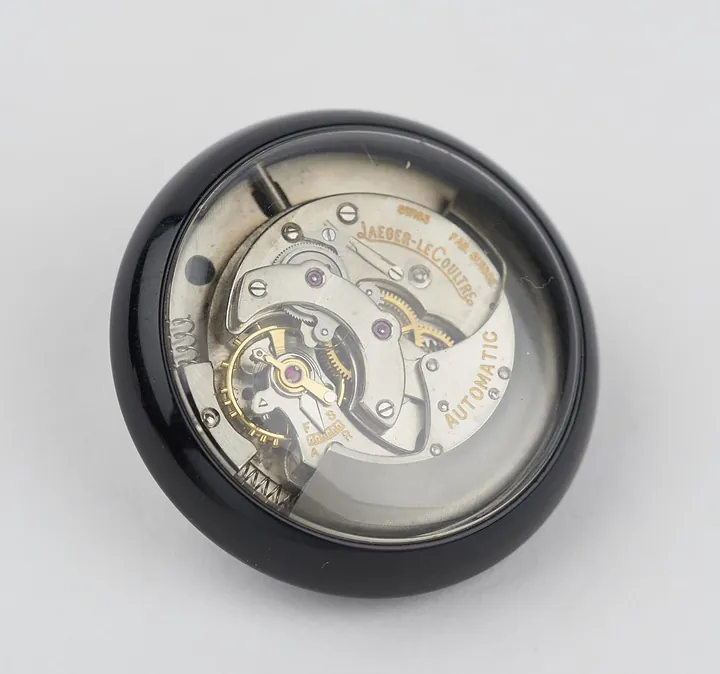
Automatic watch movement, Jaeger-LeCoultre, 1953, Geneva, Switzerland, showing self-winding mechanism
Science Museum Group, London
Wristwatches · 1953
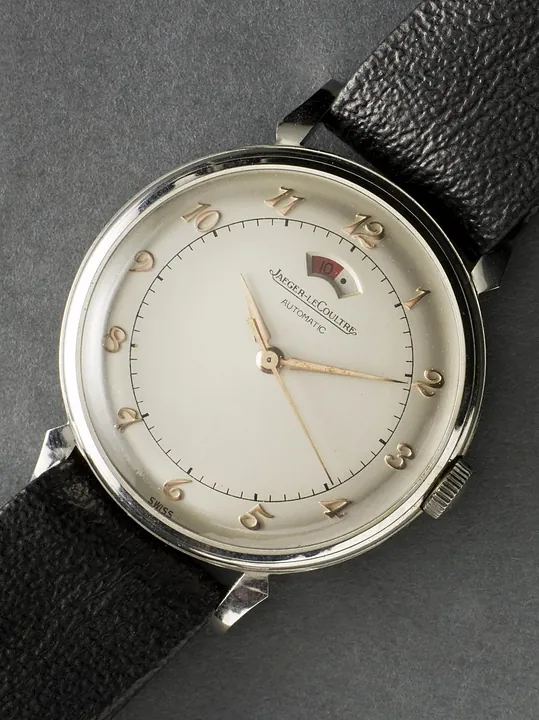
Automatic Wrist-watch, Jaeger-LeCoultre, Geneva, Switzerland, with reserve power indicator complete in steel case, 1953. Back numbered 564556.
Science Museum Group, London
Wristwatches · 1953
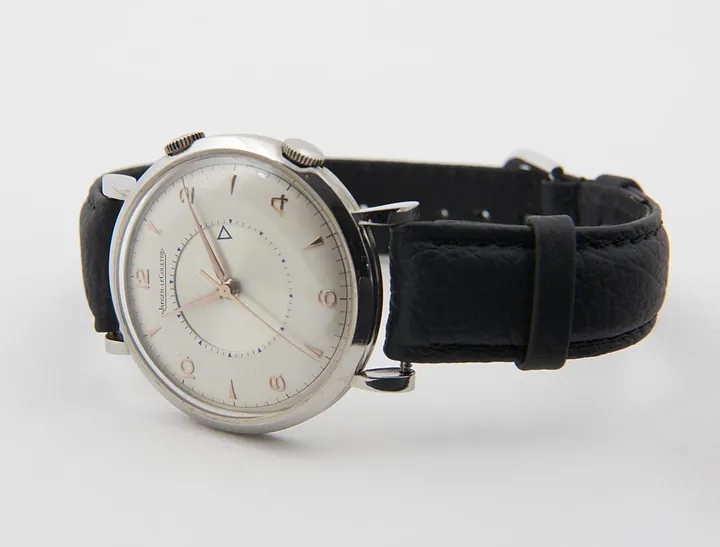
Wrist-watch, 'Memovox' alarm, Jaeger-LeCoultre, Geneva, Switzerland, complete in steel case, 1953.
Science Museum Group, London

Wristwatches · 2008
Wristwatch by Breitling?, 2008
Museum Rotterdam

Wristwatches · c. 1990s
Audemars Piguet Bamboo, c. 1990s
Antiquorum auction archive, Geneva

Wristwatches · c. 1990
Audemars Piguet Huitieme Perpetual Calendar, ref. 25696PT, c. 1990
Antiquorum auction archive, Geneva

Wristwatches · c. 1990
Breitling Chronomat, ref. b13050.1, c. 1990
Antiquorum auction archive, Geneva