
Wristwatches · Wristwatch
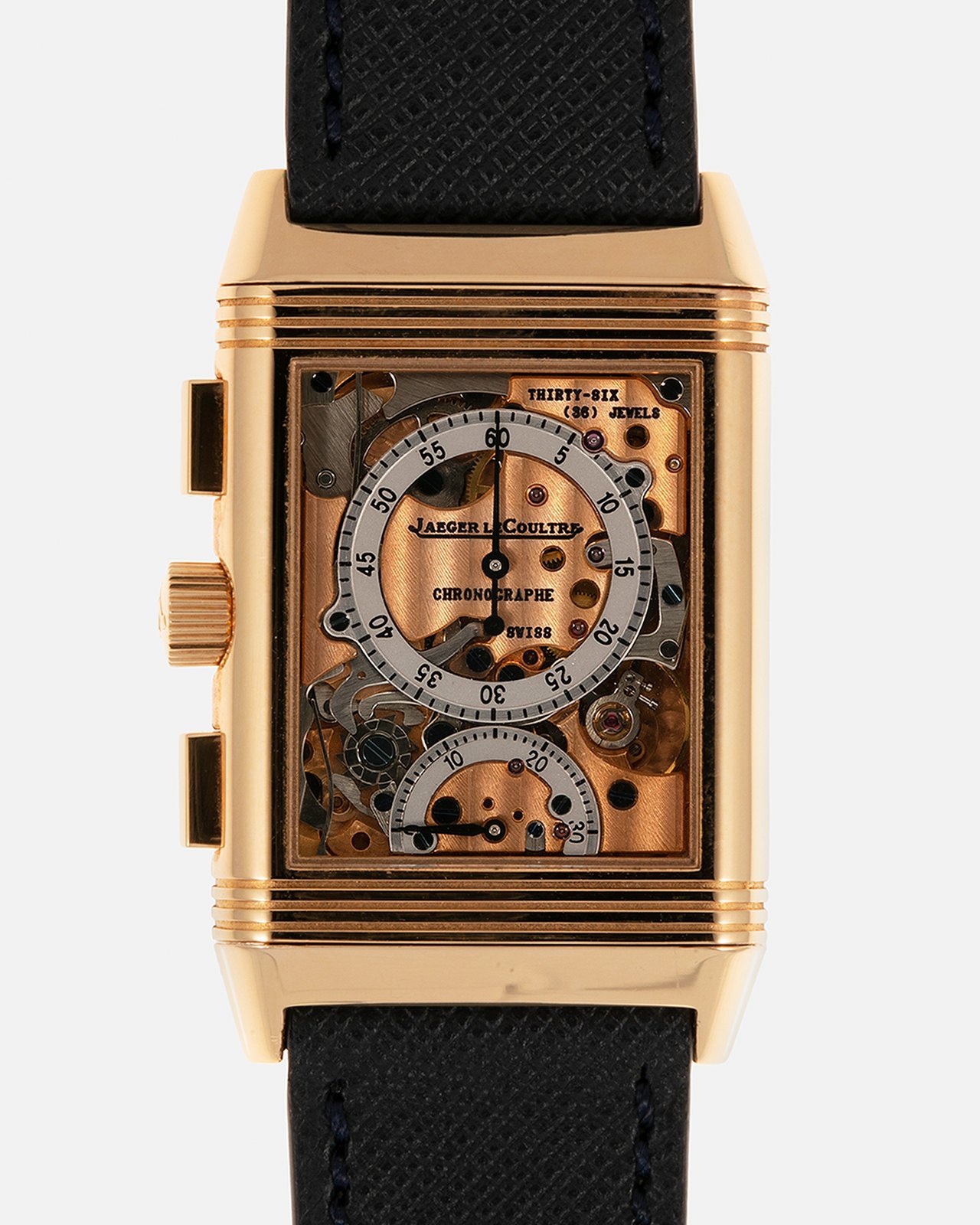
Jaeger-LeCoultre Reverso Chronograph Retrograde Ref. 270.2.69, 1996
- Maker / attribution
- Jaeger-LeCoultre (maker)
- Date
- 1996
- Historical period
- Mechanical Renaissance (1990 – 2010)
- Country of origin
- Switzerland
- Object type
- Wristwatch
- Dimensions
- Case 42 mm
- Stock no.
- Product 7184828989527
- Credit line
- Dealer listing, S.Song Watches (product 7184828989527)
- Catalogue title (original)
- Jaeger-LeCoultre Reverso Chronograph Retrograde Ref. 270.2.69 (English)
View the source record (dealer listing) ↗ (opens another website in a new tab)Suggest a correction
Record summary
Catalogued by S.Song Watches (dealer), Seattle (stock number Product 7184828989527), this is a wristwatch by Jaeger-LeCoultre, made in Switzerland, dated 1996. The Atlas places it in the Mechanical Renaissance period (1990 – 2010) of its Wristwatches collection. Recorded dimensions: Case 42 mm. The record is illustrated with 6 photographs.
Assembled from the source record's structured fields. Dates and attributions are given as the source states them; where a field is missing the Atlas leaves it blank rather than estimating.
Catalogue description
Dealer description — S.Song Watches
Created by Jacques-David LeCoultre in 1931, the Reverso was initially conceived to withstand the harsh beating a watch would endure during a game of polo. With the need for the watch to be more durable, the Reverso's genius reveals itself through its eponymous design – a reversible case. With its case able to be turned around on itself, the Reverso's dial can be protected while playing sports and returned to its natural position with a quick flick and slide. Thanks to its iconic heritage, the Reverso has evolved into one of Jaeger LeCoultre's most important design vehicles to date, with a healthy number of contemporary variations to suit the palate of modern enthusiasts and connoisseurs alike. Presented today is a rare variant of the Reverso – the Reverso Chronographe Retrograde Ref. 270.2.69 in 18-carat rose gold. Released in 1996 with a worldwide production limited to 500 units, this Reverso has an aesthetic that is quite unlike any Reversos I’ve seen and handled before. Before we dive into what makes the Ref. 270.2.69 so special, I believe it is important for us to preface this: At the time when the Ref. 270.2.69 was released, Jaeger LeCoultre had just gone through a turbulent period known as the quartz crisis. The visionary Günter Blümlein, who oversaw Jaeger LeCoultre's operations at the time, recognized the Maison's exceptional technical potential stemming from its rich history as an in-house movement maker. This realization later became pivotal in the brand's resurgence during the post-quartz crisis era. The Ref. 270.2.69 was subsequently unveiled as part of a series of six limited edition Reverso models launched between 1991 and 2000 to commemorate the 60th anniversary of the iconic Reverso. These milestones contributed significantly to solidifying Jaeger LeCoultre's esteemed position within the industry as we know it today. Starting with the Ref. 270.2.69’s 18-carat rose gold ‘Grande Taille’ style case, it measures a compact 42mm x 26mm in size and has a slim case profile of only 10mm. Like many Reverso models, the case is polished entirely and reveals a beautiful perlage and its hallmarks on the inner chassis. As for the primary silver dial, it is crafted from galvanized silver and showcases a set of blued steel hands, as well as a guilloche pattern in the centre portion. A tastefully positioned quick-set date window aperture can be found at 6 o'clock and a trapezoidal-shaped chronograph stop/run indicator at 5 o ‘clock. Engaging the chronograph pusher would cause the indicator to show ' Marche ,' meaning 'run.' When the chronograph is stopped, the trapezoidal indicator would then switch to ' Arret ,' which signifies 'stop.' I find this quite a unique feature as it indicates to the user when it is safe to engage the chronograph reset pusher. Upon flipping the dial to its opposite side, you will quickly realize that the secondary dial of the Ref. 270.2.69 is what makes this particular Reverso reference so special. Here, you'll be treated to a visually stunning view of the skeletonized 37-jewelled, manual-winding JLC Cal. 829, which was one of the first column wheel chronographs created after the quartz crisis. Mind you, this was before brands such as Patek Philippe and Vacheron Constantin had their own. The Cal. 829 features two seamlessly recessed chronograph registers, brushed steel elements, delicate blued screws, meticulously executed anglage and Côtes de Genève on the rose gold gilded bridges, as well as a power reserve of 40 hours. What is cool about this movement is that it was purpose-made to fit this exact Reverso, so what you get is a proportionately perfect rectangular in-house calibre. I highly doubt brands today are willing to fork out the cost and resources to do such a thing. While the time-telling side of this Reverso is the side that should obviously face you while on the wrist, I found myself having the chronograph side open most of the time just so I could admire the movement. It is by far the most captivating aspect of this watch. I have to say, the Ref. 270.2 69 is simply magnificent. It is a rare and exceptional reference to the iconic Reverso with a visual appeal that sets it apart from the rest. For the true connoisseur, this Ref. 270.2.69 is undoubtedly one of the most coveted and sought-after variants of the Reverso and with Jaeger-LeCoultre releasing a tribute model in 2023 after keeping this style dormant for so long, it will undoubtedly make the original even more desirable.
Historical context
Mechanical Renaissance (1990 – 2010)
Mechanical watches return as cultural objects; independent watchmaking flourishes.
Mechanical watches returned as cultural and luxury objects. Complications, tourbillons and new materials proliferated; independent watchmakers such as George Daniels, F.P. Journe and Philippe Dufour revived artisanal watchmaking; collecting vintage watches became a major field.
Read the period in the timelineMore wristwatches from this periodEarlier: Quartz Revolution
Atlas type guide
Chronographs and split-seconds watches
A chronograph is a watch with an additional seconds hand that can be started, stopped and returned to zero independently of the timekeeping. Louis Moinet built an early example in 1816 and Nicolas Rieussec a recording 'chronographe' in 1821; Adolphe Nicole's heart-shaped reset cam (patented 1862) made the modern return-to-zero possible. Split-seconds (rattrapante) chronographs add a second hand that can be stopped for intermediate times; flyback chronographs restart instantly.
Chronographs were essential tools for doctors (pulsometer scales), artillery (telemeter), engineers and sport. In wristwatches, Valjoux, Venus, Lemania and later the automatic chronographs of 1969 (Zenith El Primero, the Chronomatic Calibre 11 group and Seiko 6139) are milestones.
What to look for
- Push-pieces on the case band or a single button in the crown (monopusher).
- Subsidiary registers for minutes and hours; tachymeter, telemeter or pulsometer scales.
- Column wheel versus cam control visible in the movement.
- Calibre markings of specialist makers (Valjoux, Lemania, Venus, Landeron).
Dating clues
- Pocket chronographs with heart cam reset: after 1862.
- Wrist chronographs: from c. 1910; two-button designs from the 1930s.
- Automatic chronographs: from 1969.
General guidance written by the Atlas editors about this kind of object. It is not a statement about this particular piece; for that, rely on the source record above and on physical examination.
Read next:Flyback chronographChronograph
Related records
Clocks · 1937–1938
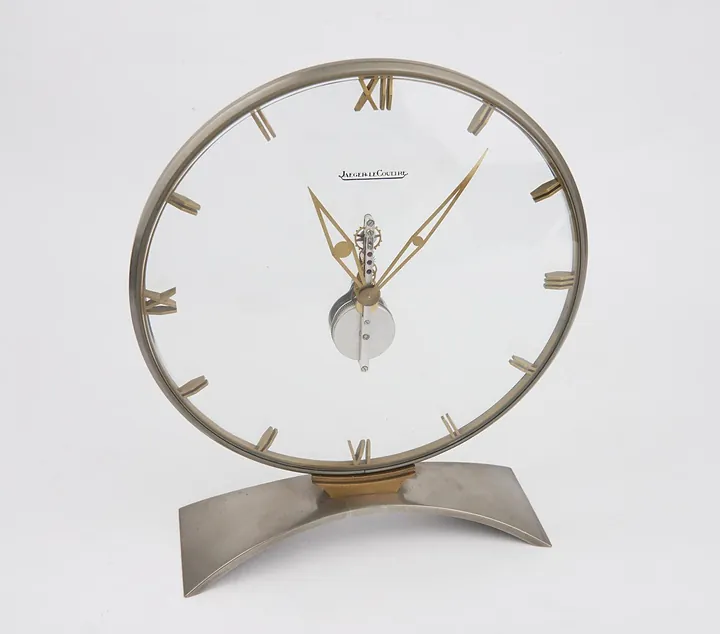
Skeleton clock by Jaeger-LeCoultre, Switzerland, 1937–1938
Science Museum Group, London
Movements & Components · 1953
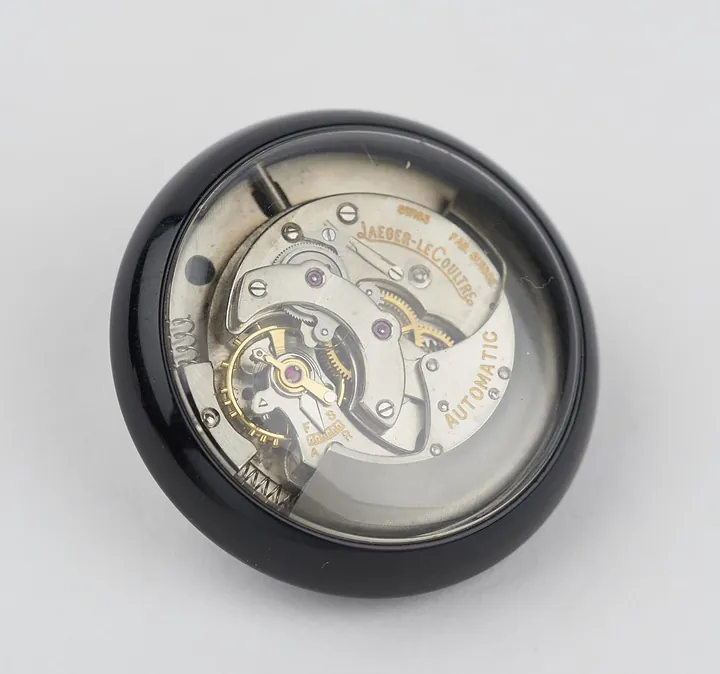
Automatic watch movement, Jaeger-LeCoultre, 1953, Geneva, Switzerland, showing self-winding mechanism
Science Museum Group, London
Wristwatches · 1953
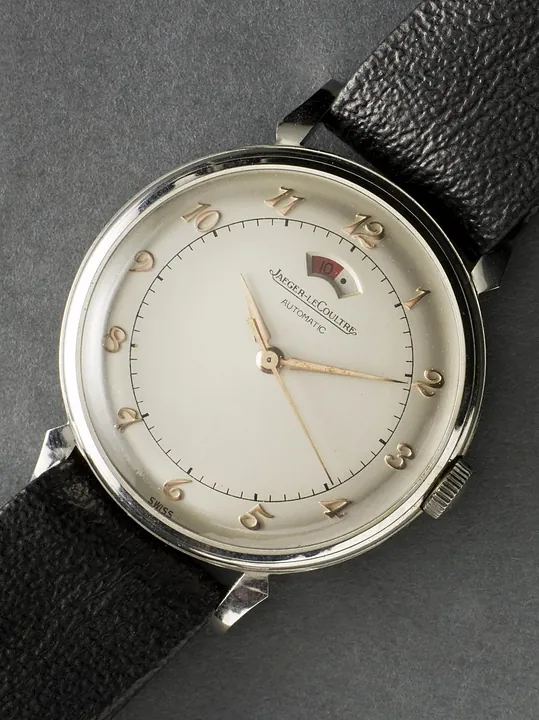
Automatic Wrist-watch, Jaeger-LeCoultre, Geneva, Switzerland, with reserve power indicator complete in steel case, 1953. Back numbered 564556.
Science Museum Group, London
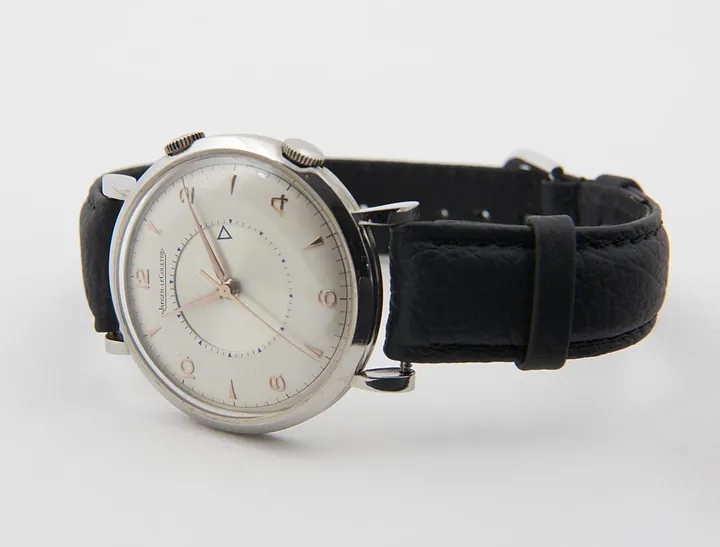
Wristwatches · 1953
Wrist-watch, 'Memovox' alarm, Jaeger-LeCoultre, Geneva, Switzerland, complete in steel case, 1953.
Science Museum Group, London

Wristwatches · 2008
Wristwatch by Breitling?, 2008
Museum Rotterdam

Wristwatches · c. 1990s
Audemars Piguet Bamboo, c. 1990s
Antiquorum auction archive, Geneva

Wristwatches · c. 1990
Audemars Piguet Huitieme Perpetual Calendar, ref. 25696PT, c. 1990
Antiquorum auction archive, Geneva

Wristwatches · c. 1990
Breitling Chronomat, ref. b13050.1, c. 1990
Antiquorum auction archive, Geneva