
Wristwatches · Wristwatch
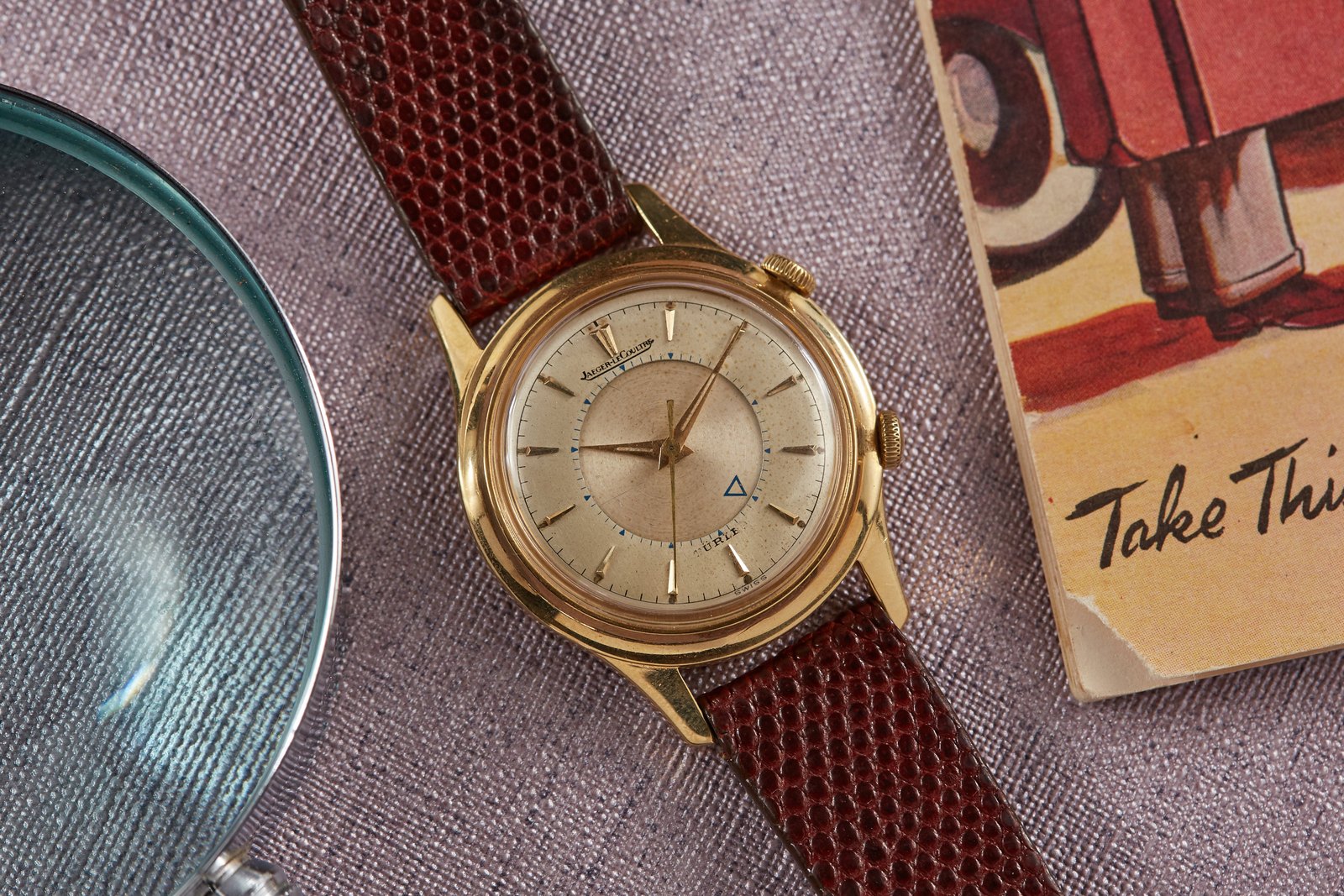
Jaeger-LeCoultre Memovox 18k Türler, 1950s
- Maker / attribution
- Jaeger LeCoultre (maker)
- Date
- 1950s
- Historical period
- Modern Mechanical Horology (1945 – 1969)
- Country of origin
- Unrecorded in source
- Object type
- Wristwatch
- Dimensions
- Case 35 mm
- Stock no.
- Product 3882343792727
- Credit line
- Dealer listing, Analog/Shift (product 3882343792727)
- Catalogue title (original)
- Jaeger-LeCoultre Memovox 18k Türler (English)
View the source record (dealer listing) ↗ (opens another website in a new tab)Suggest a correction
Record summary
Catalogued by Analog/Shift (dealer), New York (stock number Product 3882343792727), this is a wristwatch by Jaeger LeCoultre, dated 1950s. The Atlas places it in the Modern Mechanical Horology period (1945 – 1969) of its Wristwatches collection. Recorded dimensions: Case 35 mm. The record is illustrated with 6 photographs.
Assembled from the source record's structured fields. Dates and attributions are given as the source states them; where a field is missing the Atlas leaves it blank rather than estimating.
Catalogue description
Dealer description — Analog/Shift
Why We Love It Think about your morning routine. You’re jarred awake by a tinny ringtone, or maybe a soothing ambient noise emitting from an app on your phone. Another tone goes off to let you know of your upcoming meeting; still another to remind you to take your pill. Now imagine that all of those pesky ringtones and annoying alarms could be replaced by the glorious buzzing of a mechanical watch. The mechanical alarm is by far one of the coolest and most gratifying complications available in a wristwatch, and the Jaeger-LeCoultre Memovox is the flagship. This particular example, an 18K gold cased model dating to the 1950s, utilizes the early manually-winding Calibre P489/1 alarm movement, giving it a slimmer profile than later executions. Sized at 35mm, this piece features an untouched and lightly patinated dial with gold faceted applied indices and a silver-toned inner dial ring with blue printed alarm indicator. Best of all, this lovely piece features a second signature at 6:00 from famous retailer Türler, confirming its original European market provenance. This is quite simply a LOT of watch in a beautifully slim and refined package. Don't miss out! The Story The first popular mechanical alarm watch to hit the market was the Vulcain Cricket. Launched in 1947, the Cricket was the first alarm watch to be simple and robust enough to be enjoyed on the wrist, and it gained much accolade, making its way onto numerous notable individuals including several U.S. Presidents. In the late 1940s, Jaeger LeCoultre also began producing it's own mechanical alarm watch to contend with the popular Cricket. Utilizing a unique twin-crown system (the top crown being winding and setting the alarm, the bottom winding and setting the time) and a different alarm mechanism (the Memovox employs a hammer that strikes against a post that is directly welded to the case back whereas the Cricket uses a resonant dual case back design) JLC set itself apart and in so doing, created one of the most iconic models of post-war watchmaking. These early Memovox models were equipped with a Calibre 489 manually-winding movement, robust and energetic models that kept excellent time and offered potent alarm reporting.
Historical context
Modern Mechanical Horology (1945 – 1969)
Tool watches for divers, pilots and astronauts; electric watches anticipate the electronic age.
The classic era of the mechanical wristwatch: dive watches, chronographs for motor racing and space flight, GMT watches for jet travel, slim dress watches, automatic calendars, and the rise of Japanese manufacturers alongside Swiss, American, German and Soviet industries.
Read the period in the timelineMore wristwatches from this periodEarlier: Golden Age of Mechanical Watchmaking
Atlas type guide
Wristwatches
Bracelet watches were worn by women from the early nineteenth century — Breguet made one for Caroline Murat, Queen of Naples, in 1810–12 — but the wristwatch only became a man's instrument with military use and aviation in the early twentieth century. Between the World Wars it overtook the pocket watch; the 1920s and 1930s brought rectangular Art Deco cases, water-resistant cases and the first automatic winding systems.
After 1945 the wristwatch became a carrier of identity — dress watches, sports and dive watches, chronographs, calendars — produced by Swiss, American, Japanese, German, Soviet and Chinese industries. The quartz revolution after 1969 and the mechanical renaissance since the 1990s, including the rise of independent watchmakers, complete the story.
What to look for
- The reference number (between the lugs or inside the case back) and serial number, the starting point for dating.
- The calibre: its maker and number are often stamped under the dial or on the bridge.
- Originality of dial, hands and crown — refinished ('redial') dials are common.
- Case material marks: 18K/750, 14K/585, stainless steel, gold-filled, plated.
Dating clues
- Wire-lug cases: before c. 1925.
- Water-resistant screw-down cases: from 1926.
- Quartz movements: from 1969; sapphire crystals widespread after c. 1980.
General guidance written by the Atlas editors about this kind of object. It is not a statement about this particular piece; for that, rely on the source record above and on physical examination.
Related records
Wristwatches · 1953–1956
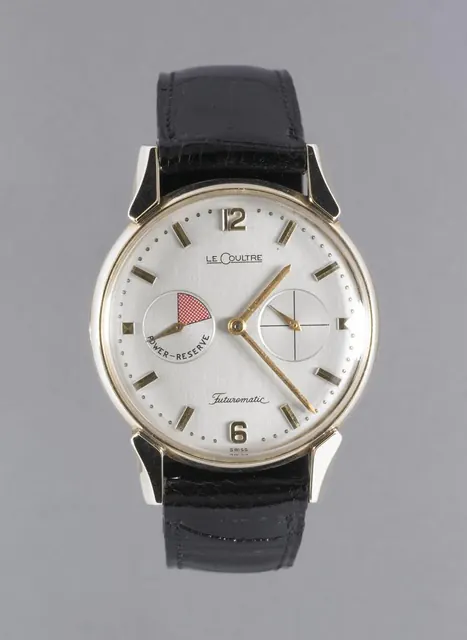
Automatic wristwatch with subsidiary seconds and power-reserve dial
British Museum
Wristwatches · mid 1960s
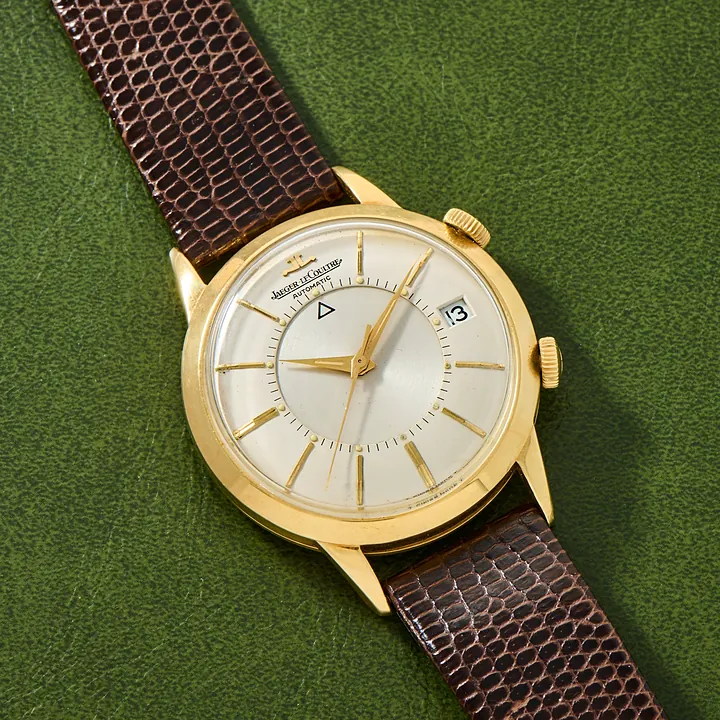
Jaeger-LeCoultre Memovox, mid 1960s
Analog/Shift (dealer), New York
Wristwatches · 1960
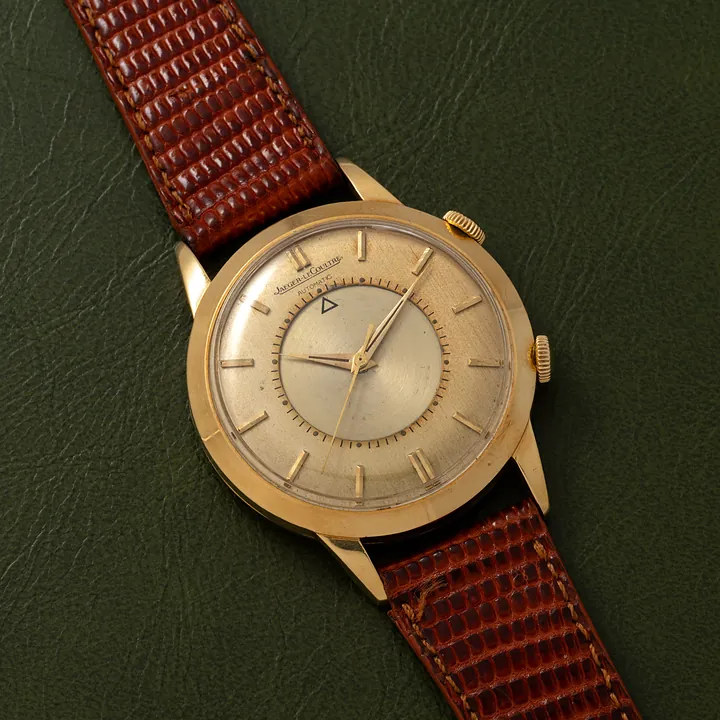
Jaeger-LeCoultre 'European Market' Memovox, 1960
Analog/Shift (dealer), New York
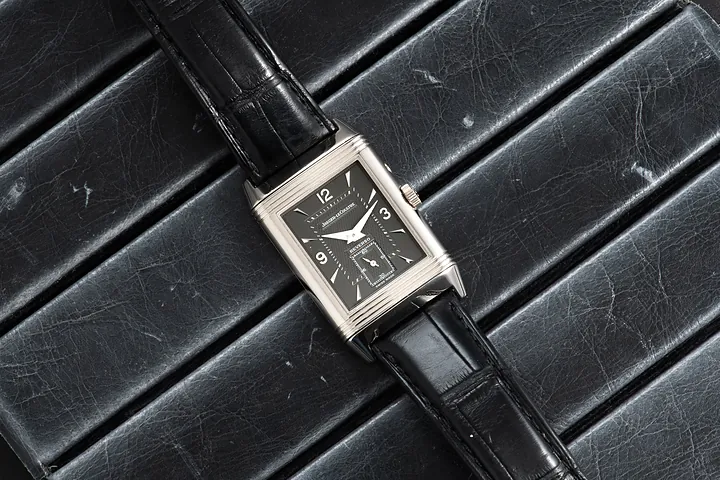
Wristwatches · 2010s
Jaeger-LeCoultre Reverso Duoface Day/Night, 2010s
Analog/Shift (dealer), New York

Wristwatches · 1945
Wristwatch by Eterna, 1945
Museum Rotterdam

Wristwatches · c. 1945
Breitling Premier, ref. 790, c. 1945
Antiquorum auction archive, Geneva

Wristwatches · c. 1945
Universal Genève Uni-Compax, ref. 22492, c. 1945
Antiquorum auction archive, Geneva
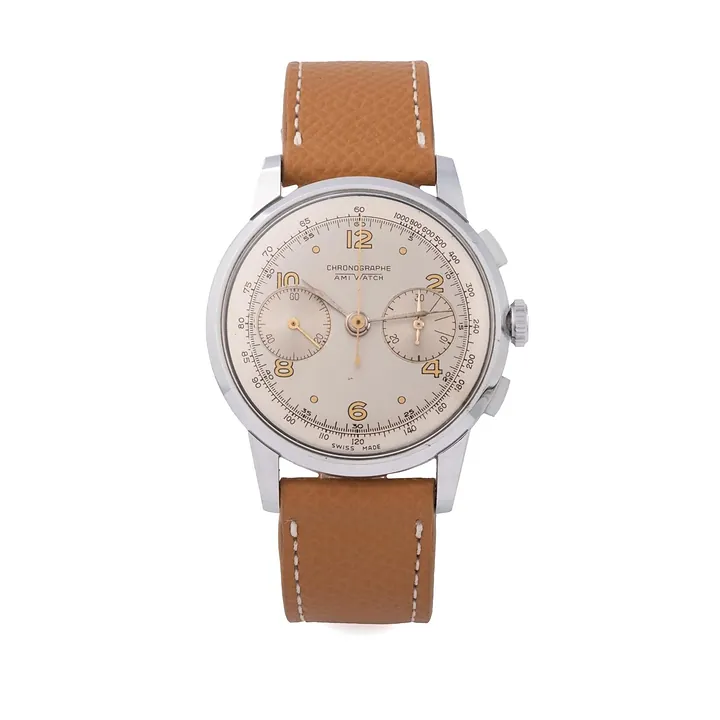
Wristwatches · c. 1950s
Ami Watch Chronographe, c. 1950s
Antiquorum auction archive, Geneva