
Wristwatches · Wristwatch
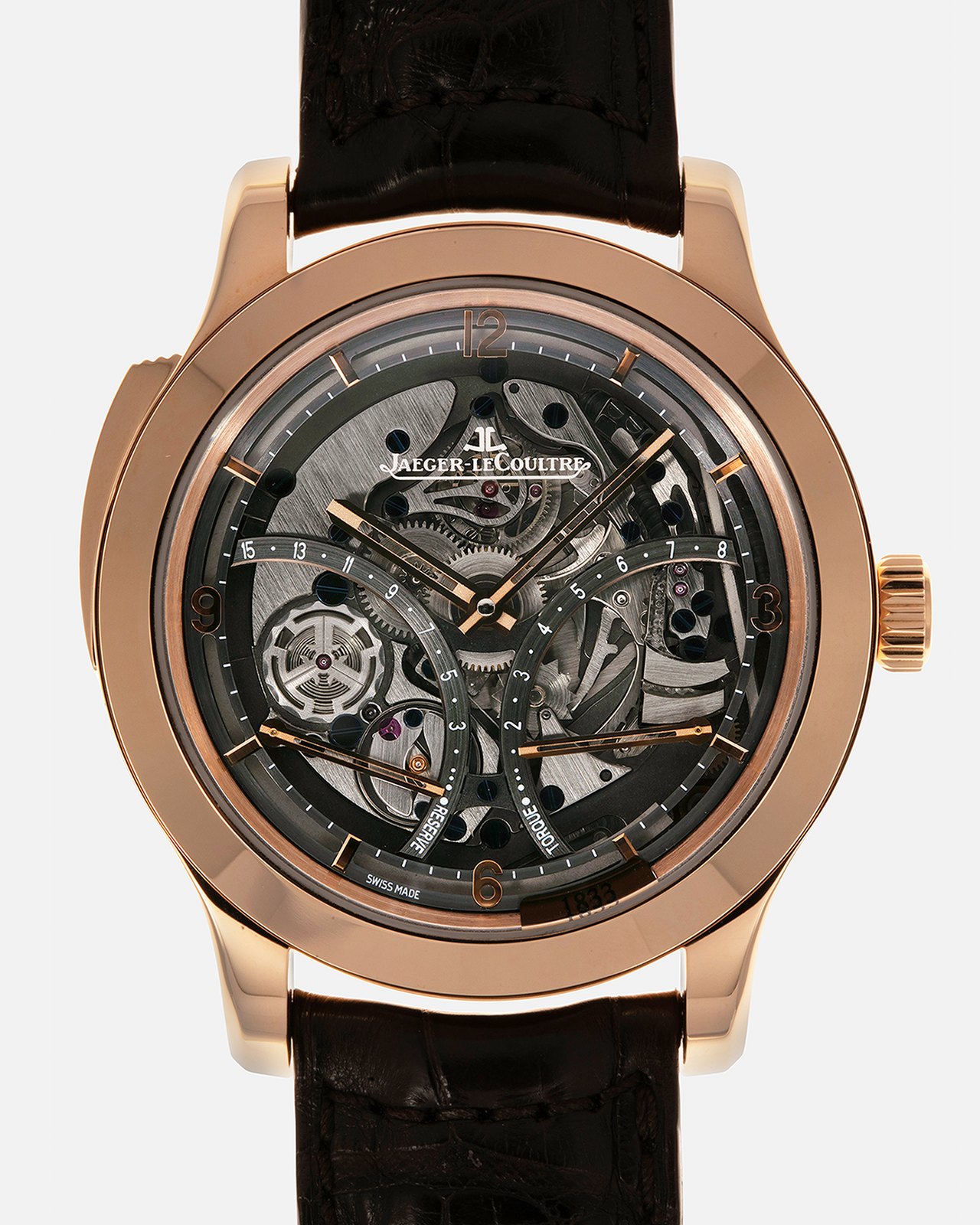
Jaeger-LeCoultre Master Minute Repeater 1833 175th Anniversary, 2008
- Maker / attribution
- Jaeger-LeCoultre (maker)
- Date
- 2008
- Historical period
- Mechanical Renaissance (1990 – 2010)
- Country of origin
- Switzerland
- Object type
- Wristwatch
- Dimensions
- Case 44 mm
- Stock no.
- Product 7450305364055
- Credit line
- Dealer listing, S.Song Watches (product 7450305364055)
- Catalogue title (original)
- Jaeger-LeCoultre Master Minute Repeater 1833 175th Anniversary (English)
View the source record (dealer listing) ↗ (opens another website in a new tab)Suggest a correction
Record summary
Catalogued by S.Song Watches (dealer), Seattle (stock number Product 7450305364055), this is a wristwatch by Jaeger-LeCoultre, made in Switzerland, dated 2008. The Atlas places it in the Mechanical Renaissance period (1990 – 2010) of its Wristwatches collection. Recorded dimensions: Case 44 mm. The record is illustrated with 6 photographs.
Assembled from the source record's structured fields. Dates and attributions are given as the source states them; where a field is missing the Atlas leaves it blank rather than estimating.
Catalogue description
Dealer description — S.Song Watches
Among the many marvels of high end watchmaking, the minute repeater stands out as both one of the most mechanically captivating and technically complex complications. Revered as the pinnacle of haute horlogerie, it challenges even the most skilled watchmakers. At its core, a repeater is a complication that audibly tells the time on command, and the minute repeater takes this a step further by chiming the hours, quarter hours, and minutes using distinct acoustic tones. Born out of necessity in a time before electric lighting, when checking the time visually was not always practical or possible, the minute repeater offered an elegant auditory solution. With a sequence of low tones for the hours, double chimes for the quarter hours, and high-pitched strikes for the minutes past the quarter, it allowed its users to hear the time precisely without ever needing to look at their watch. Due to the complexity involved in creating a minute repeater, only a select group of manufactures possess the necessary expertise and mastery to produce them. Jaeger-LeCoultre, often referred to by many as "the watchmaker of watchmakers," proudly stands among this elite few. Having crafted minute repeaters since the 1890s, Jaeger-LeCoultre brings more than just a century of expertise to this revered complication. Enter the Master Minute Repeater 1833, the example we have here today, which was unveiled back in 2008 as part of a 175-piece limited edition celebrating the Maison’s 175th anniversary. This remarkable timepiece comes housed in a bold yet refined 44mm x 15.6mm case crafted from 18-carat rose gold and showcases a beautiful interplay of textures, with brushed surfaces along the flanks and lugs, contrasted by a mirror-polished bezel and lug tops for added visual depth. Positioned on the left side of the case is a discreet slider-like pusher that activates the minute repeater mechanism. Housed within the case is a meticulously skeletonised dial that offers a partial yet captivating view into the inner workings of this mechanical marvel (more on this later). As seen in the accompanying images, the dial is thoughtfully segmented into three distinct sections, each revealing a different aspect of the minute repeater mechanism. The opening at 12:00 showcases the snail cams that coordinate the chiming sequence, along with the minute rack and quarter mechanism; critical components that spring into action when the repeater is engaged. At 9:00, another window reveals the striking mechanism’s barrel and its governor, which regulates the tempo of the chimes. Lastly, the aperture at 3:00 offers the user a glimpse of the hour and minute hammers poised above the quarter banking, ready to deliver their precise acoustic strikes. Just beneath this section, the number ‘1833’ is inscribed, a subtle nod to the esteemed Maison’s founding year. Powering this masterpiece from within is Jaeger-LeCoultre’s in-house Cal. 947, a manual-winding movement based on an earlier Cal. 944 used in the Maison’s Reverso Répétition Minutes. While it retains the foundational architecture of its predecessor, the Cal. 947 introduces several key advancements. Chief among them is Jaeger-LeCoultre’s groundbreaking proprietary crystal gong system. In contrast to traditional designs where gongs are mounted to the main plate or case, Jaeger-LeCoultre soldered the heel of each gong directly onto the sapphire crystal, taking full advantage of the crystal’s exceptional sound transmission properties. This innovative arrangement transforms the crystal into an active resonator, significantly enhancing both the clarity and volume of the chime. The result is a chime that is rich, powerful, and remarkably clear, evoking the resonance of vintage pocket watch repeaters. It is also worth noting that the Master Minute Repeater was developed in collaboration with renowned French conductor Georges Prêtre, whose expert musical ear helped Jaeger-LeCoultre further refine the tonal quality and harmony of the chime. The second major advancement in this watch is the inclusion of a second mainspring barrel. This dual-barrel configuration provides a whopping power reserve of up to 15 days, which is visible through the power reserve indicator located at the lower left section of the dial. To complement this extended autonomy, the movement is also equipped with a barrel torque indicator, positioned at the lower right side of the dial. This display shows whether the winding level is within the optimal operating range, allowing the wearer to wind the watch with precision. As expected from Jaeger-LeCoultre, the ruthenium-coated movement is also immaculately finished on both the front and back. The reverse side, in particular, features a large ¾ plate with expertly bevelled edges and a radiant Côtes de Soleil motif that appears to emanate from the balance wheel, creating a captivating visual effect reminiscent of the graceful, flowing contours of a scallop shell. It is a subtle yet elegant nod to the brand’s dedication to both technical mastery and artistic expression. Adding a nice touch of contrast are heat-blued screws, which are seen scattered across the movement, introducing a delicate splash of colour to the movement's otherwise monochromatic expanse. Without a doubt, the Master Minute Repeater 1833 is a breathtaking example of horological artistry. It has been a true pleasure to experience this masterpiece firsthand, and we are proud to offer this remarkable piece of mechanical art on the site today.
Historical context
Mechanical Renaissance (1990 – 2010)
Mechanical watches return as cultural objects; independent watchmaking flourishes.
Mechanical watches returned as cultural and luxury objects. Complications, tourbillons and new materials proliferated; independent watchmakers such as George Daniels, F.P. Journe and Philippe Dufour revived artisanal watchmaking; collecting vintage watches became a major field.
Read the period in the timelineMore wristwatches from this periodEarlier: Quartz Revolution
Atlas type guide
Repeating watches
Before electric light, telling the time in the dark was a real problem. Repeating watches strike the time on demand when a slide or push-piece is operated: quarter repeaters sound hours and quarters, minute repeaters hours, quarters and minutes. Edward Barlow and Daniel Quare disputed the invention in London in the 1680s. Early repeaters struck on a bell inside the case; Abraham-Louis Breguet introduced the gong (a coiled steel wire) around 1780, allowing thinner watches.
Repeaters require a separate train with racks, snails and a governor to control the striking speed, and are among the most demanding complications to make and adjust. Swiss makers of the Vallée de Joux specialised in repeating ébauches in the nineteenth century.
What to look for
- A slide on the case band or a push-piece through the pendant.
- Gongs encircling the movement (after c. 1780) or a bell in the case (earlier); pierced case for sound.
- The racks, snails and governor visible under the dial or on the movement.
- Terms such as 'Minutes', 'Quarts' or 'Répétition' on the dial or cuvette.
Dating clues
- Bell-striking quarter repeaters: c. 1690–1800.
- Gong repeaters and dumb repeaters (striking on the case): after c. 1780.
- Minute repeaters became more common after c. 1830 with Vallée de Joux ébauches.
General guidance written by the Atlas editors about this kind of object. It is not a statement about this particular piece; for that, rely on the source record above and on physical examination.
Read next:Minute repeater
Related records
Clocks · 1937–1938
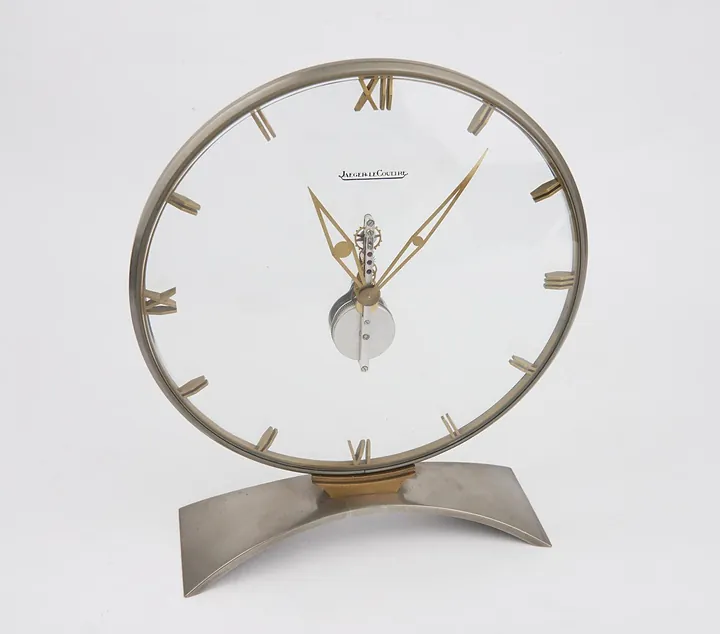
Skeleton clock by Jaeger-LeCoultre, Switzerland, 1937–1938
Science Museum Group, London
Movements & Components · 1953
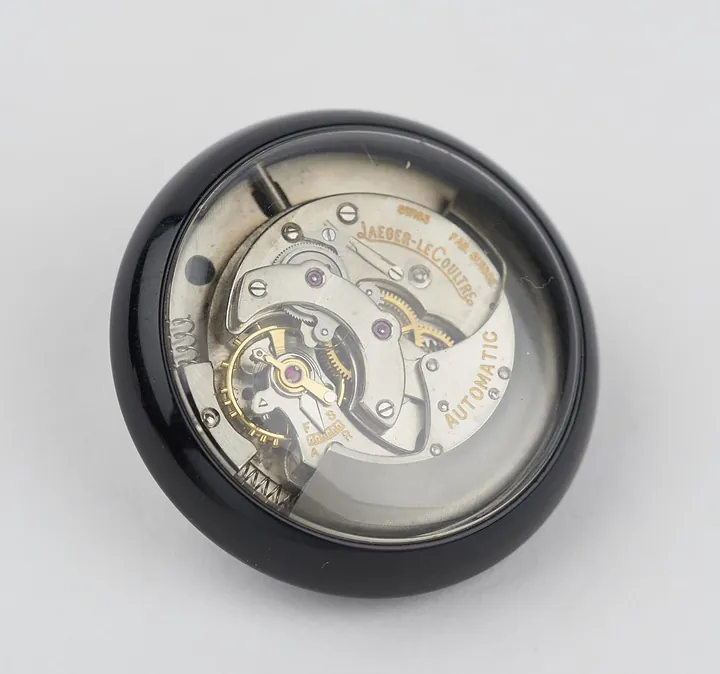
Automatic watch movement, Jaeger-LeCoultre, 1953, Geneva, Switzerland, showing self-winding mechanism
Science Museum Group, London
Wristwatches · 1953
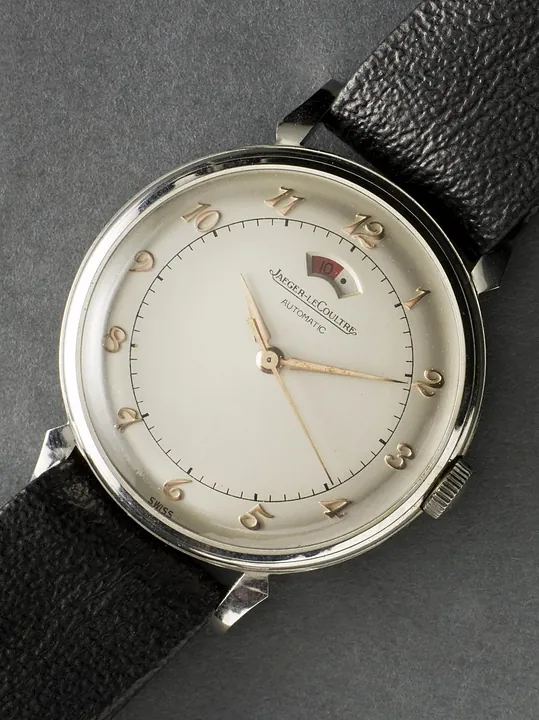
Automatic Wrist-watch, Jaeger-LeCoultre, Geneva, Switzerland, with reserve power indicator complete in steel case, 1953. Back numbered 564556.
Science Museum Group, London
Wristwatches · 1953
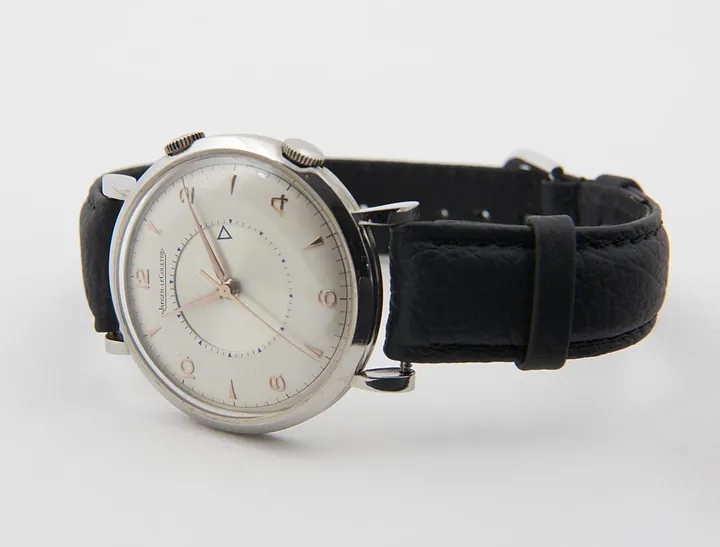
Wrist-watch, 'Memovox' alarm, Jaeger-LeCoultre, Geneva, Switzerland, complete in steel case, 1953.
Science Museum Group, London

Wristwatches · 2008
Wristwatch by Breitling?, 2008
Museum Rotterdam

Wristwatches · c. 1990s
Audemars Piguet Bamboo, c. 1990s
Antiquorum auction archive, Geneva

Wristwatches · c. 1990
Audemars Piguet Huitieme Perpetual Calendar, ref. 25696PT, c. 1990
Antiquorum auction archive, Geneva

Wristwatches · c. 1990
Breitling Chronomat, ref. b13050.1, c. 1990
Antiquorum auction archive, Geneva