
Wristwatches · Wristwatch
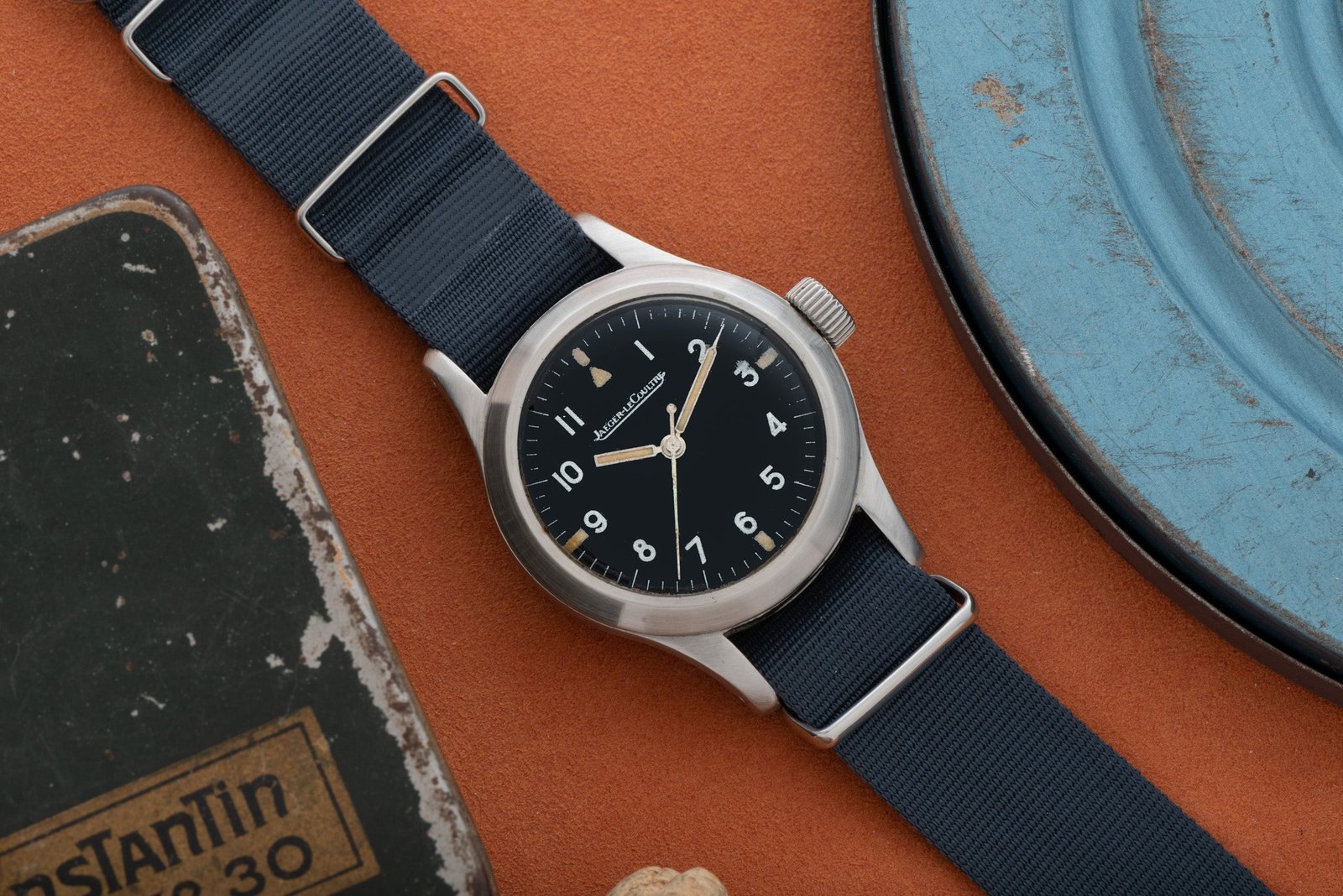
Jaeger-LeCoultre Mark XI, c. 1953
- Maker / attribution
- Jaeger LeCoultre (maker)
- Date
- c. 1953
- Historical period
- Modern Mechanical Horology (1945 – 1969)
- Country of origin
- Unrecorded in source
- Object type
- Wristwatch
- Dimensions
- Case 34.6 mm
- Stock no.
- 40980052
- Credit line
- Dealer listing, Analog/Shift (40980052)
- Catalogue title (original)
- Jaeger-LeCoultre Mark XI (English)
View the source record (dealer listing) ↗ (opens another website in a new tab)Suggest a correction
Record summary
Catalogued by Analog/Shift (dealer), New York (stock number 40980052), this is a wristwatch by Jaeger LeCoultre, dated c. 1953. The Atlas places it in the Modern Mechanical Horology period (1945 – 1969) of its Wristwatches collection. Recorded dimensions: Case 34.6 mm. The record is illustrated with 6 photographs.
Assembled from the source record's structured fields. Dates and attributions are given as the source states them; where a field is missing the Atlas leaves it blank rather than estimating.
Catalogue description
Dealer description — Analog/Shift
Through much of World War II, allied aviators were donning the American-made A-11 service watch. While this tough-as-nails timekeeper performed meritoriously for soldiers and airmen alike, Britain's Ministry of Defense found that the production specifications of the A-11 were too broad and resulted in timepieces too imprecise for effective navigation. As an answer to the A-11, the MoD issued new standards for the watches issued to its RAF pilots. The new standard, coded 6B/346, required chronometer-grade performance and anti-magnetic properties. For the production of this new timepiece, the MoD turned to major European manufactures, eventually giving contracts to two: International Watch Company and Jaeger-LeCoultre. The resulting timepiece was the Mark XI Pilot's watch. In addition to the relatively standard features present on the A-11 (center seconds, hacking and a stainless steel case), the Mark XI featured a soft iron dial and dust cover which shielded the movement from magnetism. While IWC produced their version of the Mark XI with their existing Calibre 89 (which found its way into many IWC models of the era), Jaeger-LeCoultre filled their orders with a 12.5 ligne, 16-jewel Calibre 488/SBr movement — a movement that was only used in the Mark XI series — making the JLC executions much more sought after by collectors. This particular example, issued to the Royal Australian Air Force, dates to circa 1953 and features a 34.6mm 'Staybrite' steel case with an acrylic crystal, a 'big' crown, a smooth bezel, and a matte black Radium' dial with printed 'Arabic' indices and a matching handset — in the unique style of the Mark 11 series, with a rectangular hour hand, a 'syringe' minute hand, and a white seconds hand. This piece comes fitted to an Admiralty Grey Phoenix® NATO strap with stainless steel hardware and is powered by Jaeger-LeCoultre's Calibre 488/SBr hand-wound movement. If you're a dedicated collector of military watches — or you simply have a respect and appreciation for well made things, history, or beautiful objects — it's going to be hard to pass up such an important timepiece as this!
Historical context
Modern Mechanical Horology (1945 – 1969)
Tool watches for divers, pilots and astronauts; electric watches anticipate the electronic age.
The classic era of the mechanical wristwatch: dive watches, chronographs for motor racing and space flight, GMT watches for jet travel, slim dress watches, automatic calendars, and the rise of Japanese manufacturers alongside Swiss, American, German and Soviet industries.
Read the period in the timelineMore wristwatches from this periodEarlier: Golden Age of Mechanical Watchmaking
Atlas type guide
Wristwatches
Bracelet watches were worn by women from the early nineteenth century — Breguet made one for Caroline Murat, Queen of Naples, in 1810–12 — but the wristwatch only became a man's instrument with military use and aviation in the early twentieth century. Between the World Wars it overtook the pocket watch; the 1920s and 1930s brought rectangular Art Deco cases, water-resistant cases and the first automatic winding systems.
After 1945 the wristwatch became a carrier of identity — dress watches, sports and dive watches, chronographs, calendars — produced by Swiss, American, Japanese, German, Soviet and Chinese industries. The quartz revolution after 1969 and the mechanical renaissance since the 1990s, including the rise of independent watchmakers, complete the story.
What to look for
- The reference number (between the lugs or inside the case back) and serial number, the starting point for dating.
- The calibre: its maker and number are often stamped under the dial or on the bridge.
- Originality of dial, hands and crown — refinished ('redial') dials are common.
- Case material marks: 18K/750, 14K/585, stainless steel, gold-filled, plated.
Dating clues
- Wire-lug cases: before c. 1925.
- Water-resistant screw-down cases: from 1926.
- Quartz movements: from 1969; sapphire crystals widespread after c. 1980.
General guidance written by the Atlas editors about this kind of object. It is not a statement about this particular piece; for that, rely on the source record above and on physical examination.
Related records
Wristwatches · 1953–1956
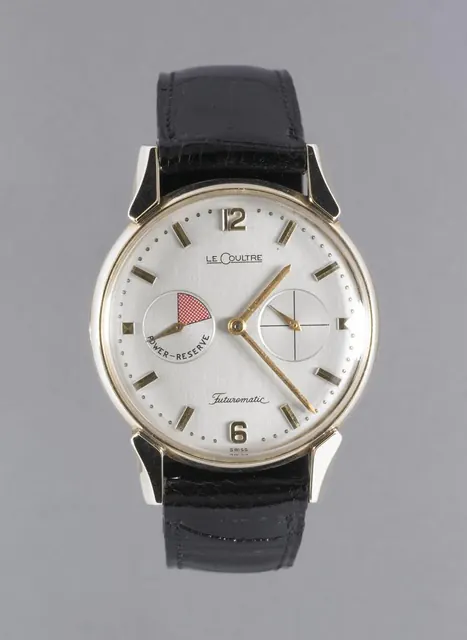
Automatic wristwatch with subsidiary seconds and power-reserve dial
British Museum
Wristwatches · mid 1960s
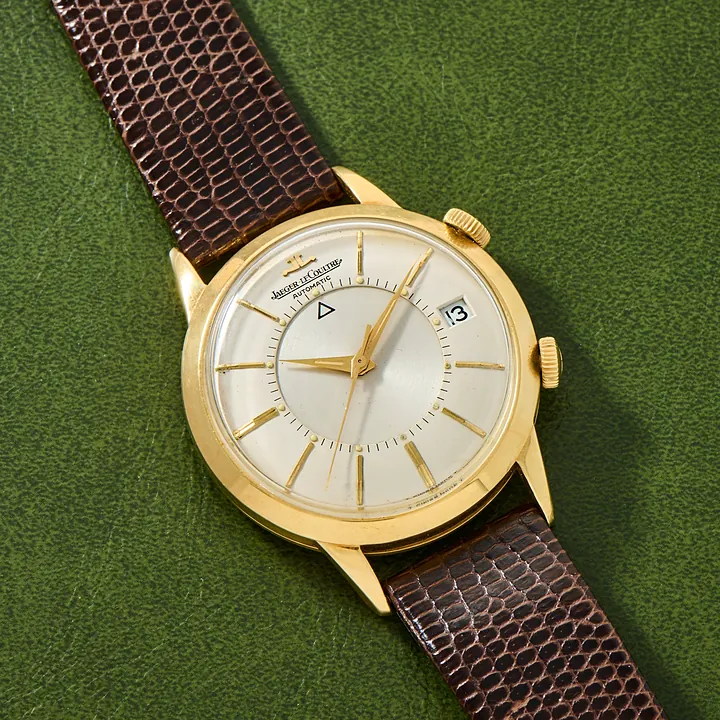
Jaeger-LeCoultre Memovox, mid 1960s
Analog/Shift (dealer), New York
Wristwatches · 1960
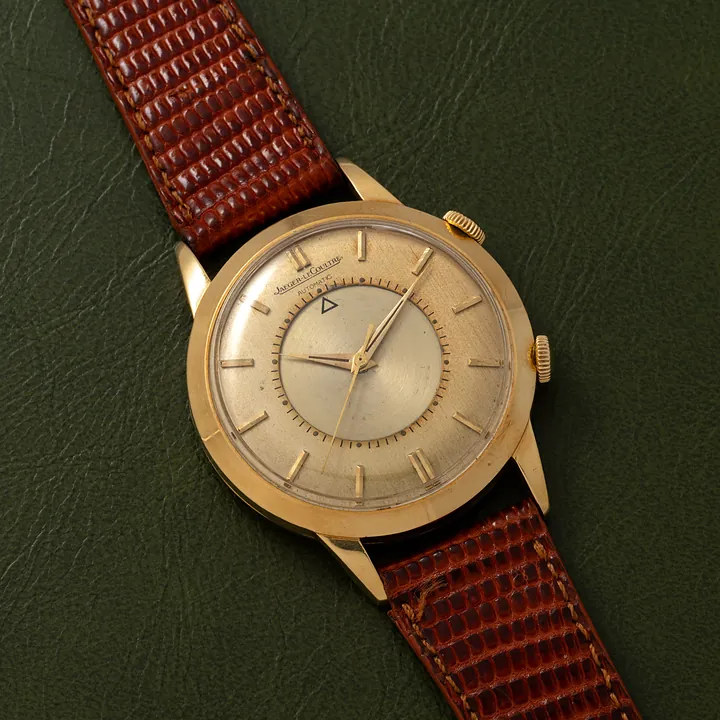
Jaeger-LeCoultre 'European Market' Memovox, 1960
Analog/Shift (dealer), New York
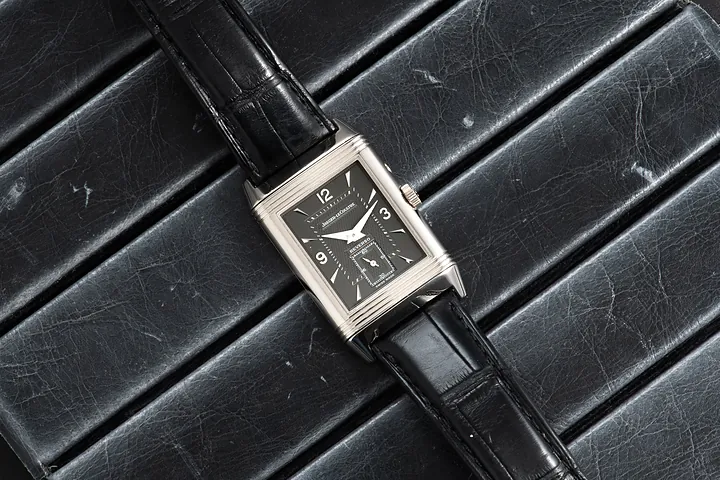
Wristwatches · 2010s
Jaeger-LeCoultre Reverso Duoface Day/Night, 2010s
Analog/Shift (dealer), New York

Wristwatches · 1945
Wristwatch by Eterna, 1945
Museum Rotterdam

Wristwatches · c. 1945
Breitling Premier, ref. 790, c. 1945
Antiquorum auction archive, Geneva

Wristwatches · c. 1945
Universal Genève Uni-Compax, ref. 22492, c. 1945
Antiquorum auction archive, Geneva
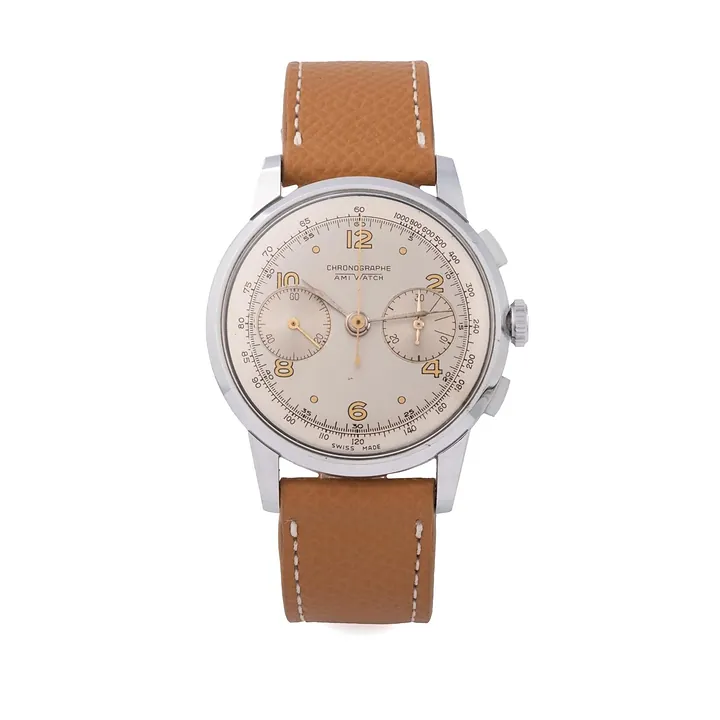
Wristwatches · c. 1950s
Ami Watch Chronographe, c. 1950s
Antiquorum auction archive, Geneva