
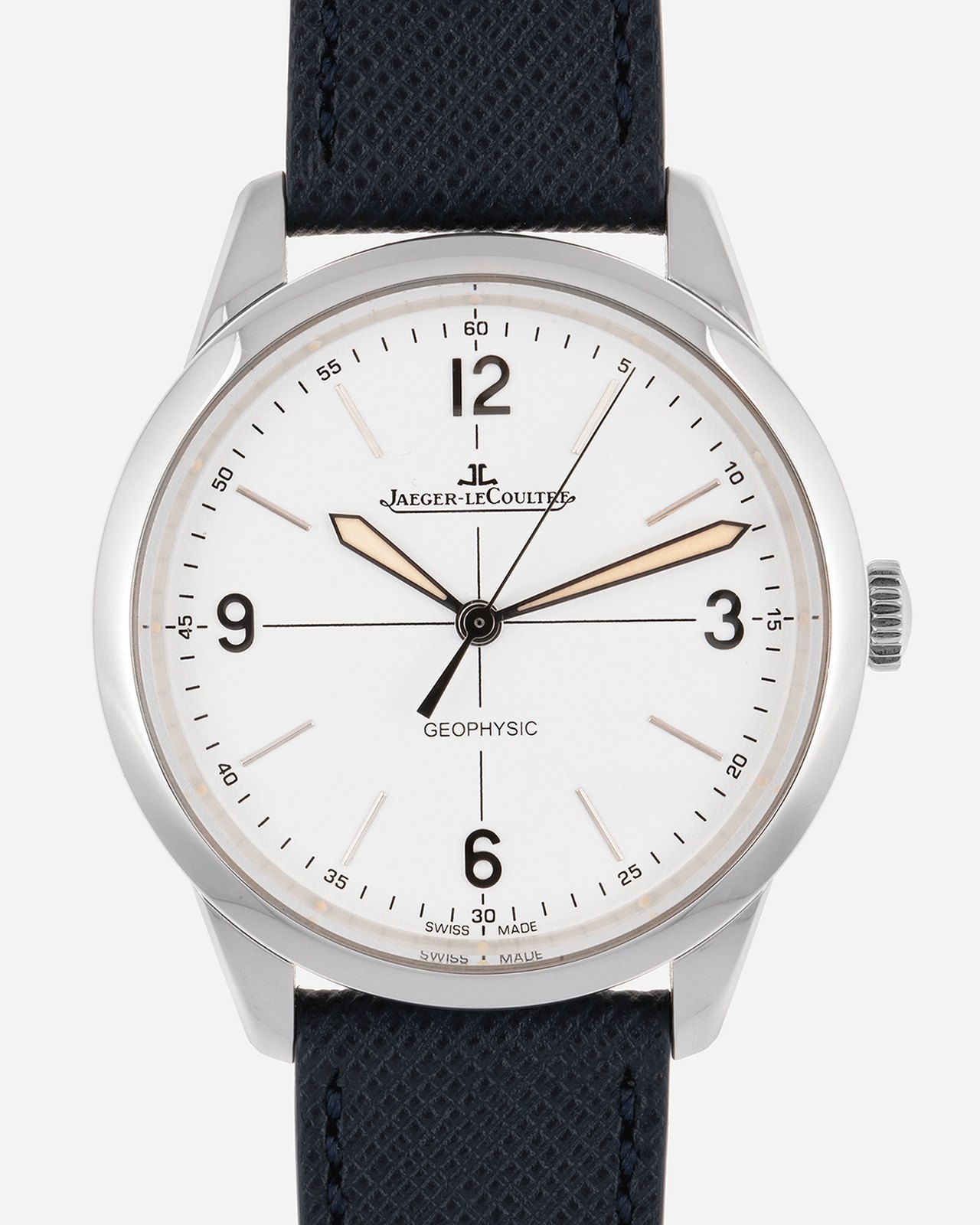
Wristwatches · Wristwatch
Jaeger-LeCoultre Geophysic 1958, 2014
- Maker / attribution
- Jaeger-LeCoultre (maker)
- Date
- 2014
- Historical period
- Contemporary Horology (2010 – Present)
- Country of origin
- Switzerland
- Object type
- Wristwatch
- Dimensions
- Case 38.5 mm
- Stock no.
- Product 6560363020375
- Credit line
- Dealer listing, S.Song Watches (product 6560363020375)
- Catalogue title (original)
- Jaeger-LeCoultre Geophysic 1958 (English)
View the source record (dealer listing) ↗ (opens another website in a new tab)Suggest a correction
Record summary
Catalogued by S.Song Watches (dealer), Seattle (stock number Product 6560363020375), this is a wristwatch by Jaeger-LeCoultre, made in Switzerland, dated 2014. The Atlas places it in the Contemporary Horology period (2010 – Present) of its Wristwatches collection. Recorded dimensions: Case 38.5 mm. The record is illustrated with 6 photographs.
Assembled from the source record's structured fields. Dates and attributions are given as the source states them; where a field is missing the Atlas leaves it blank rather than estimating.
Catalogue description
Dealer description — S.Song Watches
The Jaeger-LeCoultre Geophysic was first released in 1958 and it had one goal in mind- to be as durable and precise as a wristwatch can be. Made for extreme conditions and exploration, it was produced both as a celebration of Jaeger-LeCoultre’s 125th anniversary and also the world’s first International Geophysical Year. This was a global effort by 67 countries to encourage scientific progress in exploration and experimentation relating to geophyiscs. The result was the Geophysic Chronometer Ref. E 168 and it was a highly precise watch powered by one of the greatest movements ever conceived, the in-house caliber P 478 BWSBr. It was a chronometer grade movement that featured anti-magnetic properties, Kif shock resistance, a Glucydur balance spring to keep it protected from temperature change and the now famous swan-neck regulator. As this was a super specialised watch, just over a thousand examples were produced and today the E 168 is considered one of the rarest and most desirable vintage watches in the world. Fast forward to 2014 and the Geophysic is reborn. Inspired by its past, I’ve always mentioned that Jaeger-LeCoultre is one of the best manufactures out there when it comes to producing reissues. With the likes of the Polaris, Deep Sea Alarm and Reversos, they are all great watches and with this Geophysic, it is no different. JLC has taken a lot of design cues of the past to produce a watch that is both relevant today yet faithful to its past. Housed in a 38.5mm stainless steel case, the proportions are just perfect. It has slightly bevelled lugs with a polish finish on the top and brushed completely on the sides. The white dial is sectored with applied index markers and Arabic numerals at 12,3,6 and 9. Furthermore, the font style of the Arabic numerals is the same as you find in the original and also with the luminous sword hands. An interesting quirk about the original Geophysic is that Jaeger-LeCoultre opted to apply luminous plots on the edge of the crystal rather than on the dial and it's nice to see that they have noticed this as an important visual feature by applying the plots this time, on the edge of the rehaut. It’s not exactly the same, but it is a certainly a nod to that quirk. Of course, we can’t talk about the Geophysic without talking about the movement. The modern reincarnation is powered by the in-house self-winding Cal. 898/1. It is Jaeger-LeCoultre’s top of the line movement and follows in the tradition of the original with an antimagnetic case, ceramic ball bearings that require no lubrication, Spyr gears for a smooth transition in the gear train and a Kif parechoc for shock resistance. Furthermore, this watch was put through over 1000 hours of controlled testing and with a deviation of -1/+4 seconds a day, it is more accurate than COSC certified chronometers. It is amazing to see that JLC has not only cared about this aesthetic importance of reissues but also the functionality of it- this is pure substance. I have to say, this is the perfect modern watch for vintage lovers. It has all the charm and history of a vintage piece with the functionality and durability of a modern watch, and more! Moreover, it is an extremely versatile piece that can work both as a tool watch and also its understated looks makes it appropriate for more formal occasions. With only 800 pieces produced, this is even rarer than the original and certainly in my eyes, one of the finest watches to come out of Le Sentier in a long time.
Historical context
Contemporary Horology (2010 – Present)
Silicon components, connected watches, optical-lattice research clocks and a thriving independent scene.
Smartwatches became the world's best-selling watches, while mechanical watchmaking focuses on craft, innovation (silicon components, new escapements) and independent makers.
Read the period in the timelineMore wristwatches from this periodEarlier: Mechanical Renaissance
Atlas type guide
Wristwatches
Bracelet watches were worn by women from the early nineteenth century — Breguet made one for Caroline Murat, Queen of Naples, in 1810–12 — but the wristwatch only became a man's instrument with military use and aviation in the early twentieth century. Between the World Wars it overtook the pocket watch; the 1920s and 1930s brought rectangular Art Deco cases, water-resistant cases and the first automatic winding systems.
After 1945 the wristwatch became a carrier of identity — dress watches, sports and dive watches, chronographs, calendars — produced by Swiss, American, Japanese, German, Soviet and Chinese industries. The quartz revolution after 1969 and the mechanical renaissance since the 1990s, including the rise of independent watchmakers, complete the story.
What to look for
- The reference number (between the lugs or inside the case back) and serial number, the starting point for dating.
- The calibre: its maker and number are often stamped under the dial or on the bridge.
- Originality of dial, hands and crown — refinished ('redial') dials are common.
- Case material marks: 18K/750, 14K/585, stainless steel, gold-filled, plated.
Dating clues
- Wire-lug cases: before c. 1925.
- Water-resistant screw-down cases: from 1926.
- Quartz movements: from 1969; sapphire crystals widespread after c. 1980.
General guidance written by the Atlas editors about this kind of object. It is not a statement about this particular piece; for that, rely on the source record above and on physical examination.
Related records
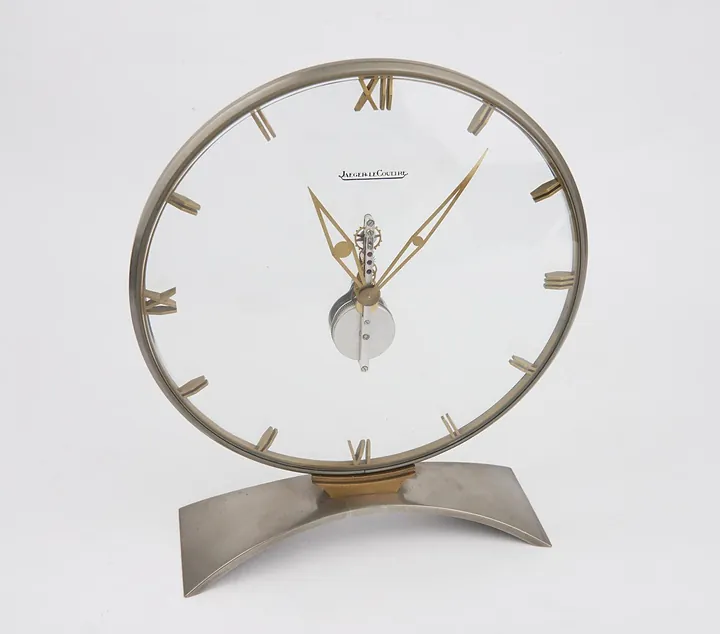
Clocks · 1937–1938
Skeleton clock by Jaeger-LeCoultre, Switzerland, 1937–1938
Science Museum Group, London
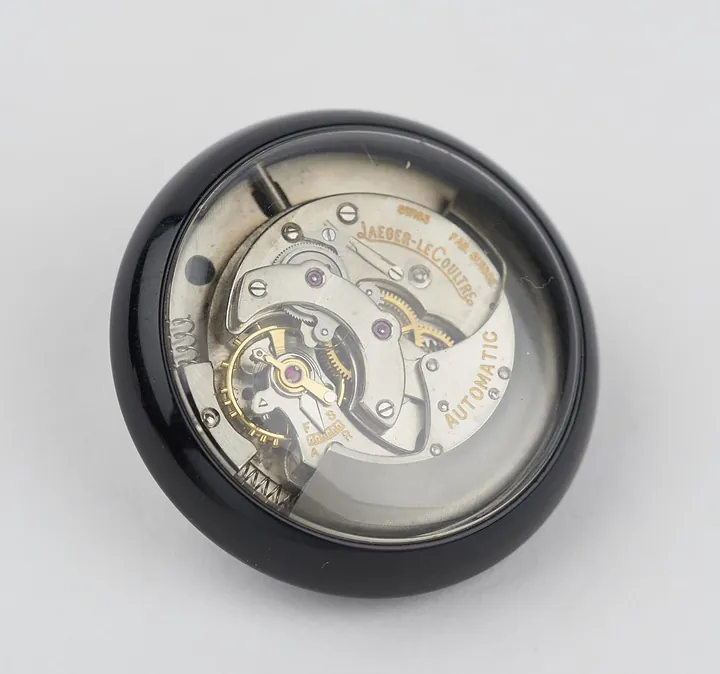
Movements & Components · 1953
Automatic watch movement, Jaeger-LeCoultre, 1953, Geneva, Switzerland, showing self-winding mechanism
Science Museum Group, London
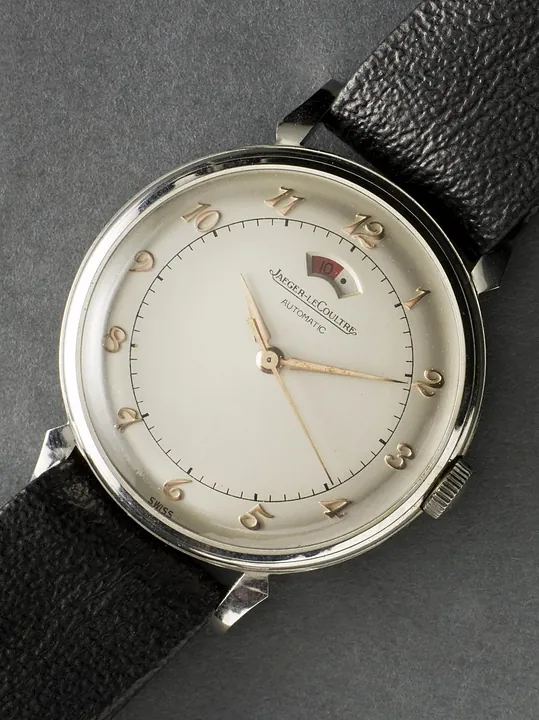
Wristwatches · 1953
Automatic Wrist-watch, Jaeger-LeCoultre, Geneva, Switzerland, with reserve power indicator complete in steel case, 1953. Back numbered 564556.
Science Museum Group, London
Wristwatches · 1953
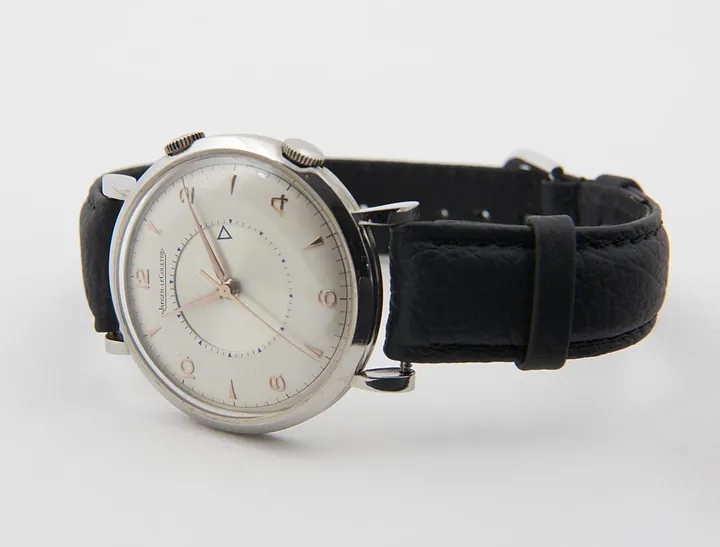
Wrist-watch, 'Memovox' alarm, Jaeger-LeCoultre, Geneva, Switzerland, complete in steel case, 1953.
Science Museum Group, London

Wristwatches · c. 2010s
Breguet Type XXI, ref. 3810, c. 2010s (Antiquorum Lot 381-24)
Antiquorum auction archive, Geneva

Wristwatches · c. 2010s
Breguet Type XXI, ref. 3810, c. 2010s (Antiquorum Lot 386-229)
Antiquorum auction archive, Geneva

Wristwatches · Sold in September 2010
Breitling Cosmonaute, ref. A 22322, Sold in September 2010
Antiquorum auction archive, Geneva

Wristwatches · c. 2010
Corum Bubble Chrono, ref. 396.150.20, c. 2010
Antiquorum auction archive, Geneva