
Clocks · Clock
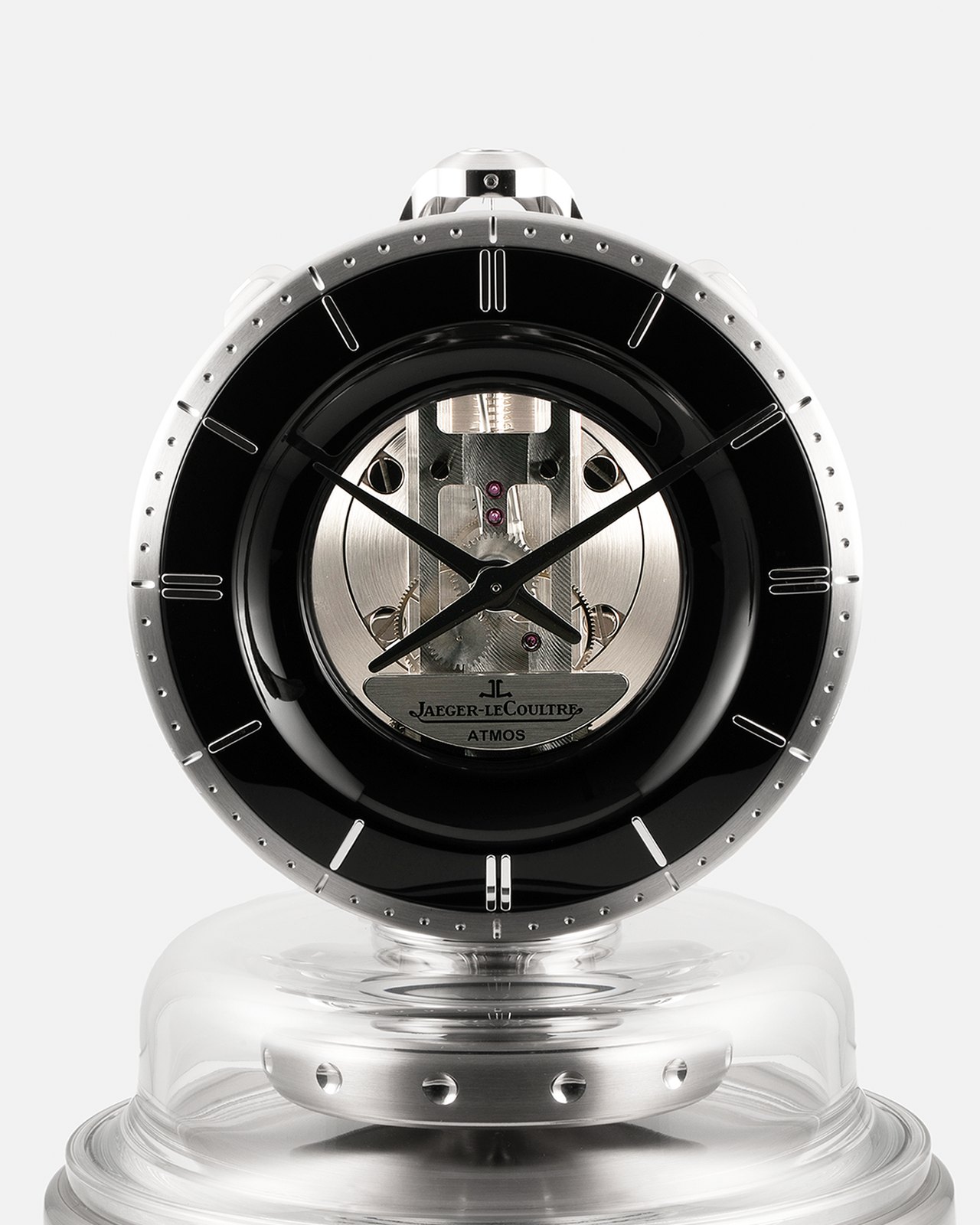
Jaeger-LeCoultre Atmos Clock Infinite, 2022
- Maker / attribution
- Jaeger-LeCoultre (maker)
- Date
- 2022
- Historical period
- Contemporary Horology (2010 – Present)
- Country of origin
- Switzerland
- Object type
- Clock
- Stock no.
- Product 7486532354135
- Credit line
- Dealer listing, S.Song Watches (product 7486532354135)
- Catalogue title (original)
- Jaeger-LeCoultre Atmos Clock Infinite (English)
View the source record (dealer listing) ↗ (opens another website in a new tab)Suggest a correction
Record summary
Catalogued by S.Song Watches (dealer), Seattle (stock number Product 7486532354135), this is a clock by Jaeger-LeCoultre, made in Switzerland, dated 2022. The Atlas places it in the Contemporary Horology period (2010 – Present) of its Clocks collection. The record is illustrated with 6 photographs.
Assembled from the source record's structured fields. Dates and attributions are given as the source states them; where a field is missing the Atlas leaves it blank rather than estimating.
Catalogue description
Dealer description — S.Song Watches
When it comes to luxury mechanical clocks, the iconic Jaeger-LeCoultre Atmos immediately comes to mind. First developed in 1928 by Swiss engineer Jean-Léon Reutter, it was conceived to run almost indefinitely without winding, making it one of the closest things to a perpetual motion clock. Jaeger-LeCoultre acquired the rights in the 1930s and has been continuously refining the design ever since, keeping the Atmos in commercial production for nearly a century. Over the decades, it has taken on many different forms—from Art Deco cabinets to intricate marquetry pieces—yet its core idea has never changed. Today, it stands as one of the most enduring and emblematic creations in horology. Enter the Atmos Infinite, Jaeger-LeCoultre’s contemporary expression of this legend, unveiled in 2022. It was designed to provide a clear 360-degree view of its inner mechanism, encased within a seamless cylindrical glass cabinet that creates the illusion of it being suspended in air. For those unfamiliar with its technical marvel, the Atmos owes its perpetuity to a hermetically sealed capsule filled with a gas called ethyl chloride (also known as chloroethane), a sensitive gas that expands and contracts with even the most subtle changes in temperature and pressure. This movement drives a friction-free torsion pendulum, which in turn is linked to the mainspring of the Cal. 570. The result is a mechanism that inherently winds itself through a membrane that seems to “breathe” with the environment. Beyond its ingenious operating principle, what I find even more fascinating is its overall efficiency: its energy consumption is so minimal that it would take approximately 60 million Atmos clocks to equal the energy consumed by a single 15-watt incandescent bulb. Adding to this, Jaeger-LeCoultre also notes that a change of just one degree Celsius is sufficient to keep the clock running for 48 hours. In practice, the Atmos requires no winding, no batteries, and no external intervention to keep it alive. As one would expect from Jaeger-LeCoultre, the Cal. 570 inside the Atmos Infinite is immaculately finished, featuring intricately brushed surfaces, polished bevels, and finely executed Côtes de Genève. The dial design is deliberately simple: a black lacquered base composed of two concentric circles, fitted with sleek baton markers and paired with a set of mirror-polished hands that echo its rhodium-toned construction. Around its outer periphery, a slim metal ring indicates the minutes with small indented dots encircling it—a subtle little detail that mirrors the similar indentations found on the annular balance, which oscillates with a mesmerising rhythm just beneath the movement. For anyone who enjoys getting lost in the details and intricacies of finely finished watch movements, the Atmos Infinite is a deeply satisfying object to observe. More than just another luxury clock, it is a timeless work of mechanical art that aptly reflects the savoir-faire of Jaeger LeCoultre. It sits perfectly at home alongside fine watches and has the power to elevate any room with its presence, breathing in rhythm with the space around it. If you are looking to fill a room with something beautiful and tasteful, this is a piece that commands attention without ever asking for it.
Historical context
Contemporary Horology (2010 – Present)
Silicon components, connected watches, optical-lattice research clocks and a thriving independent scene.
Today time is distributed by satellite navigation and networks with nanosecond accuracy, while mechanical clocks are made as art, design and craft objects. Contemporary designers explore the clock as sculpture and kinetic art.
Read the period in the timelineMore clocks from this periodEarlier: Mechanical Renaissance
Atlas type guide
Domestic clocks
A clock combines four systems: a source of power (falling weight, coiled spring, or later electricity), a gear train that divides time, an escapement and oscillator that regulate it (foliot, pendulum or balance), and an indicating system of dial and hands or a bell. Its history runs from the large iron weight-driven clocks of the late thirteenth century to Renaissance spring-driven table clocks, the pendulum revolution of 1656, the factory clocks of the nineteenth century and electric and quartz clocks of the twentieth.
Domestic clocks also reflect regional furniture and decorative traditions — English longcase and bracket clocks, French pendules, Viennese regulators, Black Forest and American shelf clocks — and therefore record changing tastes as much as technical progress.
What to look for
- How the clock is powered: weights, spring barrel, fusee, electric coil.
- The oscillator: foliot, short pendulum, long seconds pendulum or balance.
- Whether it strikes: hour only (count wheel) or hours and quarters (rack striking).
- The maker or retailer's name on dial and movement, and any factory trademarks.
- Signs of alteration — replaced dials, converted escapements, 'married' cases.
Dating clues
- Before 1656 clocks used foliots or balances; after, most domestic clocks have pendulums.
- Anchor escapements spread after c. 1670; minute hands became common at the same time.
- Factory production in America and Germany transformed prices after c. 1840.
General guidance written by the Atlas editors about this kind of object. It is not a statement about this particular piece; for that, rely on the source record above and on physical examination.
Related records
Clocks · 1937–1938
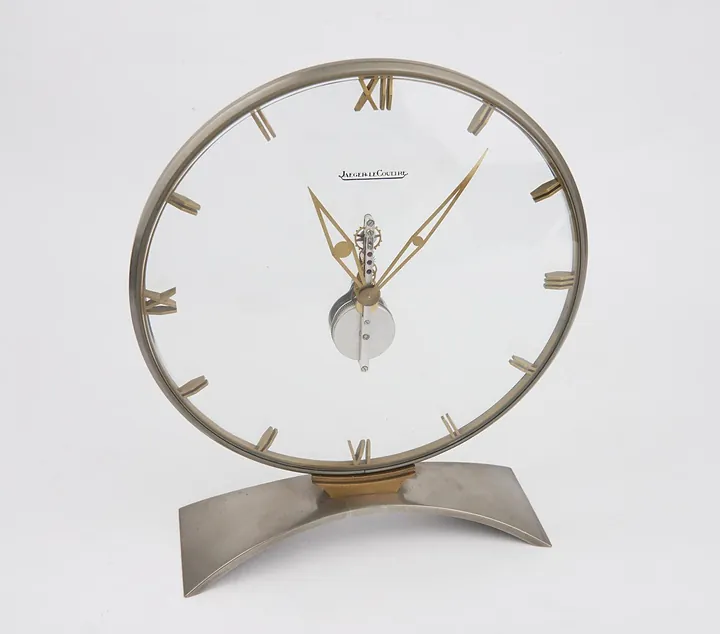
Skeleton clock by Jaeger-LeCoultre, Switzerland, 1937–1938
Science Museum Group, London
Movements & Components · 1953
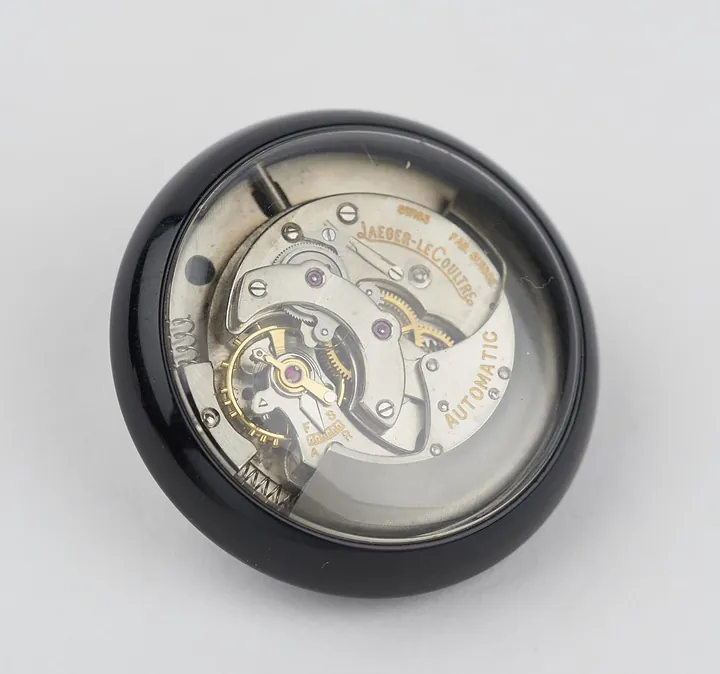
Automatic watch movement, Jaeger-LeCoultre, 1953, Geneva, Switzerland, showing self-winding mechanism
Science Museum Group, London
Wristwatches · 1953
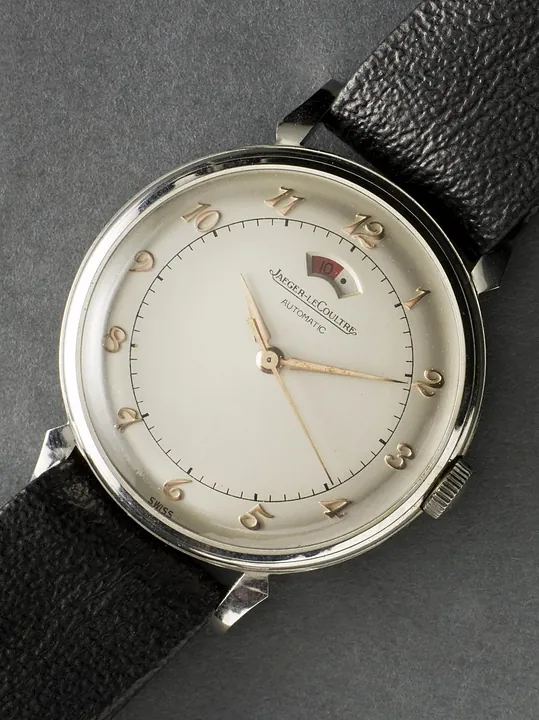
Automatic Wrist-watch, Jaeger-LeCoultre, Geneva, Switzerland, with reserve power indicator complete in steel case, 1953. Back numbered 564556.
Science Museum Group, London
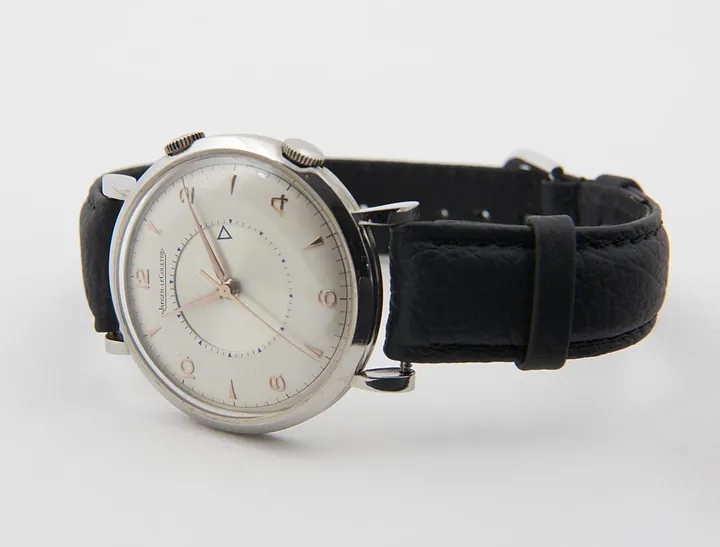
Wristwatches · 1953
Wrist-watch, 'Memovox' alarm, Jaeger-LeCoultre, Geneva, Switzerland, complete in steel case, 1953.
Science Museum Group, London
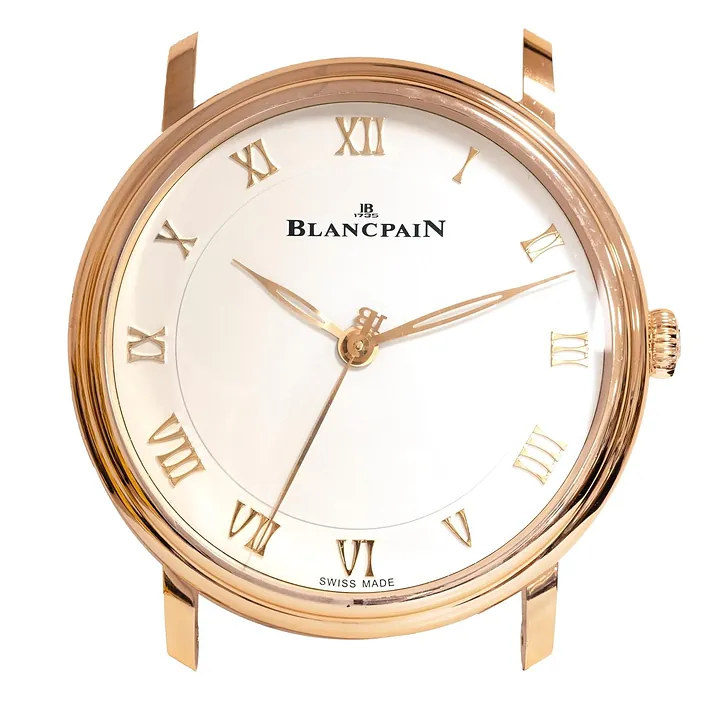
Clocks · c. 2010
Blancpain clock, c. 2010
Antiquorum auction archive, Geneva
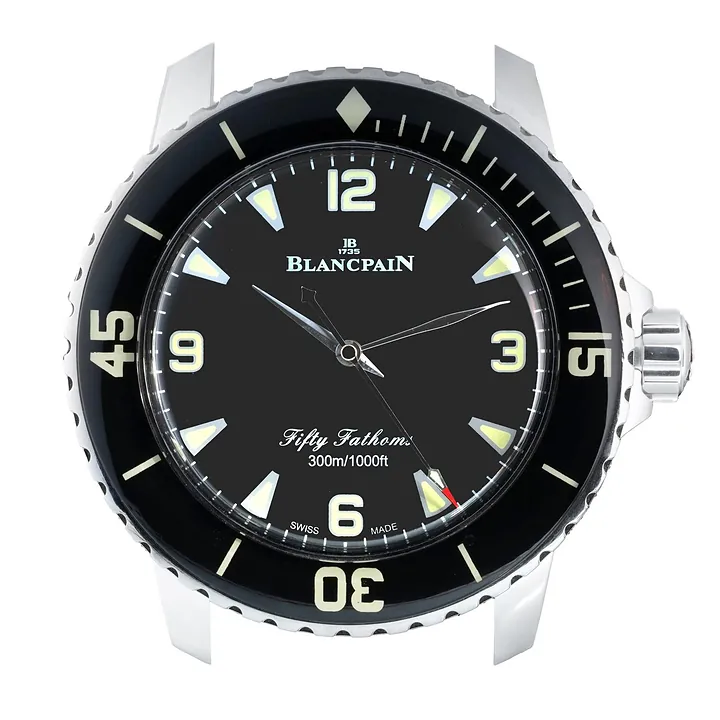
Clocks · c. 2015
Rueg Made for Blancpain Fifty Fathoms, c. 2015
Antiquorum auction archive, Geneva
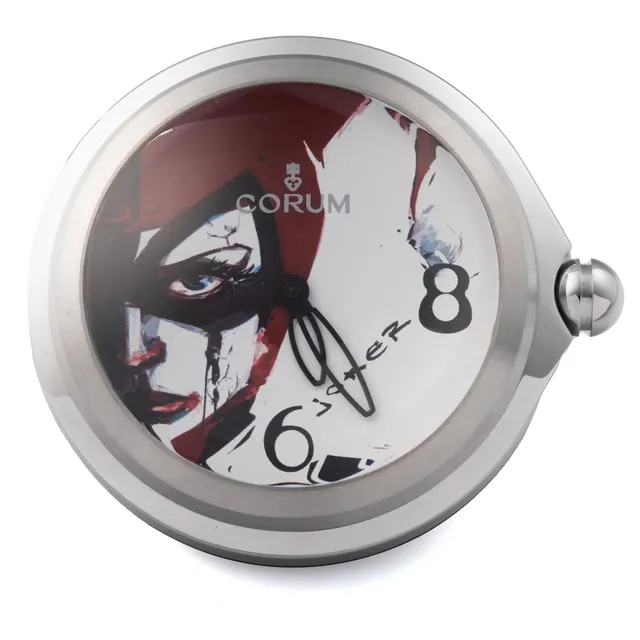
Clocks · c. 2010
Corum table clock, ref. 104636, Bubble Joker Desk Clock made in Limited Edition of 88 Pieces, circa 2010
Antiquorum auction archive, Geneva
Clocks · c. 2010s
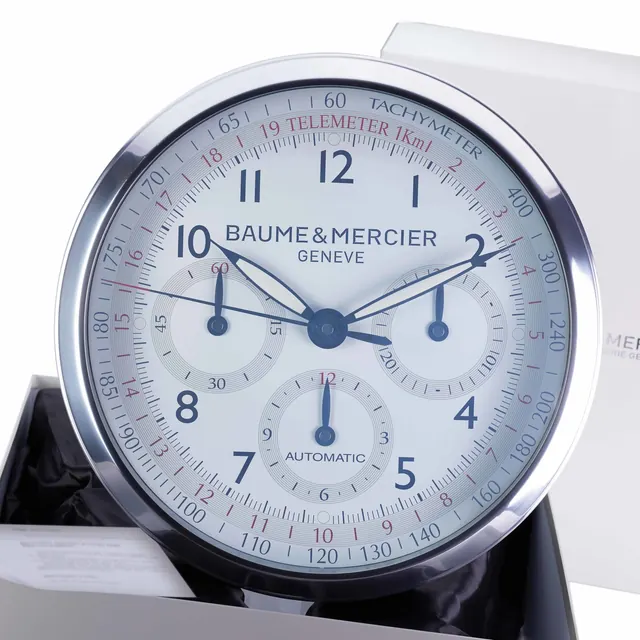
Baume & Mercier wall clock, Wall Clock Quartz, circa 2010s
Antiquorum auction archive, Geneva