
Wristwatches · Wristwatch
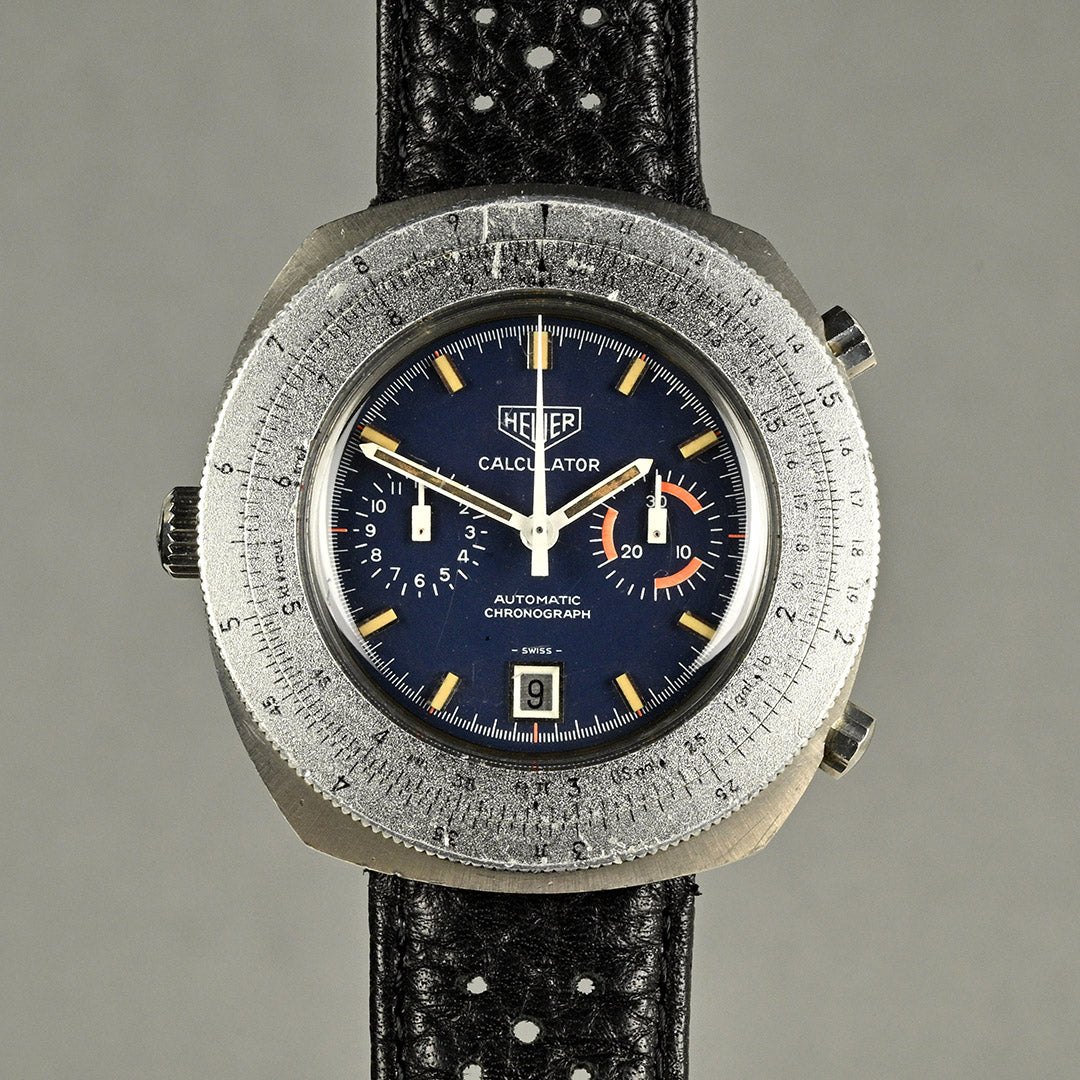
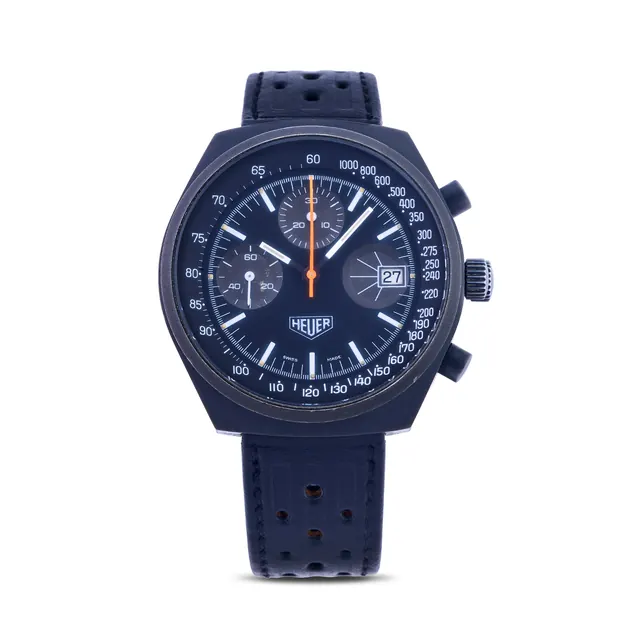
Heuer Calculator Automatic Chronograph ref. 110.633, circa 1972–1974
- Maker / attribution
- Heuer (maker)
- Date
- c. 1972–1974
- Historical period
- Quartz Revolution (1969 – 1990)
- Country of origin
- Switzerland
- Object type
- Wristwatch
- Dimensions
- Case 45 mm
- Stock no.
- vws4454cs
- Credit line
- Dealer listing, Vintage Watch Specialist (vws4454cs)
- Catalogue title (original)
- Heuer Calculator Automatic Chronograph Reference 110.633 c.1972–1974 (English)
View the source record (dealer listing) ↗ (opens another website in a new tab)Suggest a correction
Record summary
Catalogued by Vintage Watch Specialist (dealer), United Kingdom (stock number vws4454cs), this is a wristwatch by Heuer, made in Switzerland, dated c. 1972–1974. The Atlas places it in the Quartz Revolution period (1969 – 1990) of its Wristwatches collection. Recorded dimensions: Case 45 mm. The record is illustrated with 6 photographs.
Assembled from the source record's structured fields. Dates and attributions are given as the source states them; where a field is missing the Atlas leaves it blank rather than estimating.
Catalogue description
Dealer description — Vintage Watch Specialist
The 1970s were an exciting period for Heuer, with the Swiss watchmaker producing some of its most distinctive and technically ambitious chronographs. Alongside celebrated models such as the Monaco, Autavia and Carrera, the Calculator demonstrated Heuer's enthusiasm for combining mechanical precision with practical functionality. Introduced in the early 1970s, the Calculator was designed around an unusually large rotating slide-rule bezel. This allowed the wearer to perform a variety of calculations, including multiplication, division, conversions and other numerical operations, without reaching for a separate instrument. At its heart was Heuer's automatic chronograph technology, developed from the pioneering Chronomatic movement family introduced in 1969. The Calibre 12, an evolution of the original Calibre 11, offered automatic winding, a chronograph function and the distinctive left-hand crown arrangement associated with these movements. With its substantial cushion-shaped case, colourful dial and unmistakable technical bezel, the Calculator captures an era when mechanical wristwatches were becoming increasingly adventurous in both appearance and capability. Today, these distinctive chronographs offer collectors an interesting alternative to Heuer's better-known racing models, combining period styling with an impressive piece of Swiss watchmaking history. What's on Offer We are pleased to offer this impressive Heuer Calculator Automatic Chronograph, Reference 110.633, dating to approximately 1972–1974 , featuring a striking blue dial and the renowned Heuer Calibre 12 automatic chronograph movement. The first thing that catches the eye is the sheer presence of the watch. Measuring approximately 45mm across, its substantial stainless steel cushion-shaped case is unmistakably 1970s, with strong angular lines and a purposeful, instrument-like appearance. Surrounding the dial is the Calculator's defining feature: its oversized rotating slide-rule bezel. Covered in finely graduated numerical scales, this ingenious arrangement transforms the watch into a mechanical calculating instrument. The bezel remains in very good condition, with the markings retaining much of their definition despite the passage of more than five decades. The deep blue dial provides a wonderful contrast against the brushed steel case. Applied gold-tone baton hour markers introduce a little warmth, while the white chronograph hands and orange detailing within the right-hand register bring the design firmly into the sporting chronograph territory for which Heuer became famous. The two-register layout is particularly attractive, with a 12-hour chronograph counter at 9 o'clock and a 30-minute counter at 3 o'clock. A neatly framed date aperture sits at 6 o'clock, maintaining the balanced appearance of the dial. The dial itself is assessed as being in excellent condition, retaining its rich blue colouring and clearly defined printing. Inside beats the Heuer Calibre 12 , a 17-jewel automatic chronograph movement belonging to the celebrated Chronomatic family. Its unusual architecture places the winding crown on the left side of the case, with the chronograph pushers positioned conventionally on the right. The stainless steel case is assessed as being in good condition, displaying marks of wear consistent with its age and previous use. The Plexiglass crystal is also graded good, while the watch is fitted with a black perforated leather strap that complements its sporting character. With its imposing dimensions, fascinating calculating bezel and important automatic chronograph movement, this is a thoroughly characterful vintage Heuer. It is a watch that makes no attempt to disguise its 1970s origins — and is all the more appealing for it. For collectors who appreciate the more unusual creations from Heuer's golden era, this Calculator represents an excellent opportunity to acquire a distinctive example of the brand's mechanical ingenuity. Should you prefer to have the watch professionally serviced before delivery, this can be arranged through our watchmaker at an additional cost. Simply add a note when placing the watch in your basket, or contact us directly to discuss a quote. Condition Report: Crystal: Good Dial: Excellent Bezel: Very Good Case: Good Movement: See Description Overall: Very Good
Historical context
Quartz Revolution (1969 – 1990)
Seiko's Astron begins mass quartz timekeeping; traditional industries contract sharply.
Quartz and digital watches transformed the market after 1969. Swiss employment collapsed, Japanese and Hong Kong production soared, and the Swatch (1983) helped the Swiss industry recover; mechanical watches survived as luxury goods.
Read the period in the timelineMore wristwatches from this periodEarlier: Modern Mechanical Horology
Atlas type guide
Chronographs and split-seconds watches
A chronograph is a watch with an additional seconds hand that can be started, stopped and returned to zero independently of the timekeeping. Louis Moinet built an early example in 1816 and Nicolas Rieussec a recording 'chronographe' in 1821; Adolphe Nicole's heart-shaped reset cam (patented 1862) made the modern return-to-zero possible. Split-seconds (rattrapante) chronographs add a second hand that can be stopped for intermediate times; flyback chronographs restart instantly.
Chronographs were essential tools for doctors (pulsometer scales), artillery (telemeter), engineers and sport. In wristwatches, Valjoux, Venus, Lemania and later the automatic chronographs of 1969 (Zenith El Primero, the Chronomatic Calibre 11 group and Seiko 6139) are milestones.
What to look for
- Push-pieces on the case band or a single button in the crown (monopusher).
- Subsidiary registers for minutes and hours; tachymeter, telemeter or pulsometer scales.
- Column wheel versus cam control visible in the movement.
- Calibre markings of specialist makers (Valjoux, Lemania, Venus, Landeron).
Dating clues
- Pocket chronographs with heart cam reset: after 1862.
- Wrist chronographs: from c. 1910; two-button designs from the 1930s.
- Automatic chronographs: from 1969.
General guidance written by the Atlas editors about this kind of object. It is not a statement about this particular piece; for that, rely on the source record above and on physical examination.
Read next:Flyback chronographChronograph
Related records
Pocket Watches · c. 1960
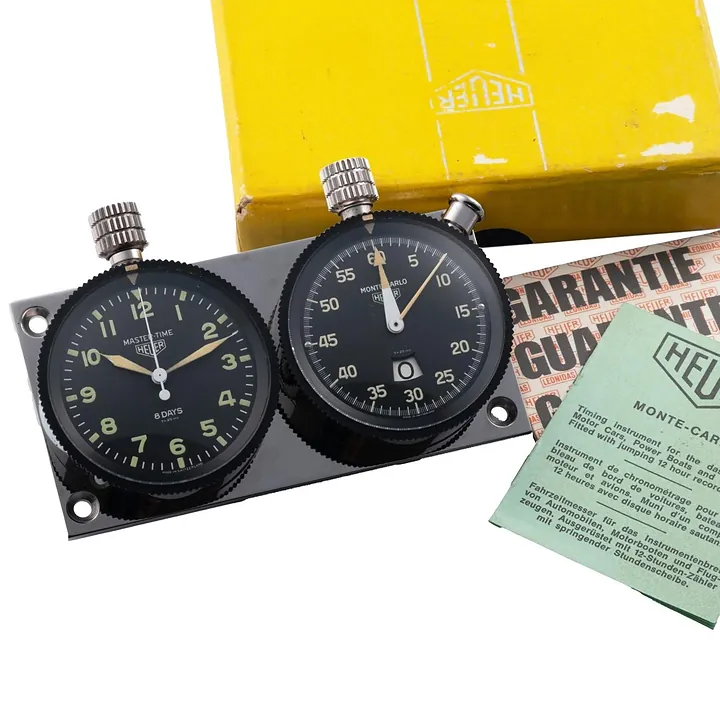
Heuer Racing SET, c. 1960
Antiquorum auction archive, Geneva
Wristwatches · c. 1980
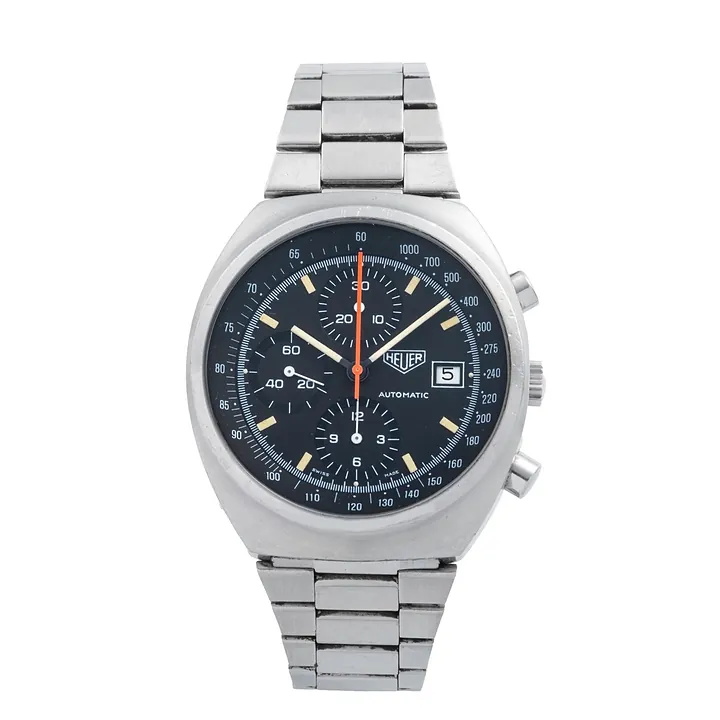
Heuer Pasadena, ref. 750.501-3, c. 1980
Antiquorum auction archive, Geneva
Wristwatches · c. 1970s
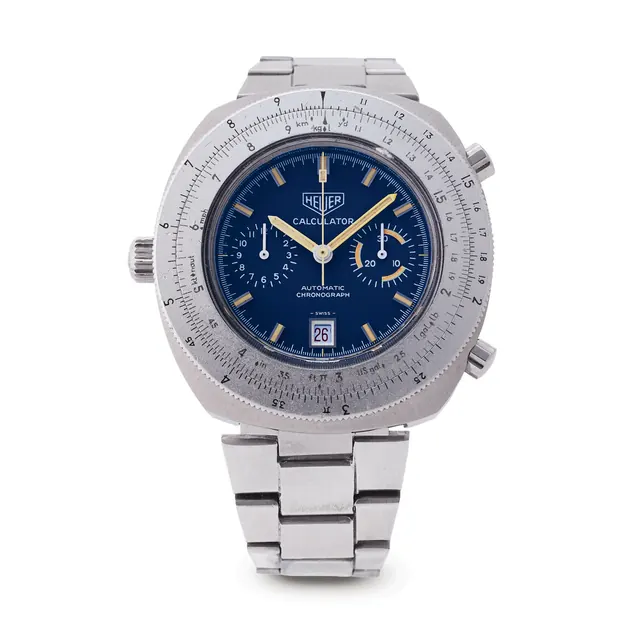
Heuer wristwatch, ref. 110.633, Calculator, circa 1970s
Antiquorum auction archive, Geneva
Wristwatches · c. 1975
Heuer wristwatch, ref. 13/1, circa 1975
Antiquorum auction archive, Geneva

Wristwatches · 1970
Wristwatch by Heno, Switzerland, 1970
Museum Rotterdam

Wristwatches · 1960–1986
'Tri-Compax' calendar chronograph wristwatch in gold case, by Universal, Geneva, Switzerland, 1960–1986.
Science Museum Group, London

Wristwatches · 1969–1970
Beta 21 Quartz wristwatch movement, made in Switzerland, 1970.
Science Museum Group, London

Wristwatches · c. 1969
Omega Speedmaster Moonwatch, ref. 145022-69st, c. 1969
Antiquorum auction archive, Geneva