
Wristwatches · Wristwatch
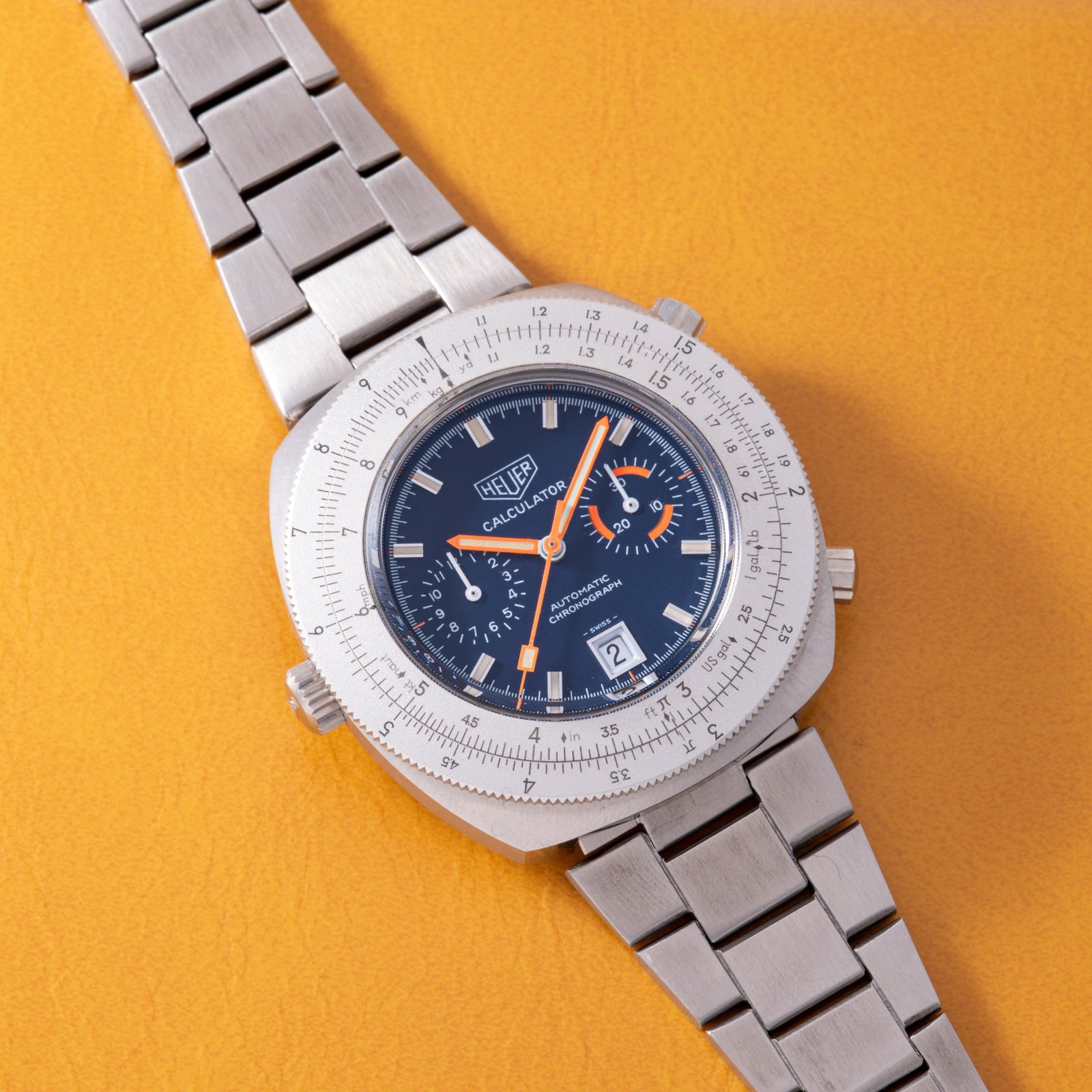
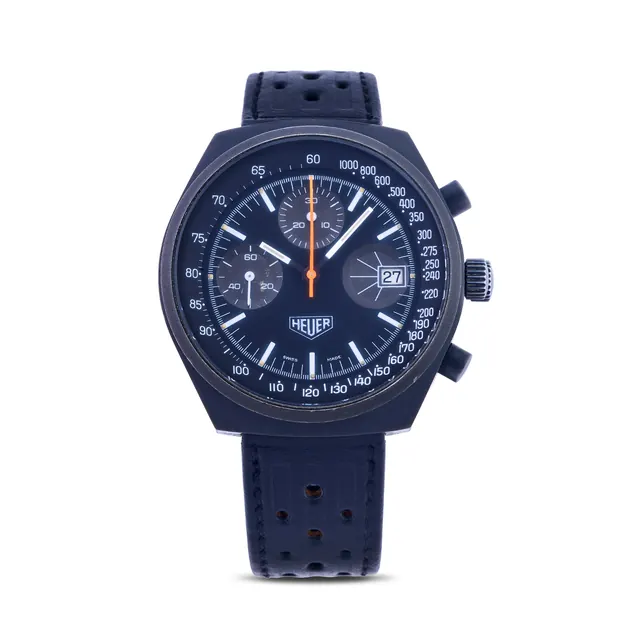
Heuer Calculator Automatic Chronograph, 1970s
- Maker / attribution
- Heuer (maker)
- Date
- 1970s
- Historical period
- Quartz Revolution (1969 – 1990)
- Country of origin
- Switzerland
- Object type
- Wristwatch
- Dimensions
- Case 45.5 mm
- Stock no.
- 40993024
- Credit line
- Dealer listing, Analog/Shift (40993024)
- Catalogue title (original)
- Heuer Calculator Automatic Chronograph (English)
View the source record (dealer listing) ↗ (opens another website in a new tab)Suggest a correction
Record summary
Catalogued by Analog/Shift (dealer), New York (stock number 40993024), this is a wristwatch by Heuer, made in Switzerland, dated 1970s. The Atlas places it in the Quartz Revolution period (1969 – 1990) of its Wristwatches collection. Recorded dimensions: Case 45.5 mm. The record is illustrated with 6 photographs.
Assembled from the source record's structured fields. Dates and attributions are given as the source states them; where a field is missing the Atlas leaves it blank rather than estimating.
Catalogue description
Dealer description — Analog/Shift
There is perhaps no more versatile complication than the chronograph. From race cars to rocket ships, boats to battlefields, you are likely to find a chronograph being employed to measure a plethora of tasks and times. From the Greek khrónos (“time) and gráphō (“to write”), a chronograph is a watch that has the ability to record time, generally via the addition of small sub-counters that register minutes and hours. Though many storied brands produced notable chronographs during the complication’s heyday from the 1930s through the 1970s, numerous other firms fell by the wayside during the Quartz Crisis, folding completely and disappearing or being rolled up into conglomerates that pillaged their stores of parts. Heuer, for its part, is still around today as TAG Heuer, but its pre-TAG period was perhaps its most fertile era of chronograph design. Take the Calculator watch, for example: this special model took advantage of the brand's esteemed automatic chronograph movement technology and paired it with a unique two-part slide rule bezel in what can best be described as a sort of mechanical calculator: Using the bezel, the wearer can easily calculate distance and weight and convert between metric and imperial. Pretty neat! This particular Heuer Calculator watch, a Reference 110.633, dates to the 1970s and features a 45.5mm 'tonneau-shaped' stainless steel case with an outer calculator bezel, dual 'pump' pushers, a left-hand crown, and a stainless steel multi-link bracelet. Its dial is a picture of legibility: Featuring an outer 1/5th-seconds track in white, luminous 'dash' indices, a dual-register chronograph with 30-minute and 12-hour counters, a date window at 6 o'clock, and a luminous orange 'baton' handset, it's easy to use as a time-recording device or for more complex calculations. Powered by the Heuer Calibre 12 automatic chronograph movement and paired to a cool stainless steel multi-link bracelet, this unique tool watch is an awesome vestige of one of the most creative periods in chronograph design. It brings a smile to our faces every time — we're confident that it'll do the same for you.
Historical context
Quartz Revolution (1969 – 1990)
Seiko's Astron begins mass quartz timekeeping; traditional industries contract sharply.
Quartz and digital watches transformed the market after 1969. Swiss employment collapsed, Japanese and Hong Kong production soared, and the Swatch (1983) helped the Swiss industry recover; mechanical watches survived as luxury goods.
Read the period in the timelineMore wristwatches from this periodEarlier: Modern Mechanical Horology
Atlas type guide
Chronographs and split-seconds watches
A chronograph is a watch with an additional seconds hand that can be started, stopped and returned to zero independently of the timekeeping. Louis Moinet built an early example in 1816 and Nicolas Rieussec a recording 'chronographe' in 1821; Adolphe Nicole's heart-shaped reset cam (patented 1862) made the modern return-to-zero possible. Split-seconds (rattrapante) chronographs add a second hand that can be stopped for intermediate times; flyback chronographs restart instantly.
Chronographs were essential tools for doctors (pulsometer scales), artillery (telemeter), engineers and sport. In wristwatches, Valjoux, Venus, Lemania and later the automatic chronographs of 1969 (Zenith El Primero, the Chronomatic Calibre 11 group and Seiko 6139) are milestones.
What to look for
- Push-pieces on the case band or a single button in the crown (monopusher).
- Subsidiary registers for minutes and hours; tachymeter, telemeter or pulsometer scales.
- Column wheel versus cam control visible in the movement.
- Calibre markings of specialist makers (Valjoux, Lemania, Venus, Landeron).
Dating clues
- Pocket chronographs with heart cam reset: after 1862.
- Wrist chronographs: from c. 1910; two-button designs from the 1930s.
- Automatic chronographs: from 1969.
General guidance written by the Atlas editors about this kind of object. It is not a statement about this particular piece; for that, rely on the source record above and on physical examination.
Read next:Flyback chronographChronograph
Related records
Pocket Watches · c. 1960
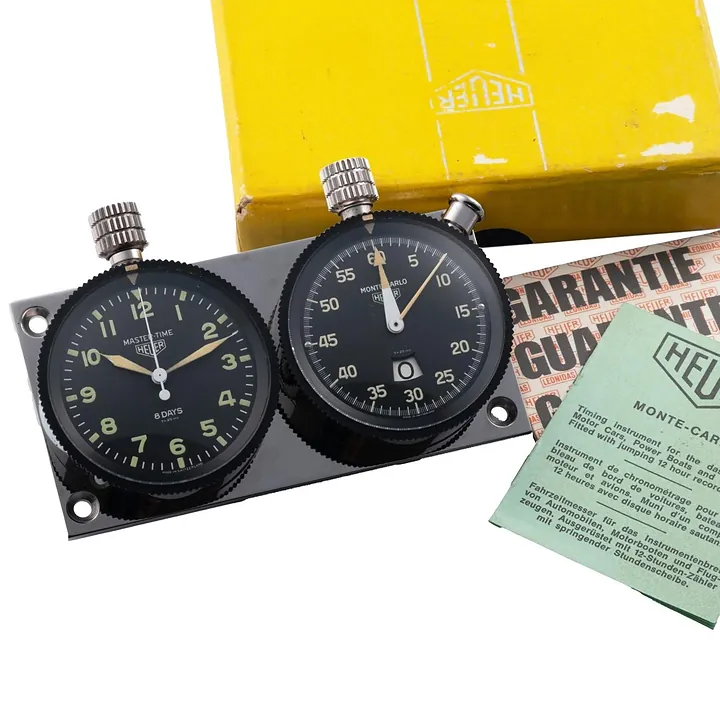
Heuer Racing SET, c. 1960
Antiquorum auction archive, Geneva
Wristwatches · c. 1980
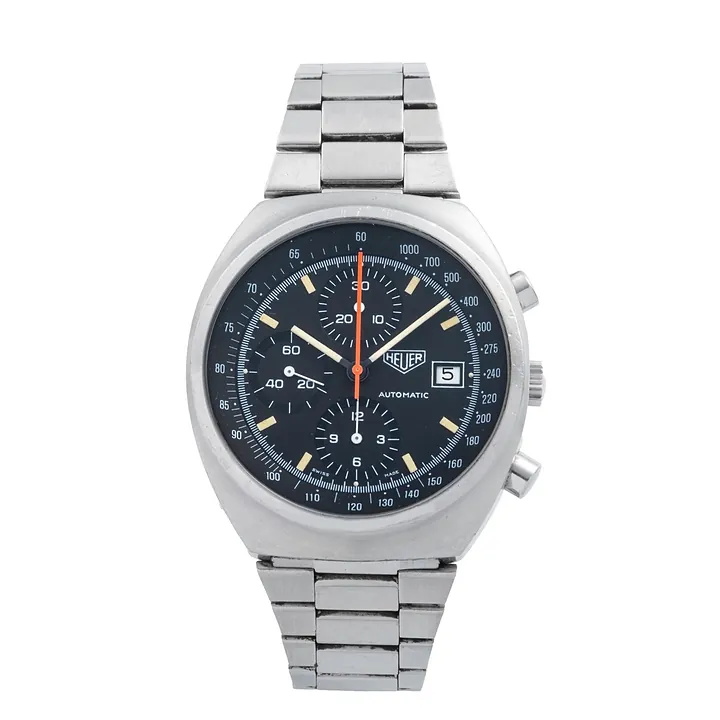
Heuer Pasadena, ref. 750.501-3, c. 1980
Antiquorum auction archive, Geneva
Wristwatches · c. 1970s
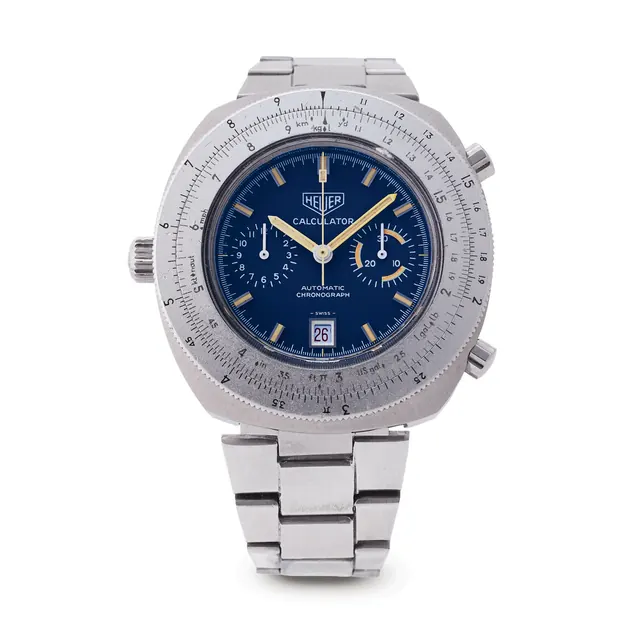
Heuer wristwatch, ref. 110.633, Calculator, circa 1970s
Antiquorum auction archive, Geneva
Wristwatches · c. 1975
Heuer wristwatch, ref. 13/1, circa 1975
Antiquorum auction archive, Geneva

Wristwatches · 1970
Wristwatch by Heno, Switzerland, 1970
Museum Rotterdam

Wristwatches · 1960–1986
'Tri-Compax' calendar chronograph wristwatch in gold case, by Universal, Geneva, Switzerland, 1960–1986.
Science Museum Group, London

Wristwatches · 1969–1970
Beta 21 Quartz wristwatch movement, made in Switzerland, 1970.
Science Museum Group, London

Wristwatches · c. 1969
Omega Speedmaster Moonwatch, ref. 145022-69st, c. 1969
Antiquorum auction archive, Geneva