
Wristwatches · Wristwatch
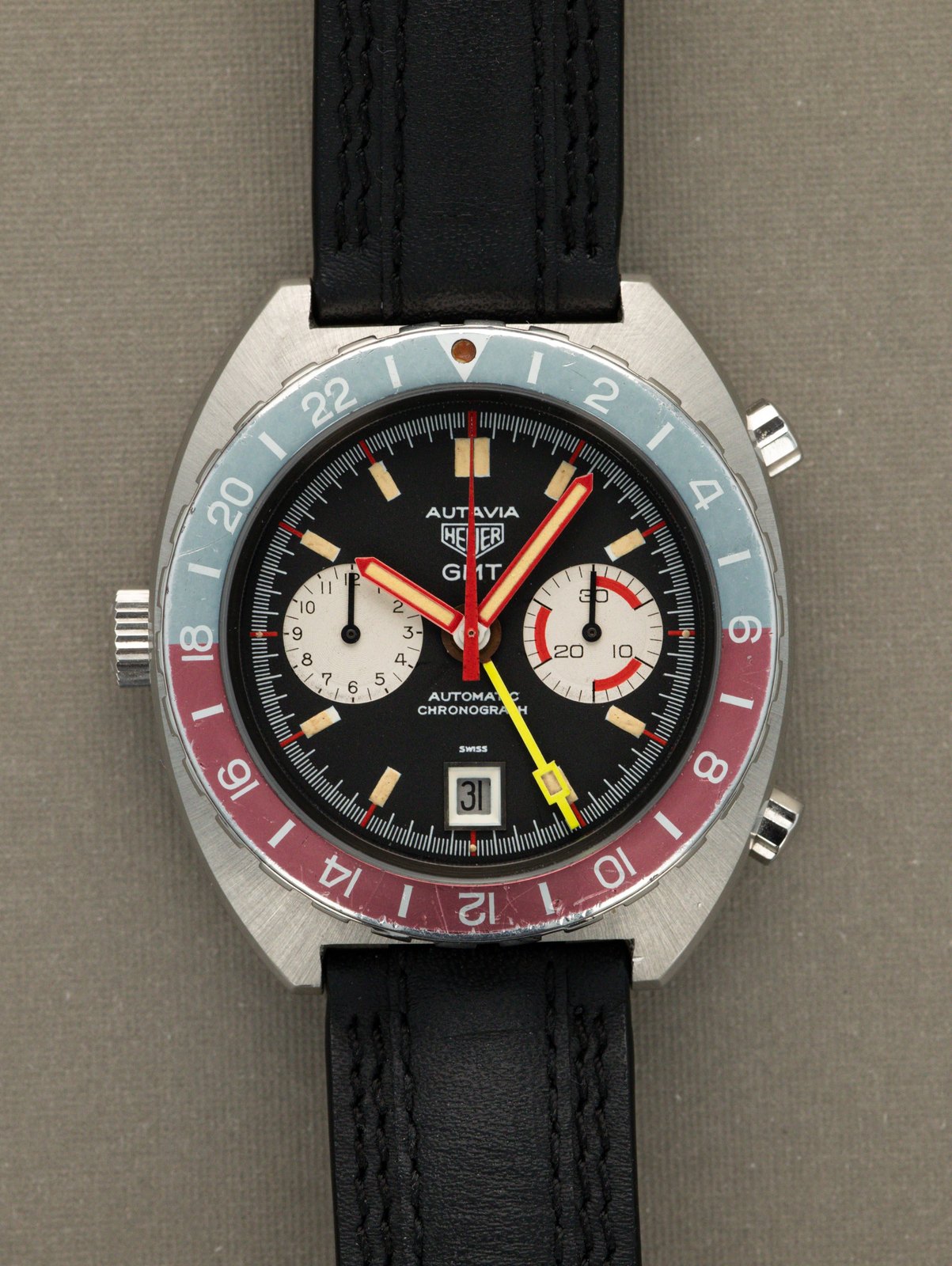
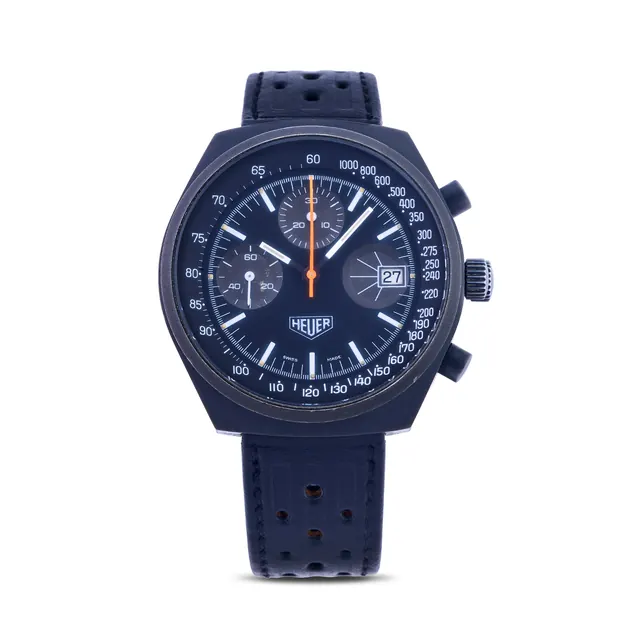
Heuer Autavia GMT ref. 11630, 'MK1'
- Maker / attribution
- Heuer (maker)
- Date
- early 1970s
- Historical period
- Quartz Revolution (1969 – 1990)
- Country of origin
- Switzerland
- Object type
- Wristwatch
- Stock no.
- OC3355
- Credit line
- Dealer listing, Oliver & Clarke (OC3355)
- Catalogue title (original)
- Heuer Autavia GMT Ref. 11630 - 'MK1' w/ Papers (English)
View the source record (dealer listing) ↗ (opens another website in a new tab)Suggest a correction
Record summary
Catalogued by Oliver & Clarke (dealer), United Kingdom (stock number OC3355), this is a wristwatch by Heuer, made in Switzerland, dated early 1970s. The Atlas places it in the Quartz Revolution period (1969 – 1990) of its Wristwatches collection. The record is illustrated with 6 photographs.
Assembled from the source record's structured fields. Dates and attributions are given as the source states them; where a field is missing the Atlas leaves it blank rather than estimating.
Catalogue description
Dealer description — Oliver & Clarke
While the Carrera gets all the attention, the Heuer Autavia is actually the ‘OG’ Heuer. A combination of ‘Automotive’ and ‘Aviation’ - the Autavia line originally started as dash mounted rally timers made for motorsport and aviation applications. It was not until the early 1960s that first Autavia wrist chronographs came around. The first generation Autvaia, the Reference 2446, utilized screw-back cases and the venerable Valjoux 72 manual-winding movements, while the second generation case with used a snap-back case or ‘Compressor’ Case - hence the model shift to 2446C. This watch, however, is a third generation ‘cushion case’ Autavia, which was the first to get Heuer’s Cal 11 automatic winding chronograph movement. When you think of an Autavia, theres a good chance that this is what comes to mind. Dating to the early 1970s, this GMT Ref. 11630 is offered in fantastic overall condition. The case has seemingly been very, very lightly previously polished, perhaps on the profiles only, retaining clear and defined finishing throughout with just light signs of wear. It retains its correct 'fluted' pushers, signed crown at the 9 o'clock position, as well as the correct bezel assembly with a red/blue aluminum 24-hr insert. Inside, the matte black dial features white and white subsidiary registers, both of which are garnished with just the right amount of red accents. The red-painted handset tied everything together beautifully, with a vibrant GMT hand that stands out for quick legibility. Powering this piece is a modified variant of the legendary Calibre 12 automatic-winding chronograph movement with a date at the 6 o'clock position: the Cal. 14. This piece comes fitted to a signed black leather strap and signed steel buckle, both replacements, as well as papers. While not an outright rare Reference, excellent, well rounded examples like the one that we have here don't surface on the market everyday.
Historical context
Quartz Revolution (1969 – 1990)
Seiko's Astron begins mass quartz timekeeping; traditional industries contract sharply.
Quartz and digital watches transformed the market after 1969. Swiss employment collapsed, Japanese and Hong Kong production soared, and the Swatch (1983) helped the Swiss industry recover; mechanical watches survived as luxury goods.
Read the period in the timelineMore wristwatches from this periodEarlier: Modern Mechanical Horology
Atlas type guide
Military, pilot and travel watches
The wristwatch owes much of its adoption by men to warfare and aviation. Wristlets — small pocket watches soldered with lugs and worn on a strap — were used in colonial campaigns and became standard equipment in the First World War, with protective grilles over the crystal ('shrapnel guards'). Louis Cartier's Santos (1904), designed for the aviator Alberto Santos-Dumont, is often cited as an early purpose-made pilot's watch.
In the Second World War governments specified watches in detail: the German B-Uhr observation watches, the American A-11, and the British 'W.W.W.' (the 'Dirty Dozen' set of 1945). After the war, jet travel brought GMT and world-time watches, which show two or more time zones at once — Louis Cottier's world-time mechanism and the Rolex GMT-Master (1955) are examples.
What to look for
- Military markings on the case back: broad arrow, issue numbers, 'W.W.W.', 'A.T.P.'
- High-legibility black dials with luminous Arabic numerals; oversized crowns for gloved hands.
- 24-hour hands and rotating 24-hour bezels or city rings on GMT/world-time watches.
- Wire lugs on early wristlets converted from pocket watches.
Dating clues
- Wire-lug wristlets: c. 1900–1925.
- Military specifications of the Second World War: 1939–1945.
- GMT and world-time wristwatches: mainly after 1950.
General guidance written by the Atlas editors about this kind of object. It is not a statement about this particular piece; for that, rely on the source record above and on physical examination.
Related records
Pocket Watches · c. 1960
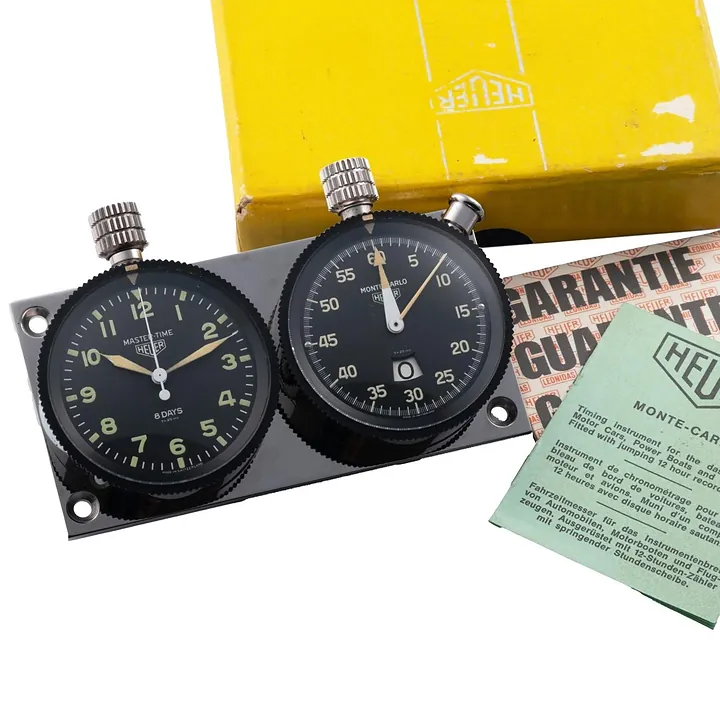
Heuer Racing SET, c. 1960
Antiquorum auction archive, Geneva
Wristwatches · c. 1980
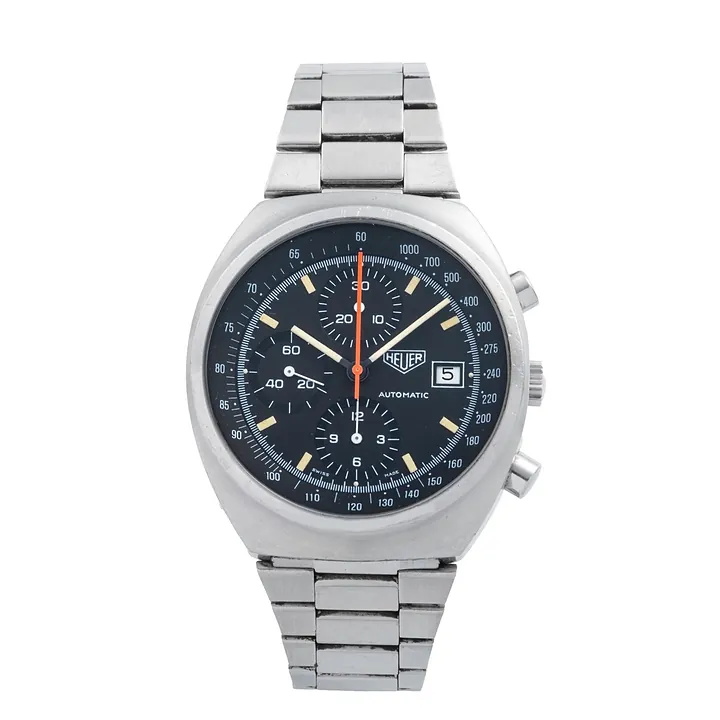
Heuer Pasadena, ref. 750.501-3, c. 1980
Antiquorum auction archive, Geneva
Wristwatches · c. 1970s
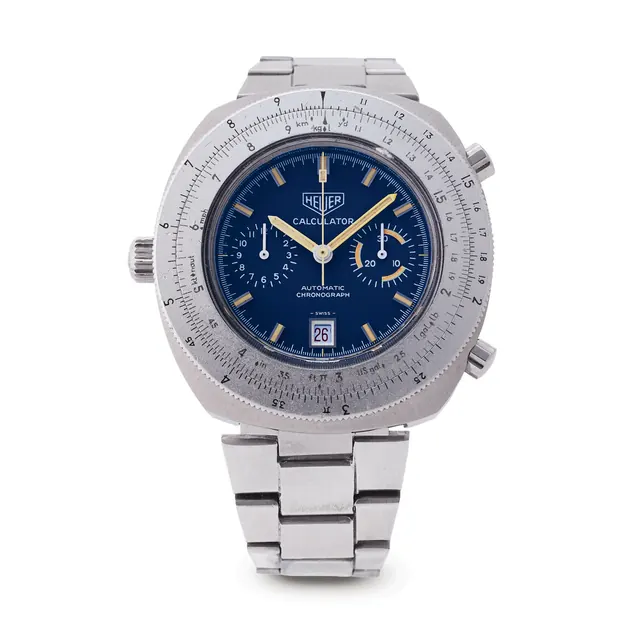
Heuer wristwatch, ref. 110.633, Calculator, circa 1970s
Antiquorum auction archive, Geneva
Wristwatches · c. 1975
Heuer wristwatch, ref. 13/1, circa 1975
Antiquorum auction archive, Geneva

Wristwatches · 1970
Wristwatch by Heno, Switzerland, 1970
Museum Rotterdam

Wristwatches · 1960–1986
'Tri-Compax' calendar chronograph wristwatch in gold case, by Universal, Geneva, Switzerland, 1960–1986.
Science Museum Group, London

Wristwatches · 1969–1970
Beta 21 Quartz wristwatch movement, made in Switzerland, 1970.
Science Museum Group, London

Wristwatches · c. 1969
Omega Speedmaster Moonwatch, ref. 145022-69st, c. 1969
Antiquorum auction archive, Geneva