
Wristwatches · Wristwatch
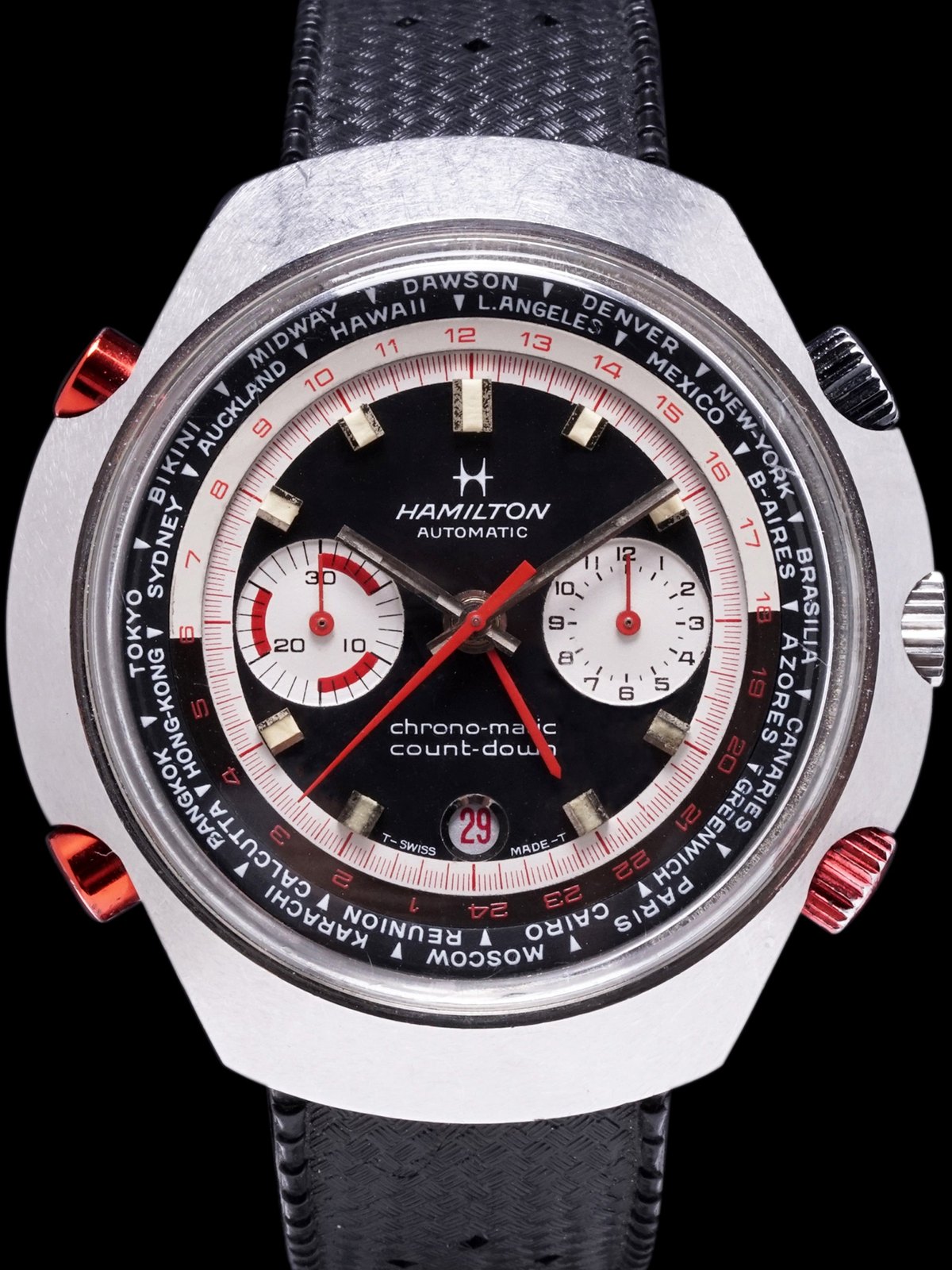
Hamilton Count-Down GMT Chrono-Matic (Ref. 141001-3), 1970s
- Maker / attribution
- Hamilton (maker)
- Date
- 1970s
- Historical period
- Quartz Revolution (1969 – 1990)
- Country of origin
- Switzerland
- Object type
- Wristwatch
- Dimensions
- Case 48 mm
- Stock no.
- HAMCDCM1410013
- Credit line
- Dealer listing, Craft & Tailored (HAMCDCM1410013)
- Catalogue title (original)
- 1970s Hamilton Count-Down GMT Chrono-Matic (Ref. 141001-3) (English)
View the source record (dealer listing) ↗ (opens another website in a new tab)Suggest a correction
Record summary
Catalogued by Craft & Tailored (dealer), Los Angeles (stock number HAMCDCM1410013), this is a wristwatch by Hamilton, made in Switzerland, dated 1970s. The Atlas places it in the Quartz Revolution period (1969 – 1990) of its Wristwatches collection. Recorded dimensions: Case 48 mm. The record is illustrated with 6 photographs.
Assembled from the source record's structured fields. Dates and attributions are given as the source states them; where a field is missing the Atlas leaves it blank rather than estimating.
Catalogue description
Dealer description — Craft & Tailored
This Hamilton Count-Down GMT Chromatic is a watch that is rarely seen outside of private collections. The Chronomatic has a large 48mm satin-brushed case, anodized red pushers and features a Chrono-Matic cal.141 with an additional GMT hand and two crowns used to rotate 24h and time-zone bezel rings. The Count-Down GMT Chronomatic uses a movement that was a joint development between Breitling, Heuer, and Buren and utilizes a micro-rotor automatic winding mechanism making it one of the first automatic chronograph movements ever made. This movement caliber was based on the highly respected cal. 11 chronograph movement. The joint collaboration created the cal. 14, which houses a GMT function. All 3 companies (Breitling, Heuer, and Buren) used these movements in their watches. Hamilton fits into this picture as they acquired the Buren firm in 1966. Hamilton dubbed this modified moment the Cal. 141. The distinct design features the chronograph push buttons on the opposite of the crown, which mostly leads to watches with the crown on the left and pushers on the right. When looking at the back of the watch the number 141001-3 is shown. Indicating it has the caliber 14 or Hamilton 141 movement. The Hamilton Count-Down GMT Chrono-Matic is not only functional but extremely sought after among the watch collecting community. Stock # HAMCDCM1410013 Brand Hamilton Style Count-Down GMT Chronomatic Model 141001-3 Serial N/A Size Men's Material Stainless Steel Dial Black White Sub-Dials Millimeters 48mm Strap 2pc Tropic Rubber Strap CASE & BRACELET The case is in exceptional, unpolished, and original condition, displaying light signs of honest use and retaining strong finishing on both the case sides and the top of the case. The crystal is in excellent condition showing only minimal signs of use. The case retains its original anodized pushers and crowns that show minimal signs of previous use. The case back displays all of its factory brushing and all of its factory markings in very clean condition. The watch comes supplied on a 2pc rubber tropic strap. DIAL & HANDS The matte black is in excellent condition showing only minimal signs of age. The white sub-dials are exceptionally clean and remain bright. The white outer minute track is flawless, displaying no signs of age whatsoever. The inner rotating day/night GMT bezel retains all of its Arabic numerals and shows very signs of age. The secondary inner rotating world time bezel is also in remarkable condition, showing only a slight amount of age. The tritium markers all remain fully intact when inspected under U.V. light and have taken on a handsome yellow patina, the 4, 5, and 7 o’clock markers have taken on a darker patina. All of the hands remain original to the watch, under U.V. light inspection the hour and minute hands display no degradation and match the patina of the marker on the lower half of the dial. ACCESSORIES
Historical context
Quartz Revolution (1969 – 1990)
Seiko's Astron begins mass quartz timekeeping; traditional industries contract sharply.
Quartz and digital watches transformed the market after 1969. Swiss employment collapsed, Japanese and Hong Kong production soared, and the Swatch (1983) helped the Swiss industry recover; mechanical watches survived as luxury goods.
Read the period in the timelineMore wristwatches from this periodEarlier: Modern Mechanical Horology
Atlas type guide
Military, pilot and travel watches
The wristwatch owes much of its adoption by men to warfare and aviation. Wristlets — small pocket watches soldered with lugs and worn on a strap — were used in colonial campaigns and became standard equipment in the First World War, with protective grilles over the crystal ('shrapnel guards'). Louis Cartier's Santos (1904), designed for the aviator Alberto Santos-Dumont, is often cited as an early purpose-made pilot's watch.
In the Second World War governments specified watches in detail: the German B-Uhr observation watches, the American A-11, and the British 'W.W.W.' (the 'Dirty Dozen' set of 1945). After the war, jet travel brought GMT and world-time watches, which show two or more time zones at once — Louis Cottier's world-time mechanism and the Rolex GMT-Master (1955) are examples.
What to look for
- Military markings on the case back: broad arrow, issue numbers, 'W.W.W.', 'A.T.P.'
- High-legibility black dials with luminous Arabic numerals; oversized crowns for gloved hands.
- 24-hour hands and rotating 24-hour bezels or city rings on GMT/world-time watches.
- Wire lugs on early wristlets converted from pocket watches.
Dating clues
- Wire-lug wristlets: c. 1900–1925.
- Military specifications of the Second World War: 1939–1945.
- GMT and world-time wristwatches: mainly after 1950.
General guidance written by the Atlas editors about this kind of object. It is not a statement about this particular piece; for that, rely on the source record above and on physical examination.
Related records
Pocket Watches · c. 1943
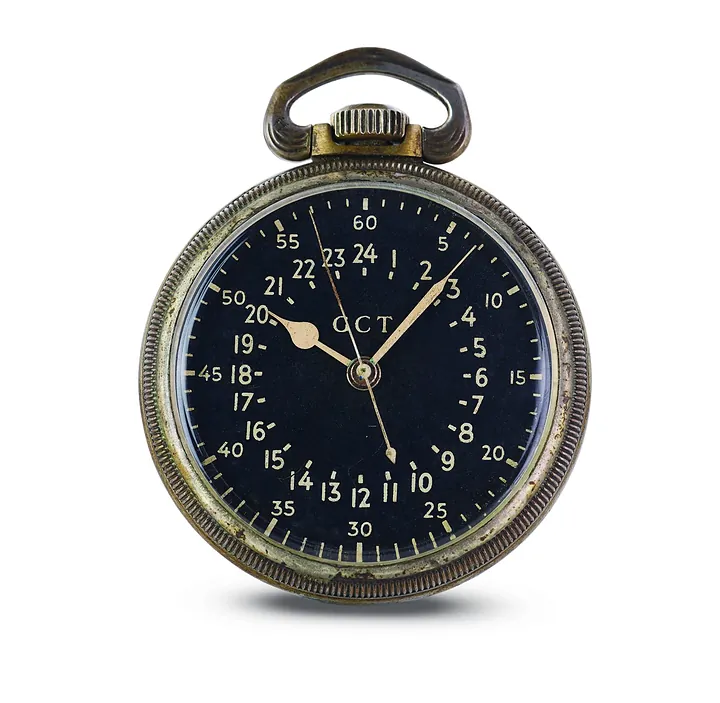
Hamilton 4992B, GCT Navigation U.S Air Force, c. 1943
Antiquorum auction archive, Geneva
Wristwatches · c. 1940s
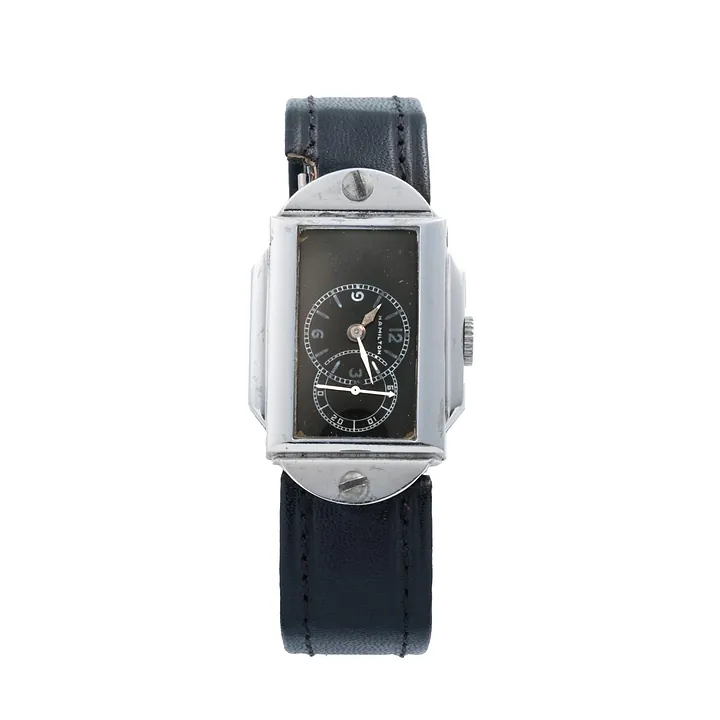
Hamilton Bomb Timer, c. 1940s
Antiquorum auction archive, Geneva
Wristwatches · originally sold in February 2025 (per the lot record)
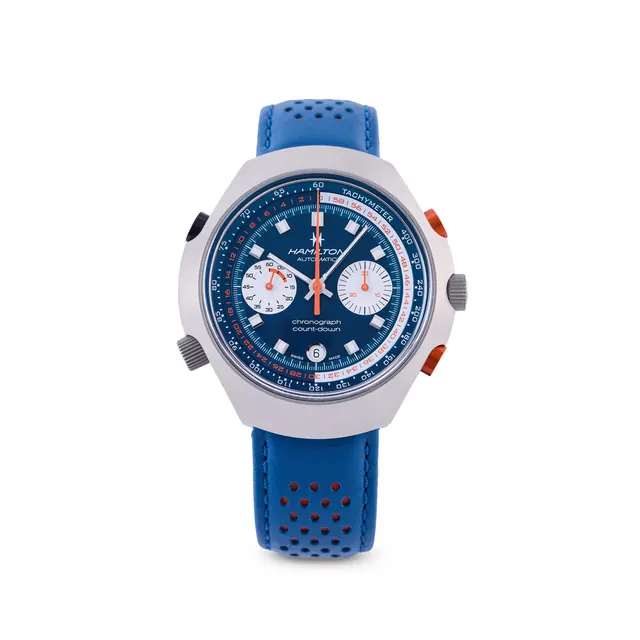
Hamilton wristwatch, ref. H51606640, American Classic Chrono-Matic 50 Limited Edition, originally sold in February 2025 (per the lot record)
Antiquorum auction archive, Geneva
Wristwatches · c. 1940s
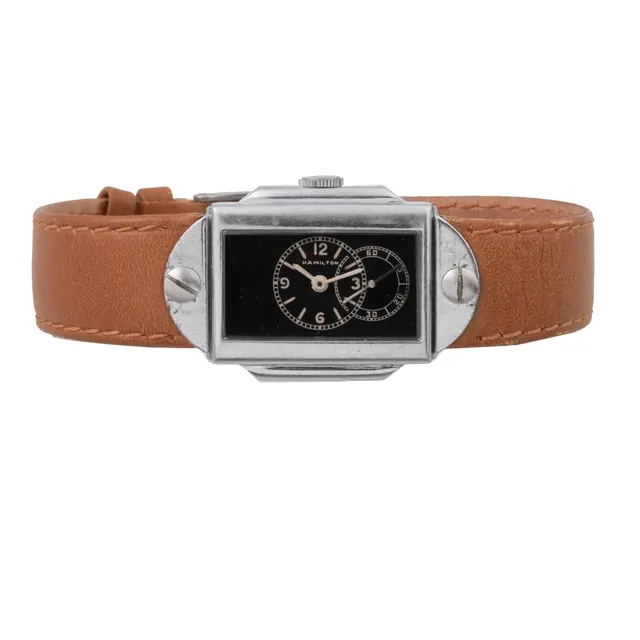
Hamilton wristwatch, Bomb Timer Watch, circa 1940's
Antiquorum auction archive, Geneva

Wristwatches · 1970
Wristwatch by Heno, Switzerland, 1970
Museum Rotterdam

Wristwatches · 1960–1986
'Tri-Compax' calendar chronograph wristwatch in gold case, by Universal, Geneva, Switzerland, 1960–1986.
Science Museum Group, London

Wristwatches · 1969–1970
Beta 21 Quartz wristwatch movement, made in Switzerland, 1970.
Science Museum Group, London

Wristwatches · c. 1969
Omega Speedmaster Moonwatch, ref. 145022-69st, c. 1969
Antiquorum auction archive, Geneva