
Wristwatches · Wristwatch
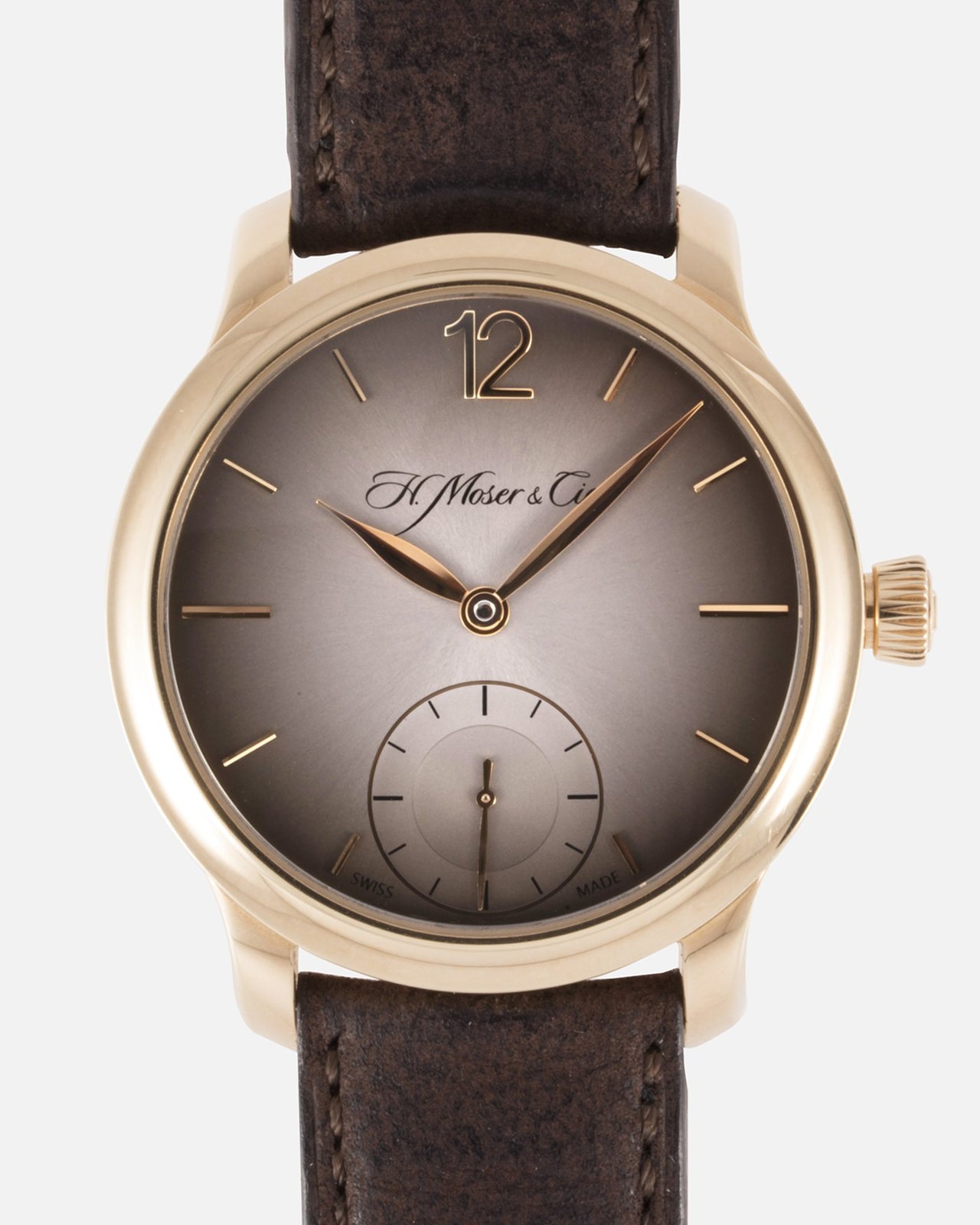
H.Moser & Cie Mayu Fumé Dial, 2016
- Maker / attribution
- H. Moser & Cie (maker)
- Date
- 2016
- Historical period
- Contemporary Horology (2010 – Present)
- Country of origin
- Switzerland
- Object type
- Wristwatch
- Dimensions
- Case 39 mm
- Stock no.
- Product 2001920720983
- Credit line
- Dealer listing, S.Song Watches (product 2001920720983)
- Catalogue title (original)
- H.Moser & Cie Mayu Fumé Dial (English)
View the source record (dealer listing) ↗ (opens another website in a new tab)Suggest a correction
Record summary
Catalogued by S.Song Watches (dealer), Seattle (stock number Product 2001920720983), this is a wristwatch by H. Moser & Cie, made in Switzerland, dated 2016. The Atlas places it in the Contemporary Horology period (2010 – Present) of its Wristwatches collection. Recorded dimensions: Case 39 mm. The record is illustrated with 6 photographs.
Assembled from the source record's structured fields. Dates and attributions are given as the source states them; where a field is missing the Atlas leaves it blank rather than estimating.
Catalogue description
Dealer description — S.Song Watches
H. Moser & Cie are an independent watch brand who has become known as the enfant terrible of the Swiss watchmaking industry. Quite a polarising brand, they made their name initially creating beautiful elegant timepieces but in the last few years, they have really become a force to reckon with introducing satire into their watchmaking, with pieces such as the one-off ‘Swiss Cheese’ watch and ‘Apple’ watch. I for one think this is refreshing that a brand is taking an active stand to criticise and create a commentary on the Swiss watch industry, especially as it comes from a brand with a very strong pedigree. The H. Moser & Cie Mayu is one of the earlier creations from the manufacture and is a very nice, understated and elegant piece with a lot of details going for it. The 39mm case is crafted in rose gold and despite it looking like a traditional watch case, the construction of the lugs gives it a lot of extra depth and makes it far more interesting. The case design is done so that the softly bevelled lugs run off to the side of the case and slowly diminish, with its polished finish perfectly contrasted with the brushed finished in the background. The dial is seriously mesmerising as the brown fume finish really reflects light well and creates all sorts of tones. It’s not all looks with the Moser Mayu as the watch is powered by a very impressive in-house calibre HMC 321.503. The manual winding movement is regulated by a Straumann double hairspring which is also produced in-house and the springs move in opposite directions, offsetting gravity errors. Not many manufactures can say they create their own hairsprings! Furthermore, there is a power reserve indicator on the movement and it has a whopping 80 hours of run time! The movement is beautifully finished and architecturally very pleasing to look at. With only approximately 1200 pieces produced a year, H. Moser & Cie is truly an enigmatic independent brand that creates highly original timepieces.
Historical context
Contemporary Horology (2010 – Present)
Silicon components, connected watches, optical-lattice research clocks and a thriving independent scene.
Smartwatches became the world's best-selling watches, while mechanical watchmaking focuses on craft, innovation (silicon components, new escapements) and independent makers.
Read the period in the timelineMore wristwatches from this periodEarlier: Mechanical Renaissance
Atlas type guide
Wristwatches
Bracelet watches were worn by women from the early nineteenth century — Breguet made one for Caroline Murat, Queen of Naples, in 1810–12 — but the wristwatch only became a man's instrument with military use and aviation in the early twentieth century. Between the World Wars it overtook the pocket watch; the 1920s and 1930s brought rectangular Art Deco cases, water-resistant cases and the first automatic winding systems.
After 1945 the wristwatch became a carrier of identity — dress watches, sports and dive watches, chronographs, calendars — produced by Swiss, American, Japanese, German, Soviet and Chinese industries. The quartz revolution after 1969 and the mechanical renaissance since the 1990s, including the rise of independent watchmakers, complete the story.
What to look for
- The reference number (between the lugs or inside the case back) and serial number, the starting point for dating.
- The calibre: its maker and number are often stamped under the dial or on the bridge.
- Originality of dial, hands and crown — refinished ('redial') dials are common.
- Case material marks: 18K/750, 14K/585, stainless steel, gold-filled, plated.
Dating clues
- Wire-lug cases: before c. 1925.
- Water-resistant screw-down cases: from 1926.
- Quartz movements: from 1969; sapphire crystals widespread after c. 1980.
General guidance written by the Atlas editors about this kind of object. It is not a statement about this particular piece; for that, rely on the source record above and on physical examination.
Related records
Wristwatches · originally sold in 2021 (per the lot record)
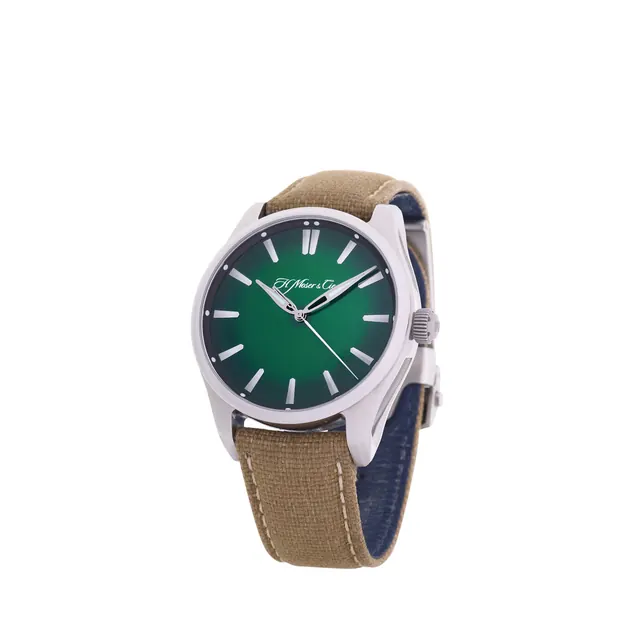
H. Moser & Cie wristwatch, ref. 3200.1202, Pionner, originally sold in 2021
Antiquorum auction archive, Geneva
Wristwatches · c. 2016
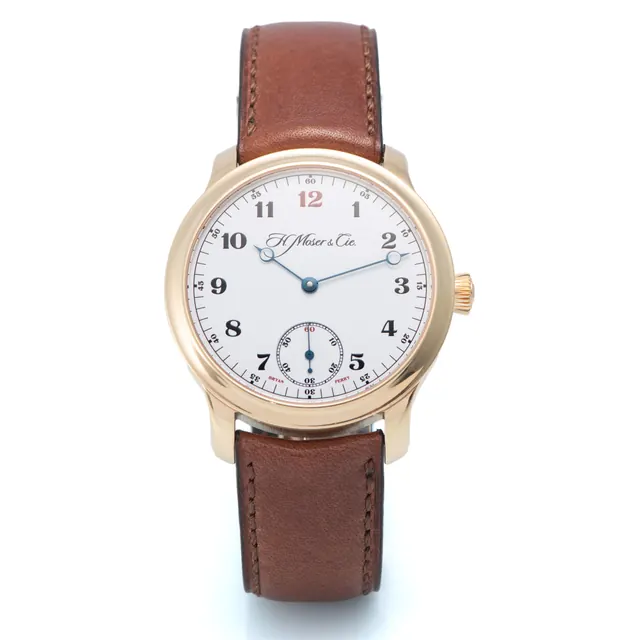
H. Moser & Cie wristwatch, ref. 1321-0116, Endeavour Limited Brian Ferry Edition of 100 Pieces, circa 2016
Antiquorum auction archive, Geneva
Pocket Watches · c. 1910
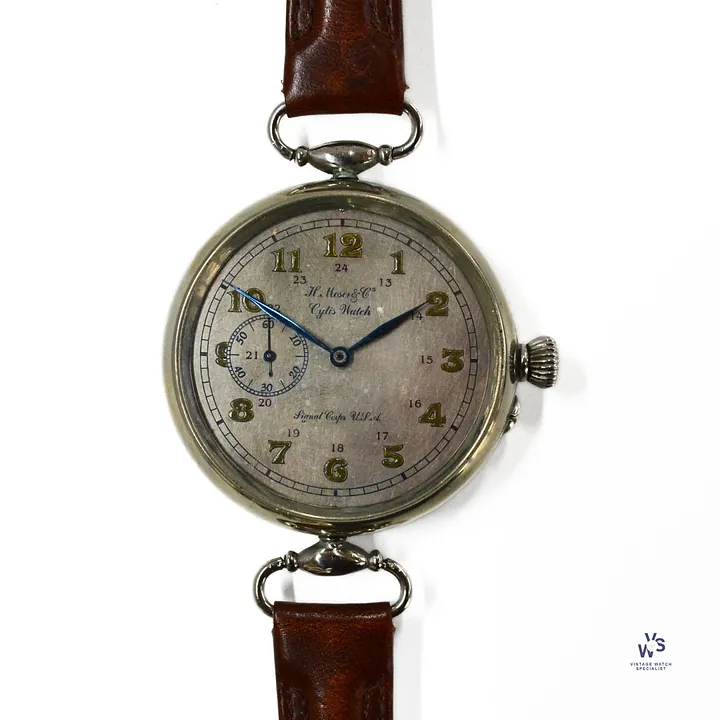
H.Moser & Cie, Cylis Watch, US Signal Corps, Pocket Watch Conversion, circa 1910
Vintage Watch Specialist (dealer), United Kingdom
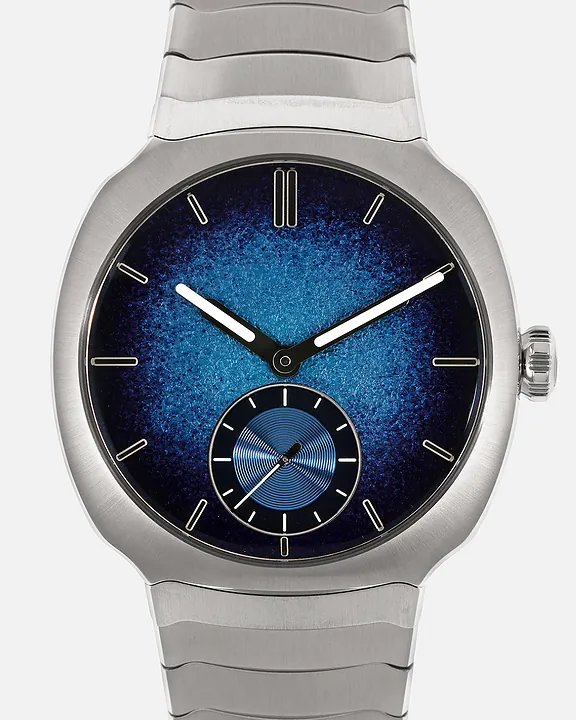
Wristwatches · 2025
H. Moser & Cie Streamliner Small Seconds Blue Enamel 6500-1200, 2025
S.Song Watches (dealer), Seattle

Wristwatches · c. 2010s
Breguet Type XXI, ref. 3810, c. 2010s (Antiquorum Lot 381-24)
Antiquorum auction archive, Geneva

Wristwatches · c. 2010s
Breguet Type XXI, ref. 3810, c. 2010s (Antiquorum Lot 386-229)
Antiquorum auction archive, Geneva

Wristwatches · Sold in September 2010
Breitling Cosmonaute, ref. A 22322, Sold in September 2010
Antiquorum auction archive, Geneva

Wristwatches · c. 2010
Corum Bubble Chrono, ref. 396.150.20, c. 2010
Antiquorum auction archive, Geneva