
Wristwatches · Wristwatch
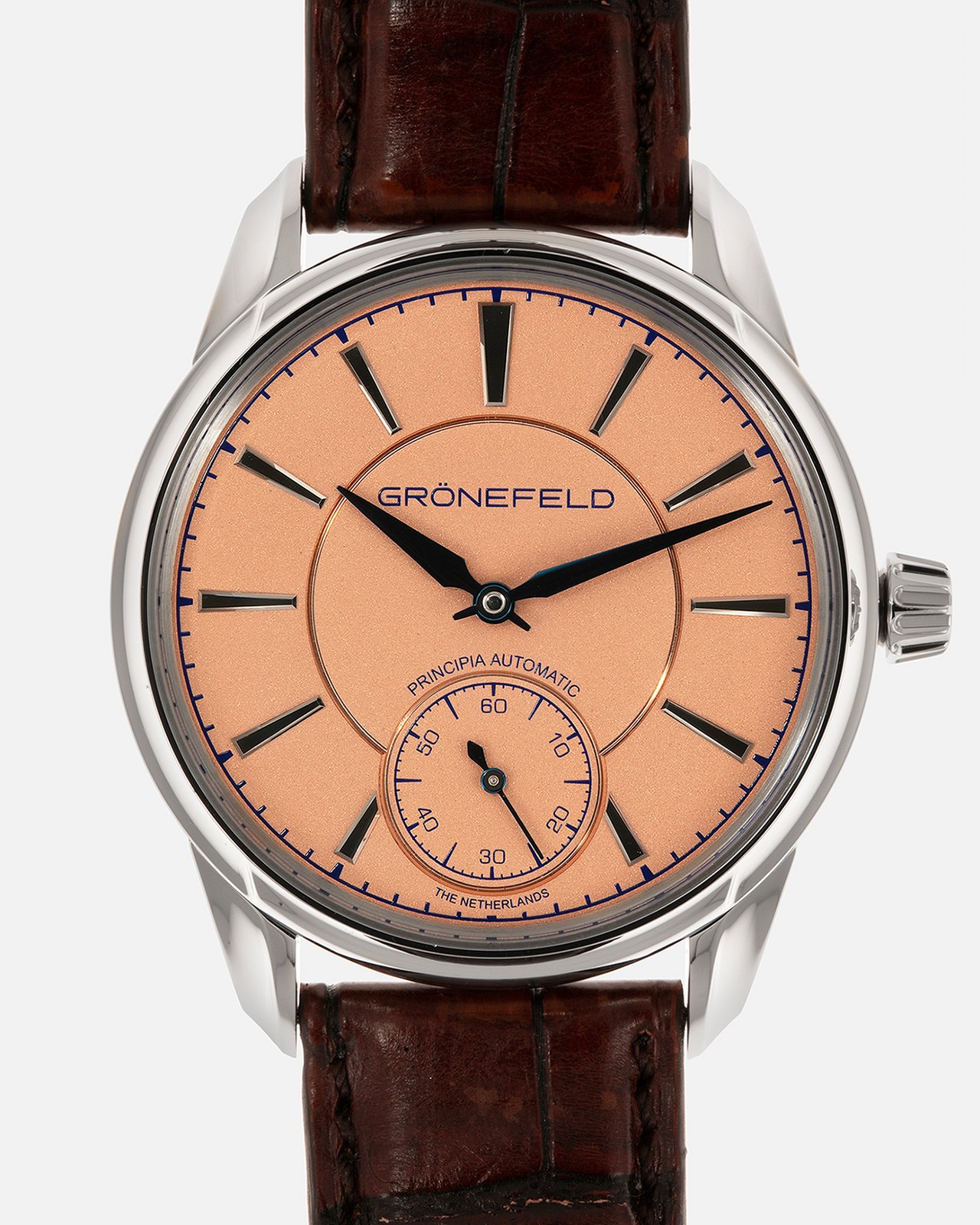
Grönefeld 1941 Principia Salmon, 2022
- Maker / attribution
- Unrecorded in source
- Date
- 2022
- Historical period
- Contemporary Horology (2010 – Present)
- Country of origin
- Unrecorded in source
- Object type
- Wristwatch
- Dimensions
- Case 39.5 mm
- Stock no.
- Product 7653846319191
- Credit line
- Dealer listing, S.Song Watches (product 7653846319191)
- Catalogue title (original)
- Grönefeld 1941 Principia Salmon (English)
View the source record (dealer listing) ↗ (opens another website in a new tab)Suggest a correction
Record summary
Catalogued by S.Song Watches (dealer), Seattle (stock number Product 7653846319191), this is a wristwatch, dated 2022. The Atlas places it in the Contemporary Horology period (2010 – Present) of its Wristwatches collection. Recorded dimensions: Case 39.5 mm. The record is illustrated with 6 photographs.
Assembled from the source record's structured fields. Dates and attributions are given as the source states them; where a field is missing the Atlas leaves it blank rather than estimating.
Catalogue description
Dealer description — S.Song Watches
For those unfamiliar, Grönefeld is an independent brand founded by Dutch brothers Tim and Bart Grönefeld, descendants of a family lineage of watchmakers spanning three generations. Raised in the town of Oldenzaal, the brothers grew up immersed in horology through the workshop operated by their father and grandfather, Sjef and Johan Grönefeld, where restoration, precision, and traditional craftsmanship formed the foundation of their approach to watchmaking. Their work today reflects that same philosophy, combining contemporary watchmaking with a deep respect for artisanal finishing and mechanical integrity. While Grönefeld is often associated with technically ambitious creations such as the 1941 Remontoire and Parallax Tourbillon, the 1941 Principia perhaps offers the clearest expression of the brothers’ approach to watchmaking. Sharing the same sculpted case architecture as the 1941 Remontoire, the Principia emerges as the cleanest and arguably most approachable watch the brothers have produced to date. It also represents an important milestone for the brand as the first automatic watch developed by Grönefeld. The name “1941” pays tribute to the birth year of their father, Sjef Grönefeld, while “Principia” references Sir Isaac Newton’s seminal work, Philosophiæ Naturalis Principia Mathematica , reflecting the watch’s emphasis on fundamental watchmaking rather than mechanical excess. Starting with its beautifully sculpted 39.5mm x 10.5mm stainless steel case, the 1941 Principia demonstrates the level of attention Grönefeld applies to even the smallest details. Fully polished throughout, the case initially appears elegant and understated, though closer inspection reveals a surprising degree of intricacy. The bezel subtly recesses along its flanks, allowing the flowing profile of the dramatic scalloped lugs to integrate seamlessly into the mid-case. Beyond their striking appearance, the lugs are secured using two hidden titanium screws positioned within the case, allowing them to be detached for refinishing or replacement if ever required. This particular example is especially attractive in its salmon dial configuration, a colour that has become increasingly sought after among collectors in recent years. The vibrant salmon tone contrasts elegantly against the faceted, mirror-polished indices, creating a refined balance between softness and sharpness. Despite its relative simplicity, the dial possesses considerable depth, with the interplay of textures and polished surfaces allowing it to shift character subtly under changing light. The Principia also features Grönefeld’s signature “Lancette” hands, executed in flame-blued steel with mirror-polished centres that catch the light beautifully at different angles. The lower portion of the dial sits a small seconds display, accompanied by a flame-blued hand with an elegant counterweight that traverses the sub-dial with notable poise. Altogether, the dial achieves a sense of harmony and restraint without ever feeling sparse. Turning the watch over reveals where the Principia truly distinguishes itself. Beneath the sapphire caseback sits the in-house Cal. G-06, the first automatic movement developed by the brothers. While the front of the watch embraces restraint, the movement remains as elaborate and meticulously executed as collectors have come to expect from the brand. Comprising 226 individual components and delivering a 56-hour power reserve, the Cal. G-06 is fitted with a large 22-carat gold monobloc rotor that dominates the visual presentation of the movement while maintaining excellent overall balance. Looking at the Cal. G-06 up close, the stainless steel bridges replicate the facades of traditional Dutch houses, known as “bell gables”, once again referencing the brothers’ Dutch heritage. These bridges are exceptionally difficult to finish due to the hardness of the material, yet Grönefeld’s pedigree in movement finishing remains second to none. Each bridge is meticulously hand-bevelled and polished to a brilliant gleam, while the jewels are set within warm gold chatons that provide a striking contrast against the cooler tones of the steel. The result is a movement that feels unexpectedly elaborate for a simple time-only watch, delivering the same sense of artisanal craftsmanship and tactile satisfaction typically associated with far more complicated pieces. Unlike many independent watches produced in extremely small numbered runs, the 1941 Principia was not conceived as a limited edition. Yet despite this, it remains one of the most compelling expressions of contemporary independent watchmaking today. Rather than relying on mechanical theatrics or complexity, its appeal lies in the quiet confidence of its execution, where every surface, proportion, and component reflects the immense care behind its creation. For collectors who value craftsmanship, finishing, and authenticity above spectacle, the Principia stands as a pure distillation of everything that makes Grönefeld so highly respected within modern independent watchmaking.
Historical context
Contemporary Horology (2010 – Present)
Silicon components, connected watches, optical-lattice research clocks and a thriving independent scene.
Smartwatches became the world's best-selling watches, while mechanical watchmaking focuses on craft, innovation (silicon components, new escapements) and independent makers.
Read the period in the timelineMore wristwatches from this periodEarlier: Mechanical Renaissance
Atlas type guide
Wristwatches
Bracelet watches were worn by women from the early nineteenth century — Breguet made one for Caroline Murat, Queen of Naples, in 1810–12 — but the wristwatch only became a man's instrument with military use and aviation in the early twentieth century. Between the World Wars it overtook the pocket watch; the 1920s and 1930s brought rectangular Art Deco cases, water-resistant cases and the first automatic winding systems.
After 1945 the wristwatch became a carrier of identity — dress watches, sports and dive watches, chronographs, calendars — produced by Swiss, American, Japanese, German, Soviet and Chinese industries. The quartz revolution after 1969 and the mechanical renaissance since the 1990s, including the rise of independent watchmakers, complete the story.
What to look for
- The reference number (between the lugs or inside the case back) and serial number, the starting point for dating.
- The calibre: its maker and number are often stamped under the dial or on the bridge.
- Originality of dial, hands and crown — refinished ('redial') dials are common.
- Case material marks: 18K/750, 14K/585, stainless steel, gold-filled, plated.
Dating clues
- Wire-lug cases: before c. 1925.
- Water-resistant screw-down cases: from 1926.
- Quartz movements: from 1969; sapphire crystals widespread after c. 1980.
General guidance written by the Atlas editors about this kind of object. It is not a statement about this particular piece; for that, rely on the source record above and on physical examination.
Related records
Wristwatches · 2010
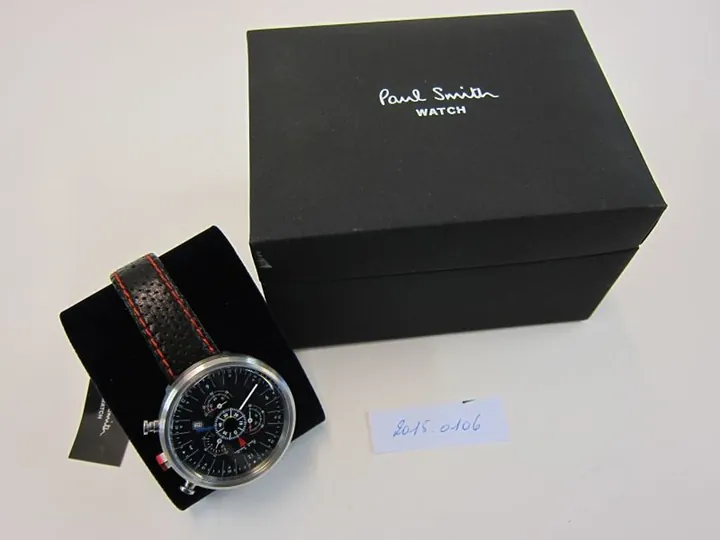
Wristwatch, 2010
Modemuseum Hasselt
Wristwatches · 2018 (Series 4 released in September 2018; '1977' in the source is the model number A1977)
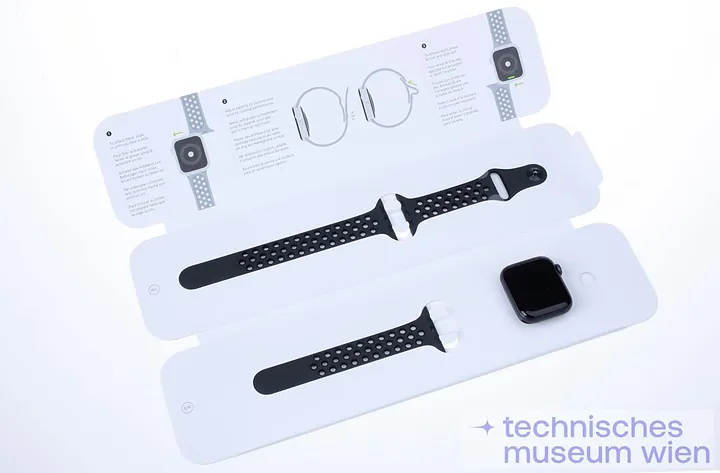
Apple Watch Series 4 (GPS, 40 mm, model A1977), 2018
Vienna Museum of Science and Technology
Wristwatches · c. 2010s
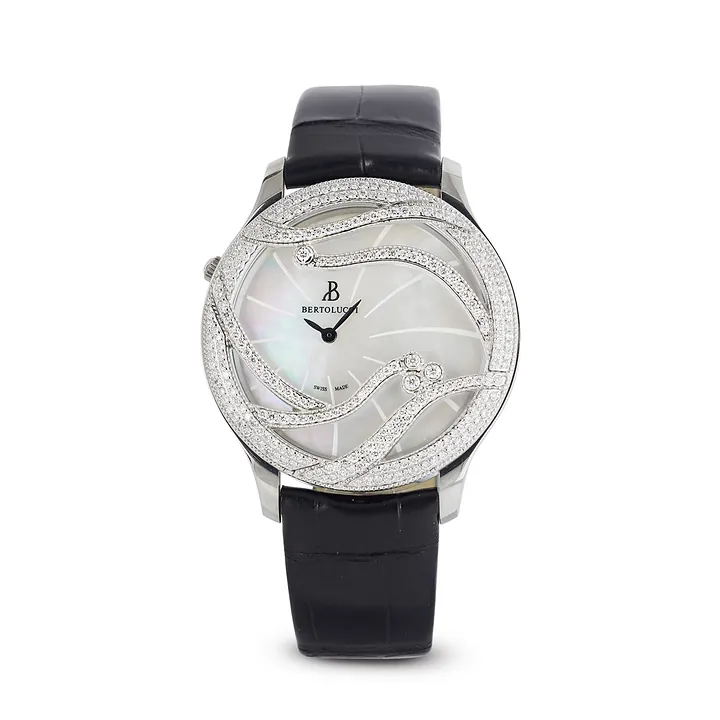
Bertolucci Stria III, ref. 11513.50.45.B88.6C1.501, c. 2010s
Antiquorum auction archive, Geneva
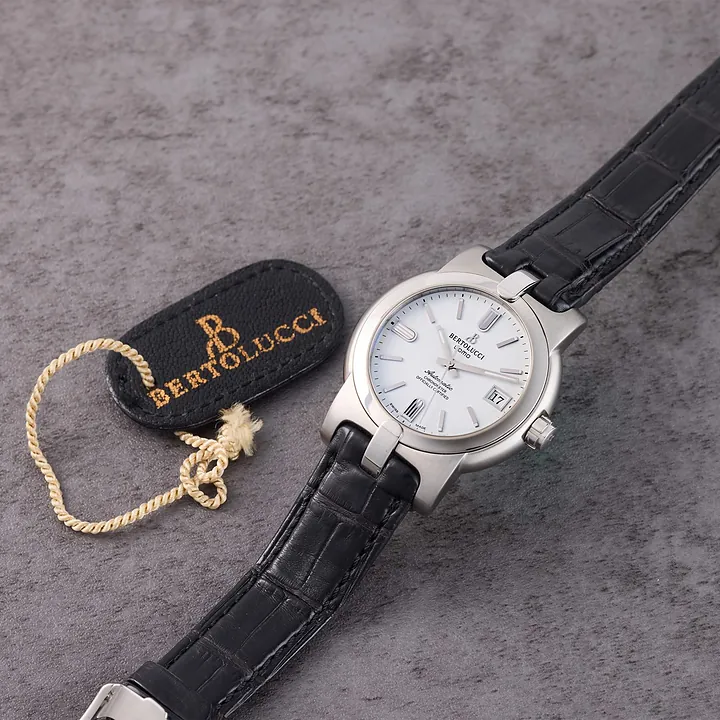
Wristwatches · c. 2010s
Bertolucci Uoma, ref. 824.51.41.10B, c. 2010s
Antiquorum auction archive, Geneva

Wristwatches · c. 2010s
Breguet Type XXI, ref. 3810, c. 2010s (Antiquorum Lot 381-24)
Antiquorum auction archive, Geneva

Wristwatches · c. 2010s
Breguet Type XXI, ref. 3810, c. 2010s (Antiquorum Lot 386-229)
Antiquorum auction archive, Geneva

Wristwatches · Sold in September 2010
Breitling Cosmonaute, ref. A 22322, Sold in September 2010
Antiquorum auction archive, Geneva
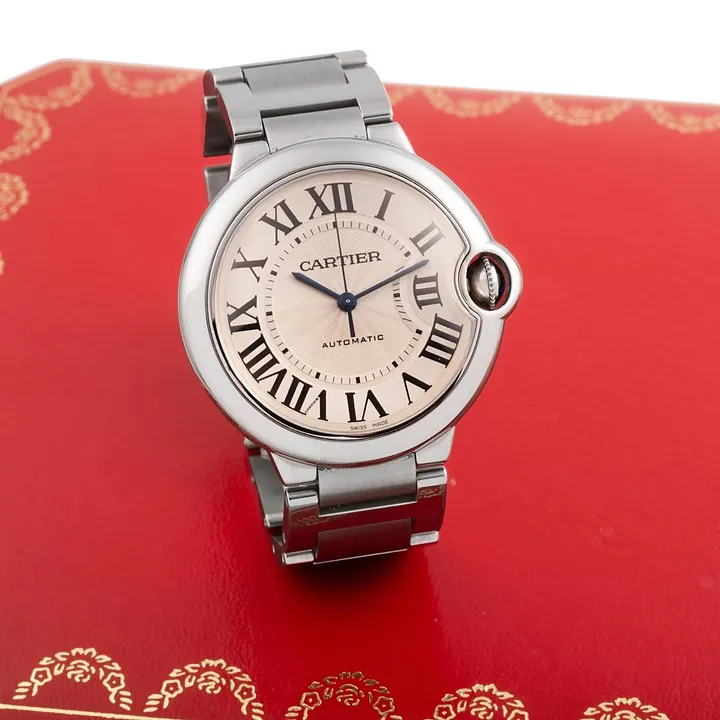
Wristwatches · c. 2010s
Cartier Ballon Bleu, ref. 3284, c. 2010s
Antiquorum auction archive, Geneva