
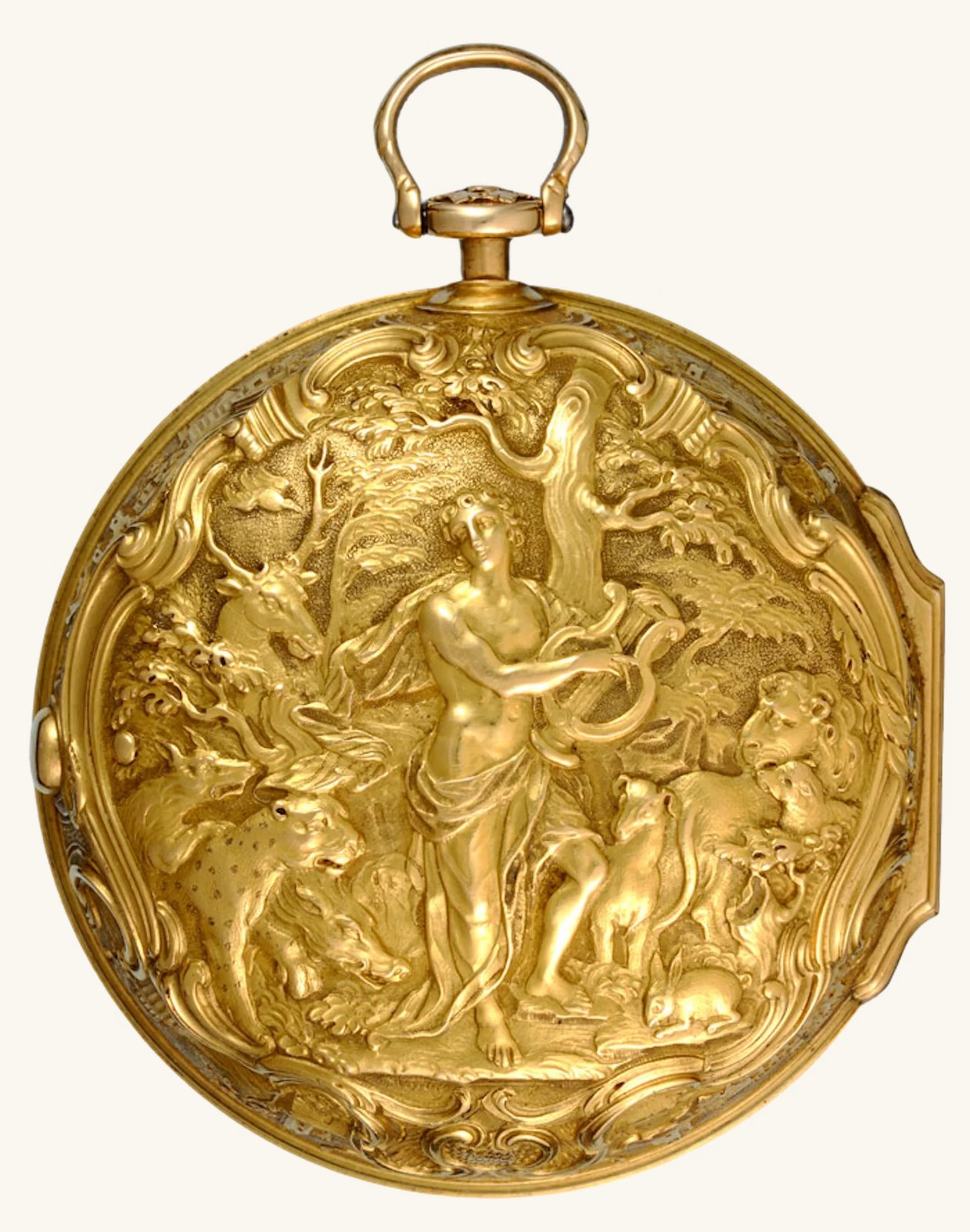
Pocket Watches · Pocket watch
Gold Repousse Pair Case by Moser, 1744
- Maker / attribution
- Moser (case chaser)
- Date
- 1744
- Historical period
- Early Modern Horology (1600 – 1750)
- Country of origin
- Unrecorded in source
- Object type
- Pocket watch
- Materials / technique
- gold
- Dealer
- WatchMuseum.org shop
- Stock no.
- Product 1569
- Credit line
- Dealer listing, WatchMuseum.org shop (product 1569)
- Catalogue title (original)
- Gold Repousse Pair Case by Moser (English)
View the source record (dealer listing) ↗ (opens another website in a new tab)Suggest a correction
Record summary
Catalogued by WatchMuseum.org shop (stock number Product 1569), this is a pocket watch by Moser, dated 1744. The Atlas places it in the Early Modern Horology period (1600 – 1750) of its Pocket Watches collection. Materials and techniques recorded by the source: gold. The record is illustrated with 6 photographs.
Assembled from the source record's structured fields. Dates and attributions are given as the source states them; where a field is missing the Atlas leaves it blank rather than estimating.
Catalogue description
Dealer description — WatchMuseum.org shop
The ”Gold Repousse Pair Case by Moser – 1744″ is a breathtaking example of mid-18th century English craftsmanship, showcasing the intricate artistry and technical precision of the era. This exquisite verge watch, encased in a pair of meticulously crafted gold repousse cases by Moser, features a full plate fire gilt movement complemented by a silver dust cover that is both signed and numbered. The movement is adorned with a pierced and engraved masked cock, highlighted by a large diamond endstone set in polished steel, a silver regulator disc, and a fusee and chain mechanism, all supported by turned pillars. The watch’s plain three-arm steel balance and blue steel spiral hairspring ensure accurate timekeeping. Its white enamel dial is elegantly designed with delicate Arabic numerals encircling a fine tracery border and is equipped with gold beetle and poker hands. The inner gold case is richly decorated with foliate engravings, a grotesque mark, and a small scenic depiction around the pendant, featuring a bird perched in reeds within a symmetrical border and the maker’s mark “EB” with a fleur-de-lis. The outer case, made of 22-carat gold, is a masterpiece of chased and engraved repousse work, signed “Moser f” at the feet of the central figure. This case is adorned with a symmetrical border that frames a captivating scene of a musician playing a lyre, surrounded by various animals including a stag, boar, wolf, and lamb, encapsulating the elegance and detailed artistry of the period. This is a stunning mid 18th Century English verge watch in a pair of very fine gold repousse cases by Moser. The movement is full plate fire gilt with a silver dust cover that is signed and numbered. The pierced and engraved masked cock has a large diamond endstone in a polished steel setting, a silver regulator disc, fusee and chain, and turned pillars. The plain three arm steel balance and blue steel spiral hairspring bring it all together. The white enamel dial features delicate Arabic numerals around a fine tracery border and gold beetle and poker hands. The gold inner case is also decorated with foliate engraving around the edge, a grotesque mark at the base, and a small scene around the pendant. A bird perched in reeds is surrounded by a symmetrical border, and the maker’s mark “EB” with fleur dis lis above. The outer case is a beautifully worked 22 carat gold case of chased and engraved repousse work signed “Moser f” at the feet of the figure. The symmetrical repousse border surrounds the main scene which depicts a musician playing a lyre surrounded by animals, including a stag, boar, wolf, lamb, lion, and leopard. Outside the border, there is a frieze of small landscapes and buildings. This is an important and fine watch, an early example of Moser’s work made in the same year as a case made for a repeating watch by Graham, which Richard Edgcumbe lists as No. 4. The scene appears to be a visualisation of a passage from Isaiah chapter 11, which is thought to be the origin of the phrase “The lion and lamb shall lay down together”. George Michael Moser was born in Schaffhausen on January 17, 1706. He moved to London in 1726 and worked for John Valentine Haidt, goldsmith and watch chaser. By 1737 he was working on his own account at Craven Buildings off Drury Lane, producing chased and gilded works as well as creating fine enamel cases. He designed the great seal of George III and painted enamel portraits of the royal children for Queen Charlotte. Moser continued to work at least until the late 1770s and was active for the Royal Academy until the end of his life. On January 30, 1783, the “Gentleman’s Magazine” reported that Moser “was followed to his grave in grand funeral pomp by all the capital artists, Sir Joshua Reynolds at their head as chief mourner, Sir William Chambers, etc. Ten mourning coaches, besides two gentlemen’s coaches, were in the procession”. In The Art of the Gold Chaser in Eighteenth-Century London, Richard Edgcumbe devotes over 40 pages of text to Moser’s work, including many illustrations. This case is unusual for gracing the movement from a lesser-known watchmaker. Other examples house movements by eminent watchmakers of the period such as Graham, Delander, Mudge, Ellicott, and Vulliamy. It is also most unusual for the inner case to be engraved on a timepiece. The casemaker is either Edward Bradshaw or Edward Branstone Bayley. Materials Gold Carat for Gold 22 K Hallmark 1744 Diameter 51mm
Historical context
Early Modern Horology (1600 – 1750)
Huygens' pendulum and balance spring transform accuracy; English makers develop the anchor and deadbeat escapements.
The balance spring (c. 1675) improved watches dramatically and introduced the minute hand. English pair-cased verge watches with pierced balance cocks and French oignons were typical; enamel painting at Blois and Geneva, and the repeating watch (1680s), made watches objects of great refinement.
Read the period in the timelineMore pocket watches from this periodEarlier: Renaissance Horology
Atlas type guide
Verge and pair-cased watches
After Christiaan Huygens and Robert Hooke applied the balance spring around 1675, the verge watch became a reasonably reliable timekeeper and the minute hand became standard. Through the eighteenth century the typical English watch was a pair-cased verge: a fusee movement with a pierced, engraved balance cock, housed in an inner case and a separate protective outer case, often of repoussé gold, shagreen, tortoiseshell or enamel.
French watches of the same period were thicker 'oignons', later replaced by elegant thinner watches following Jean-Antoine Lépine's bar-bridge calibre of c. 1770. Dutch, Swiss and German makers supplied international markets, and verge watches were made until the mid-nineteenth century as cheaper alternatives to the cylinder and lever.
What to look for
- The pierced balance cock on the backplate: winged (continental) or with a foot (English); its style dates the watch.
- Fusee and chain visible through the movement; key winding through the dial (early) or case back.
- Hallmarks inside English silver or gold cases, which give a date letter.
- Maker's name and serial number engraved on the backplate; watch papers inside outer cases.
- Enamel dials (after c. 1720) versus earlier champlevé metal dials.
Dating clues
- Champlevé dials: c. 1680–1730; white enamel dials thereafter.
- English case hallmarks give the year of assay to within a year.
- Verge watches persisted in cheap production until c. 1850.
General guidance written by the Atlas editors about this kind of object. It is not a statement about this particular piece; for that, rely on the source record above and on physical examination.
Read next:Verge escapement
Related records
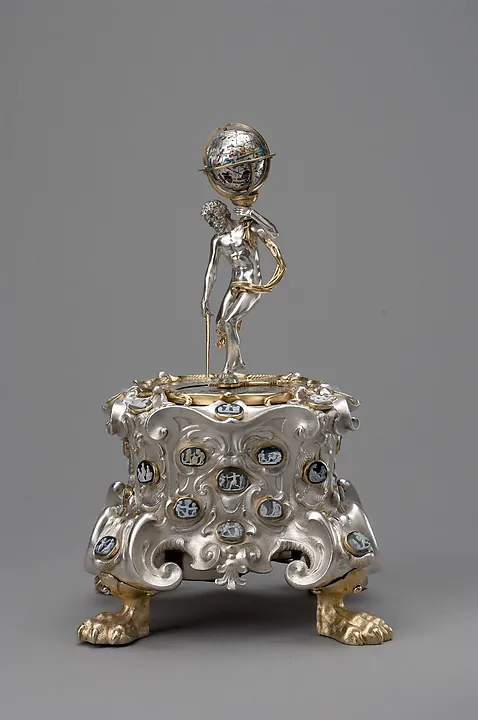
Pocket Watches · 1600–1699
Pocket watch by Georg Ernst, Germany, 1600–1699
Fine Arts Museum Vienna
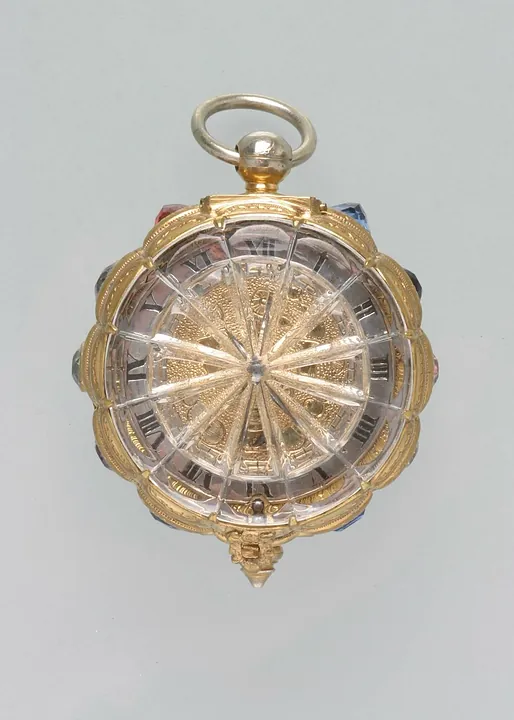
Pocket Watches · c. 1600
Pocket watch by Balthasar de Paep, Belgium, c. 1600
German Clock Museum
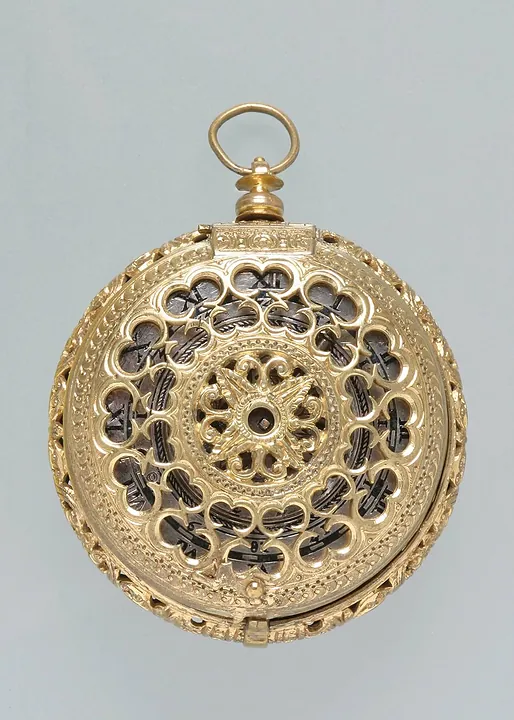
Pocket Watches · c. 1600
Pocket watch by Hans Reinboldt, France, c. 1600
German Clock Museum
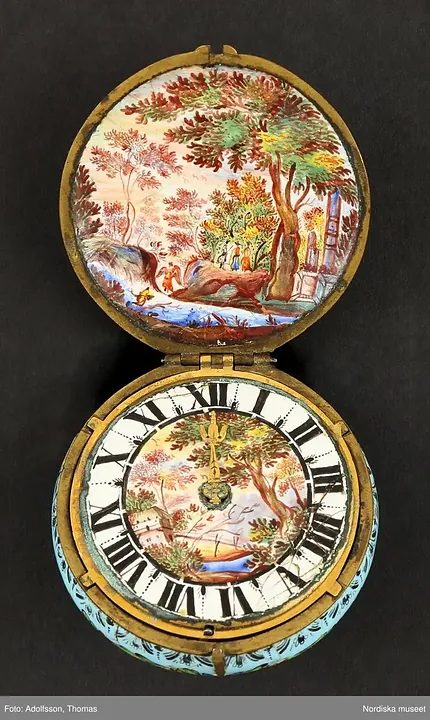
Pocket Watches · 1600–1699
Pocket watch by Johan Etmiller, Germany, 1600–1699
Nordic Museum Foundation
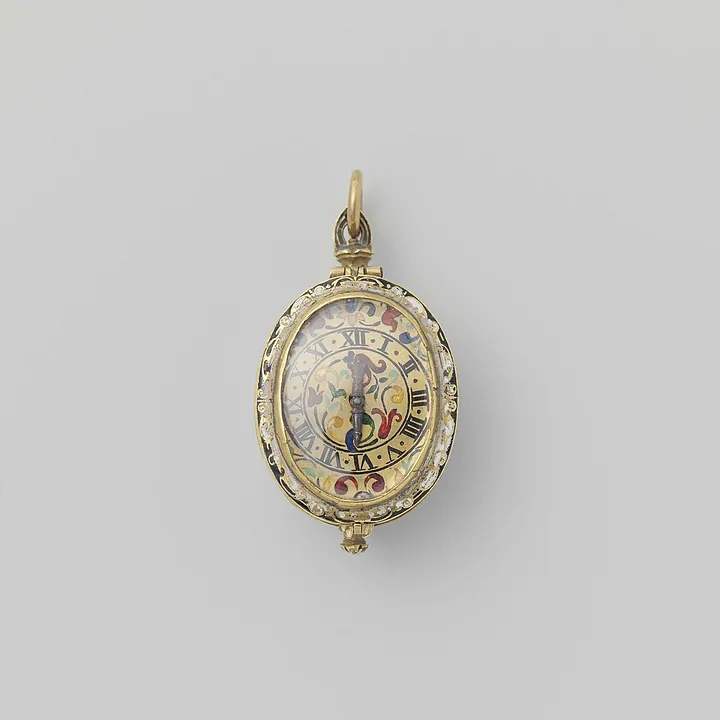
Pocket Watches · 1600
Pocket watch, France, 1600
Rijksmuseum
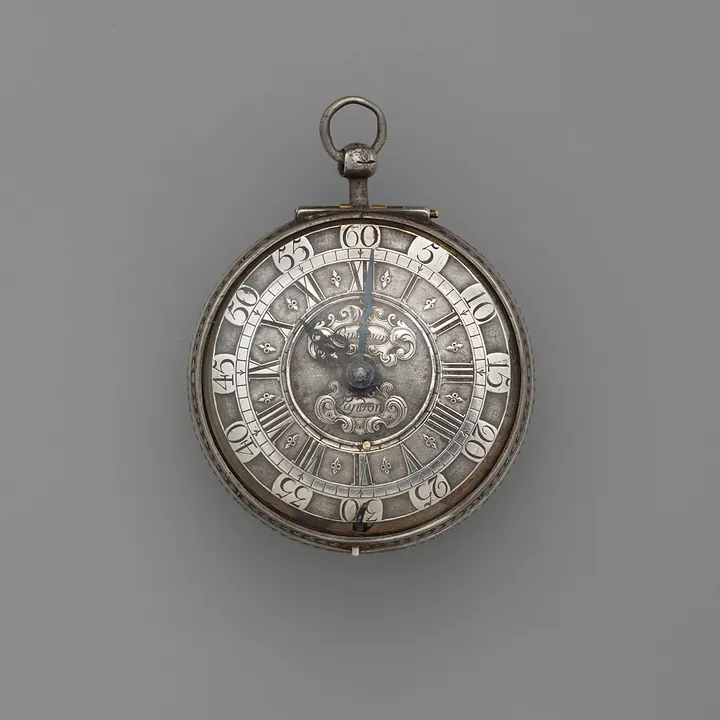
Pocket Watches · 17th century
Watch by John Bushman, England, 17th century
The Metropolitan Museum of Art, New York
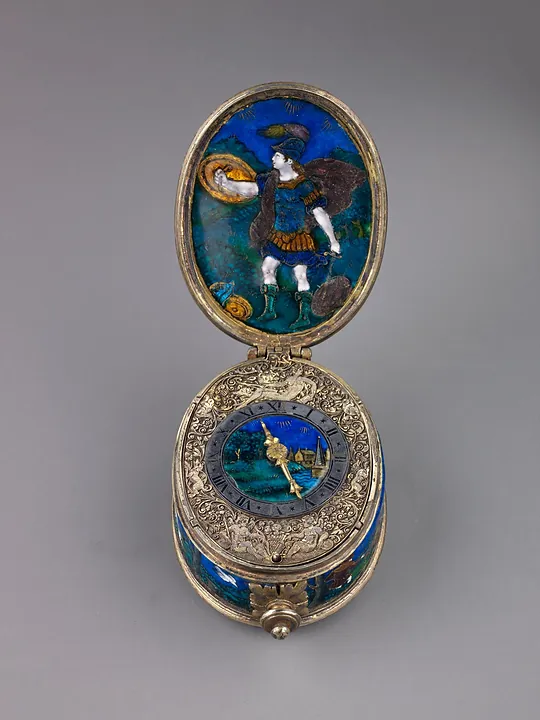
Pocket Watches · first quarter of 17th century
Watch by Suzanne de Court, France, first quarter of 17th century
The Metropolitan Museum of Art, New York
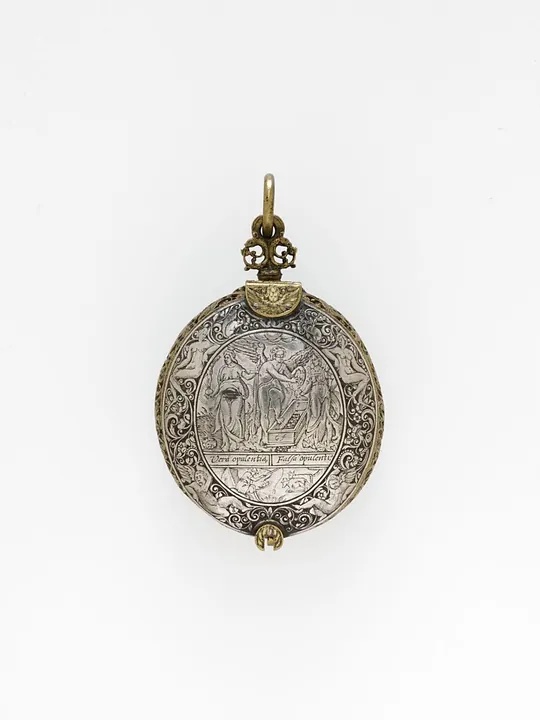
Pocket Watches · early 17th century
Watch of engraved and pierced silver and gilt brass, signed 'Noel Hubert A Rouen', France, early 17th century
Victoria and Albert Museum, London