
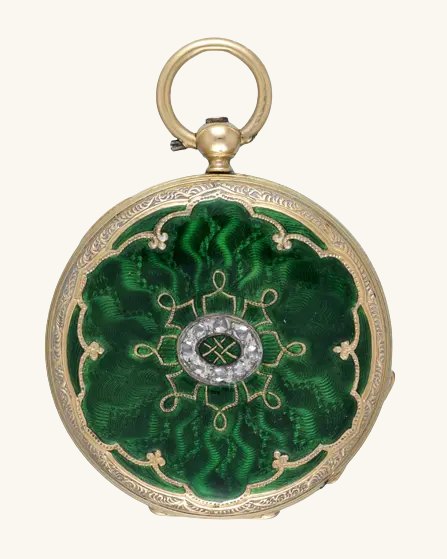
Pocket Watches · Pocket watch
Gold & Enamel Watch With Spare Dial, c. 1870
- Maker / attribution
- Unrecorded in source
- Date
- c. 1870
- Historical period
- Industrial Revolution (1850 – 1900)
- Country of origin
- Unrecorded in source
- Object type
- Pocket watch
- Materials / technique
- gold, enamel
- Dealer
- WatchMuseum.org shop
- Stock no.
- Product 6244
- Credit line
- Dealer listing, WatchMuseum.org shop (product 6244)
- Catalogue title (original)
- Gold & Enamel Watch With Spare Dial (English)
View the source record (dealer listing) ↗ (opens another website in a new tab)Suggest a correction
Record summary
Catalogued by WatchMuseum.org shop (stock number Product 6244), this is a pocket watch, dated c. 1870. The Atlas places it in the Industrial Revolution period (1850 – 1900) of its Pocket Watches collection. Materials and techniques recorded by the source: gold, enamel. The record is illustrated with 6 photographs.
Assembled from the source record's structured fields. Dates and attributions are given as the source states them; where a field is missing the Atlas leaves it blank rather than estimating.
Catalogue description
Dealer description — WatchMuseum.org shop
Step back in time with the Gold & Enamel Watch With Spare Dial, a captivating masterpiece from the 19th century that embodies the pinnacle of Swiss watchmaking craftsmanship. This circa 1870 timepiece is an exquisite example of elegance and precision, featuring a diamond-set gold and enamel open face case that exudes luxury and sophistication. Enclosed within a presentation case, this watch is accompanied by an additional enamel dial, a rare and thoughtful inclusion that speaks to its uniqueness. The watch boasts a keywind gilt bar movement with a suspended going barrel, showcasing the intricate engineering that defines Swiss horology. Its plain cock is equipped with a polished steel regulator, while the three-arm gilt balance is complemented by a blue steel spiral hairspring, ensuring accurate timekeeping. The polished steel cylinder and steel escape wheel further enhance its mechanical prowess. The engine-turned gold dial, adorned with Roman numerals and blue steel Breguet hands, adds a touch of timeless elegance. The small 18-carat open face case, with its ribbed middle and translucent green enamel over an engine-turned ground, is a testament to the artistry of its era. A small central oval set with diamonds adds a final flourish of opulence. Winding and setting are effortlessly achieved through the gold cuvette, which proudly bears the maker’s mark “D & C”. Presented in a rectangular case designed to house both the watch and its spare enamel dial, this piece is a rare find, as it is uncommon for a watch to be provided with an alternative dial, not intended for the owner to fit themselves. With a diameter of 32 mm, this anonymous Swiss creation remains in good condition, offering a glimpse into the past while maintaining its allure and charm. This exquisite 19th Century Swiss cylinder watch features a diamond-set gold and enamel open face case. It comes with a presentation case and an additional enamel dial. The watch has a keywind gilt bar movement with a suspended going barrel. The plain cock has a polished steel regulator, and the three-arm gilt balance is adorned with a blue steel spiral hairspring. The watch also has a polished steel cylinder and steel escape wheel. The engine-turned gold dial is enhanced with Roman numerals and blue steel Breguet hands. The small 18-carat open face case has a ribbed middle and a back decorated with translucent green enamel over an engine-turned ground. There is a small central oval set with diamonds. Winding and setting can be done through the gold cuvette, which bears the maker’s mark “D & C”. The watch is presented in a rectangular case, designed to accommodate both the watch and a spare enamel dial. It is worth noting that it is uncommon for a watch to be provided with an alternative dial, and it would not be intended for the owner to fit it themselves. Anonymous Swiss Date of Manufacture: Circa 1870 Diameter : 32 mm Condition: Good
Historical context
Industrial Revolution (1850 – 1900)
American interchangeable-parts manufacture; railroad time standards; Swiss and German factory systems.
Machine production with interchangeable parts, pioneered by Waltham (1850s) and adopted by Elgin, Longines, Omega and others, made reliable lever watches widely affordable. Keyless winding became standard, railroad watch standards were introduced (1890s), and Swiss and American industries competed globally.
Read the period in the timelineMore pocket watches from this periodEarlier: Precision & Scientific Horology
Atlas type guide
Pocket watches
The pocket watch was the dominant personal timekeeper from the late seventeenth century until the First World War. Its development tracks the history of the escapement: verge watches with fusees until the late eighteenth century; Thomas Mudge's lever escapement (c. 1755) and the cylinder escapement popularised by George Graham and later by Swiss makers; and the Swiss and English lever watches of the nineteenth century. Lépine's bar-bridge calibre and keyless winding made watches thinner and easier to use.
Industrialisation transformed the trade: American factories such as Waltham (from 1850) and Elgin produced interchangeable parts by machine, and Swiss makers responded with their own mechanisation after the 1876 Philadelphia Exhibition. By 1900 a reliable watch was affordable to millions; the finest makers continued to produce complications and precision watches.
What to look for
- The escapement: verge (crown wheel), cylinder, duplex, English or Swiss lever.
- Key winding (a square arbor in dial or back) or keyless crown winding.
- Signatures and serial numbers on the movement, dial and inside case back.
- Hallmarks, case maker's marks and gold or silver standards stamped in the case.
- Dial material: enamel, silver, gold, later printed metal.
Dating clues
- Verge watches dominate before c. 1800; cylinder watches c. 1770–1900; lever watches after c. 1820.
- Keyless winding: increasingly common after c. 1860.
- Manufacturer serial number lists exist for Waltham, Elgin, Longines, Omega, Patek Philippe and others.
General guidance written by the Atlas editors about this kind of object. It is not a statement about this particular piece; for that, rely on the source record above and on physical examination.
Read next:Verge escapementDetached lever escapementFuseeIdentification Centre
Related records
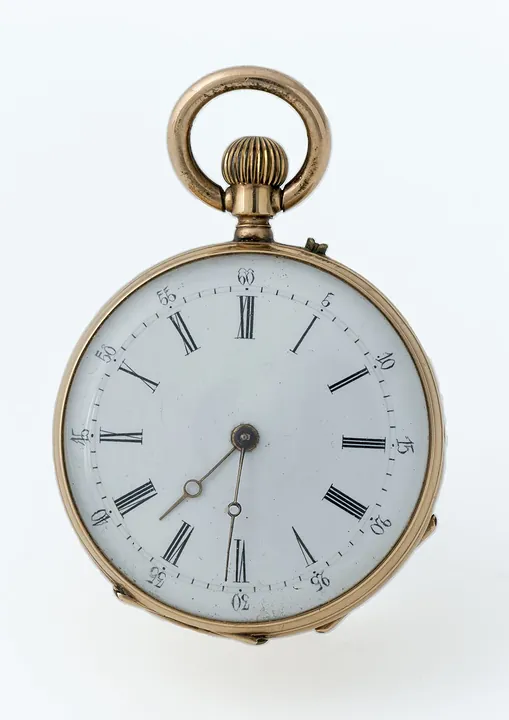
Pocket Watches · 1880
Pocket watch, 1880
Museum Rotterdam
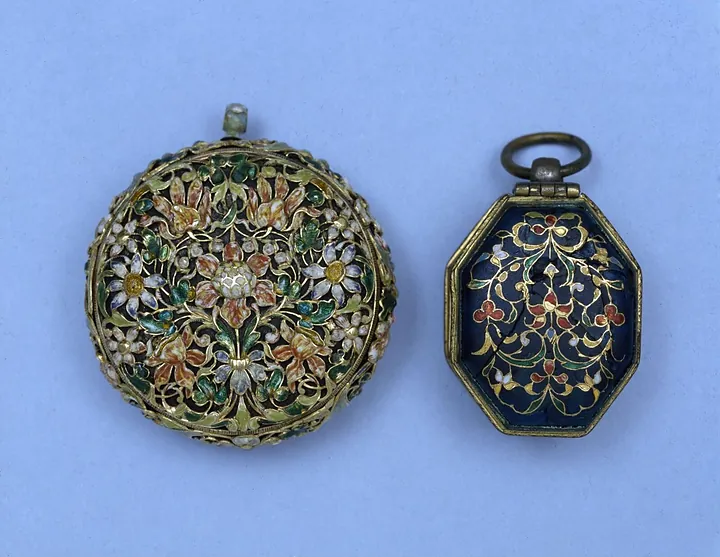
Pocket Watches · mid 19th century
Watch, enamelled gilt brass of floral design, signed 'A Bloys.', France, in an early 17th century style but possibly mid 19th century
Victoria and Albert Museum, London
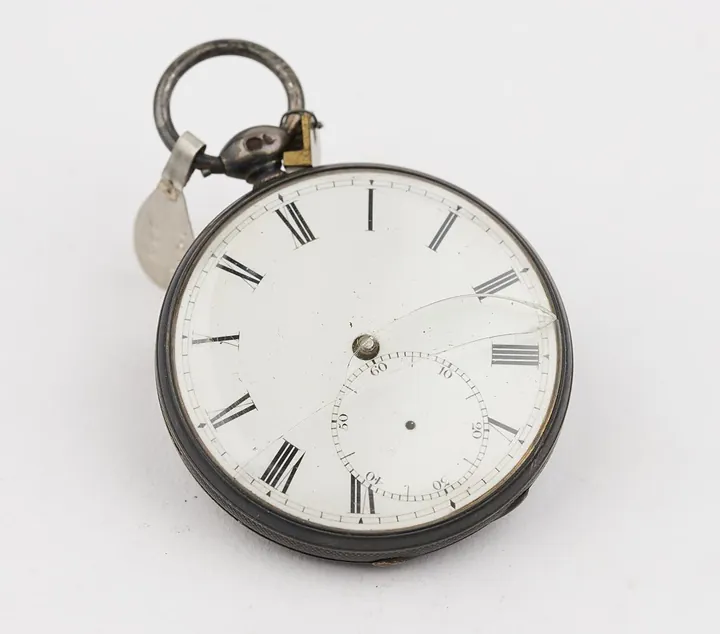
Pocket Watches · 1835–1875
Pocket watch by Cornelius Brooks Holliday, England, 1835–1875
Science Museum Group, London
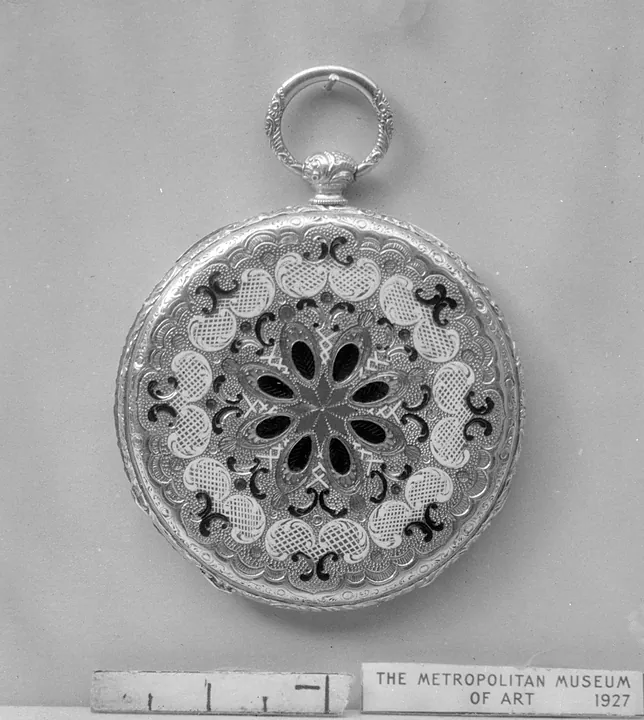
Pocket Watches · c. 1840–60
Watch by Callaud, c. 1840–60
The Metropolitan Museum of Art, New York
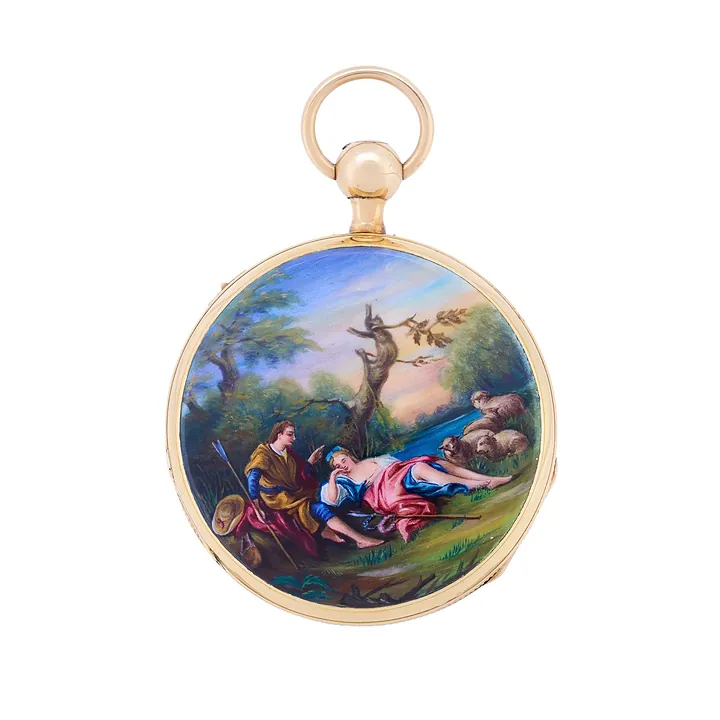
Pocket Watches · c. 1840-1860s
G.H. Berblinger pocket watch, c. 1840-1860s
Antiquorum auction archive, Geneva
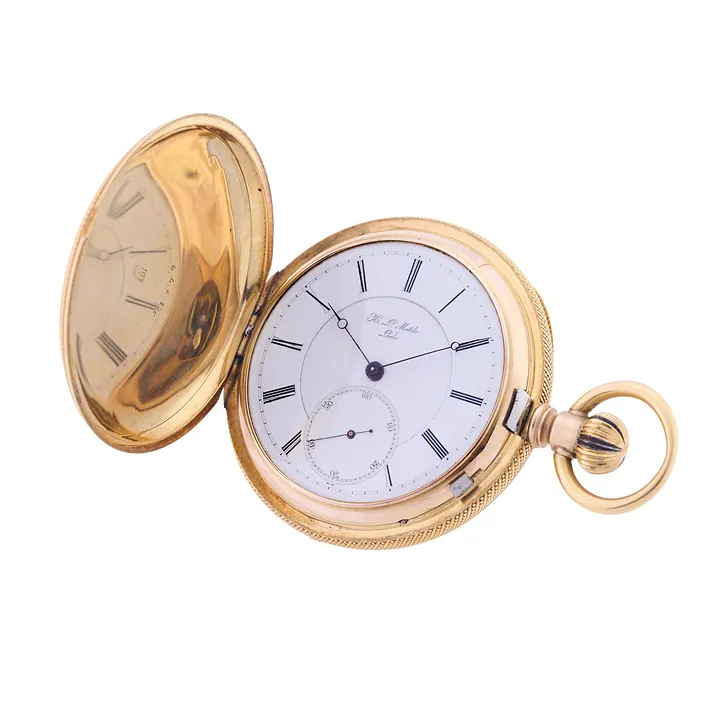
Pocket Watches · c. 1840-1860s
H.L Matile Locle pocket watch, c. 1840-1860s
Antiquorum auction archive, Geneva
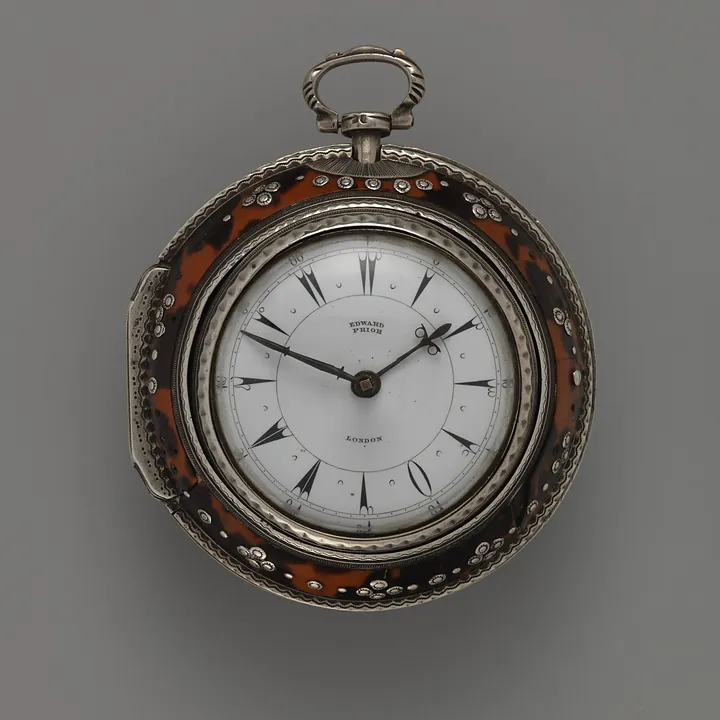
Pocket Watches · c. 1849–50
Watch by Edward Prior, England, c. 1849–50
The Metropolitan Museum of Art, New York
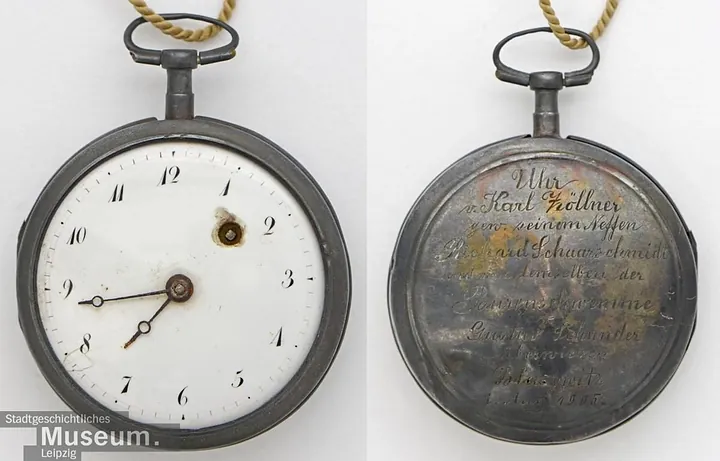
Pocket Watches · 1845–1855
Pocket watch, 1845–1855
Museum of City History Leipzig