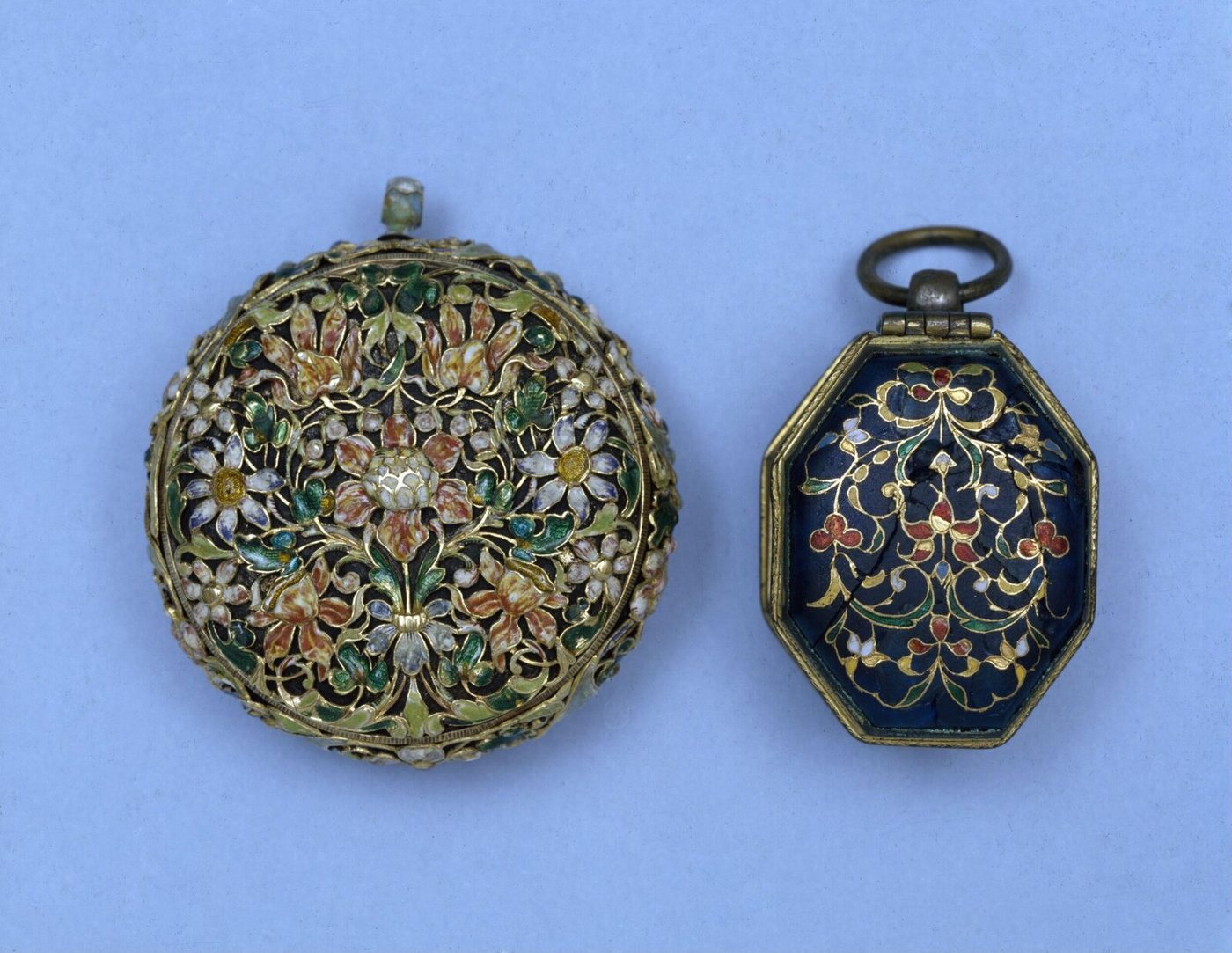
Pocket Watches · Watch
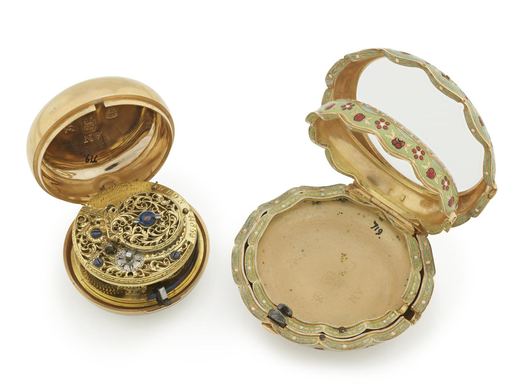
Watch, enamelled gilt brass of floral design, signed 'A Bloys.', France, in an early 17th century style but possibly mid 19th century
- Maker / attribution
- Unrecorded in source
- Date
- mid 19th century
- Historical period
- Industrial Revolution (1850 – 1900)
- Country of origin
- France
- Place
- France
- Object type
- Watch
- Materials / technique
- Gilt brass, enamelled
- Dimensions
- Height: 4.4 cm; Width: 3.1 cm; Depth: 2.5 cm
- Holding institution
- Victoria and Albert Museum, London
- Accession / object no.
- 2353-1855
Record summary
Held and catalogued by Victoria and Albert Museum, London (object number 2353-1855), this is a watch, made in France, dated mid 19th century. The Atlas places it in the Industrial Revolution period (1850 – 1900) of its Pocket Watches collection. Materials and techniques recorded by the source: Gilt brass, enamelled. Recorded dimensions: Height: 4.4 cm; Width: 3.1 cm; Depth: 2.5 cm. The record is illustrated with 2 photographs.
Assembled from the source record's structured fields. Dates and attributions are given as the source states them; where a field is missing the Atlas leaves it blank rather than estimating.
Catalogue description
V&A — Physical description
Enamelled gilt brass watch of floral design, signed 'A Bloys.'
V&A — Object history
Purchased at the auction by Christie's of the collection of Ralph Bernal (1783-1854), politician and art collector, in 1855. He held a seat in the House of Commons from 1815-52. After his death the Society of Arts proposed without success that the Government should buy his entire collection for the Museum of Ornamental Art then at Marlborough House which became the future South Kensington Museum, now the Victoria and Albert Museum. 730 lots were acquired for Marlborough House (Anthony Burton, Vision & Accident, V&A Publications, 1999, p. 34). After his father's death in 1811, Bernal inherited three large sugar estates and over 500 enslaved people in Jamaica. 'In 1835 and 1836 he was awarded compensation for slave ownership amounting to over £11,450' Provenance Ralph Bernal (1783-1854) was a renowned collector and objects from his collection are now in museums across the world, including the V&A. He was born into a Sephardic Jewish family of Spanish descent, but was baptised into the Christian religion at the age of 22. Bernal studied at Christ's College, Cambridge, and subsequently became a prominent Whig politician. He built a reputation for himself as a man of taste and culture through the collection he amassed and later in life he became the president of the British Archaeological Society. Yet the main source of income which enabled him to do this was the profits from enslaved labour. In 1811, Bernal inherited three sugar plantations in Jamaica, where over 500 people were eventually enslaved. Almost immediately, he began collecting works of art and antiquities. After the emancipation of those enslaved in the British Caribbean in the 1830s, made possible in part by acts of their own resistance, Bernal was awarded compensation of more than £11,450 (equivalent to over £1.5 million today). This was for the loss of 564 people enslaved on Bernal's estates who were classed by the British government as his 'property'. They included people like Antora, and her son Edward, who in August 1834 was around five years old (The National Archives, T 71/49). Receiving the money appears to have led to an escalation of Bernal's collecting. When Bernal died in 1855, he was celebrated for 'the perfection of his taste, as well as the extent of his knowledge' (Christie and Manson, 1855). His collection was dispersed in a major auction during which the Museum of Ornamental Art at Marlborough House, which later became the South Kensington Museum (now the V&A), was the biggest single buyer.
V&A — Production note
In an early 17th century style.
Inscriptions & marks
signed 'A Bloys.'
Historical context
Industrial Revolution (1850 – 1900)
American interchangeable-parts manufacture; railroad time standards; Swiss and German factory systems.
Machine production with interchangeable parts, pioneered by Waltham (1850s) and adopted by Elgin, Longines, Omega and others, made reliable lever watches widely affordable. Keyless winding became standard, railroad watch standards were introduced (1890s), and Swiss and American industries competed globally.
Read the period in the timelineMore pocket watches from this periodEarlier: Precision & Scientific Horology
Atlas type guide
Pocket watches
The pocket watch was the dominant personal timekeeper from the late seventeenth century until the First World War. Its development tracks the history of the escapement: verge watches with fusees until the late eighteenth century; Thomas Mudge's lever escapement (c. 1755) and the cylinder escapement popularised by George Graham and later by Swiss makers; and the Swiss and English lever watches of the nineteenth century. Lépine's bar-bridge calibre and keyless winding made watches thinner and easier to use.
Industrialisation transformed the trade: American factories such as Waltham (from 1850) and Elgin produced interchangeable parts by machine, and Swiss makers responded with their own mechanisation after the 1876 Philadelphia Exhibition. By 1900 a reliable watch was affordable to millions; the finest makers continued to produce complications and precision watches.
What to look for
- The escapement: verge (crown wheel), cylinder, duplex, English or Swiss lever.
- Key winding (a square arbor in dial or back) or keyless crown winding.
- Signatures and serial numbers on the movement, dial and inside case back.
- Hallmarks, case maker's marks and gold or silver standards stamped in the case.
- Dial material: enamel, silver, gold, later printed metal.
Dating clues
- Verge watches dominate before c. 1800; cylinder watches c. 1770–1900; lever watches after c. 1820.
- Keyless winding: increasingly common after c. 1860.
- Manufacturer serial number lists exist for Waltham, Elgin, Longines, Omega, Patek Philippe and others.
General guidance written by the Atlas editors about this kind of object. It is not a statement about this particular piece; for that, rely on the source record above and on physical examination.
Read next:Verge escapementDetached lever escapementFuseeIdentification Centre
Related records
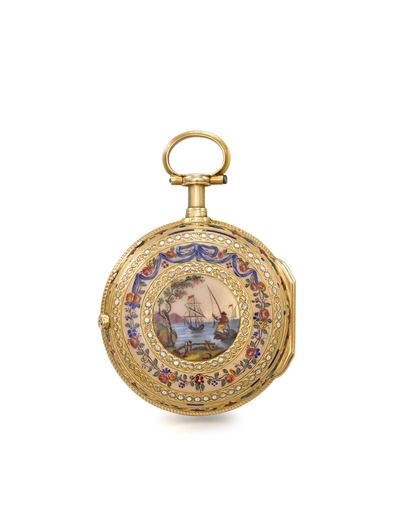
Pocket Watches · 1801-1900
Pocket watch by L'Epine, Jean Antoine, France, 1801-1900
Science Museum Group, London
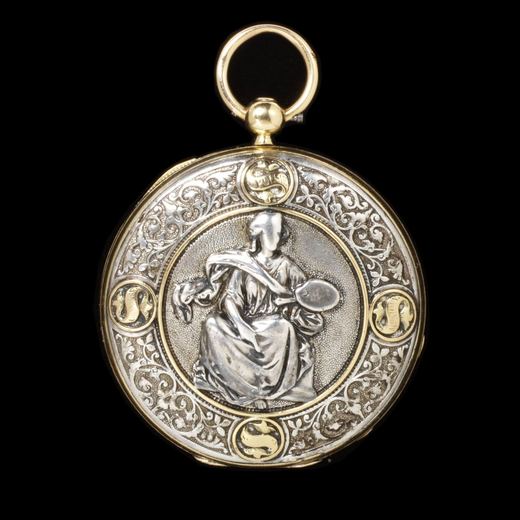
Pocket Watches · 1867
Watch by Froment-Meurice, France, 1867
Victoria and Albert Museum, London
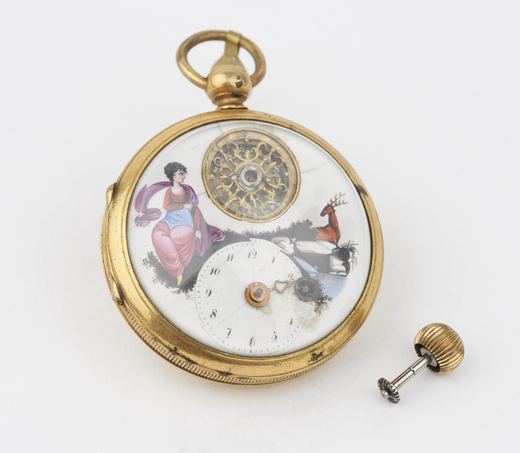
Pocket Watches · 1870-1910
Watch (French or Swiss) with balance wheel visible through a window in the dial
Science Museum Group, London
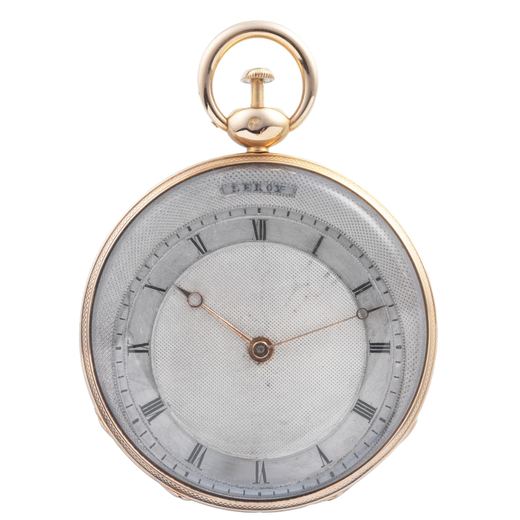
Pocket Watches · circa 1875
Leroy & Fils pocket watch, circa 1875
Antiquorum auction archive, Geneva
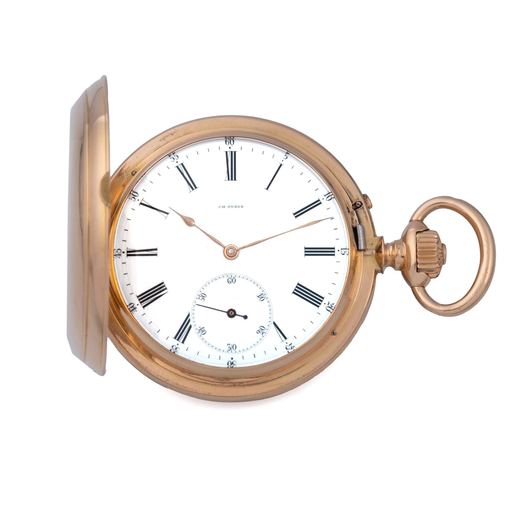
Pocket Watches · circa 1890
Charles Oudin pocket watch, circa 1890
Antiquorum auction archive, Geneva
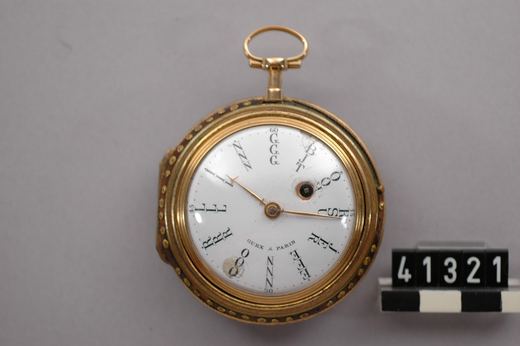
Pocket Watches · 1898
Pocket watch by Guex, France, 1898
Swedish National Museum of Science and Technology
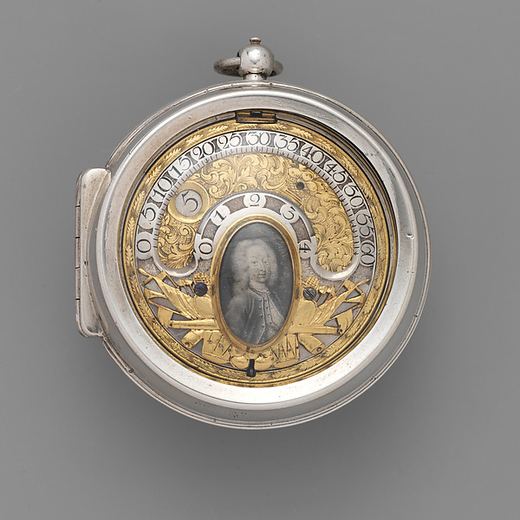
Pocket Watches · 19th or 20th century, in the style of 16th–early 17th century
Watch by Thomas Tompion, United Kingdom, 1800–1917
The Metropolitan Museum of Art, New York
Pocket Watches · 1801-1900
Pocket watch by Markwick, Markham; Perigal family, England, 1801-1900
Science Museum Group, London