
Wristwatches · Wristwatch
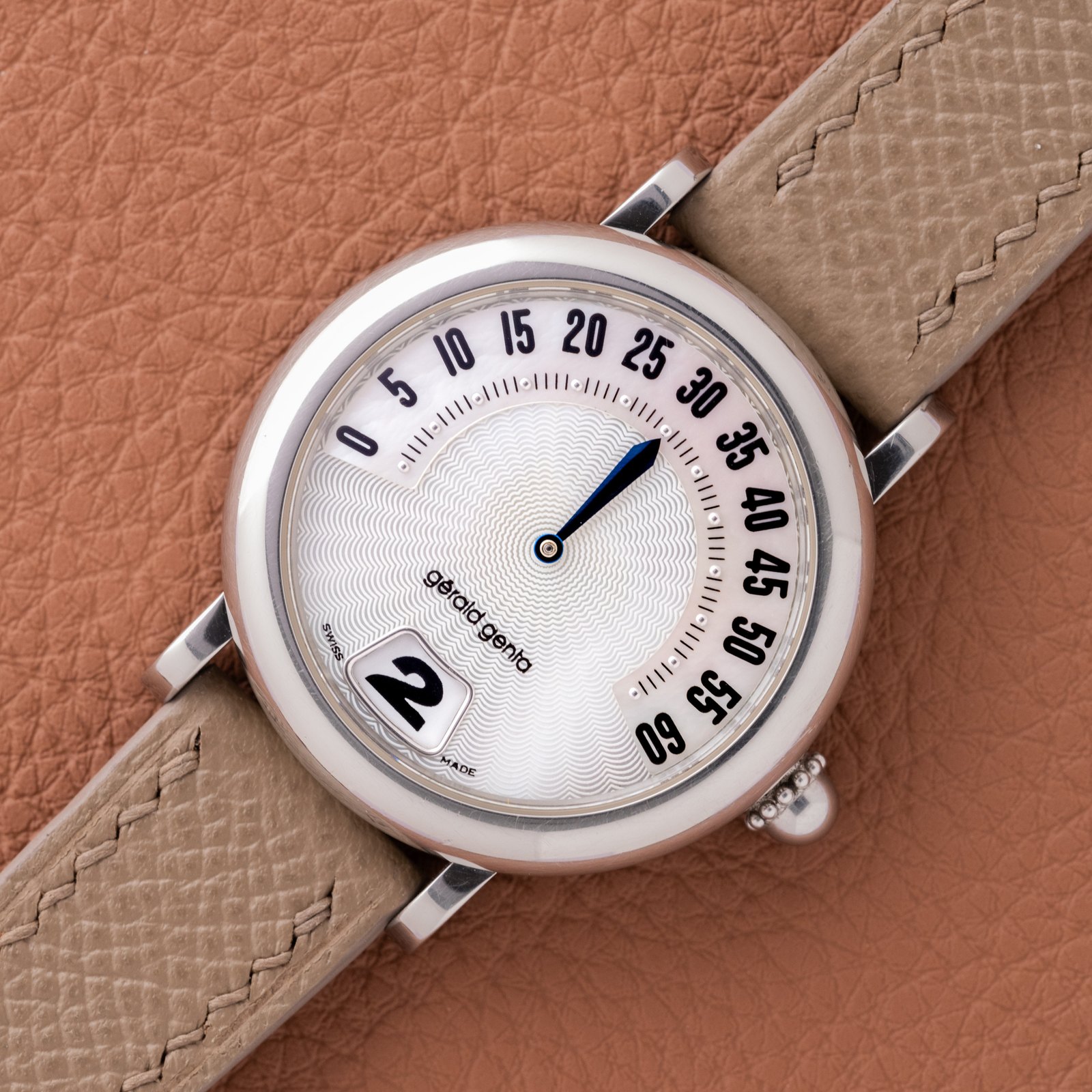
Gérald Genta Retrograde Jump Hour Guilloche Pearl Dial (Ref. G.3614), 2000s
- Maker / attribution
- Gerald Genta (maker)
- Date
- 2000s
- Historical period
- Mechanical Renaissance (1990 – 2010)
- Country of origin
- Switzerland
- Object type
- Wristwatch
- Dimensions
- Case 34 mm
- Stock no.
- Product 8806105710775
- Credit line
- Dealer listing, Huntington Company (product 8806105710775)
- Catalogue title (original)
- 2000s Gérald Genta Retrograde Jump Hour Guilloche Pearl Dial (Ref. G.3614) (English)
View the source record (dealer listing) ↗ (opens another website in a new tab)Suggest a correction
Record summary
Catalogued by Huntington Company (dealer) (stock number Product 8806105710775), this is a wristwatch by Gerald Genta, made in Switzerland, dated 2000s. The Atlas places it in the Mechanical Renaissance period (1990 – 2010) of its Wristwatches collection. Recorded dimensions: Case 34 mm. The record is illustrated with 6 photographs.
Assembled from the source record's structured fields. Dates and attributions are given as the source states them; where a field is missing the Atlas leaves it blank rather than estimating.
Catalogue description
Dealer description — Huntington Company
History and Significance Before Gérald Genta became a name most commonly discussed in connection with watches designed for other manufactures, there was an entire collection of watches carrying the designer's own name. Those pieces gave Genta considerably more freedom to experiment with displays, case shapes, and complications that rarely appeared in conventional Swiss watches. Retrograde indications and jumping hours became particularly important parts of that vocabulary. The reference G.3614 belongs squarely to this wonderfully unconventional period. The time display immediately separates the reference G.3614 from an ordinary dress watch. Rather than using conventional centrally mounted hour and minute hands, the jumping-hour mechanism advances the hour instantaneously while the retrograde display travels across its scale before snapping back to begin again. Reading the time becomes part of the personality of the watch rather than a purely functional exercise. It is mechanical watchmaking used to create visual theater. The dial makes the unusual display even more interesting. Mother of pearl brings natural variation to the surface, while the guilloché treatment introduces a geometric texture underneath the shifting color. Those two decorative techniques could easily compete with one another, yet here they suit the eccentricity of the complication. The result feels luxurious without becoming predictable. What makes these early Gérald Genta watches especially interesting today is how little they resemble the safer luxury watches that surrounded them. The reference G.3614 was not trying to reinterpret a traditional round dress watch or imitate an established sports-watch formula. It came from a brand willing to make the movement, display, and exterior design equally unconventional. That willingness to be strange is a large part of why this era of Gérald Genta remains so rewarding to rediscover. Writer's Thoughts There is something wonderfully unapologetic about the reference G.3614. The mother of pearl, guilloché, retrograde display, and jumping hour sound like far too many ideas for one watch, yet the result somehow feels cohesive. Gérald Genta understood that an unusual complication could also be playful, and this watch embraces that idea completely. It is exactly the sort of forgotten early-2000s watch that makes digging through old catalogs more interesting. The 34mm proportions are also a huge part of the charm. Instead of turning the complication into a large technical object, the reference G.3614 keeps everything compact and elegant. That contrast makes the unconventional display feel even more unexpected. There are plenty of watches designed by Gérald Genta worth discussing, but the watches bearing his own name reveal a much stranger and more personal side of his work. Our Promise Every watch is thoroughly vetted, carefully described with complete transparency, and guaranteed authentic. Each piece is offered in honest condition, ensuring collectors receive a timepiece that reflects both originality and integrity. Specifications Brand: Gérald Genta Model: Retrograde Jump Hour Reference: G.3614 Year: Early 2000s Case Material: Stainless steel Case Size: 34mm Dial: Guilloché mother-of-pearl dial Movement: Automatic retrograde jump-hour movement Strap/Buckle: Leather strap Buckle/Clasp: Original Gérald Genta buckle Contents: Watch only Condition Case: Stainless steel case presents well with signs of wear consistent with age and use. Dial: Mother-of-pearl guilloché dial presents beautifully, retaining its distinctive texture and natural variation. Hands: Blued hand presents well with a clean appearance. Crystal: Crystal presents well overall with light signs of wear. Strap/Buckle: Leather strap is new. Buckle/Clasp: Original Gérald Genta buckle remains present and shows light signs of wear.
Historical context
Mechanical Renaissance (1990 – 2010)
Mechanical watches return as cultural objects; independent watchmaking flourishes.
Mechanical watches returned as cultural and luxury objects. Complications, tourbillons and new materials proliferated; independent watchmakers such as George Daniels, F.P. Journe and Philippe Dufour revived artisanal watchmaking; collecting vintage watches became a major field.
Read the period in the timelineMore wristwatches from this periodEarlier: Quartz Revolution
Atlas type guide
Wristwatches
Bracelet watches were worn by women from the early nineteenth century — Breguet made one for Caroline Murat, Queen of Naples, in 1810–12 — but the wristwatch only became a man's instrument with military use and aviation in the early twentieth century. Between the World Wars it overtook the pocket watch; the 1920s and 1930s brought rectangular Art Deco cases, water-resistant cases and the first automatic winding systems.
After 1945 the wristwatch became a carrier of identity — dress watches, sports and dive watches, chronographs, calendars — produced by Swiss, American, Japanese, German, Soviet and Chinese industries. The quartz revolution after 1969 and the mechanical renaissance since the 1990s, including the rise of independent watchmakers, complete the story.
What to look for
- The reference number (between the lugs or inside the case back) and serial number, the starting point for dating.
- The calibre: its maker and number are often stamped under the dial or on the bridge.
- Originality of dial, hands and crown — refinished ('redial') dials are common.
- Case material marks: 18K/750, 14K/585, stainless steel, gold-filled, plated.
Dating clues
- Wire-lug cases: before c. 1925.
- Water-resistant screw-down cases: from 1926.
- Quartz movements: from 1969; sapphire crystals widespread after c. 1980.
General guidance written by the Atlas editors about this kind of object. It is not a statement about this particular piece; for that, rely on the source record above and on physical examination.
Related records
Wristwatches · 1990s
Gerald Genta Octo (Ref. G35587) Black Dial, 1990s
Craft & Tailored (dealer), Los Angeles
Wristwatches · c. 1990s
Gérald Genta Octagonal 'Cushion' Skeleton, c. 1990s
Analog/Shift (dealer), New York
Wristwatches · early 2000s
Gerald Genta Night & Day, early 2000s
Analog/Shift (dealer), New York
Wristwatches · 1990s
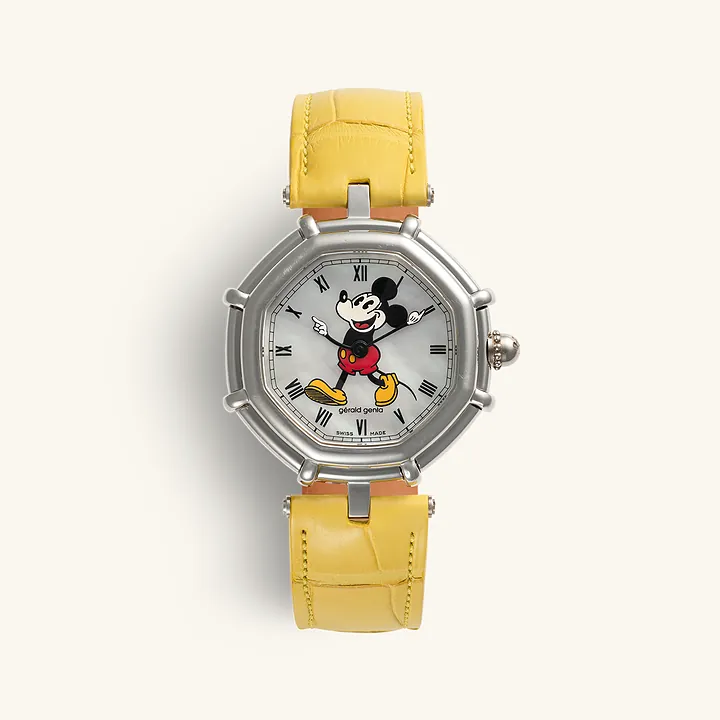
Gerald Genta Disney Automatic, ref. G.3487.7, 1990s
Watches of Knightsbridge (dealer), London

Wristwatches · 2008
Wristwatch by Breitling?, 2008
Museum Rotterdam

Wristwatches · c. 1990s
Audemars Piguet Bamboo, c. 1990s
Antiquorum auction archive, Geneva

Wristwatches · c. 1990
Audemars Piguet Huitieme Perpetual Calendar, ref. 25696PT, c. 1990
Antiquorum auction archive, Geneva

Wristwatches · c. 1990
Breitling Chronomat, ref. b13050.1, c. 1990
Antiquorum auction archive, Geneva