
Clocks · Banjo clock
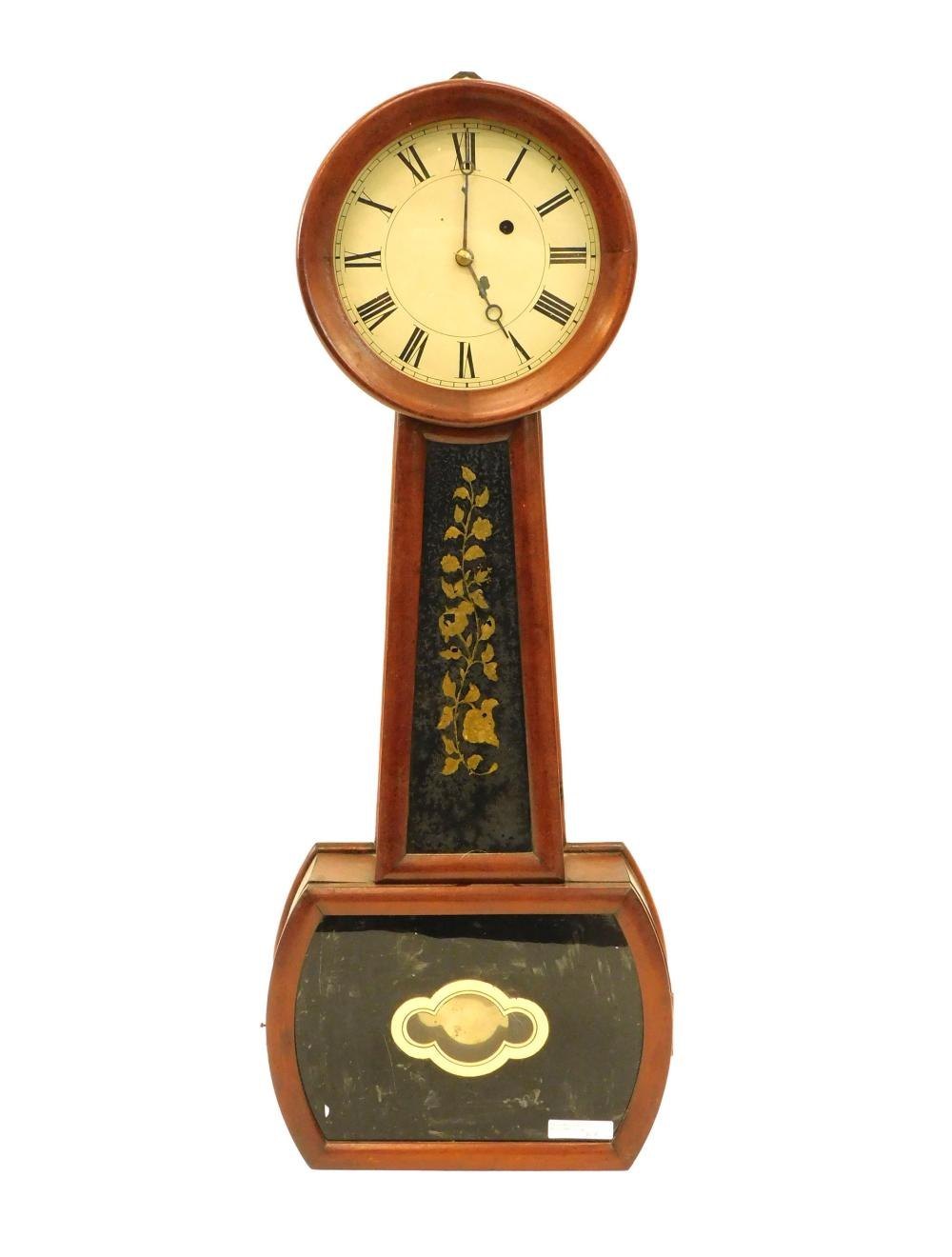
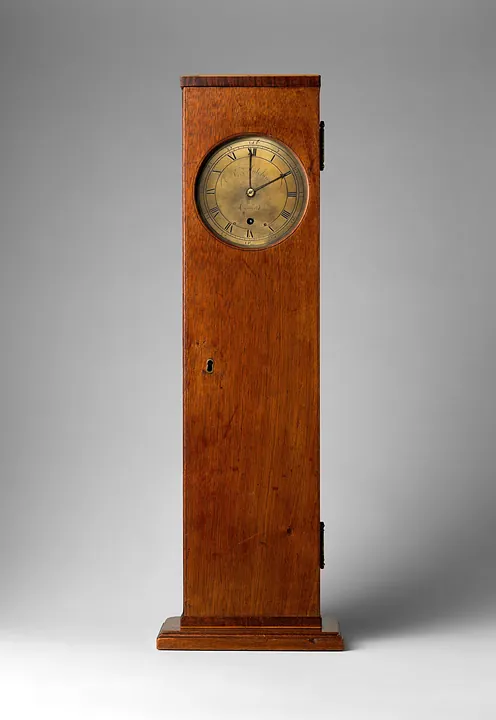
George Hatch Banjo Clock
- Maker / attribution
- George Hatch (source attribution)
- Date
- 19th century
- Historical period
- Precision & Scientific Horology (1750 – 1850)
- Country of origin
- United States
- Object type
- Banjo clock
- Materials / technique
- Mahogany
- Dimensions
- 29 inches long
- Auction house
- Marion Antique Auctions (via Invaluable)
- Lot
- 168
- Credit line
- Marion Antique Auctions (via Invaluable)
- Catalogue title (original)
- George Hatch (1817-1879) Banjo Clock (English)
View the source record (auction lot) ↗ (opens another website in a new tab)Suggest a correction
Record summary
Catalogued by Marion Antique Auctions (via Invaluable) (lot 168), this is a banjo clock attributed to George Hatch, made in United States, dated 19th century. The Atlas places it in the Precision & Scientific Horology period (1750 – 1850) of its Clocks collection. Materials and techniques recorded by the source: Mahogany. Recorded dimensions: 29 inches long. The record is illustrated with 1 photograph.
Assembled from the source record's structured fields. Dates and attributions are given as the source states them; where a field is missing the Atlas leaves it blank rather than estimating.
Catalogue description
Original object description
This nineteenth-century banjo clock is credited to Attleboro, Massachusetts craftsman George Hatch (1817–1879) and incorporates stylistic features pioneered by Howard and Davis as well as the Willards. Its mahogany case stands 29 inches high, measuring 9 inches across the upper section and 11 inches across the base, and features rounded border moldings alongside a turned timber bezel. Timekeeping is maintained by an unsigned, eight-day brass movement driven by a cast-iron weight and governed by a brass pendulum; the plumb line is marked by a brass acorn mounted to the weight baffle. Painted Roman numerals appear on the iron dial, which shows minor paint losses from age. Original gilt-painted reverse-glass tablets line the throat and lower door, the lower panel having sustained some later touch-ups. Complete with its original key, the timepiece contains an early manuscript note stating it once belonged to Lunan Thurston and was displayed in the Leicester Post Office until his 1911 passing. Though earlier assigned to Howard—a maker whose work is frequently conflated with Hatch's—the construction and mechanical details point to Hatch's authorship.
Historical context
Precision & Scientific Horology (1750 – 1850)
Harrison solves longitude; Mudge invents the lever; Breguet's Paris workshop defines the modern watch.
The age of the deadbeat escapement, compensated pendulums and observatory regulators. Domestic clocks spread through the middle classes: English longcase and bracket clocks, French gilt-bronze mantel clocks, Viennese Biedermeier wall clocks, Black Forest painted-shield clocks, and the first American shelf clocks.
Read the period in the timelineMore clocks from this periodEarlier: Early Modern Horology
Atlas type guide
Domestic clocks
A clock combines four systems: a source of power (falling weight, coiled spring, or later electricity), a gear train that divides time, an escapement and oscillator that regulate it (foliot, pendulum or balance), and an indicating system of dial and hands or a bell. Its history runs from the large iron weight-driven clocks of the late thirteenth century to Renaissance spring-driven table clocks, the pendulum revolution of 1656, the factory clocks of the nineteenth century and electric and quartz clocks of the twentieth.
Domestic clocks also reflect regional furniture and decorative traditions — English longcase and bracket clocks, French pendules, Viennese regulators, Black Forest and American shelf clocks — and therefore record changing tastes as much as technical progress.
What to look for
- How the clock is powered: weights, spring barrel, fusee, electric coil.
- The oscillator: foliot, short pendulum, long seconds pendulum or balance.
- Whether it strikes: hour only (count wheel) or hours and quarters (rack striking).
- The maker or retailer's name on dial and movement, and any factory trademarks.
- Signs of alteration — replaced dials, converted escapements, 'married' cases.
Dating clues
- Before 1656 clocks used foliots or balances; after, most domestic clocks have pendulums.
- Anchor escapements spread after c. 1670; minute hands became common at the same time.
- Factory production in America and Germany transformed prices after c. 1840.
General guidance written by the Atlas editors about this kind of object. It is not a statement about this particular piece; for that, rely on the source record above and on physical examination.
Related records
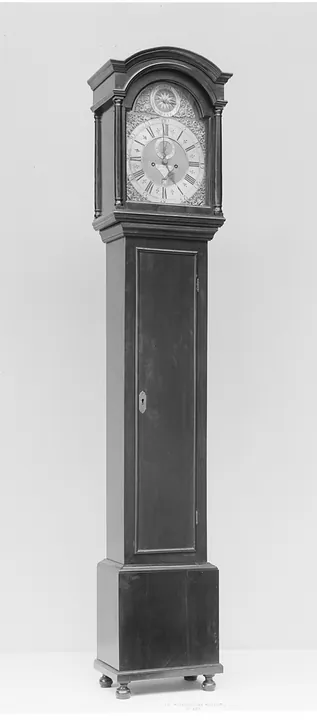
Clocks · 1740–60
Tall clock by Samuel Bagnall, United States, 1740–60
The Metropolitan Museum of Art, New York
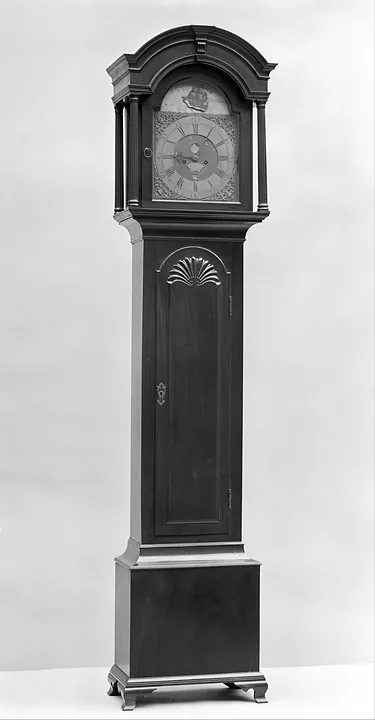
Clocks · 1750–60
Tall clock by Gawen Brown, United States, 1750–60
The Metropolitan Museum of Art, New York
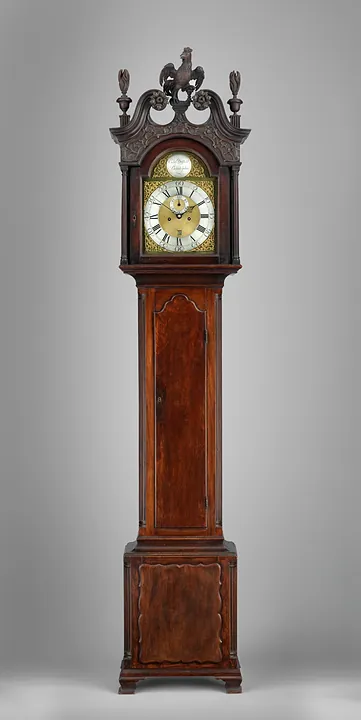
Clocks · 1765–75
Clock by Edward Duffield, United States, 1765–75
The Metropolitan Museum of Art, New York
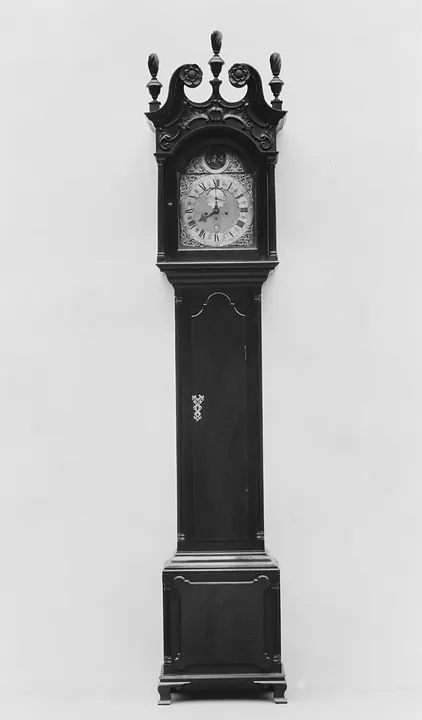
Clocks · 1767–71
Tall clock by William Huston, United States, 1767–71
The Metropolitan Museum of Art, New York
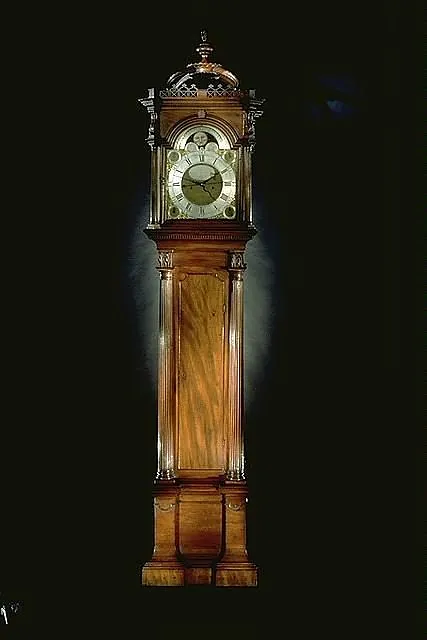
Clocks · 1769
Clock by Joseph Ellicott, United States, 1769
National Museum of American History, Smithsonian Institution, Washington DC
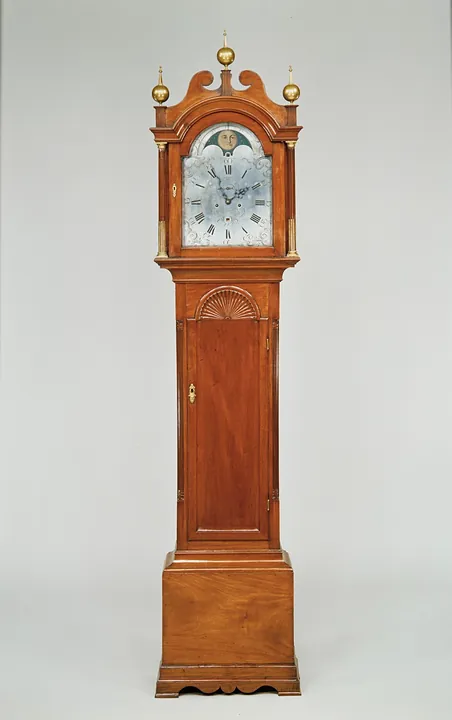
Clocks · 1772
Tall clock by Benjamin Willard, United States, 1772
The Metropolitan Museum of Art, New York
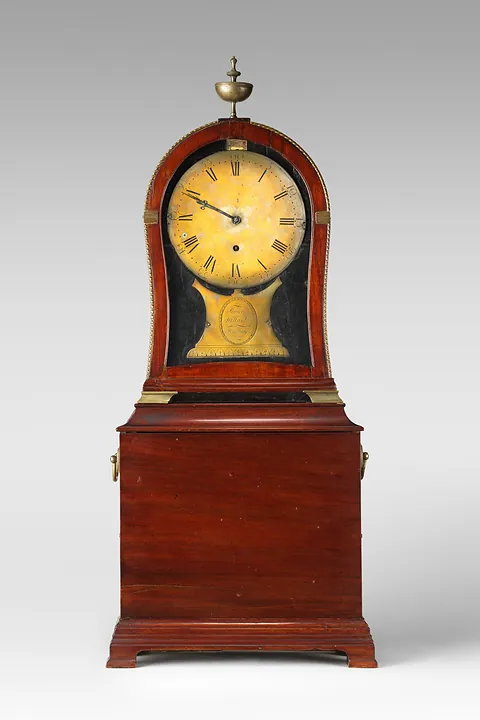
Clocks · 1780–90
"balloon" shelf clock by Simon Willard, United States, 1780–90
The Metropolitan Museum of Art, New York
Clocks · c. 1786
Shelf clock by Levi Hutchins, United States, c. 1786
The Metropolitan Museum of Art, New York