
Wristwatches · Wristwatch
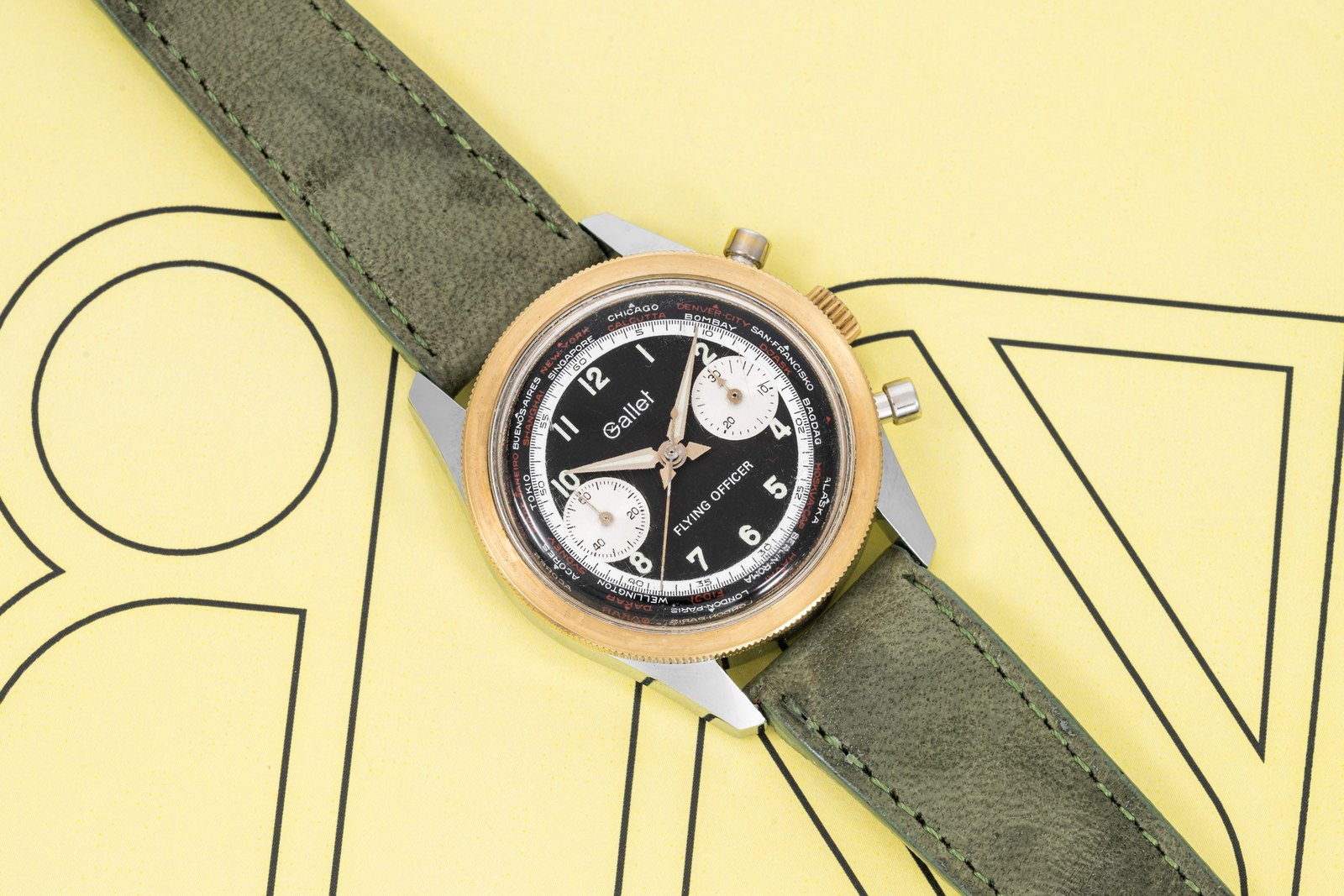
Gallet Flying Officer, c. 1980s
- Maker / attribution
- Gallet (maker)
- Date
- c. 1980s
- Historical period
- Quartz Revolution (1969 – 1990)
- Country of origin
- Switzerland
- Object type
- Wristwatch
- Dimensions
- Case 38 mm
- Stock no.
- 40990207
- Credit line
- Dealer listing, Analog/Shift (40990207)
- Catalogue title (original)
- Gallet Flying Officer (English)
View the source record (dealer listing) ↗ (opens another website in a new tab)Suggest a correction
Record summary
Catalogued by Analog/Shift (dealer), New York (stock number 40990207), this is a wristwatch by Gallet, made in Switzerland, dated c. 1980s. The Atlas places it in the Quartz Revolution period (1969 – 1990) of its Wristwatches collection. Recorded dimensions: Case 38 mm. The record is illustrated with 6 photographs.
Assembled from the source record's structured fields. Dates and attributions are given as the source states them; where a field is missing the Atlas leaves it blank rather than estimating.
Catalogue description
Dealer description — Analog/Shift
If you've never heard of Gallet, pay attention: One of the oldest manufactures in Switzerland, Gallet has been around since 1466, and has a colorful and diverse history of watchmaking tradition. From one-off handmade pocket watches for kings to some of the first mass-produced wristwatches in history, there is little road in the timekeeping industry on which Gallet hasn't tread in their 500+ year history. Gallet timepieces have been worn by individuals from every walk of life, including presidents, racing drivers, soldiers, and pilots. From the dawn of the 20th century onward, Gallet has been manufacturing high-grade chronographs for sports timing and aviation usage. The brand has an outstanding portfolio of innovations and world firsts, including the first wrist-worn chronograph, the first waterproof chronograph, the first regatta timer, the first chronograph with GMT hand, and the first chronograph with built-in worldtimer…just to name a few. One of the more well known Gallet designs is that of the Flying Officer, an aeronautical chronograph with a 12-hour bezel and city ring that allowed pilots to track multiple time zones. Launched in 1939 at the outbreak of the Second World War, the Flying Officer was famously worn by President Harry Truman during his time in office. This particular Flying Officer dates to circa the 1980s and features a 38mm stainless steel case with a bronze bidirectional 12-hour bezel, a matching unsigned bronze crown, a matte black Tritium dial with silver sub-registers and a white minute track, a world time chapter ring, and a matching alpha hands. In strong condition throughout, it’s perfect for the aeronautical enthusiast or the modern traveler. Check it out today!
Historical context
Quartz Revolution (1969 – 1990)
Seiko's Astron begins mass quartz timekeeping; traditional industries contract sharply.
Quartz and digital watches transformed the market after 1969. Swiss employment collapsed, Japanese and Hong Kong production soared, and the Swatch (1983) helped the Swiss industry recover; mechanical watches survived as luxury goods.
Read the period in the timelineMore wristwatches from this periodEarlier: Modern Mechanical Horology
Atlas type guide
Military, pilot and travel watches
The wristwatch owes much of its adoption by men to warfare and aviation. Wristlets — small pocket watches soldered with lugs and worn on a strap — were used in colonial campaigns and became standard equipment in the First World War, with protective grilles over the crystal ('shrapnel guards'). Louis Cartier's Santos (1904), designed for the aviator Alberto Santos-Dumont, is often cited as an early purpose-made pilot's watch.
In the Second World War governments specified watches in detail: the German B-Uhr observation watches, the American A-11, and the British 'W.W.W.' (the 'Dirty Dozen' set of 1945). After the war, jet travel brought GMT and world-time watches, which show two or more time zones at once — Louis Cottier's world-time mechanism and the Rolex GMT-Master (1955) are examples.
What to look for
- Military markings on the case back: broad arrow, issue numbers, 'W.W.W.', 'A.T.P.'
- High-legibility black dials with luminous Arabic numerals; oversized crowns for gloved hands.
- 24-hour hands and rotating 24-hour bezels or city rings on GMT/world-time watches.
- Wire lugs on early wristlets converted from pocket watches.
Dating clues
- Wire-lug wristlets: c. 1900–1925.
- Military specifications of the Second World War: 1939–1945.
- GMT and world-time wristwatches: mainly after 1950.
General guidance written by the Atlas editors about this kind of object. It is not a statement about this particular piece; for that, rely on the source record above and on physical examination.
Related records
Wristwatches · c. 1960-1970s
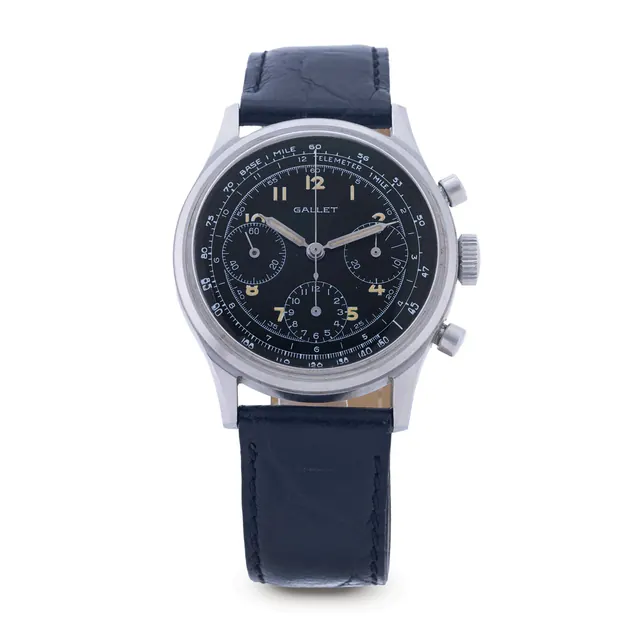
Gallet wristwatch, Chronograph, circa 1960-1970s
Antiquorum auction archive, Geneva
Wristwatches · c. 1960-70’s
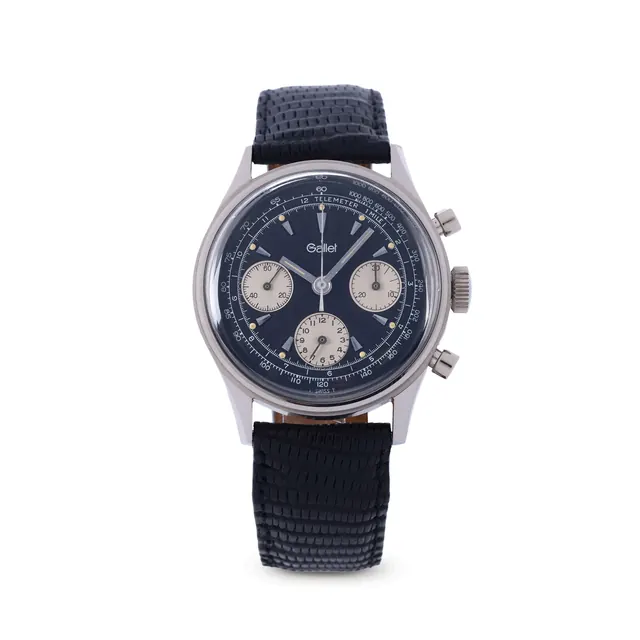
Gallet wristwatch, Multichron Chronograph, circa 1960-70’s
Antiquorum auction archive, Geneva
Wristwatches · c. 1940s
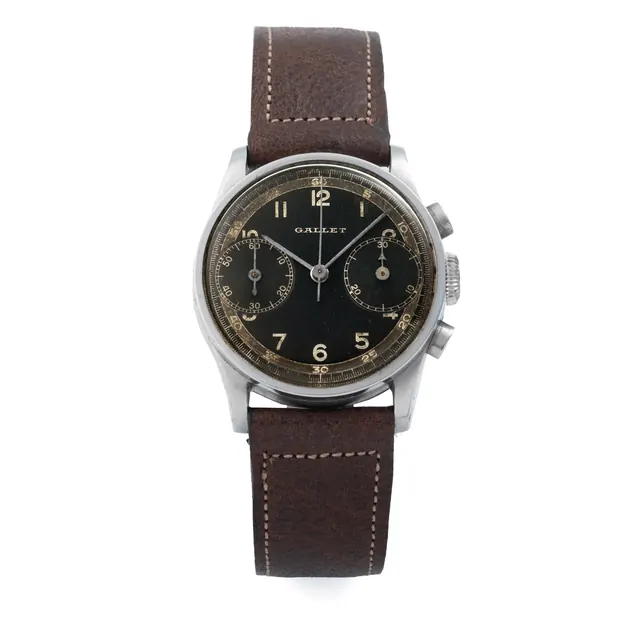
Gallet wristwatch, circa 1940's
Antiquorum auction archive, Geneva
Wristwatches · c. 1940
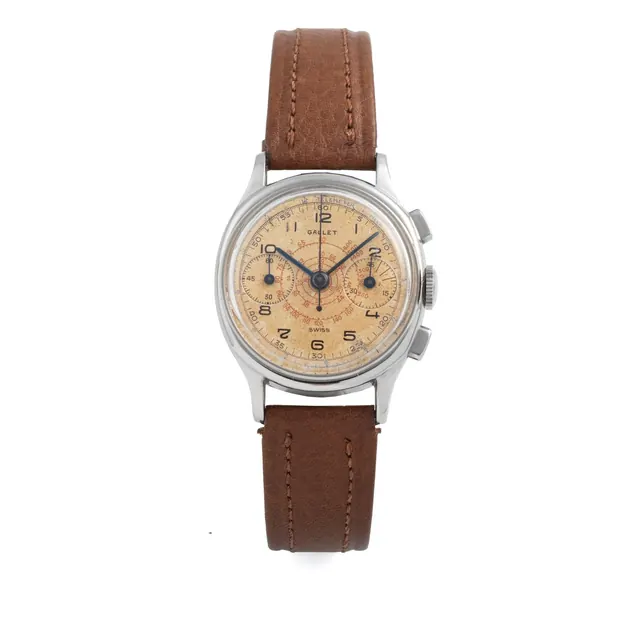
Gallet wristwatch, Commander, CIrca 1940
Antiquorum auction archive, Geneva

Wristwatches · 1970
Wristwatch by Heno, Switzerland, 1970
Museum Rotterdam

Wristwatches · 1960–1986
'Tri-Compax' calendar chronograph wristwatch in gold case, by Universal, Geneva, Switzerland, 1960–1986.
Science Museum Group, London

Wristwatches · 1969–1970
Beta 21 Quartz wristwatch movement, made in Switzerland, 1970.
Science Museum Group, London

Wristwatches · c. 1969
Omega Speedmaster Moonwatch, ref. 145022-69st, c. 1969
Antiquorum auction archive, Geneva