
Wristwatches · Wristwatch
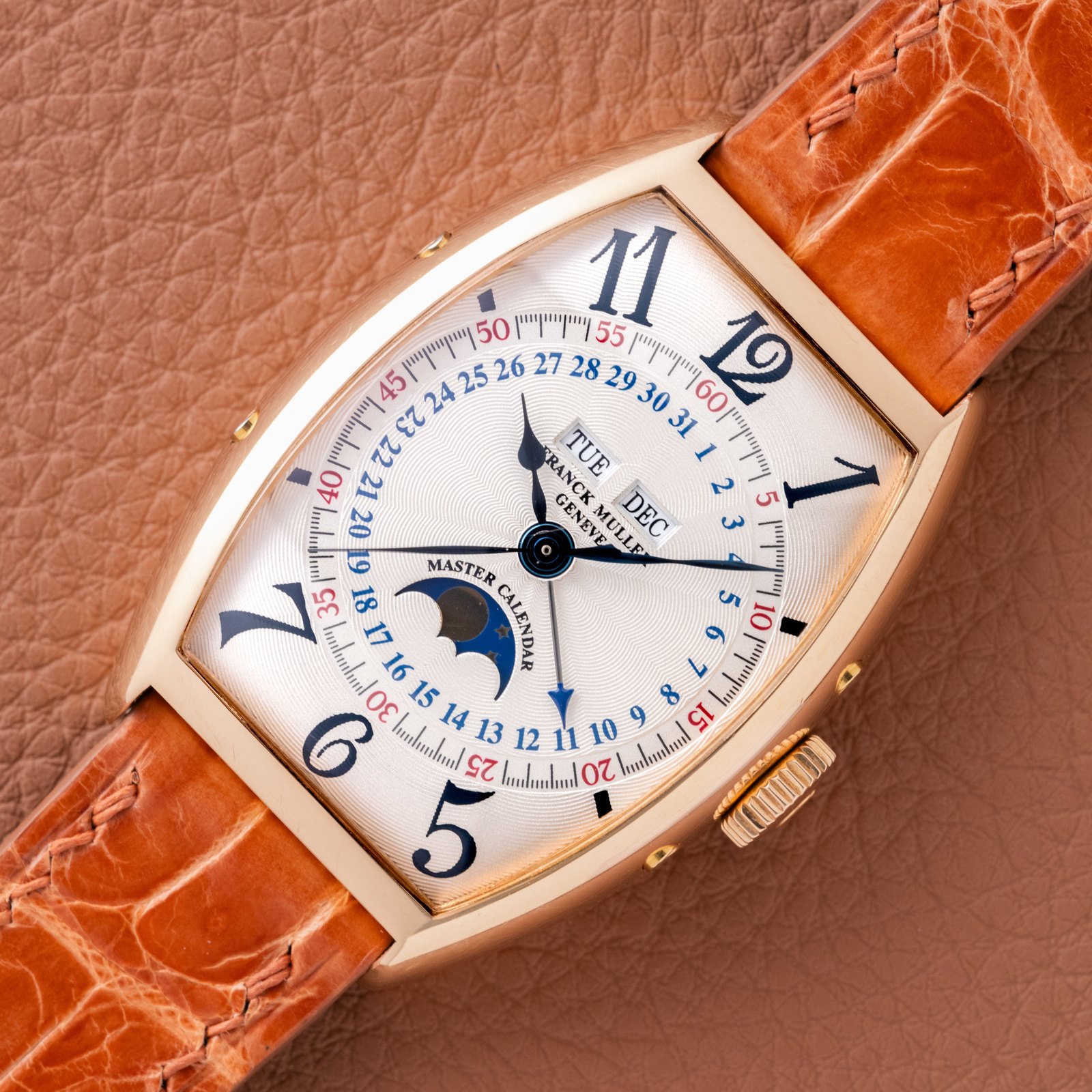
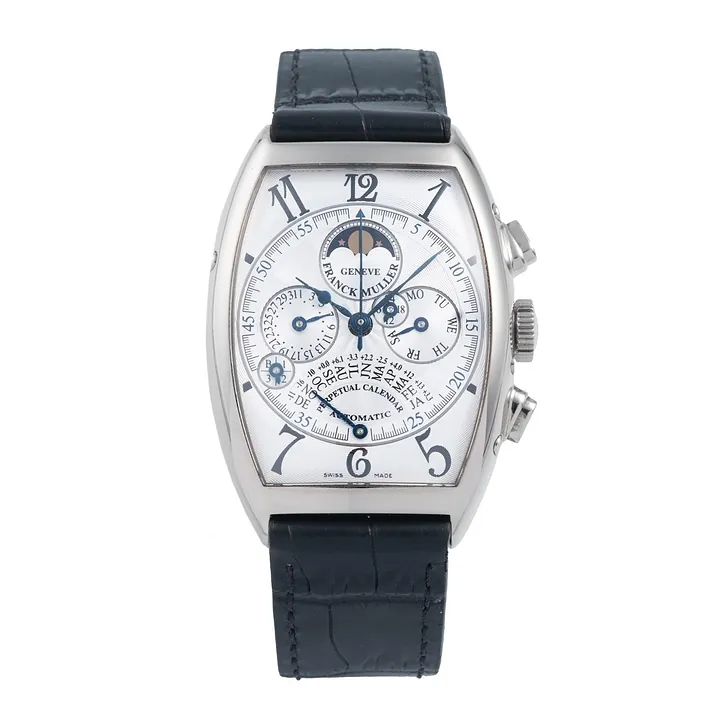
Franck Muller Cintrée Curvex Master Calendar Moonphase - Mk 1 (Ref. 5850 MC L), 1990s
- Maker / attribution
- Franck Muller (maker)
- Date
- 1990s
- Historical period
- Mechanical Renaissance (1990 – 2010)
- Country of origin
- Switzerland
- Object type
- Wristwatch
- Dimensions
- Case 32 mm
- Stock no.
- Product 15932535144631
- Credit line
- Dealer listing, Huntington Company (product 15932535144631)
- Catalogue title (original)
- 1990s Franck Muller Cintrée Curvex Master Calendar Moonphase - Mk 1 (Ref. 5850 MC L) (English)
View the source record (dealer listing) ↗ (opens another website in a new tab)Suggest a correction
Record summary
Catalogued by Huntington Company (dealer) (stock number Product 15932535144631), this is a wristwatch by Franck Muller, made in Switzerland, dated 1990s. The Atlas places it in the Mechanical Renaissance period (1990 – 2010) of its Wristwatches collection. Recorded dimensions: Case 32 mm. The record is illustrated with 6 photographs.
Assembled from the source record's structured fields. Dates and attributions are given as the source states them; where a field is missing the Atlas leaves it blank rather than estimating.
Catalogue description
Dealer description — Huntington Company
History and Significance The Franck Muller Cintrée Curvex is one of the few modern watch designs that established an immediately recognizable identity without borrowing heavily from the established shapes of traditional Swiss watchmaking. Introduced during the manufacturer's formative years in the early 1990s, the collection departed from the familiar round dress watch in favor of an elongated tonneau case with pronounced curves in multiple directions. The result was a design that felt simultaneously connected to the extravagant shaped watches of the early twentieth century and entirely appropriate for a new generation of independent watchmaking. The reference 5850 became an important foundation for the Cintrée Curvex family, establishing proportions and architectural details that would become central to the brand's identity. Franck Muller's early success was closely connected to an ability to make complicated mechanical watches feel expressive rather than intimidating. Traditional complications such as perpetual calendars, minute repeaters, and chronographs had long been associated with conservative case designs and relatively restrained dials. Muller approached these mechanisms with a different philosophy, frequently incorporating oversized numerals, unconventional displays, and elaborate decorative finishes. The Master Calendar represented an especially interesting expression of this approach, bringing together multiple calendar indications within a dial that remained unmistakably Franck Muller. Rather than hiding the complexity, the design made the calendar functions an essential part of the watch's visual character. The reference 5850 MC L incorporates a complete calendar display with indications of the day, date, month, and moon phase. The day and month appear through two apertures positioned beneath twelve o'clock, while the date is indicated by a centrally mounted hand pointing toward a numbered scale around the dial. A moonphase display occupies the lower portion, introducing a traditional astronomical complication into an otherwise distinctly contemporary arrangement. The combination recalls the elaborate calendar wristwatches produced by important Swiss manufacturers during the middle of the twentieth century, although the unusual case and expressive typography give the reference 5850 an entirely different personality. One of the most significant details of this example is its early Mark I dial configuration. The words "Master Calendar" appear in black, distinguishing the earliest executions from later examples that adopted red lettering. Small differences of this kind are particularly important when studying the early production history of Franck Muller, where changes to typography, dial layouts, and finishing can help distinguish different periods. The extensive guilloché decoration adds another layer of interest, with finely patterned surfaces extending across the dial and interacting beautifully with the oversized Arabic numerals. The result is a remarkably intricate composition that rewards close inspection. The early two-digit serial number further connects this watch to the formative years of the Cintrée Curvex collection. As Franck Muller expanded throughout the 1990s, the reference 5850 would become an increasingly important part of the manufacturer's catalog, eventually appearing in numerous complicated and decorative variations. Early examples retain a particular historical appeal because they represent the period when the design was still establishing its identity. In yellow gold, the reference 5850 MC L offers a compelling combination of traditional calendar watchmaking, elaborate decorative finishing, and the unconventional design language that would define Franck Muller's rise. Writer’s Thoughts Among the early Cintrée Curvex references, the Master Calendar is particularly interesting because the complication seems perfectly suited to the case. The elongated dial creates enough room for multiple calendar indications without making the watch feel excessively crowded, while the oversized numerals give the entire arrangement a wonderfully eccentric character. The early black "Master Calendar" signature is a small but important detail, especially when considered alongside the two-digit serial number. These are the characteristics that make the earliest examples worth separating from the much larger number of Franck Muller watches produced in later years. Our Promise Every watch is thoroughly vetted, carefully described with complete transparency, and guaranteed authentic. Each piece is offered in honest condition, ensuring collectors receive a timepiece that reflects both originality and integrity. Specifications Brand: Franck Muller Model: Cintrée Curvex Master Calendar Moonphase Reference: 5850 MC L Year: 1990s Case Material: 18k Yellow Gold Case Size: 32mm Dial: Silver Guilloché Mark I Dial with Black Master Calendar Signature, Complete Calendar, and Moonphase Movement: Automatic Strap/Buckle: New H.C. Leather Strap Buckle/Clasp: Generic Pin Buckle Contents: Watch only Condition Case: Yellow gold case remains in excellent condition with attractive polished surfaces and light signs of normal wear. Dial: Silver guilloché dial remains in excellent condition with well-preserved decorative finishing, crisp printing, and clear calendar indications. Hands: Blued hands remain in excellent condition with attractive, consistent color and finishing. Crystal: Crystal remains in excellent condition with no notable visible wear. Strap/Buckle: Newly fitted H.C. leather strap remains in excellent condition. Buckle/Clasp: Generic pin buckle remains in excellent condition.
Historical context
Mechanical Renaissance (1990 – 2010)
Mechanical watches return as cultural objects; independent watchmaking flourishes.
Mechanical watches returned as cultural and luxury objects. Complications, tourbillons and new materials proliferated; independent watchmakers such as George Daniels, F.P. Journe and Philippe Dufour revived artisanal watchmaking; collecting vintage watches became a major field.
Read the period in the timelineMore wristwatches from this periodEarlier: Quartz Revolution
Atlas type guide
Calendar, moon-phase and perpetual calendar watches
Calendar complications range from a simple date to the perpetual calendar, which automatically allows for months of different lengths and leap years until 2100. Pocket watches with perpetual calendars were made in the eighteenth and nineteenth centuries; Patek Philippe made the first perpetual calendar wristwatch in 1925, and series production followed in 1941. The annual calendar (Patek Philippe, 1996) needs correction only once a year.
Moon-phase displays use a disc with two moons and 59 teeth advanced daily, approximating the 29.5-day lunation; more precise trains reduce the error to one day in over a century.
What to look for
- Apertures or subsidiary dials for day, date, month and leap year.
- Moon disc under a 'bosom' shaped aperture.
- Recessed correctors on the case band for setting the calendar.
Dating clues
- Triple-date wristwatches: popular c. 1940–1955.
- Perpetual calendar wristwatches: from 1925 (unique) and 1941 (series).
General guidance written by the Atlas editors about this kind of object. It is not a statement about this particular piece; for that, rely on the source record above and on physical examination.
Related records
Wristwatches · c. 1996-99
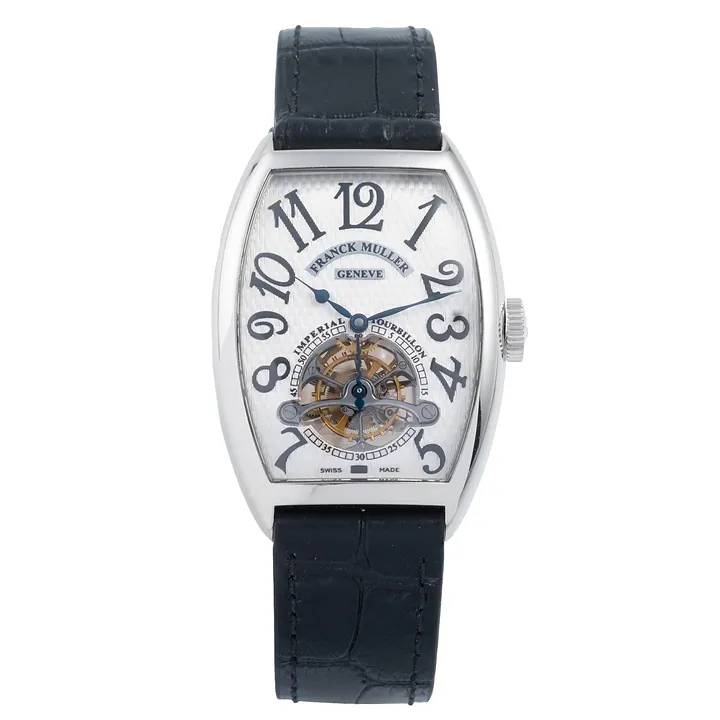
Franck Muller Imperial Tourbillon, ref. 5850T, c. 1996-99
Antiquorum auction archive, Geneva
Wristwatches · c. 2005
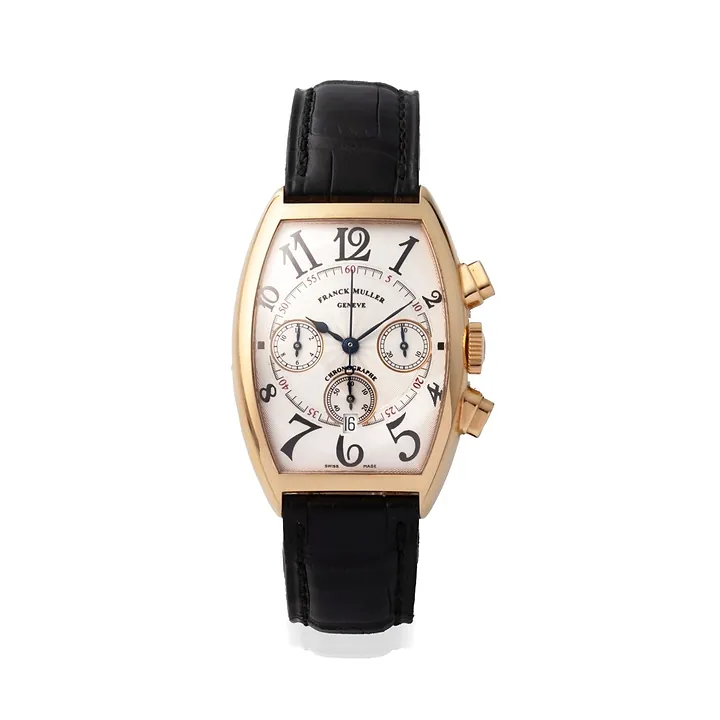
Franck Muller Casablanca Chronograph, ref. 5850 CC AT, c. 2005
Antiquorum auction archive, Geneva
Wristwatches · c. 2010-2020
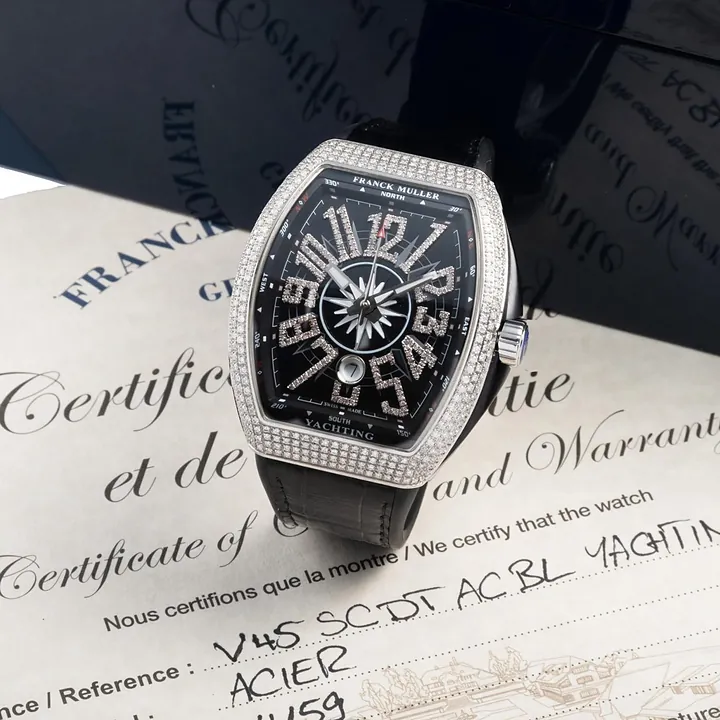
Franck Muller Vanguard Yachting, ref. V45SCDT, c. 2010-2020
Antiquorum auction archive, Geneva
Wristwatches · Sold in August 2016
Franck Muller wristwatch, ref. 6850 QPE, Sold in August 2016
Antiquorum auction archive, Geneva

Wristwatches · 2008
Wristwatch by Breitling?, 2008
Museum Rotterdam

Wristwatches · c. 1990s
Audemars Piguet Bamboo, c. 1990s
Antiquorum auction archive, Geneva

Wristwatches · c. 1990
Audemars Piguet Huitieme Perpetual Calendar, ref. 25696PT, c. 1990
Antiquorum auction archive, Geneva

Wristwatches · c. 1990
Breitling Chronomat, ref. b13050.1, c. 1990
Antiquorum auction archive, Geneva