
Wristwatches · Wristwatch
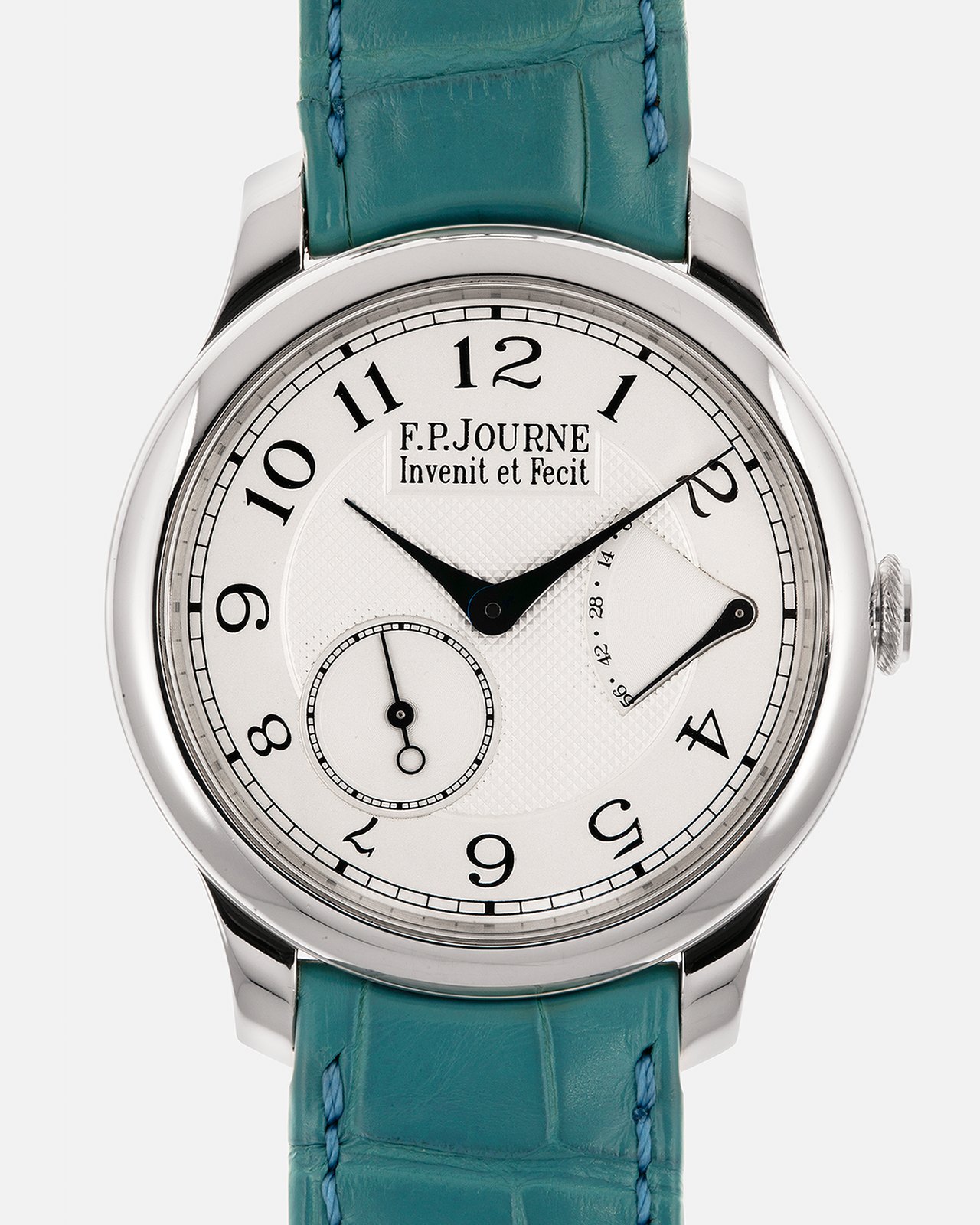
F.P. Journe Chronomètre Souverain PT 40mm Silver Guilloche, 2010s
- Maker / attribution
- F.P. Journe (maker)
- Date
- 2010s
- Historical period
- Contemporary Horology (2010 – Present)
- Country of origin
- Switzerland
- Object type
- Wristwatch
- Materials / technique
- silver
- Dimensions
- Case 40 mm
- Stock no.
- Product 7679789269079
- Credit line
- Dealer listing, S.Song Watches (product 7679789269079)
- Catalogue title (original)
- F.P. Journe Chronomètre Souverain PT 40mm Silver Guilloche (English)
View the source record (dealer listing) ↗ (opens another website in a new tab)Suggest a correction
Record summary
Catalogued by S.Song Watches (dealer), Seattle (stock number Product 7679789269079), this is a wristwatch by F.P. Journe, made in Switzerland, dated 2010s. The Atlas places it in the Contemporary Horology period (2010 – Present) of its Wristwatches collection. Materials and techniques recorded by the source: silver. Recorded dimensions: Case 40 mm. The record is illustrated with 6 photographs.
Assembled from the source record's structured fields. Dates and attributions are given as the source states them; where a field is missing the Atlas leaves it blank rather than estimating.
Catalogue description
Dealer description — S.Song Watches
Offered here is the F.P. Journe Chronomètre Souverain in a 40mm × 8mm platinum case. Introduced in 2005, the Chronomètre Souverain received the Grand Prix d'Horlogerie de Genève's (GPHG) Favourite Men's Watch award that same year and remains one of the brand's defining references. While F.P. Journe is often associated with its more complicated creations, the Chronomètre Souverain is arguably one of the clearest expressions of the brand's philosophy, combining chronometric performance, mechanical substance, and distinctive aesthetics in a remarkably balanced package. One of the Chronomètre Souverain's greatest strengths is the clarity of its dial. Crafted from whitened silver, it features a black printed minute track around the periphery, Arabic numerals, and matching hands that provide excellent legibility throughout. At its centre, a Clous de Paris guilloché field introduces depth and texture, while the snailed finishes within the small seconds and power reserve displays add subtle contrast without disturbing the dial's overall coherence. Together, these details create a surprising degree of visual richness that tends to reveal itself more fully over time than in photographs. Characteristic of many Journe creations, the layout is asymmetrical yet immediately intuitive. The subsidiary seconds display sits between 7 and 8 o'clock, balanced by a 56-hour power reserve indicator at 3 o'clock. It is a design that has become closely associated with F.P. Journe, offering enough character to stand apart while remaining exceptionally easy to live with on a daily basis. Turning the watch over reveals the in-house Cal. 1304 through the sapphire crystal caseback. Inspired by the precision marine chronometers of the nineteenth century, the manually wound movement is crafted entirely from 18-carat rose gold and features twin mainspring barrels delivering a 56-hour power reserve. With no rotor to obstruct the view, its architecture and finishing are fully exposed, from Côtes de Genève and perlage to polished screw heads and finely executed bevels throughout. Beyond its visual appeal, the Cal. 1304 serves as a reminder that F.P. Journe's reputation rests not only on original design, but also on movements engineered with chronometric performance as a primary objective. Like many of the finest collector watches, the Chronomètre Souverain rewards familiarity. The more time one spends with it, the more its proportions, layout, and details reveal themselves. Guided by the motto "Invenit et Fecit"—Invented and Made—François-Paul Journe has built a manufacture that remains fiercely independent while producing fewer than a thousand watches annually. The Chronomètre Souverain captures that philosophy particularly well, combining thoughtful engineering, refined execution, and a visual identity that remains instantly recognisable within contemporary independent watchmaking.
Historical context
Contemporary Horology (2010 – Present)
Silicon components, connected watches, optical-lattice research clocks and a thriving independent scene.
Smartwatches became the world's best-selling watches, while mechanical watchmaking focuses on craft, innovation (silicon components, new escapements) and independent makers.
Read the period in the timelineMore wristwatches from this periodEarlier: Mechanical Renaissance
Atlas type guide
Wristwatches
Bracelet watches were worn by women from the early nineteenth century — Breguet made one for Caroline Murat, Queen of Naples, in 1810–12 — but the wristwatch only became a man's instrument with military use and aviation in the early twentieth century. Between the World Wars it overtook the pocket watch; the 1920s and 1930s brought rectangular Art Deco cases, water-resistant cases and the first automatic winding systems.
After 1945 the wristwatch became a carrier of identity — dress watches, sports and dive watches, chronographs, calendars — produced by Swiss, American, Japanese, German, Soviet and Chinese industries. The quartz revolution after 1969 and the mechanical renaissance since the 1990s, including the rise of independent watchmakers, complete the story.
What to look for
- The reference number (between the lugs or inside the case back) and serial number, the starting point for dating.
- The calibre: its maker and number are often stamped under the dial or on the bridge.
- Originality of dial, hands and crown — refinished ('redial') dials are common.
- Case material marks: 18K/750, 14K/585, stainless steel, gold-filled, plated.
Dating clues
- Wire-lug cases: before c. 1925.
- Water-resistant screw-down cases: from 1926.
- Quartz movements: from 1969; sapphire crystals widespread after c. 1980.
General guidance written by the Atlas editors about this kind of object. It is not a statement about this particular piece; for that, rely on the source record above and on physical examination.
Related records
Wristwatches · 2012
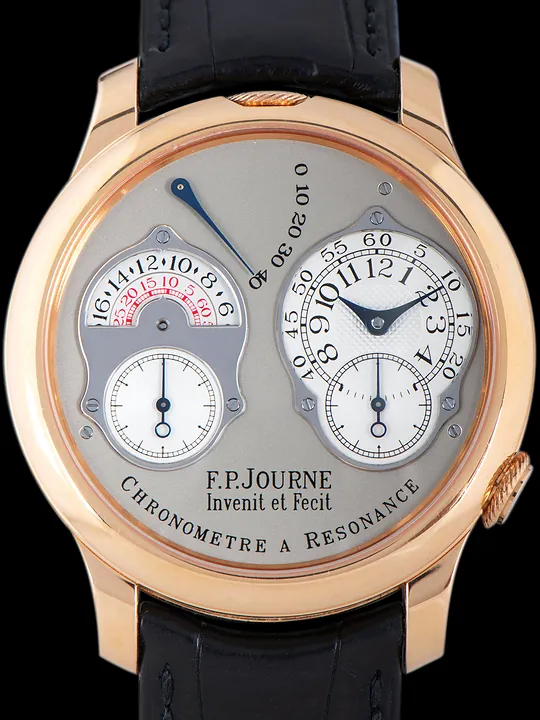
F.P. Journe Résonance "Parking Meter" 18K RG (Ref. RT) Grey Dial, 2012
Craft & Tailored (dealer), Los Angeles
Wristwatches · 2003
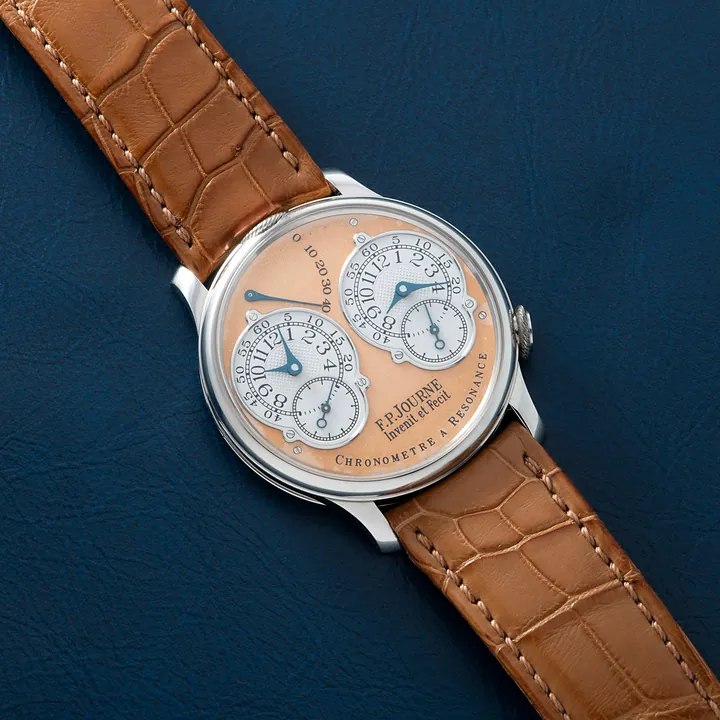
F.P. Journe Chronomètre à Résonance 'Brass Movement', 2003
Analog/Shift (dealer), New York
Wristwatches · 2019
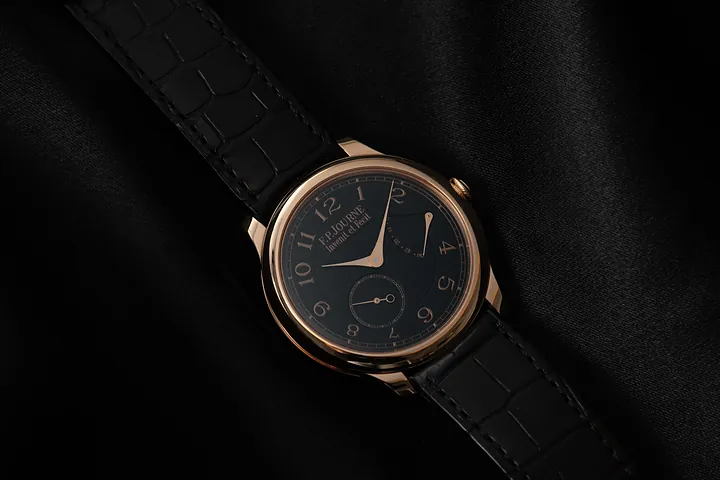
F.P. Journe Chronométre Souverain Boutique Edition, 2019
Analog/Shift (dealer), New York
Wristwatches · 2006
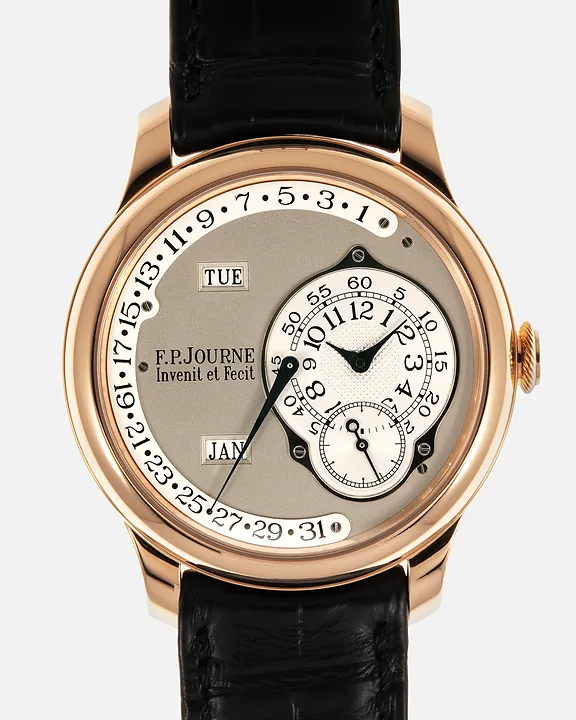
F.P. Journe Octa Calendrier RG Grey 40mm, 2006
S.Song Watches (dealer), Seattle

Wristwatches · c. 2010s
Breguet Type XXI, ref. 3810, c. 2010s (Antiquorum Lot 381-24)
Antiquorum auction archive, Geneva

Wristwatches · c. 2010s
Breguet Type XXI, ref. 3810, c. 2010s (Antiquorum Lot 386-229)
Antiquorum auction archive, Geneva

Wristwatches · Sold in September 2010
Breitling Cosmonaute, ref. A 22322, Sold in September 2010
Antiquorum auction archive, Geneva

Wristwatches · c. 2010
Corum Bubble Chrono, ref. 396.150.20, c. 2010
Antiquorum auction archive, Geneva