
Wristwatches · Wristwatch
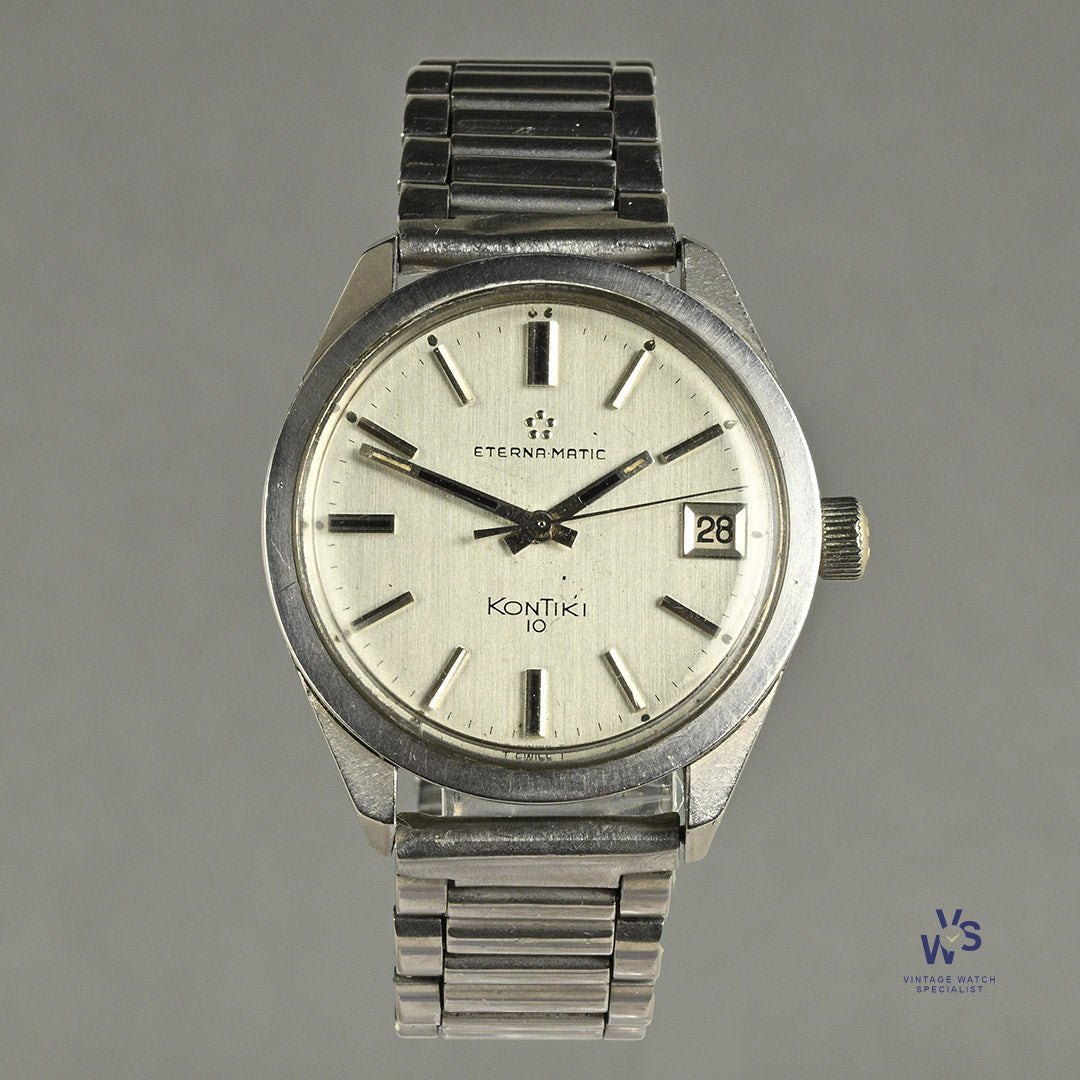
Eterna-Matic KonTiki 10 Automatic Date, circa 1968
- Maker / attribution
- Eterna (maker)
- Date
- c. 1968
- Historical period
- Modern Mechanical Horology (1945 – 1969)
- Country of origin
- Switzerland
- Object type
- Wristwatch
- Dimensions
- Case 39 mm
- Stock no.
- vws4412cs
- Credit line
- Dealer listing, Vintage Watch Specialist (vws4412cs)
- Catalogue title (original)
- Eterna-Matic KonTiki 10 Automatic Date c.1968 (English)
View the source record (dealer listing) ↗ (opens another website in a new tab)Suggest a correction
Record summary
Catalogued by Vintage Watch Specialist (dealer), United Kingdom (stock number vws4412cs), this is a wristwatch by Eterna, made in Switzerland, dated c. 1968. The Atlas places it in the Modern Mechanical Horology period (1945 – 1969) of its Wristwatches collection. Recorded dimensions: Case 39 mm. The record is illustrated with 6 photographs.
Assembled from the source record's structured fields. Dates and attributions are given as the source states them; where a field is missing the Atlas leaves it blank rather than estimating.
Catalogue description
Dealer description — Vintage Watch Specialist
Few Swiss watchmakers can claim such an interesting combination of technical innovation and adventure as Eterna . Founded in Grenchen, Switzerland, in 1856, the company established a reputation for precision engineering, dependable mechanical movements and a willingness to push the boundaries of traditional watchmaking. One of Eterna's greatest achievements came in 1948 with the introduction of its revolutionary automatic winding system. By mounting the oscillating rotor on five tiny ball bearings, Eterna reduced friction and wear, improving the efficiency and durability of its self-winding movements. This development gave rise to the celebrated Eterna-Matic name, and the five ball bearings became the inspiration for the company's famous five-dot emblem. Still instantly recognisable today, the emblem represents one of the most important advances in automatic wristwatch technology. The story behind the KonTiki name is equally fascinating. In 1947, Norwegian explorer Thor Heyerdahl and five companions embarked on an extraordinary voyage across the Pacific Ocean aboard a simple balsa-wood raft named Kon-Tiki . Setting sail from Peru, the crew travelled approximately 4,300 nautical miles over 101 days, eventually reaching the islands of Polynesia. The expedition demonstrated that such an extraordinary journey was possible using traditional raft-building techniques and the prevailing ocean currents. The adventure subsequently inspired Eterna's KonTiki collection, introduced in 1958. Eterna has long associated its watches with the voyage, maintaining that the crew wore its timepieces during the crossing, although the precise details of this connection remain debated among watch historians. Whatever the exact circumstances, the KonTiki name became firmly established within Eterna's collection, representing a combination of adventure, durability and Swiss watchmaking expertise. By the late 1960s, the KonTiki had developed into an established family of robust yet elegant automatic watches. The KonTiki 10 combined Eterna's celebrated self-winding technology with the clean, architectural styling of the period. Today, these watches remain particularly appealing to collectors, bringing together a remarkable story of exploration, an important chapter in automatic movement development and some of Eterna's most attractive vintage designs. What's on Offer Here we have a wonderfully attractive Eterna-Matic KonTiki 10 Automatic Date, dating from approximately 1968, presented in stainless steel with its distinctive silver dial and KonTiki-signed Gay Frères bracelet. The dial is a particularly lovely feature, displaying a finely brushed silver finish that catches the light beautifully. Applied baton hour markers with onyx inserts provide excellent contrast, while the matching hands retain their slender luminous inserts. At 12 o'clock sits the famous five-dot Eterna emblem, representing the five ball bearings used in the company's pioneering automatic rotor system. Immediately beneath is the Eterna-Matic signature, identifying the watch as part of this important family of self-winding timepieces. The KonTiki 10 designation appears above 6 o'clock, while a neatly framed date aperture at 3 o'clock adds everyday practicality without disturbing the balance of the dial. The watch retains its original Eterna-etched Plexiglass crystal, a desirable detail that complements its vintage presentation. Its stainless-steel case measures approximately 39mm across and 44.5mm lug-to-lug, giving it a confident wrist presence while retaining the elegant proportions associated with late-1960s watch design. The case features broad, angular lugs and a substantial brushed bezel, creating a purposeful appearance that reflects the KonTiki collection's adventurous heritage. There are visible marks of wear across the case surfaces, entirely appropriate for a watch approaching six decades of age. The signed crown also displays Eterna's distinctive five-dot emblem, a particularly pleasing detail. Fitted to the watch is a stainless-steel Gay Frères bracelet with KonTiki-signed clasp. Gay Frères was one of Switzerland's most respected bracelet manufacturers, producing high-quality bracelets for some of the industry's most prestigious watchmakers. The bracelet is an attractive addition to the watch, although it is important to note that the fitted end pieces are not the correct ones for this particular case. This does not detract from the quality or appeal of the bracelet itself, but is worth mentioning for collectors who appreciate accurate period details. Inside beats the Eterna Calibre 1489K, a 17-jewel automatic mechanical movement with an approximate 49-hour power reserve. This movement reflects Eterna's considerable expertise in self-winding watchmaking. Condition Details: Crystal: Excellent Dial: Excellent Bezel: Very Good Case: Very Good Bracelet: Very Good Movement: Not Serviced Overall: Very Good
Historical context
Modern Mechanical Horology (1945 – 1969)
Tool watches for divers, pilots and astronauts; electric watches anticipate the electronic age.
The classic era of the mechanical wristwatch: dive watches, chronographs for motor racing and space flight, GMT watches for jet travel, slim dress watches, automatic calendars, and the rise of Japanese manufacturers alongside Swiss, American, German and Soviet industries.
Read the period in the timelineMore wristwatches from this periodEarlier: Golden Age of Mechanical Watchmaking
Atlas type guide
Automatic (self-winding) watches
Self-winding watches use the wearer's motion to wind the mainspring. Abraham-Louis Perrelet and Breguet made 'perpétuelle' pocket watches with oscillating weights in the late eighteenth century, but the principle only became practical in the wristwatch. John Harwood patented a bumper automatic in 1923; Rolex's Perpetual rotor (1931) winding in one direction, and later bidirectional rotors (Eterna, Felsa Bidynator), established the modern form. Micro-rotors (Universal Genève, Buren) and peripheral rotors made automatic watches thinner.
What to look for
- A semicircular rotor turning 360° over the movement, or a 'bumper' weight that rebounds between springs.
- 'Automatic', 'Perpetual' or 'Self-winding' on the dial.
- A sealed screw-back case, since automatic watches are wound less often by the crown.
Dating clues
- Bumper automatics: 1923–c. 1955.
- Full rotors: from 1931 (Rolex); widespread after c. 1950.
- Micro-rotors: from 1954–1958.
General guidance written by the Atlas editors about this kind of object. It is not a statement about this particular piece; for that, rely on the source record above and on physical examination.
Related records

Wristwatches · 1945
Wristwatch by Eterna, 1945
Museum Rotterdam
Wristwatches · 1900–1999
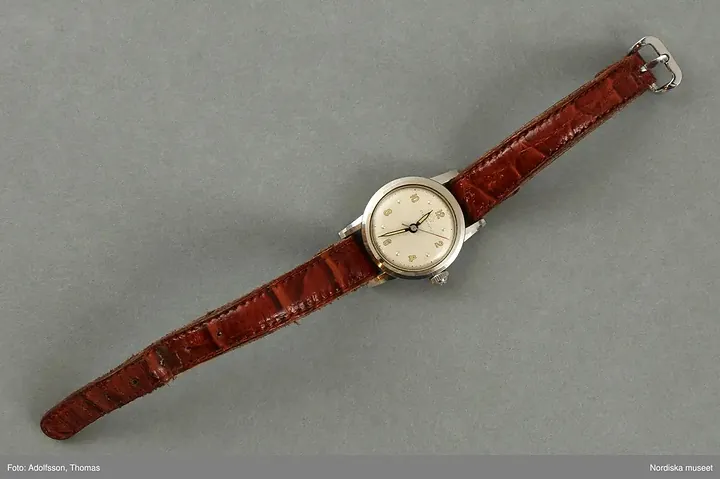
Wristwatch by Eterna, Sweden, 1900–1999
Nordic Museum Foundation
Wristwatches · c. 1930s
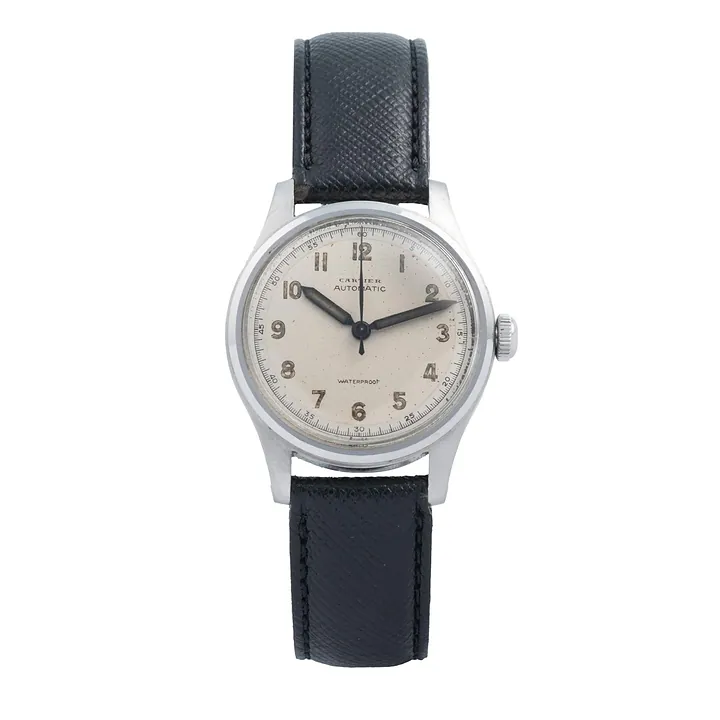
Eterna wristwatch, c. 1930s
Antiquorum auction archive, Geneva
Pocket Watches · 1934
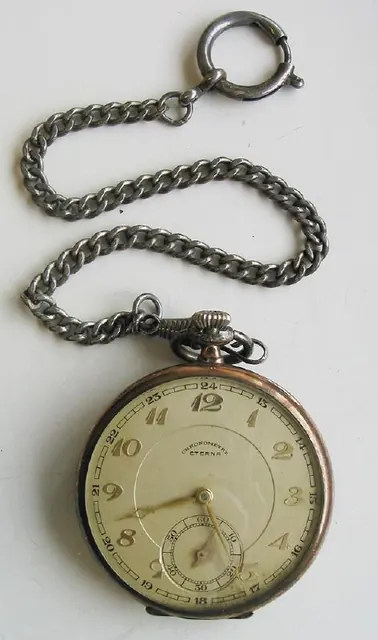
Pocket watch by Eterna, Switzerland, 1934
Turun kaupunginmuseo

Wristwatches · c. 1945
Breitling Premier, ref. 790, c. 1945
Antiquorum auction archive, Geneva

Wristwatches · c. 1945
Universal Genève Uni-Compax, ref. 22492, c. 1945
Antiquorum auction archive, Geneva

Wristwatches · c. 1950s
Baume & Mercier wristwatch, c. 1950s
Antiquorum auction archive, Geneva
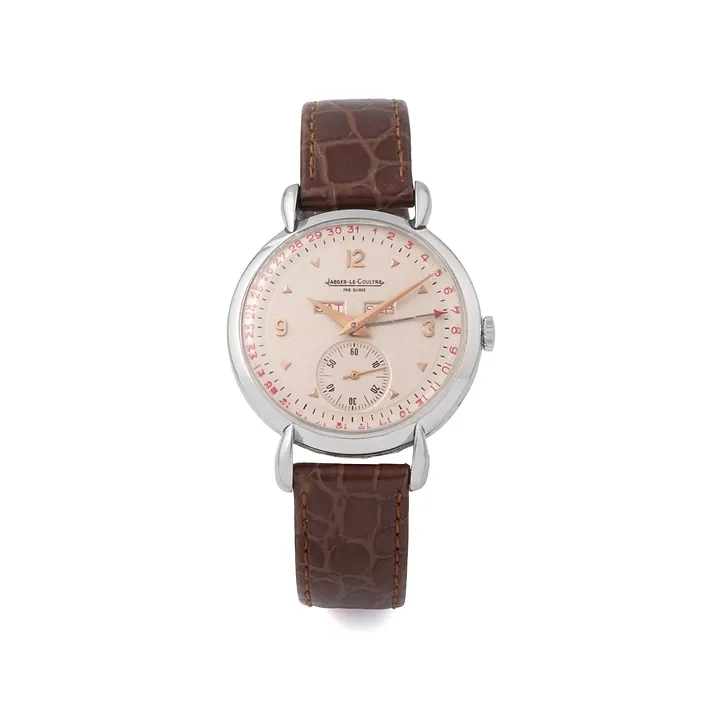
Wristwatches · c. 1950
Jaeger Lecoultre Triple Calendar, c. 1950
Antiquorum auction archive, Geneva