
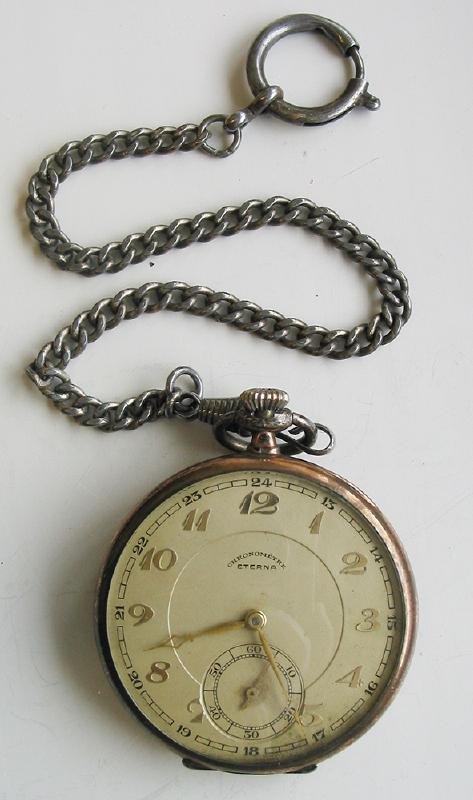
Pocket Watches · Pocket watch
Pocket watch by Eterna, Switzerland, 1934
- Maker / attribution
- Eterna (maker)
- Date
- 1934
- Historical period
- Golden Age of Mechanical Watchmaking (1900 – 1945)
- Country of origin
- Switzerland
- Place
- Germany, Switzerland
- Object type
- Pocket watch
- Dimensions
- length, max. 26.0 cm; diameter 4.8 cm; height, max. 5.8 cm
- Holding institution
- Turun kaupunginmuseo
- Accession / object no.
- TKM23103:29
- Credit line
- Turun kaupunginmuseo (via Finna)
- Catalogue title (original)
- kello; taskukello (Finnish)
View the source record ↗ (opens another website in a new tab)Suggest a correction
Record summary
Held and catalogued by Turun kaupunginmuseo (object number TKM23103:29), this is a pocket watch by Eterna, made in Germany, Switzerland, dated 1934. The Atlas places it in the Golden Age of Mechanical Watchmaking period (1900 – 1945) of its Pocket Watches collection. Recorded dimensions: length, max. 26.0 cm; diameter 4.8 cm; height, max. 5.8 cm. The record is illustrated with 3 photographs.
Assembled from the source record's structured fields. Dates and attributions are given as the source states them; where a field is missing the Atlas leaves it blank rather than estimating.
Catalogue description
Description — Turun kaupunginmuseo
fyysinen kuvaus: Taskukello, hopeakuori punakullattu. Etukannessa lasi, takakannen ulkopinta rasteroitu ja keskellä vaakunamainen lehväkoristein ympäröity sileä tyhjä kenttä. Takakannen sisällä leimoja, ks merkinnät. takannen alla irrallinen pyöreä vaaleanpunainen silkipaperin pala. Valkoinen kellotaulu, jossa kultaiset painetut arabialaiset numerot 1 - 12 ja niiden yllä pienemmät mustat numerot 13 - 24. Numeroiden 5 ja 7 välissä erillinen sekunttinäyttö, numerot 10 - 60. Kullanväriset viisarit. Kuoressa numero 12:n kohdalla nuppi ja siinä ruuvi, jolla kello sekä vedetään että viisareita siirretään. Nupissa olevasta lenkistä lähtee ketju, kellonperät. Ketjun päässä pyöreä jousilukko.
Shown in the original language of the source catalogue. An editor-reviewed English translation has not yet been published; we do not publish machine translations as authoritative text.
Inscriptions & marks
kellotaulussa numeron 12 alapuolella CHRONOMETRE ETERNA merkintä painatus; takakannen sisäpinnalla syväleimoja, kolme ensinmainittua peräkkäin ja viimeinen niiden alla metson sivukuva / 0,800 / (pienempi) metso sivukuvassa / puolikuu ja kruunu leima leimaus; takakannen sisäpinnalla syväleima ETERNA 2572608 E leima leimaus; takakannen alla sisäkannessa syväleima, ylinnä kaarevaan riviin asetettujen kuuden kultamitalin kuvat, kullatut. ETERNA GRAND PRIX liikemerkki leimaus
Historical context
Golden Age of Mechanical Watchmaking (1900 – 1945)
The wristwatch displaces the pocket watch; waterproof cases, self-winding and grand complications.
The pocket watch reached technical maturity and then began to give way to the wristwatch after the First World War. Complicated watches for collectors such as Henry Graves Jr. and James Ward Packard, railroad watches, and slim Art Deco dress watches are characteristic.
Read the period in the timelineMore pocket watches from this periodEarlier: Industrial Revolution
Atlas type guide
Pocket watches
The pocket watch was the dominant personal timekeeper from the late seventeenth century until the First World War. Its development tracks the history of the escapement: verge watches with fusees until the late eighteenth century; Thomas Mudge's lever escapement (c. 1755) and the cylinder escapement popularised by George Graham and later by Swiss makers; and the Swiss and English lever watches of the nineteenth century. Lépine's bar-bridge calibre and keyless winding made watches thinner and easier to use.
Industrialisation transformed the trade: American factories such as Waltham (from 1850) and Elgin produced interchangeable parts by machine, and Swiss makers responded with their own mechanisation after the 1876 Philadelphia Exhibition. By 1900 a reliable watch was affordable to millions; the finest makers continued to produce complications and precision watches.
What to look for
- The escapement: verge (crown wheel), cylinder, duplex, English or Swiss lever.
- Key winding (a square arbor in dial or back) or keyless crown winding.
- Signatures and serial numbers on the movement, dial and inside case back.
- Hallmarks, case maker's marks and gold or silver standards stamped in the case.
- Dial material: enamel, silver, gold, later printed metal.
Dating clues
- Verge watches dominate before c. 1800; cylinder watches c. 1770–1900; lever watches after c. 1820.
- Keyless winding: increasingly common after c. 1860.
- Manufacturer serial number lists exist for Waltham, Elgin, Longines, Omega, Patek Philippe and others.
General guidance written by the Atlas editors about this kind of object. It is not a statement about this particular piece; for that, rely on the source record above and on physical examination.
Read next:Verge escapementDetached lever escapementFuseeIdentification Centre
Related records

Wristwatches · 1945
Wristwatch by Eterna, 1945
Museum Rotterdam
Wristwatches · 1900–1999
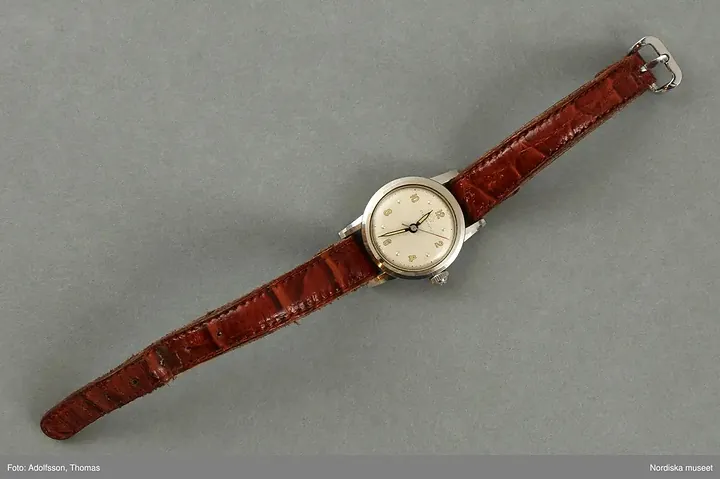
Wristwatch by Eterna, Sweden, 1900–1999
Nordic Museum Foundation
Wristwatches · c. 1930s
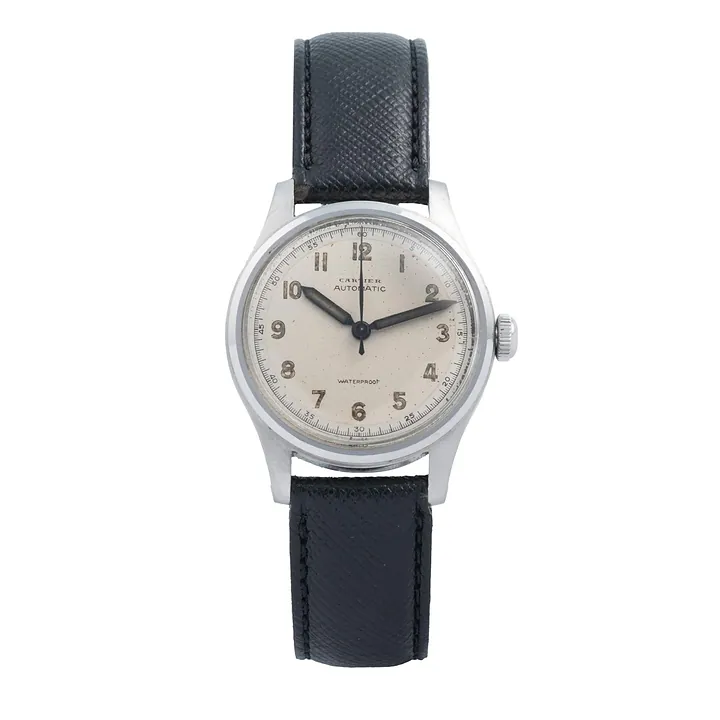
Eterna wristwatch, c. 1930s
Antiquorum auction archive, Geneva
Clocks · 1910–1940
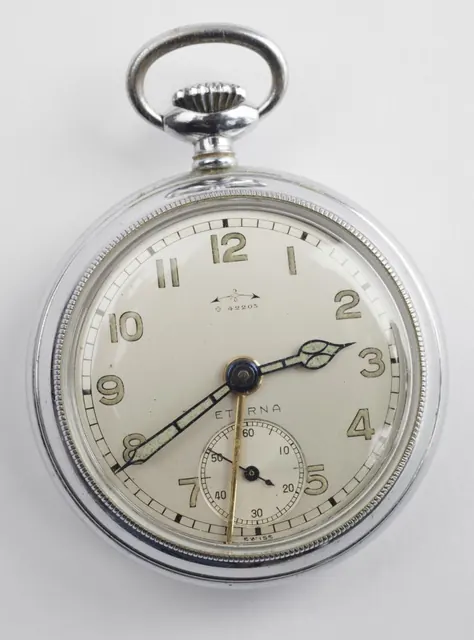
Alarm clock by Eterna, Switzerland, 1910–1940
Lusto – Suomen Metsämuseo

Pocket Watches · c. 1900
Patek Philippe Chronometro Gondolo, c. 1900
Antiquorum auction archive, Geneva
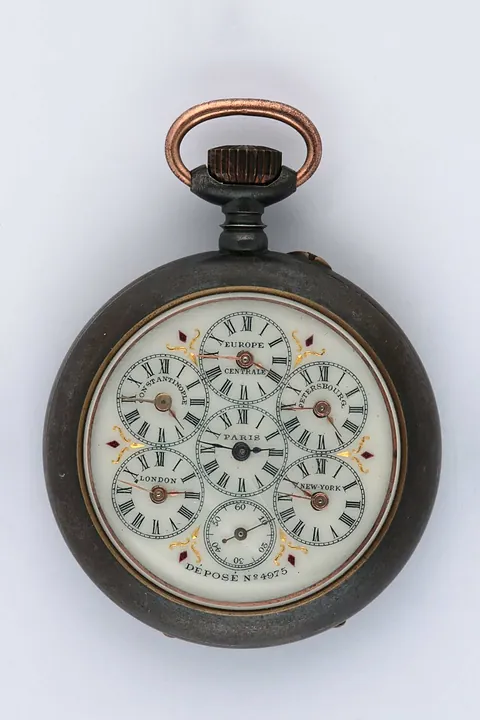
Pocket Watches · c. 1900
Pocket watch by A. Sandoz-Boucherin, Switzerland, c. 1900
German Clock Museum
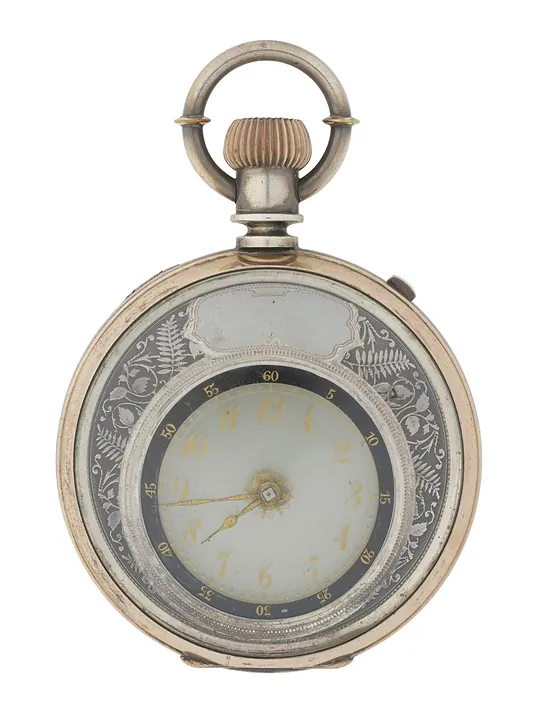
Pocket Watches · 1900
Pocket watch by Armand Schwob & Frère, Switzerland, 1900
Science Museum Group, London
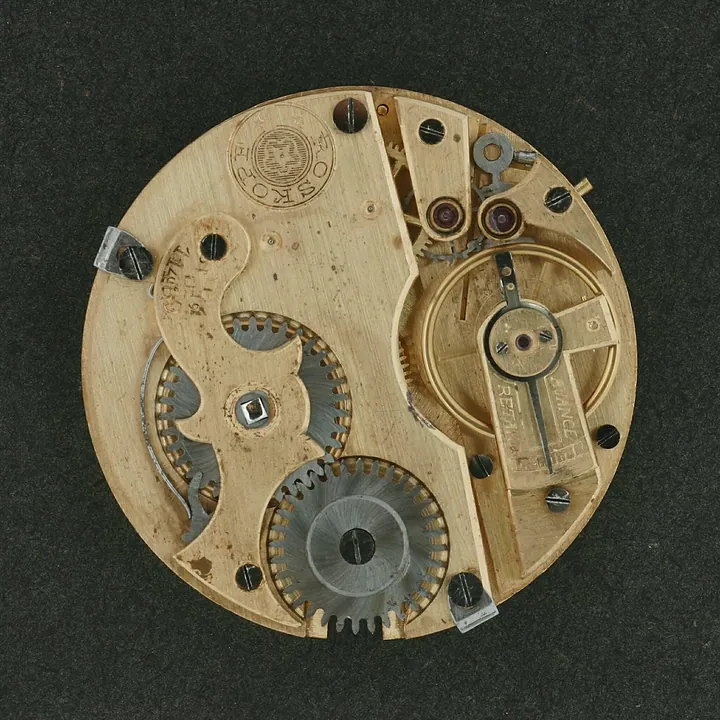
Pocket Watches · c. 1900
Pocket watch by Vve. Chs. Léon Schmid und Cie, Switzerland, c. 1900
German Clock Museum