
Clocks · Skeleton clock
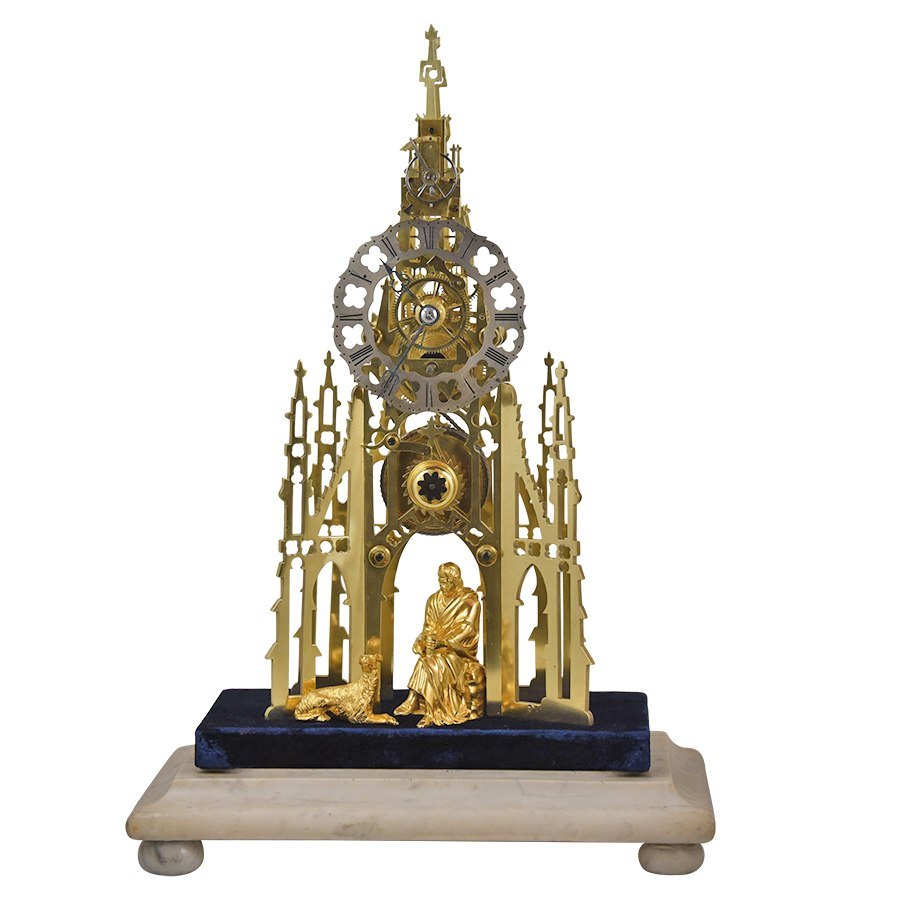
English Sir Walter Scott Memorial Skeleton Clock
- Maker / attribution
- Unrecorded in source
- Date
- c. 1870
- Historical period
- Industrial Revolution (1850 – 1900)
- Country of origin
- United Kingdom
- Object type
- Skeleton clock
- Dimensions
- 20″H x 13″W x 9″D
- Holding institution
- Renaissance Antiques
- Accession / object no.
- GHOL 1 P
- Credit line
- Renaissance Antiques
- Catalogue title (original)
- English Sir Walter Scott Memorial Skeleton Clock - Renaissance Antiques (English)
View the source record ↗ (opens another website in a new tab)Suggest a correction
Record summary
Held and catalogued by Renaissance Antiques (object number GHOL 1 P), this is a skeleton clock, made in United Kingdom, dated c. 1870. The Atlas places it in the Industrial Revolution period (1850 – 1900) of its Clocks collection. Recorded dimensions: 20″H x 13″W x 9″D. The record is illustrated with 1 photograph.
Assembled from the source record's structured fields. Dates and attributions are given as the source states them; where a field is missing the Atlas leaves it blank rather than estimating.
Catalogue description
Original object description
Constructed in England circa 1870, this skeleton clock replicates the Gothic spires and tracery of Edinburgh's Sir Walter Scott Monument in pierced brass. Figures of the author and his dog, Maida, cast in gilt brass, occupy the space beneath the principal lower arch. The timekeeping mechanism is a single-train, eight-day fusee controlled by a balance wheel escapement mounted near the top. Black Roman numerals circle an openwork, engraved silvered dial, read with blued steel trefoil hands. Supported by bun feet, the rectangular stepped marble plinth is topped with blue velvet upon which the clock rests. While documentation references an unseamed square glass dome, this cover does not appear in photographs. The piece is recorded as fully restored, though no serial numbers, maker marks, or hallmarks are present.
Historical context
Industrial Revolution (1850 – 1900)
American interchangeable-parts manufacture; railroad time standards; Swiss and German factory systems.
Factory production transformed the clock into an everyday object. American makers (Seth Thomas, Ansonia, Waterbury) and German factories (Junghans, Gustav Becker, Lenzkirch) sold millions of shelf, wall and alarm clocks worldwide; France produced standardised Paris movements and carriage clocks; electric time distribution began.
Read the period in the timelineMore clocks from this periodEarlier: Precision & Scientific Horology
Atlas type guide
Skeleton clocks
A skeleton clock displays its movement: the plates are pierced to a minimum so that wheels, escapement and fusee can be seen, usually under a glass dome. French makers produced fine skeleton clocks in the late eighteenth century; in Victorian England they became popular showpieces, with frames in the shapes of cathedrals and famous buildings.
What to look for
- Pierced brass plates in scroll or architectural shapes.
- A glass dome and wooden or marble base.
- Fusee movements and sometimes passing strike on a bell.
Dating clues
- French skeleton clocks: c. 1780–1830.
- English cathedral-style skeleton clocks: c. 1840–1890.
General guidance written by the Atlas editors about this kind of object. It is not a statement about this particular piece; for that, rely on the source record above and on physical examination.
Read next:Anchor (recoil) escapement
Related records
Clocks · c. 1859
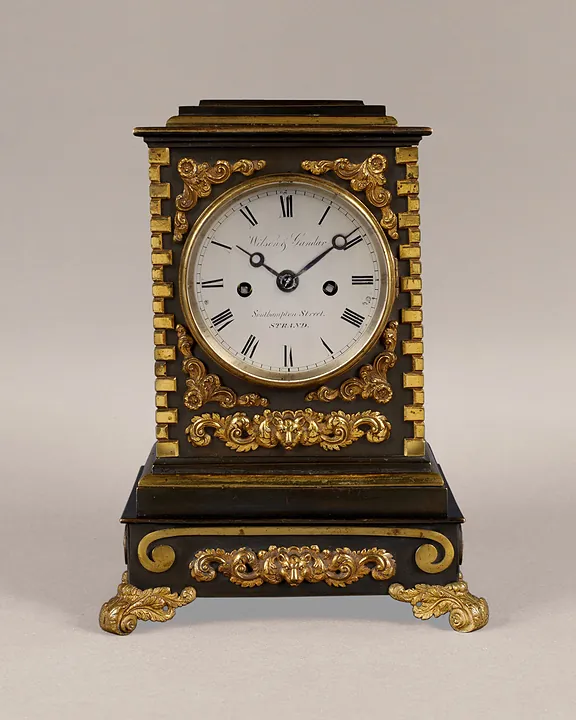
Clock by Wilson & Gandar, Southampton Street, Strand, c. 1859
Howard Walwyn Fine Antique Clocks (dealer), London
Clocks · c. 1870
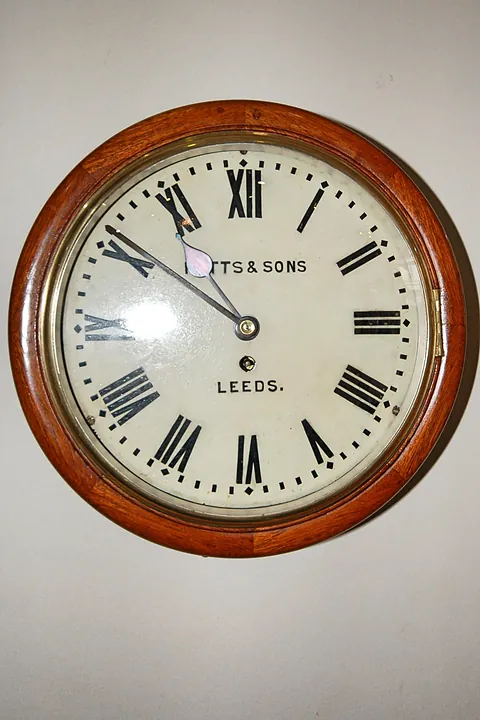
Wall Clock by Potts & Sons, Leeds, c. 1870
Pendulum of Mayfair (dealer), London
Clocks · c. 1880
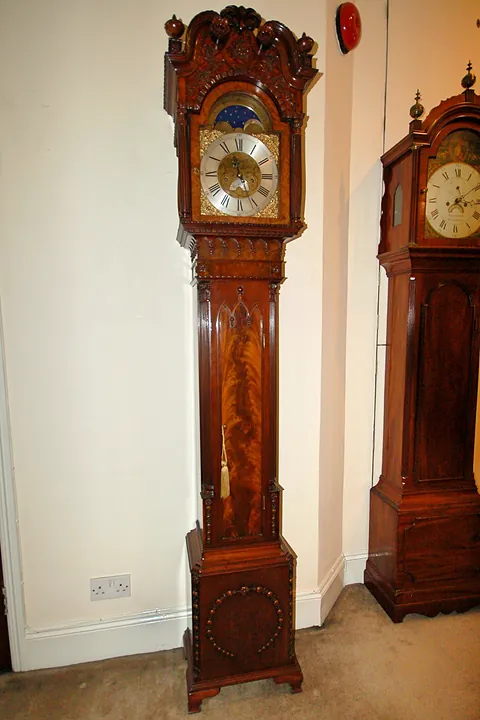
Grandfather Clock by Lowe & Sons, Chester, c. 1880
Pendulum of Mayfair (dealer), London
Clocks · c. 1880
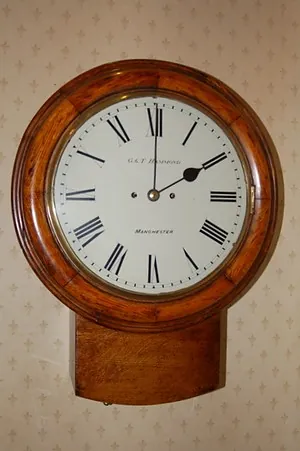
G and T Hammond, Manchester, c. 1880
Pendulum of Mayfair (dealer), London
Clocks · c. 1880
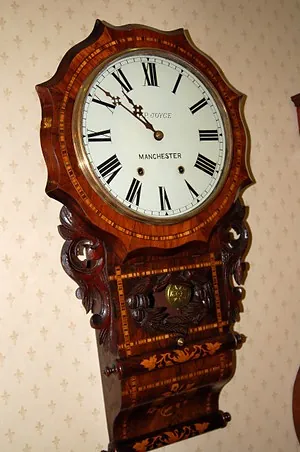
American Wall Clock retailed by T P Joyce, Manchester, c. 1880
Pendulum of Mayfair (dealer), London
Clocks · c. 1860
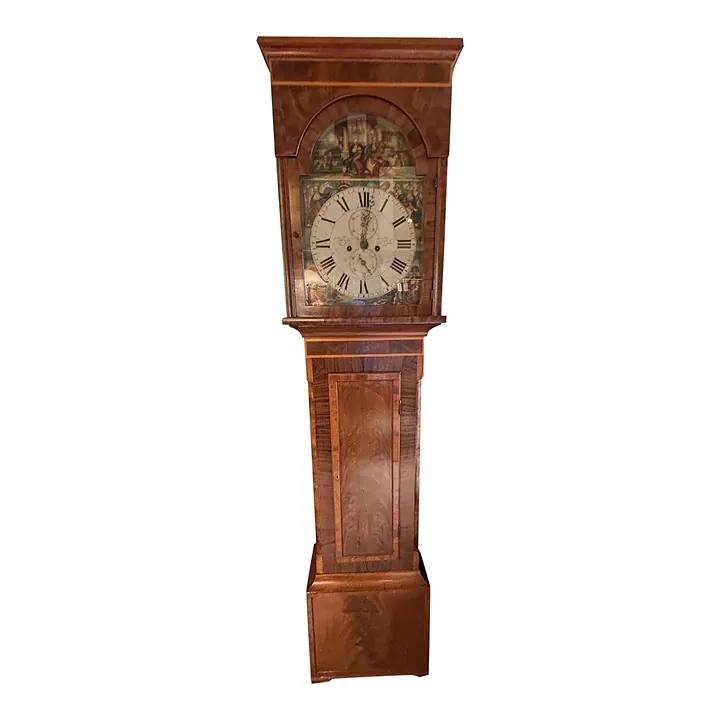
David Wilson Scottish Mahogany Longcase Clock
Chairish / J.G. Antiquary Co.
Clocks · 1830–1870
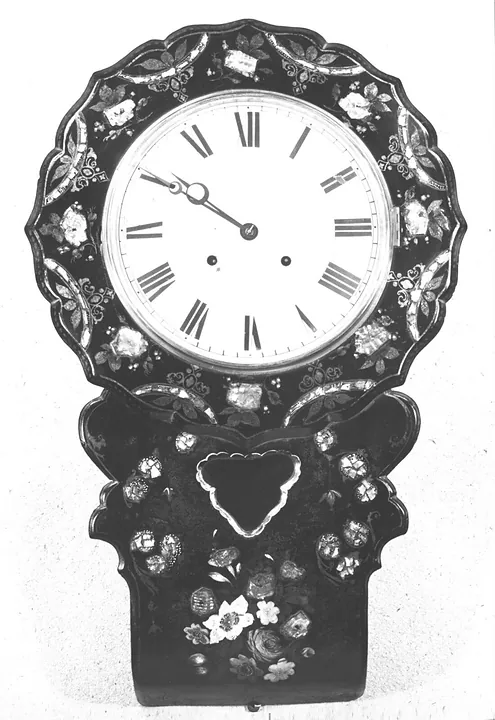
Wall clock in a papier mâché case with painted decoration. English, mid 19th century.
Victoria and Albert Museum, London
Clocks · 1840–1900
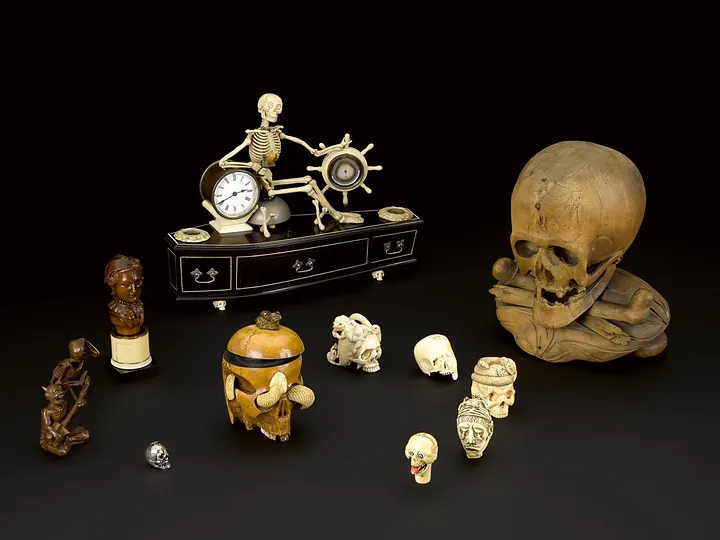
Alarm clock, mounted on model of coffin with skeleton, probably English, 1840–1900
Science Museum Group, London