
Clocks · Bracket clock
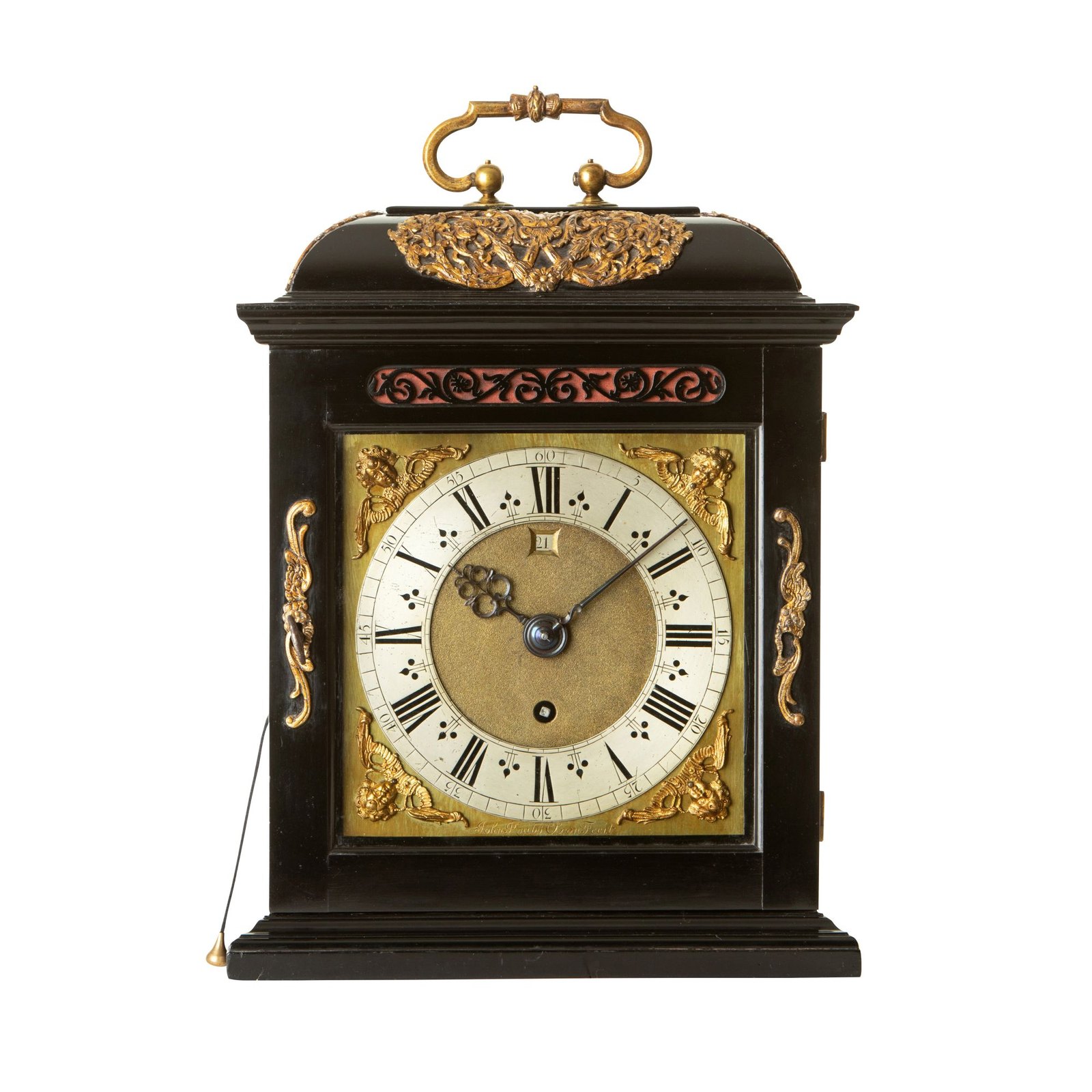
Early ebony timepiece with quarter repeat table clock by John Knibb, Oxford
- Maker / attribution
- John Knibb (maker)
- Date
- c. 1690
- Historical period
- Early Modern Horology (1600 – 1750)
- Country of origin
- England
- Place
- Oxford
- Object type
- Bracket clock
- Materials / technique
- ebony
- Dimensions
- Height 34 cm
- Stock no.
- Product 2806
- Credit line
- Dealer listing, The Antique Clock Company (product 2806)
- Catalogue title (original)
- A EARLY EBONY TIMEPIECE WITH QUARTER REPEAT TABLE CLOCK – JOHN KNIBB – OXFORD (English)
View the source record (dealer listing) ↗ (opens another website in a new tab)Suggest a correction
Record summary
Catalogued by The Antique Clock Company (dealer), Dorset (stock number Product 2806), this is a bracket clock by John Knibb, made in Oxford, England, dated c. 1690. The Atlas places it in the Early Modern Horology period (1600 – 1750) of its Clocks collection. Materials and techniques recorded by the source: ebony. Recorded dimensions: Height 34 cm. The record is illustrated with 3 photographs.
Assembled from the source record's structured fields. Dates and attributions are given as the source states them; where a field is missing the Atlas leaves it blank rather than estimating.
Catalogue description
Dealer description — The Antique Clock Company
Movement : The 8-day single fusee timepiece movement with verge knife edge escapement and brass rod short bob regulated pendulum. There are five latched bulbus pillars to hold the movement together, with a beautifully engraved rectangular back plate signed “John Knibb Oxon Fecit”. The pull repeat feature strikes the hour on the larger bell and quarters struck on the smaller bell. Case : The case is of ebony veneer over an oak carcase with typical Knibb foliate-tied gilded handle, finished with Knibb S-scroll and mask escutcheons to the glazed lockable front door, pierced ebony silk backed sound fret above with rectangular glazed sides, sound frets and lockable glazed back door. Dial : The 6 ½” square gilt brass dial with finely matted centre and signed “John Knibb Oxon Fecit” to the lower edge. Four chased gilt winged cherub spandrels in each corner of the dial plate with a silvered engraved chapter ring and typical Knibb style fleur-de-lys half hour divisions, Roman numerals to mark the hours and Arabic numerals for five minute markers. The clock also boasts its beautiful original blued steel hands. Currently – Private collection, UK Comparative Literature : The Knibb Family Clockmakers by R. A. Lee Height: 13 ½” or 34cm (Handle up) 12” or 30.5cm (Top of case) John Knibb – John Knibb (1650-1722), an excellent clockmaker in his own right, he was the younger brother of Joseph Knibb (1640-1721), to whom he was apprenticed in Oxford in 1664. In 1670, when his elder brother Joseph left for London, John took charge of the Oxford workshops and in 1673, upon payment of a fine, he received the Freedom of the City of Oxford, where he was to remain and prosper, for the rest of his life. It is undeniably true that Joseph and John’s workshops were closely associated. The Oxford workshops had a small output compared to Joseph’s prodigious London workshops. Despite the low output, the Oxford workshops still had ten apprentices between 1673 and 1715; this strongly suggests that the London business was outsourcing a considerable proportion of work to John’s Oxford workshops. Once Joseph had left for London in 1670, John’s limited production of Oxford clocks had a distinct, slightly provincial, style of their own. However, a few of John’s clocks, including this fine example, were of such outstanding quality that one can only come to the conclusion that they were made in London and retailed by John to one of his very wealthy clients. Many collectors aspire to “one-day own a Knibb” and with this being a timepiece, it is a rather inexpensive way of achieving such an honour. It is also an ideal investment that you can really appreciate simultaneously.
Provenance
Provenance :
Historical context
Early Modern Horology (1600 – 1750)
Huygens' pendulum and balance spring transform accuracy; English makers develop the anchor and deadbeat escapements.
Huygens's pendulum (1656–57) improved clock accuracy from about a quarter of an hour to under a minute a day. The anchor escapement (c. 1670) and the long seconds pendulum created the longcase clock; London makers such as Fromanteel, Knibb, Tompion and Quare led European clockmaking, and French makers created the Boulle pendule.
Read the period in the timelineMore clocks from this periodEarlier: Renaissance Horology
Atlas type guide
Bracket, table and spring-driven clocks
Spring-driven clocks freed timekeeping from the hanging weight. The coiled mainspring, documented from the fifteenth century, made portable table clocks possible; to even out its declining force, makers used the fusee, a conical pulley connected to the barrel by a gut line or chain. Renaissance table clocks from Augsburg and Nuremberg — drum-shaped, square or tower-shaped in gilt brass — were luxury scientific objects, often with astronomical dials and alarms.
After the pendulum, English makers developed the bracket clock: a wooden case with a carrying handle, a short pendulum with a verge escapement, and often repeating work to sound the hours on demand at night. Later examples use the anchor escapement. In the nineteenth century, 'table clock' became a broad term for spring clocks of every nationality.
What to look for
- A fusee in the movement (cone-shaped pulley) and the type of line — gut or chain.
- Verge escapement with a short bob pendulum, often with a decoratively engraved backplate.
- Repeat cords or buttons that make the clock strike again on demand.
- Gilt-brass engraved cases and horizontal dials on Renaissance pieces.
- Case shapes: inverted bell, bell top, break-arch, lancet or balloon.
Dating clues
- Drum and tower table clocks: c. 1520–1650.
- Ebony veneered English bracket clocks with verge escapements: c. 1670–1800.
- Engraved backplates were usual on English clocks until c. 1800, then generally plain.
General guidance written by the Atlas editors about this kind of object. It is not a statement about this particular piece; for that, rely on the source record above and on physical examination.
Read next:Anchor (recoil) escapement
Related records
Clocks · c. 1695–1700
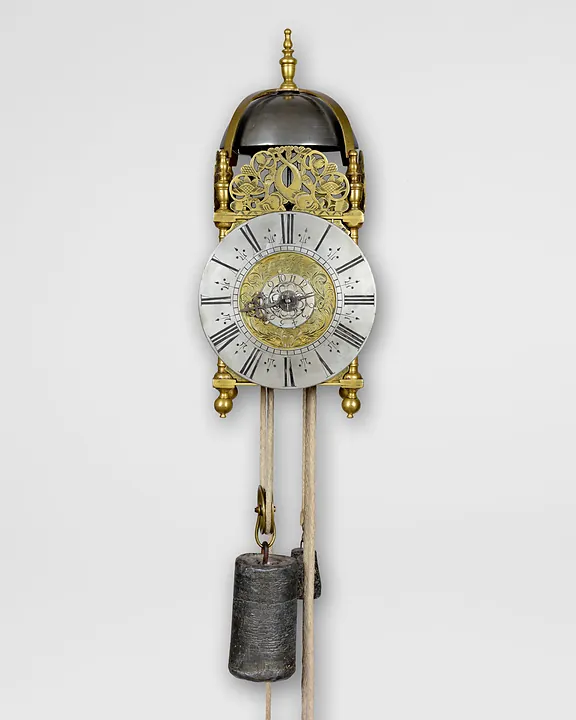
Lantern clock by John Knibb, Oxford, c. 1695–1700
Howard Walwyn Fine Antique Clocks (dealer), London
Clocks · c. 1680–1685
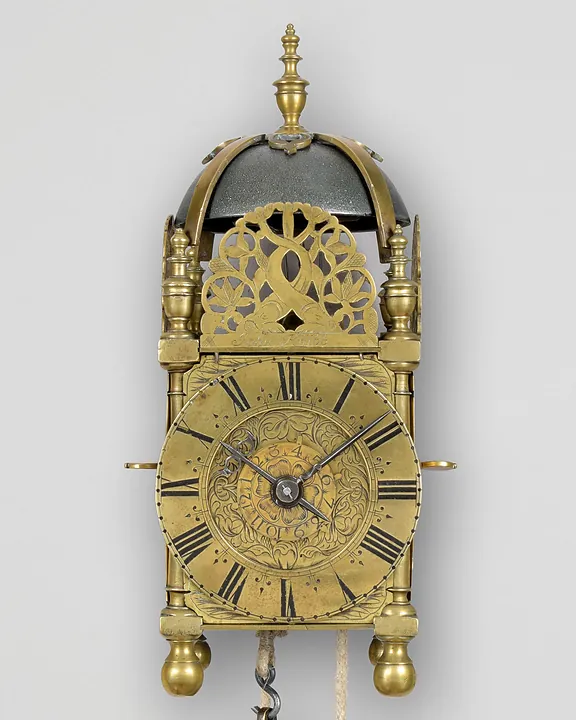
Lantern clock by John Knibb, Oxford, c. 1680–1685
Howard Walwyn Fine Antique Clocks (dealer), London
Clocks · c. 1695–1700
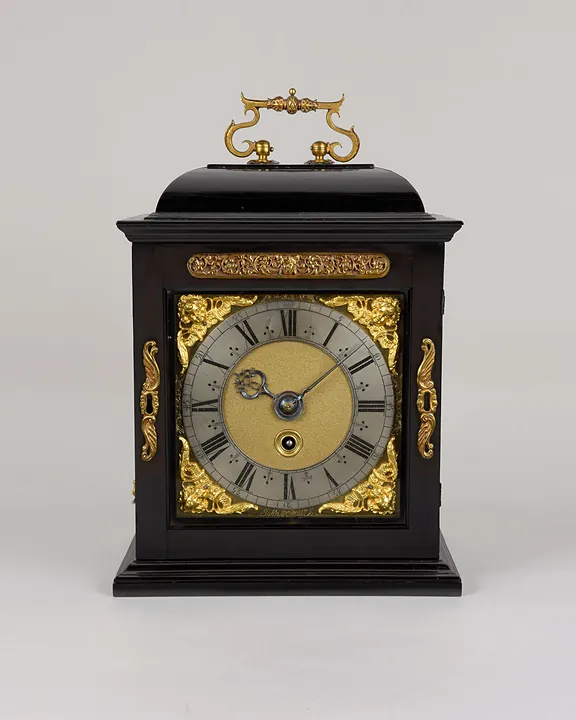
Bracket clock by John Knibb, Oxford, c. 1695–1700
Howard Walwyn Fine Antique Clocks (dealer), London
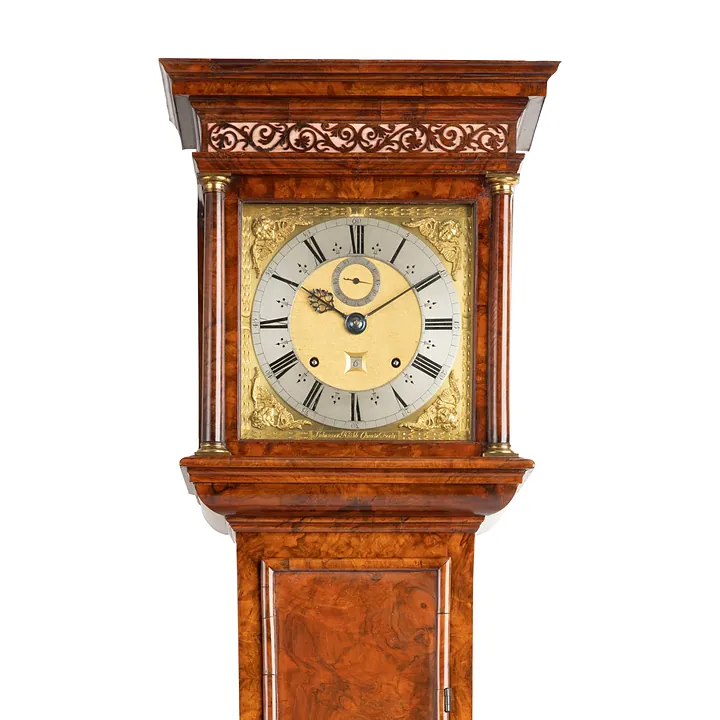
Clocks · c. 1685
Month duration walnut longcase clock by John Knibb, Oxford
The Antique Clock Company (dealer), Dorset
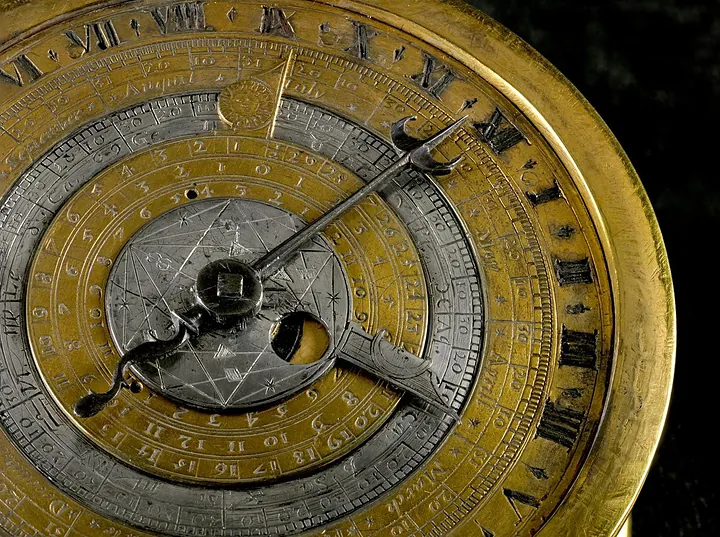
Clocks · 1598–1603
Circular table-clock with calendrical and lunar indications made by Nicholas Vallin in London between 1598 and 1603.
Science Museum Group, London
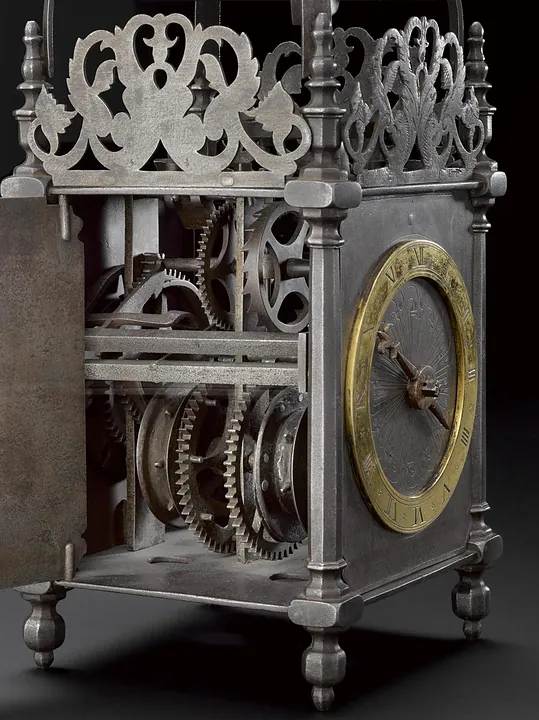
Clocks · 1611
English iron lantern clock, with wheel balance, by John Holloway, Market Lavington, Wiltshire, England, 1611.
Science Museum Group, London
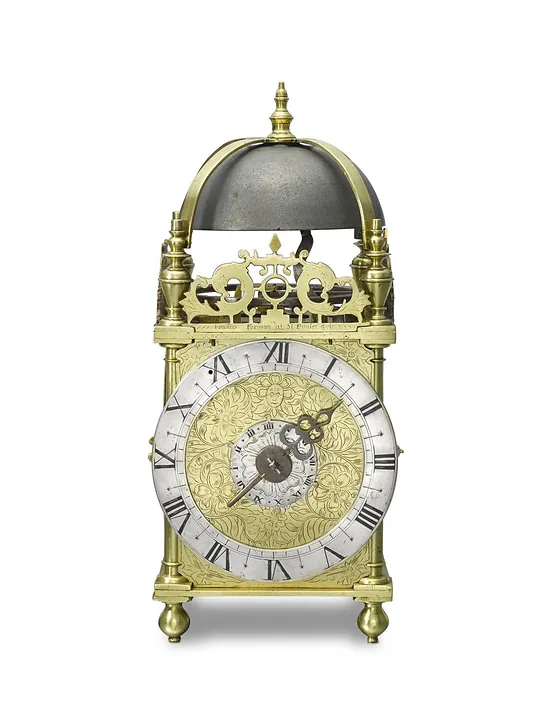
Clocks · 1630
Lantern clock by Francis Forman, England, 1630
Science Museum Group, London
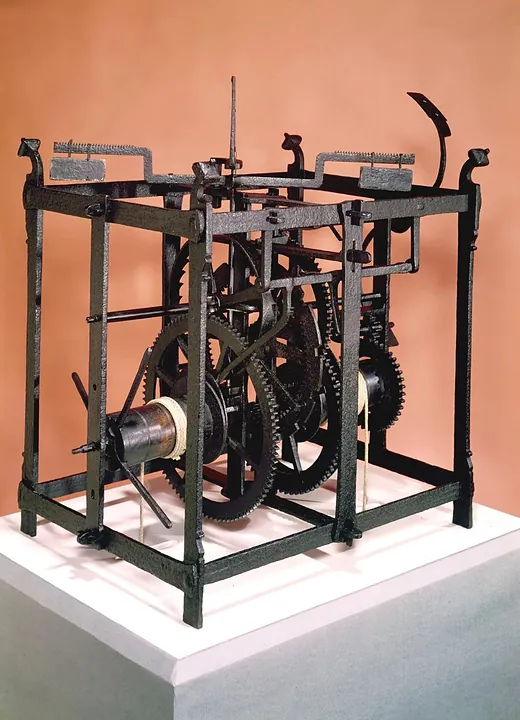
Clocks · 1632–1640
Turret clock, England, 1632–1640
Science Museum Group, London