
Instruments · Deck watch
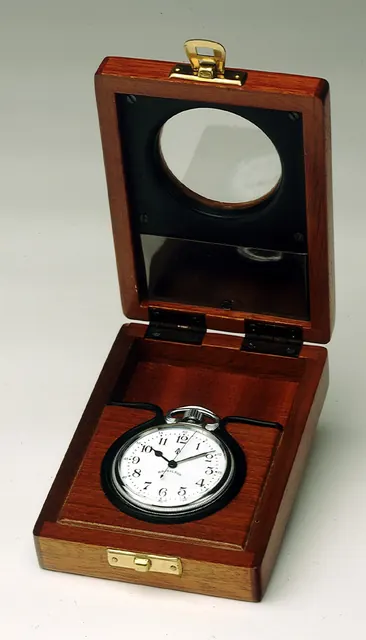
Deck watch no. 121966 by Ulysse Nardin
- Maker / attribution
- Ulysse Nardin (maker)
- Date
- c. 1943
- Historical period
- Golden Age of Mechanical Watchmaking (1900 – 1945)
- Country of origin
- Switzerland
- Object type
- Deck watch
- Materials / technique
- silver; brass; gold; steel; glass; textile; jewels; mahogany
- Dimensions
- Overall: 40 x 105 x 145 mm
- Holding institution
- Royal Museums Greenwich
- Accession / object no.
- ZBA7910
- Credit line
- National Maritime Museum, Greenwich, London
- Catalogue title (original)
- 121966 (English)
View the source record ↗ (opens another website in a new tab)Suggest a correction
Record summary
Held and catalogued by Royal Museums Greenwich (object number ZBA7910), this is a deck watch by Ulysse Nardin, made in Switzerland, dated c. 1943. The Atlas places it in the Golden Age of Mechanical Watchmaking period (1900 – 1945) of its Instruments collection. Materials and techniques recorded by the source: silver; brass; gold; steel; glass; textile; jewels; mahogany. Recorded dimensions: Overall: 40 x 105 x 145 mm. The record is illustrated with 2 photographs.
Assembled from the source record's structured fields. Dates and attributions are given as the source states them; where a field is missing the Atlas leaves it blank rather than estimating.
Catalogue description
Catalogue description — Royal Museums Greenwich
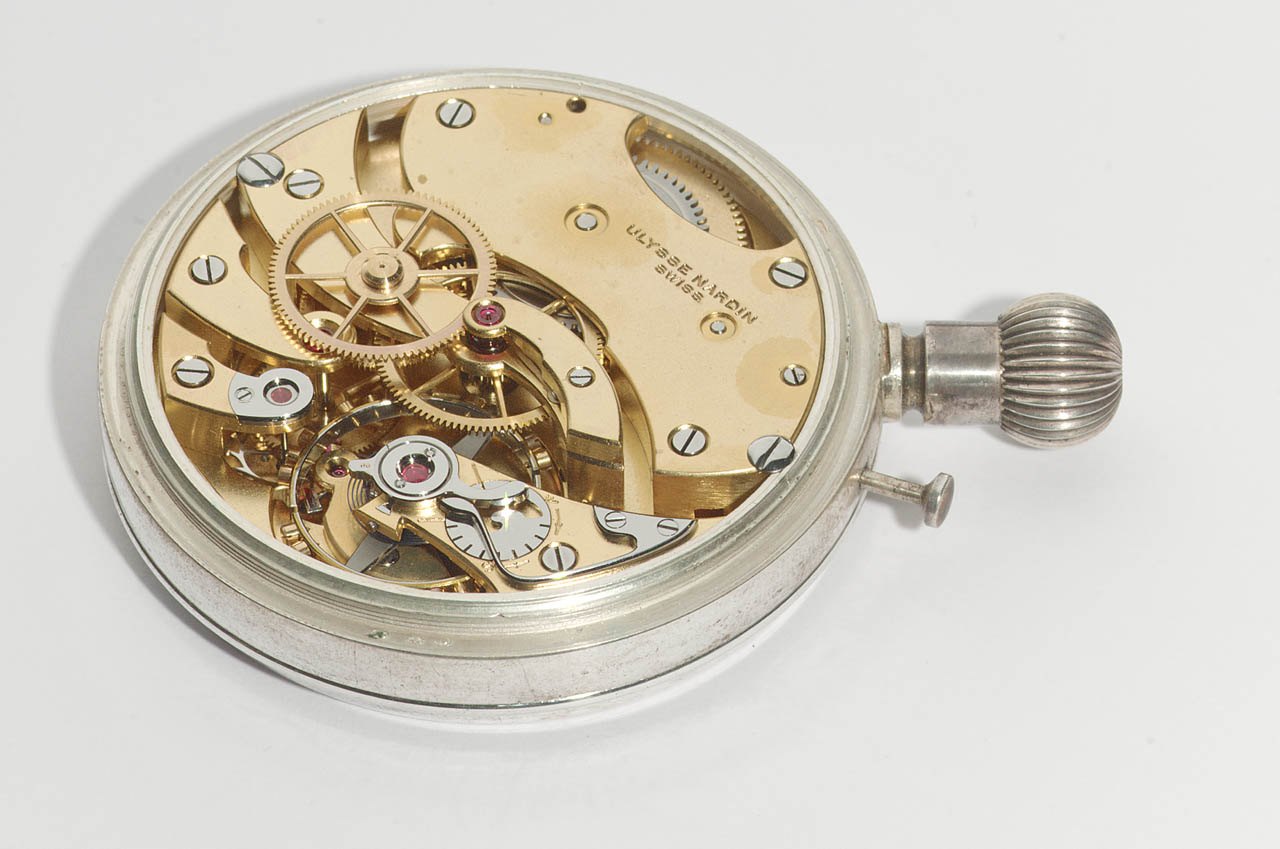
A mahogany deck box fitted with two brass hinges. It has a simple pressed brass clip-type catch and the top is glazed with a circular 'porthole' on the upper surface. The box is lined with green baize in the lid and the lower half, shaped to the form of the watch. The lid has a brass-plated, folded steel label holder on the inside containing an issue card marked '54897 / MOEBIUS / - - SEP 1965'. The bottom of the box is covered with green baize. The silver, open-face case has the winding/setting crown inset into a cylindrical pendant, with a hand-setting push piece on the side of the case to the left at '11 o'clock'. The plain silver, rolled-edge bezel has no fitting for a glass. The silver, screw-down back is machine engraved on the back 'H.S. 2'. The inside of the back is stamped with the manufacturer's mark 'ULYSSE NARDIN / LOCLE' in Nardin's emblematic shield, a separate octagonal cameo 'Canard' (Swiss control mark for silver) mark, including the 'L' for Locle, the incuse number '611948', and, within rectangular marks, '0.925' and 'FFBA / 46'. A white enamel dial of 50 mm Æ is signed 'ULYSSE NARDIN / LOCLE SUISSE' above the centre, and '121966' below. The dial has Roman numerals, small Arabic five-minute figures and divisions for fifth-of-second marks round the outside. Polished and blued-steel spade and poker-hands have a counter-balanced blued-steel centre seconds hand. The going barrel, barred movement is of matt-gilt brass, and is signed with machine engraving on the barrel bridge 'ULYSSE NARDIN / SWISS'. It is marked on the main plate, by the escape wheel cock foot '121966' in a rectangular surround. A polished steel index, mounted on the balance cock, acts on a polished steel internal cam for fine rating adjustment. The steel cam disc has a scale engraved on it and the cock is engraved with 'F' and 'S' for fast and slow. There is a four-wheel train with a going barrel and a centre seconds drive off the third wheel. There is a double roller, jewelled and club tooth lever escapement. The impulse roller has a jewelled impulse pin and pallets with red stones. The pallets bank against brass banking pins. The cut bimetallic compensation balance is mounted with 22 brass screws around the rim. The flat spiral, blued-steel balance spring, with over coil, has an index mounted on the upper surface of the balance cock. The train is jewelled to the centre with red pressed-in stones. The balance and escape wheel have polished steel-set end stones. The instrument is in fine, almost as new condition, with just a few marks on the wooden box.
Historical context
Golden Age of Mechanical Watchmaking (1900 – 1945)
The wristwatch displaces the pocket watch; waterproof cases, self-winding and grand complications.
Timing instruments became electrical and specialised: industrial time recorders, sports timers and aviation instruments.
Read the period in the timelineMore instruments from this periodEarlier: Industrial Revolution
Atlas type guide
Marine chronometers
A marine chronometer is a precision timekeeper carried at sea to find longitude: the navigator compares local noon, observed with a sextant, with the time at a reference meridian kept by the chronometer. Each hour of difference corresponds to fifteen degrees of longitude. John Harrison proved the method in the 1760s; Pierre Le Roy, Ferdinand Berthoud, John Arnold and Thomas Earnshaw then developed the detent escapement and the compensation balance that made chronometers practical to manufacture.
By the nineteenth century London, Liverpool, Le Locle and Glashütte supplied navies and merchant fleets. A typical box chronometer has a spring-detent escapement, a fusee to equalise mainspring torque, a bimetallic compensation balance with a helical balance spring, and is mounted in gimbals inside a wooden box so that it stays level.
What to look for
- Gimbals and a three-tier wooden box with a glazed inner lid.
- A power-reserve ('up and down') indicator on the dial, usually showing 56 hours on two-day instruments.
- Spring-detent escapement and a cylindrical (helical) balance spring visible through the movement.
- Admiralty or navy marks (broad arrow), and rating certificates from observatories.
- The maker's number on the dial and movement; many makers' registers survive, allowing dating.
Dating clues
- Earnshaw-type spring-detent chronometers became standard after about 1800.
- Auxiliary compensation devices on the balance appear from the mid-nineteenth century.
- Quartz and radio time signals ended routine use of mechanical chronometers in the 1970s and 1980s.
General guidance written by the Atlas editors about this kind of object. It is not a statement about this particular piece; for that, rely on the source record above and on physical examination.
Read next:Spring detent (chronometer) escapementFuseeDetent escapement
Related records
Pocket Watches · c. 1880
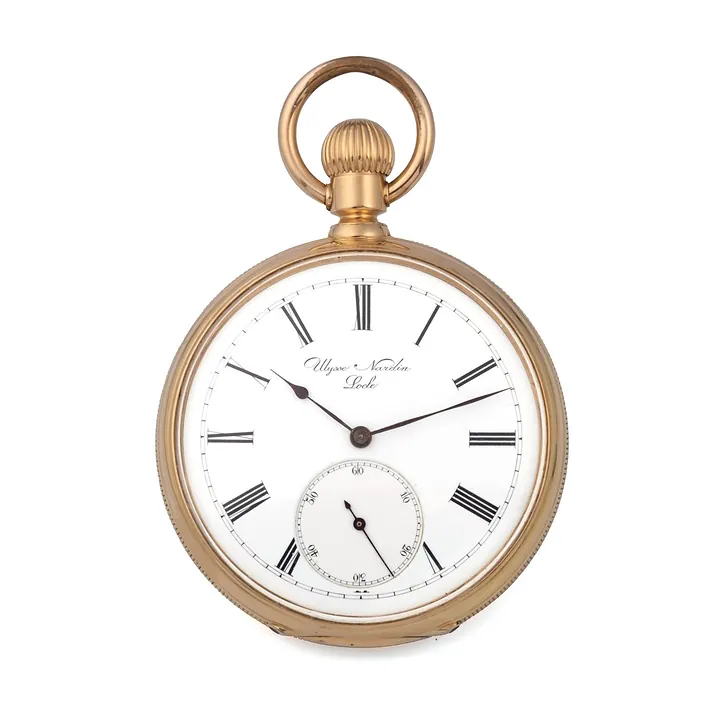
Ulysse Nardin pocket watch, c. 1880 (Antiquorum Lot 374-168)
Antiquorum auction archive, Geneva
Pocket Watches · c. 1880
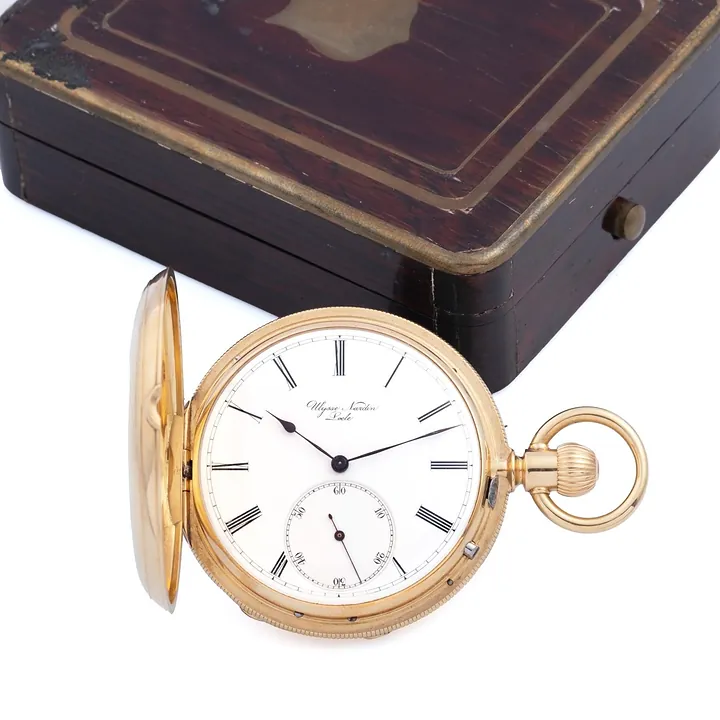
Ulysse Nardin pocket watch, c. 1880 (Antiquorum Lot 374-197)
Antiquorum auction archive, Geneva
Pocket Watches · c. 1920
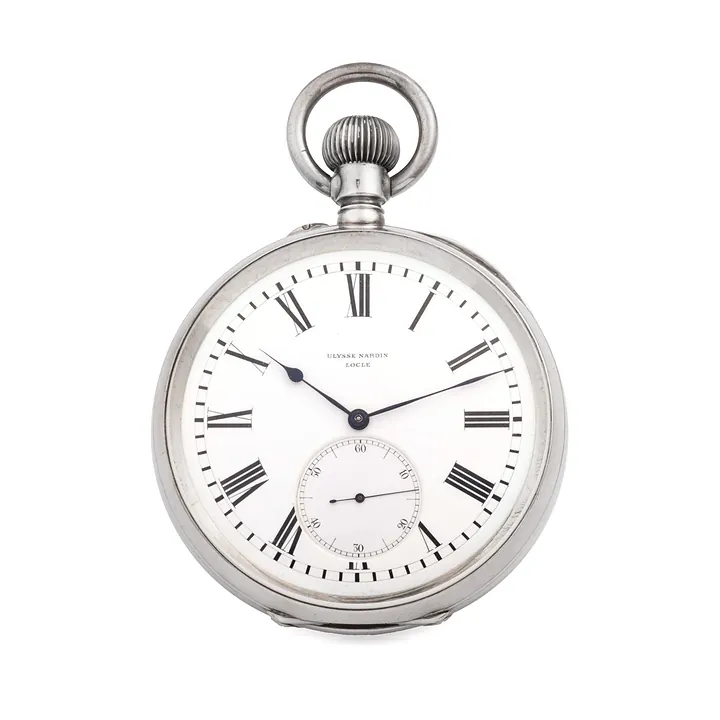
Ulysse Nardin Chronometer, c. 1920 (Antiquorum Lot 374-162)
Antiquorum auction archive, Geneva
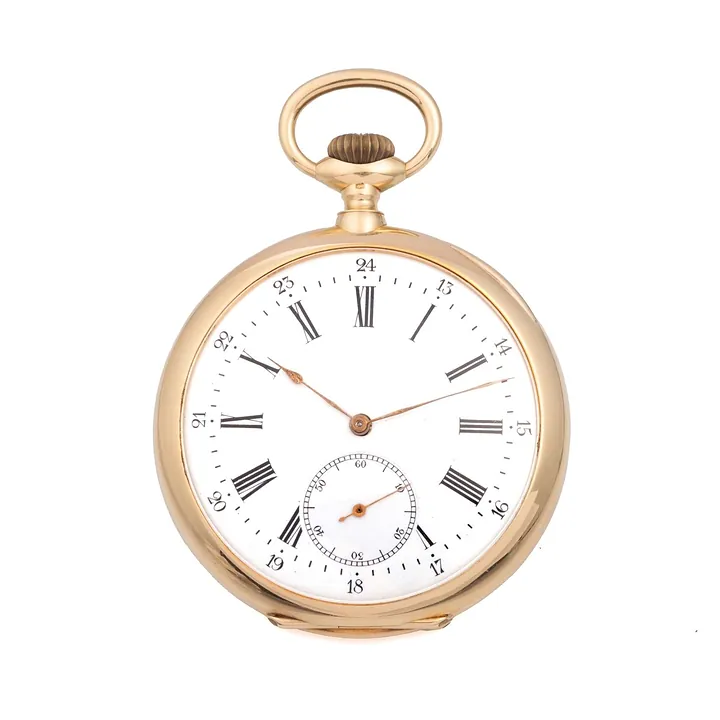
Pocket Watches · c. 1920
Ulysse Nardin Chronometer, c. 1920 (Antiquorum Lot 374-169)
Antiquorum auction archive, Geneva
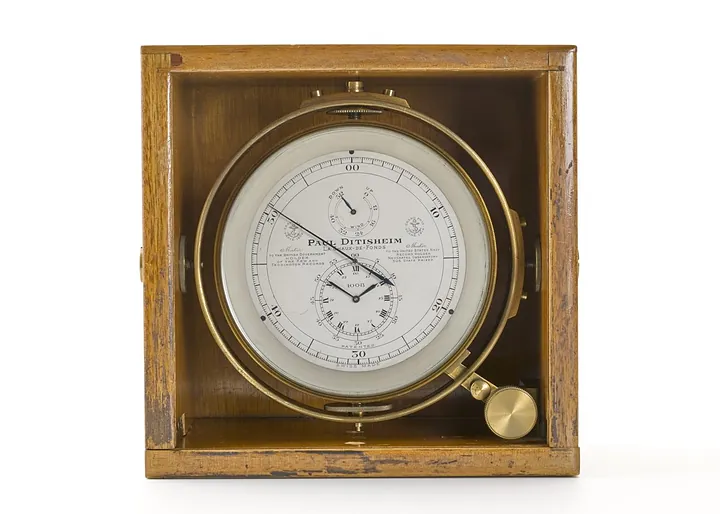
Instruments · 1925
Chronometer by Paul Ditisheim, 1925
Science Museum Group, London
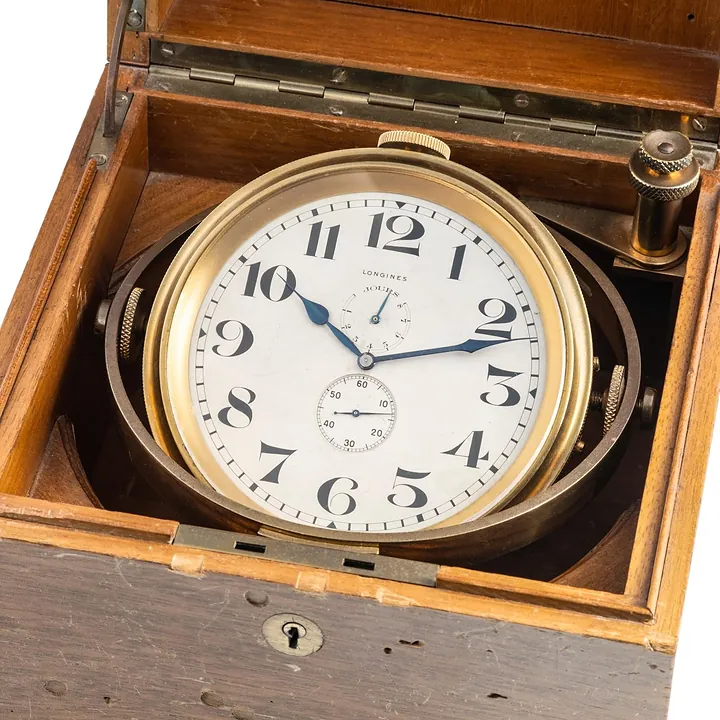
Instruments · c. 1940
Longines marine chronometer, c. 1940
Antiquorum auction archive, Geneva
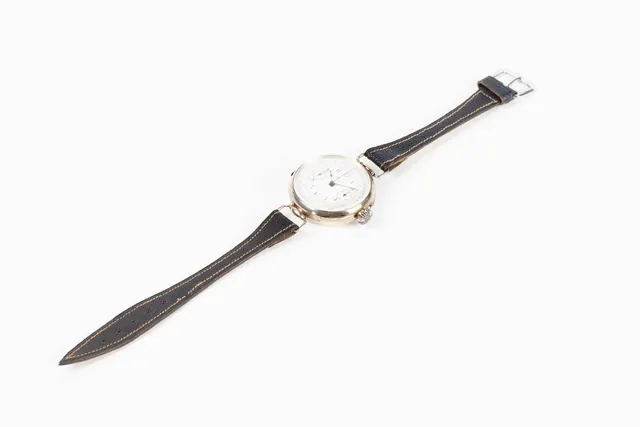
Instruments · c. 1920
Chronograph by Francillon und Cie (Longines), Switzerland, c. 1920
German Clock Museum
Instruments · c. 1942
Deck watch no. 739 by Hamilton Watch Co
Royal Museums Greenwich