
Wristwatches · Wristwatch
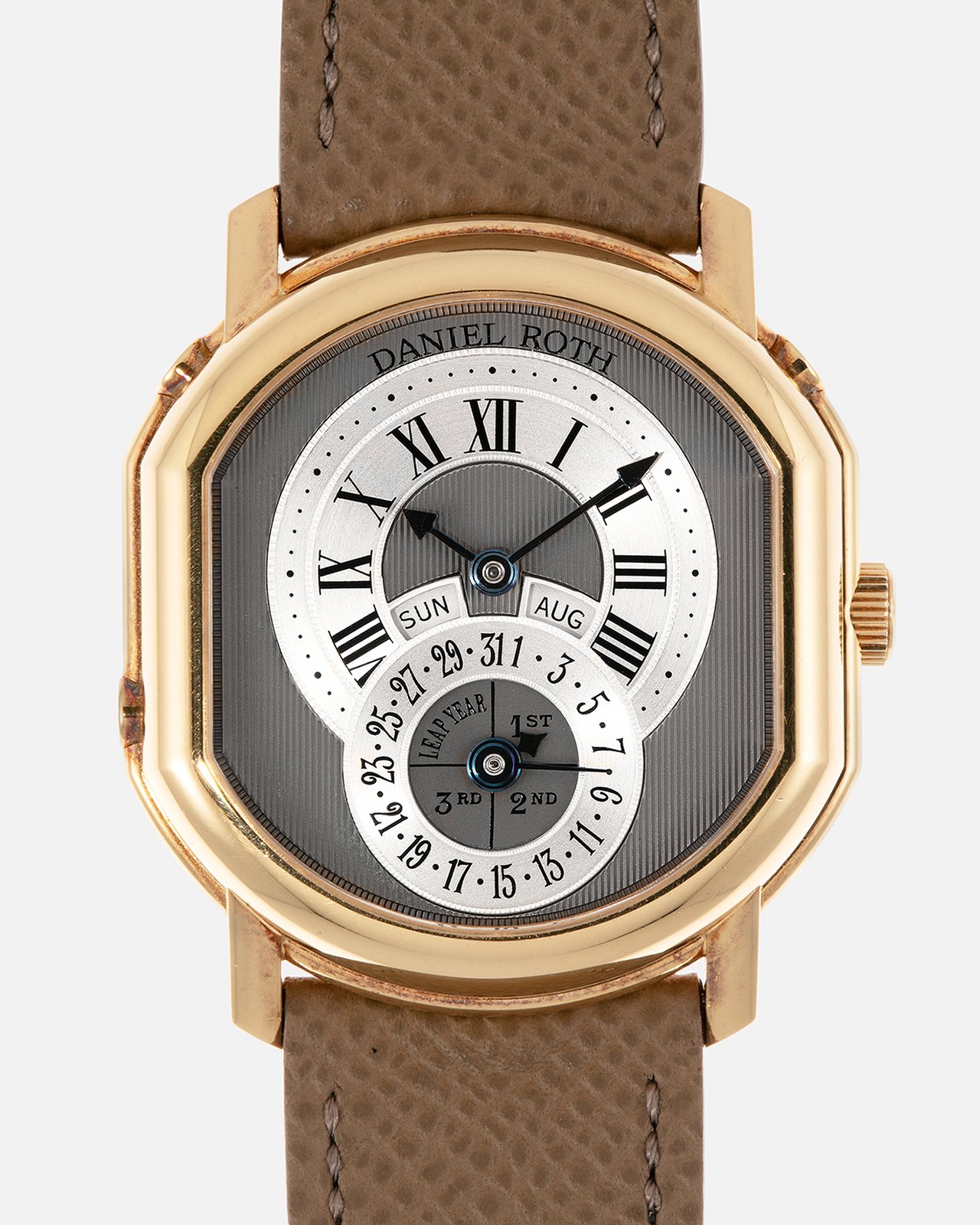
Daniel Roth Perpetual Calendar 2117 First Generation, 1990s
- Maker / attribution
- Daniel Roth (maker)
- Date
- 1990s
- Historical period
- Mechanical Renaissance (1990 – 2010)
- Country of origin
- Switzerland
- Object type
- Wristwatch
- Stock no.
- Product 7592648147031
- Credit line
- Dealer listing, S.Song Watches (product 7592648147031)
- Catalogue title (original)
- Daniel Roth Perpetual Calendar 2117 First Generation (English)
View the source record (dealer listing) ↗ (opens another website in a new tab)Suggest a correction
Record summary
Catalogued by S.Song Watches (dealer), Seattle (stock number Product 7592648147031), this is a wristwatch by Daniel Roth, made in Switzerland, dated 1990s. The Atlas places it in the Mechanical Renaissance period (1990 – 2010) of its Wristwatches collection. The record is illustrated with 6 photographs.
Assembled from the source record's structured fields. Dates and attributions are given as the source states them; where a field is missing the Atlas leaves it blank rather than estimating.
Catalogue description
Dealer description — S.Song Watches
When we think of modern independent watchmaking, names like Kari Voutilainen, Philippe Dufour, F.P. Journe, and Roger Smith often come to mind. Independent horology has grown so much in stature that owning at least one piece is now considered a hallmark of serious collecting. That being said, before this wave of recognition, there was Daniel Roth—a watchmaker who, in many ways, helped lay the foundation for today’s independent movement. To add some context, Daniel Roth was one of the most talented watchmakers of his generation and is responsible for many things we see in watchmaking today. For one, he was a leading figure who firmly established the design language of the Breguet watches you see today. In the '60s and ’70s, Breguet had become a shadow of its former self with seemingly no future until it was acquired by Chaumet, who in turn brought in Daniel Roth to take the helm. The reference 3130, with its guilloché dial and straight-lugged case, set the tone for Breguet’s rebirth. Beyond design, Roth also contributed to the development of complex movements at Lemania, which, may I remind you, still supplied chronograph calibres to Patek Philippe and Vacheron Constantin until fairly recently. Daniel Roth, the brand, unfolds in three distinct eras: the early independent years, its time under The Hour Glass, and the final chapter under Bulgari after Roth’s departure. Offered here today is a stunning example of a Perpetual Calendar 2117 from the brand’s revered first generation, widely considered the most collectable period of his work. Rare and mechanically ambitious, pieces from this era are distinguished not only by technical substance but by a clear and disciplined design language. While Roth’s technical brilliance is widely recognized, his instinctive command of proportion, texture, and depth is often overlooked. Historically, this complication was central to Roth’s early vision: to create the world’s first instantaneous perpetual calendar module. In most traditional perpetual calendars, the date, and often the day and month, begins advancing gradually around midnight rather than switching in a single, decisive ‘jump’, but achieving a true ‘jump’ at 12:00 midnight required extraordinary skill and mastery. To realise this, Roth worked closely with the venerable Philippe Dufour, combining their expertise to develop an ambitious perpetual calendar module built on a Lemania 8810 ébauche . When introduced in 1991, two years before the 2117’s eventual launch, the model featured two individual aperture displays for the day and month, as seen here, which was initially engineered to deliver that instantaneous ‘jump’. In practice, however, driving the calendar discs required significant torque. To address this, the design was later updated and replaced by a dual sub-dial configuration with hands—a version we have previously offered—which reduced inertia and allowed the indications to switch more rapidly. That said, whether the system should be described as truly instantaneous remains a subject of extensive debate and discussion among scholars, with many referring to it as “semi-instantaneous”. While the latter dual sub-dial execution reflects the technical evolution of the module, the dual-aperture variant offered here remains the earliest and purest expression of Roth’s original concept from this period. Another enduring challenge of perpetual calendars is fitting extensive information onto a compact dial—something the 2117 manages with notable clarity. With legibility and proportion carefully considered, it features a silver-brushed chapter ring which houses Roman numeral hour markers and dotted minute indices on the outer section. Apertures at 3:00 and 9:00 display the day and month, while a large sub-dial at 6:00 integrates the date and leap-year indication; this is made possible by an additional gear train incorporated beneath it by Dufour. All of this sits atop Roth’s signature vertical pinstripe guilloché dial, perfectly maintaining balance and visual depth without compromising readability. Thankfully, that era has given way to renewal. With Daniel Roth’s recent resurgence under La Fabrique du Temps and LVMH, and the introduction of the Tourbillon Souscription, Extra Plat and Extra Plat Rose Gold Skeleton models, I’m elated to see that Daniel Roth is finally returning to form and being celebrated for what it always was: one of the most important and original voices in the realm of high-end independent watchmaking.
Historical context
Mechanical Renaissance (1990 – 2010)
Mechanical watches return as cultural objects; independent watchmaking flourishes.
Mechanical watches returned as cultural and luxury objects. Complications, tourbillons and new materials proliferated; independent watchmakers such as George Daniels, F.P. Journe and Philippe Dufour revived artisanal watchmaking; collecting vintage watches became a major field.
Read the period in the timelineMore wristwatches from this periodEarlier: Quartz Revolution
Atlas type guide
Calendar, moon-phase and perpetual calendar watches
Calendar complications range from a simple date to the perpetual calendar, which automatically allows for months of different lengths and leap years until 2100. Pocket watches with perpetual calendars were made in the eighteenth and nineteenth centuries; Patek Philippe made the first perpetual calendar wristwatch in 1925, and series production followed in 1941. The annual calendar (Patek Philippe, 1996) needs correction only once a year.
Moon-phase displays use a disc with two moons and 59 teeth advanced daily, approximating the 29.5-day lunation; more precise trains reduce the error to one day in over a century.
What to look for
- Apertures or subsidiary dials for day, date, month and leap year.
- Moon disc under a 'bosom' shaped aperture.
- Recessed correctors on the case band for setting the calendar.
Dating clues
- Triple-date wristwatches: popular c. 1940–1955.
- Perpetual calendar wristwatches: from 1925 (unique) and 1941 (series).
General guidance written by the Atlas editors about this kind of object. It is not a statement about this particular piece; for that, rely on the source record above and on physical examination.
Related records
Wristwatches · 2001
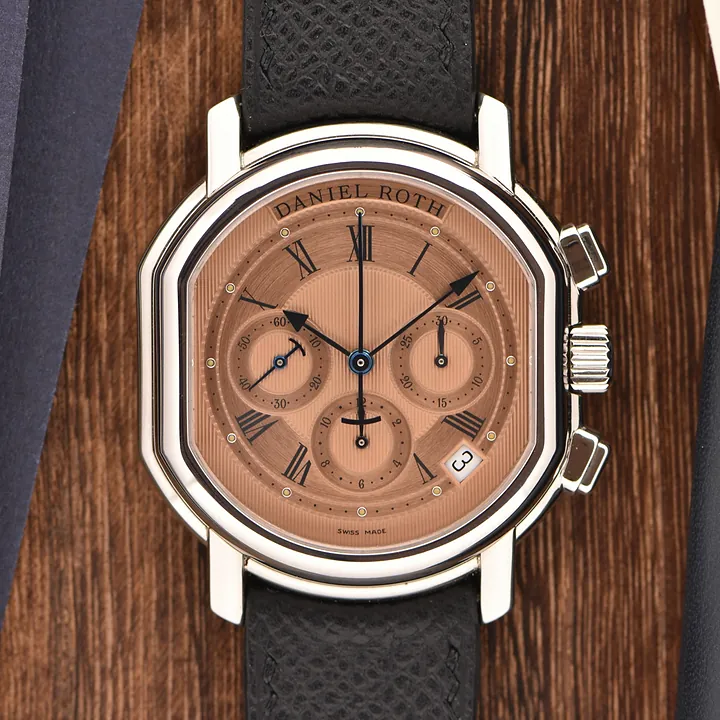
Daniel Roth Masters Chronograph Salmon, 2001
Huntington Company (dealer)
Wristwatches · 1990s
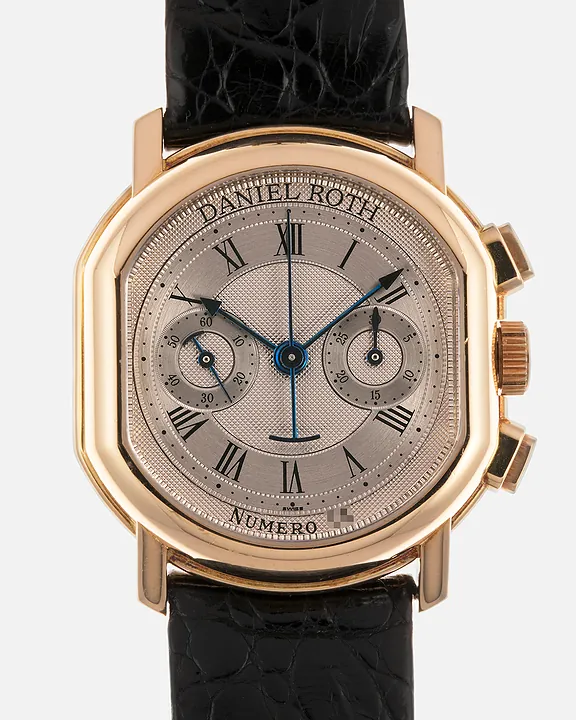
Daniel Roth Chronograph Lemania 2147 Clous De Paris, 1990s
S.Song Watches (dealer), Seattle
Wristwatches · 1990s
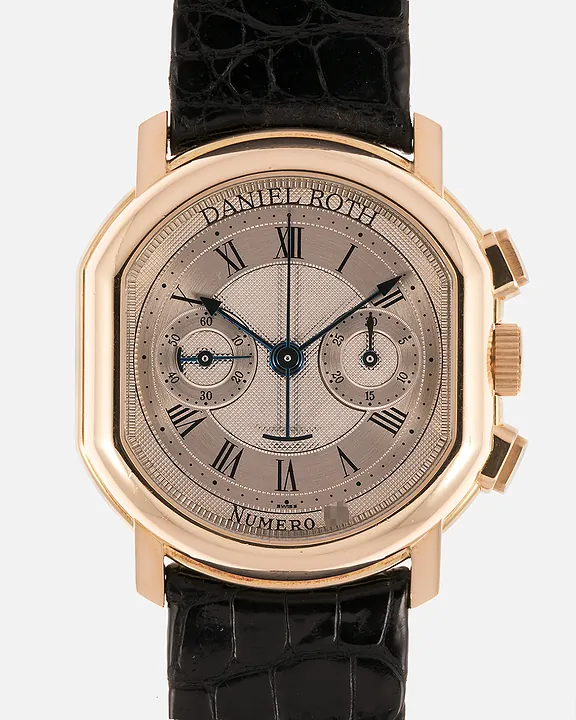
Daniel Roth Chronograph Lemania 2147 Clous De Paris, 1990s
S.Song Watches (dealer), Seattle
Wristwatches · 2025
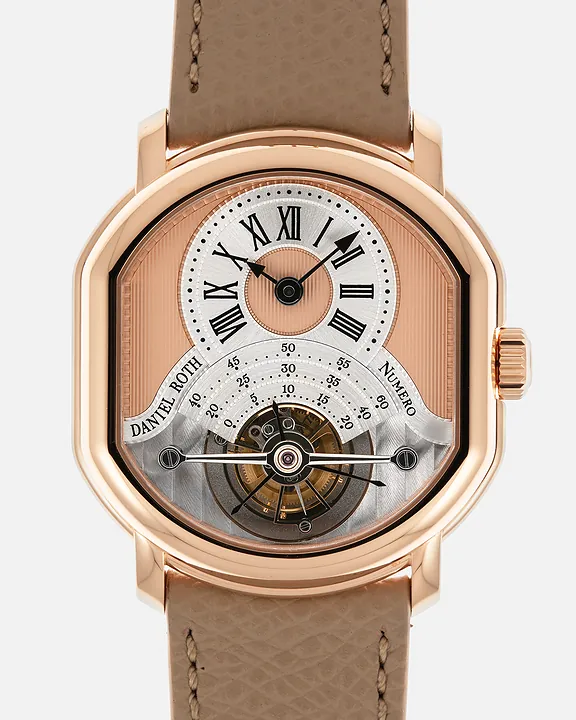
Daniel Roth Tourbillon Rose Gold DR 001, 2025
S.Song Watches (dealer), Seattle

Wristwatches · 2008
Wristwatch by Breitling?, 2008
Museum Rotterdam

Wristwatches · c. 1990s
Audemars Piguet Bamboo, c. 1990s
Antiquorum auction archive, Geneva

Wristwatches · c. 1990
Audemars Piguet Huitieme Perpetual Calendar, ref. 25696PT, c. 1990
Antiquorum auction archive, Geneva

Wristwatches · c. 1990
Breitling Chronomat, ref. b13050.1, c. 1990
Antiquorum auction archive, Geneva