
Wristwatches · Wristwatch
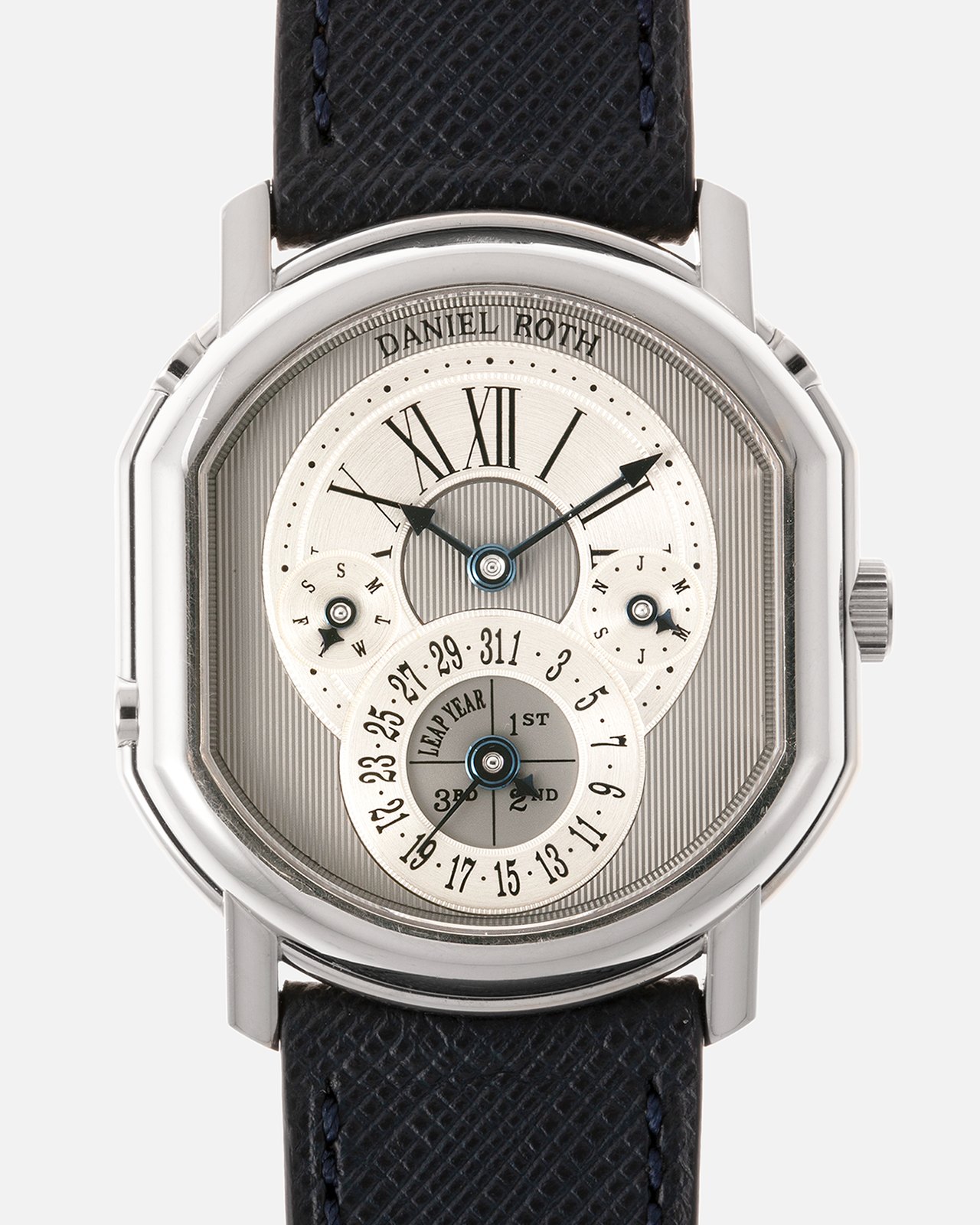
Daniel Roth Perpetual Calendar 2117 First Generation, 1990s
- Maker / attribution
- Daniel Roth (maker)
- Date
- 1990s
- Historical period
- Mechanical Renaissance (1990 – 2010)
- Country of origin
- Switzerland
- Object type
- Wristwatch
- Stock no.
- Product 6843692417111
- Credit line
- Dealer listing, S.Song Watches (product 6843692417111)
- Catalogue title (original)
- Daniel Roth Perpetual Calendar 2117 First Generation (English)
View the source record (dealer listing) ↗ (opens another website in a new tab)Suggest a correction
Record summary
Catalogued by S.Song Watches (dealer), Seattle (stock number Product 6843692417111), this is a wristwatch by Daniel Roth, made in Switzerland, dated 1990s. The Atlas places it in the Mechanical Renaissance period (1990 – 2010) of its Wristwatches collection. The record is illustrated with 6 photographs.
Assembled from the source record's structured fields. Dates and attributions are given as the source states them; where a field is missing the Atlas leaves it blank rather than estimating.
Catalogue description
Dealer description — S.Song Watches
When we think of the big independents today, names such as Voutilainen, Dufour, Journe, and Smith come to mind. In fact, there is such a huge appreciation for independents today that it has become somewhat mainstream within collecting circles to own at least one watch from an independent brand. Before all of this hype though, there was Daniel Roth. To be honest, in my opinion, the story of the Daniel Roth brand is a tragic one that could’ve worked out very differently. To add some context, Daniel Roth was one of the most talented watchmakers of his generation and was responsible for many things you see today but do not realize. For one, he was a leading figure that established the design language of Breguet dress watches that you see today. In the 60s and ’70s, Breguet had become a below-average watch brand with no future, until they were acquired by Chaumet, who in turn brought in Daniel Roth to lead the helm. The reference 3130, with its guilloche dial and its straight-lugged case, set the tone for Breguet and was during the time of Daniel Roth. Moreover, he played a significant role in producing complicated movements for Lemania who may I remind you up until recently still provided the likes of Patek Philippe and Vacheron Constantin with chronograph calibers. After that chapter of Roth’s life and entering into the ’90s, the independent brand ‘Daniel Roth’ began taking form. There are three distinct periods in the Daniel Roth brand, the early period when he was truly independent, the middle period when The Hour Glass was a stakeholder, and the final period when Bvlgari took over and Daniel Roth left the company. This particular model is part of the revered first generation- a complicated and rare Perpetual Calendar. For a bit of historical context, this complication played a big role in Daniel Roth’s early days, with his goal to create the world’s first instantaneous perpetual calendar module. All perpetual calendars prior to this gradually shifted to their correct setting after 12 o’clock and to create one that created that magical ‘jump’ immediately required a huge amount of skill. Working together with none other than Philippe Dufour, the initial development that featured apertures did not work as well because of the power required to shift the wheels. The subsequent refinement resulted in what you see here, a highly modified Lemania 8810 ebauche with day, date, month, and leap year wheels using hands that jump instantaneously. This watch shares the same reference as the model with the aperture and is also considered a first-generation model and was released around the same time. One of the persistent problems of perpetual calendars is the amount of information required to be displayed on a small dial of a watch and I do think that the 2117 executes this perfectly. With legibility and proportions a priority, this Daniel Roth Perpetual Calendar features a primary, silver brushed ring with elongated Roman numerals for the hour and minutes, with two sub-dials within it at 3 and 9 o’clock displaying the day and month. Overlaying this ring at 6 o’clock is a smaller sub-dial that displays the date and the leap year indicator inside it, all atop Daniel Roth’s signature grey ‘ligne’ textured dial. I truly think that these Daniel Roth watches are hugely under-appreciated and it is a tragedy that the man himself does not get the recognition he deserves. Due to bad business decisions, several takeovers, and just pure bad luck, the brand Daniel Roth eventually ended up with Bvlgari, who today absorbed his distinctive case shape and branded it under their own. Compared to the original Roth pieces, which were elegant, understated, and beautiful, today’s reiteration by Bvlgari is a far cry from that- oversized and gaudy. It does make me sad to see such a great watch brand tarnished, but as I have been an advocate for Daniel Roth for quite a few years now, it is great to finally see that early examples from the brand is coming back into the fore, getting the recognition it has always deserved.
Historical context
Mechanical Renaissance (1990 – 2010)
Mechanical watches return as cultural objects; independent watchmaking flourishes.
Mechanical watches returned as cultural and luxury objects. Complications, tourbillons and new materials proliferated; independent watchmakers such as George Daniels, F.P. Journe and Philippe Dufour revived artisanal watchmaking; collecting vintage watches became a major field.
Read the period in the timelineMore wristwatches from this periodEarlier: Quartz Revolution
Atlas type guide
Calendar, moon-phase and perpetual calendar watches
Calendar complications range from a simple date to the perpetual calendar, which automatically allows for months of different lengths and leap years until 2100. Pocket watches with perpetual calendars were made in the eighteenth and nineteenth centuries; Patek Philippe made the first perpetual calendar wristwatch in 1925, and series production followed in 1941. The annual calendar (Patek Philippe, 1996) needs correction only once a year.
Moon-phase displays use a disc with two moons and 59 teeth advanced daily, approximating the 29.5-day lunation; more precise trains reduce the error to one day in over a century.
What to look for
- Apertures or subsidiary dials for day, date, month and leap year.
- Moon disc under a 'bosom' shaped aperture.
- Recessed correctors on the case band for setting the calendar.
Dating clues
- Triple-date wristwatches: popular c. 1940–1955.
- Perpetual calendar wristwatches: from 1925 (unique) and 1941 (series).
General guidance written by the Atlas editors about this kind of object. It is not a statement about this particular piece; for that, rely on the source record above and on physical examination.
Related records
Wristwatches · 2001
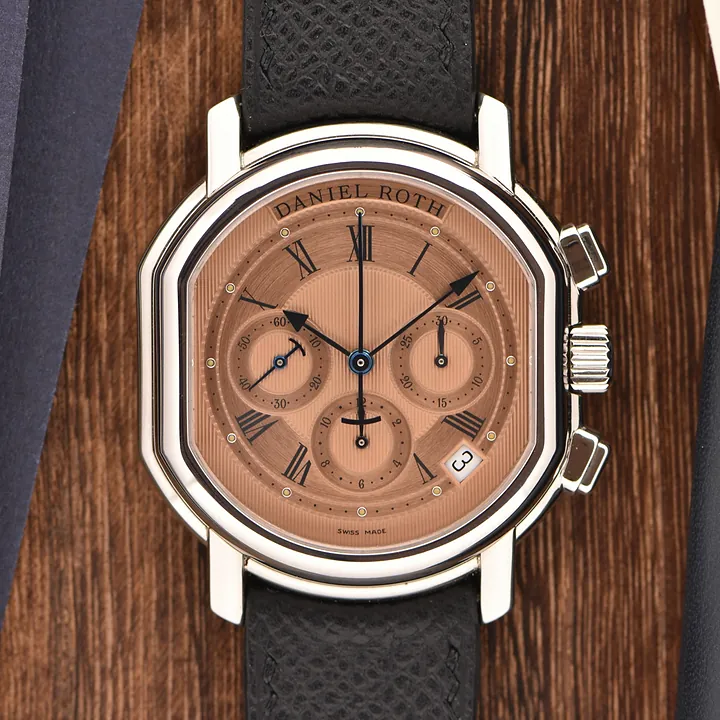
Daniel Roth Masters Chronograph Salmon, 2001
Huntington Company (dealer)
Wristwatches · 1990s
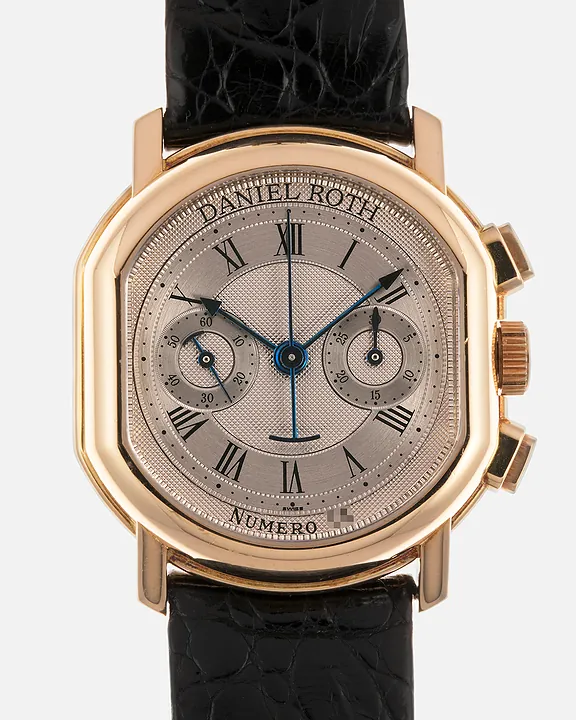
Daniel Roth Chronograph Lemania 2147 Clous De Paris, 1990s
S.Song Watches (dealer), Seattle
Wristwatches · 1990s
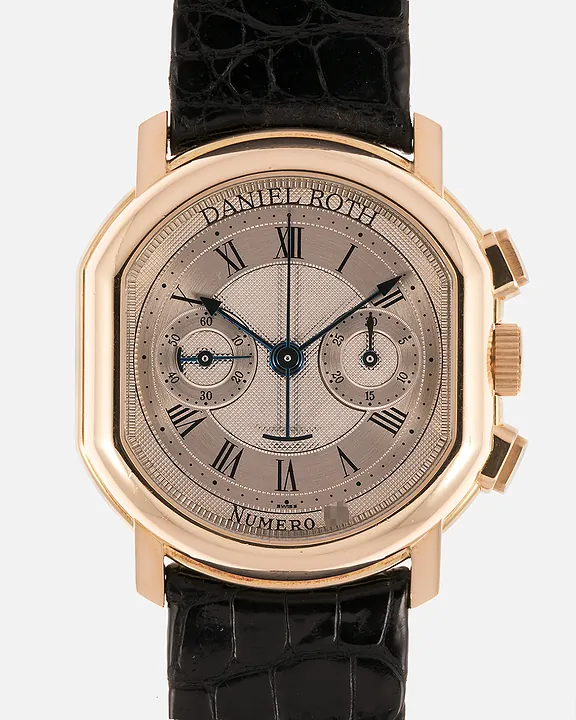
Daniel Roth Chronograph Lemania 2147 Clous De Paris, 1990s
S.Song Watches (dealer), Seattle
Wristwatches · 2025
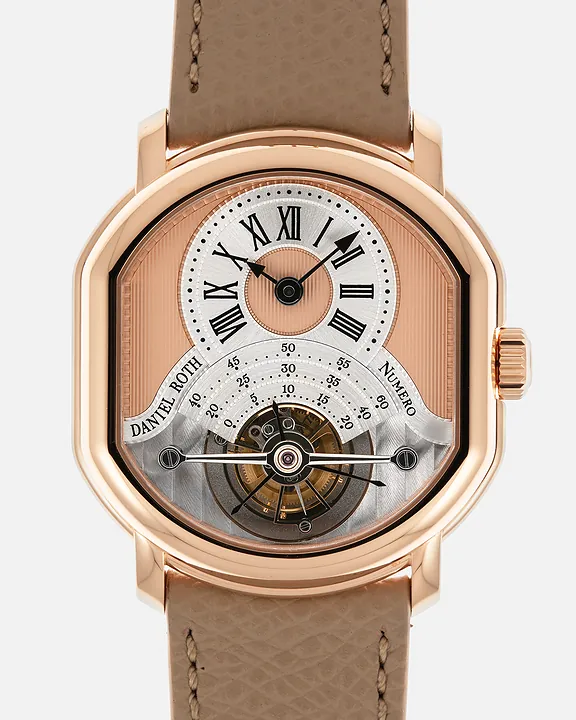
Daniel Roth Tourbillon Rose Gold DR 001, 2025
S.Song Watches (dealer), Seattle

Wristwatches · 2008
Wristwatch by Breitling?, 2008
Museum Rotterdam

Wristwatches · c. 1990s
Audemars Piguet Bamboo, c. 1990s
Antiquorum auction archive, Geneva

Wristwatches · c. 1990
Audemars Piguet Huitieme Perpetual Calendar, ref. 25696PT, c. 1990
Antiquorum auction archive, Geneva

Wristwatches · c. 1990
Breitling Chronomat, ref. b13050.1, c. 1990
Antiquorum auction archive, Geneva