
Wristwatches · Wristwatch
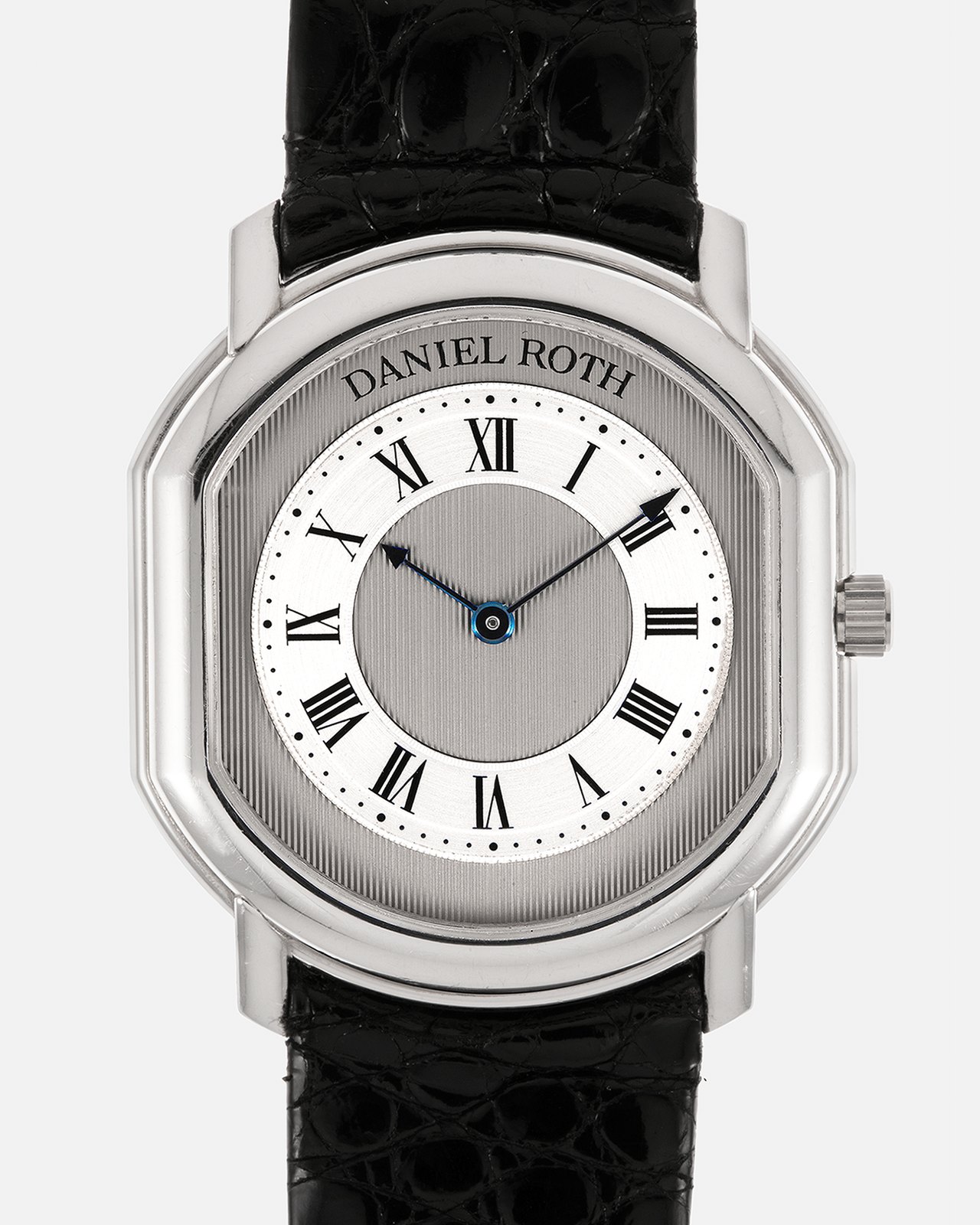
Daniel Roth Extra Plat 2107 1st Generation, 1990s
- Maker / attribution
- Daniel Roth (maker)
- Date
- 1990s
- Historical period
- Mechanical Renaissance (1990 – 2010)
- Country of origin
- Switzerland
- Object type
- Wristwatch
- Dimensions
- Case 35 mm
- Stock no.
- Product 7679783501911
- Credit line
- Dealer listing, S.Song Watches (product 7679783501911)
- Catalogue title (original)
- Daniel Roth Extra Plat 2107 1st Generation (English)
View the source record (dealer listing) ↗ (opens another website in a new tab)Suggest a correction
Record summary
Catalogued by S.Song Watches (dealer), Seattle (stock number Product 7679783501911), this is a wristwatch by Daniel Roth, made in Switzerland, dated 1990s. The Atlas places it in the Mechanical Renaissance period (1990 – 2010) of its Wristwatches collection. Recorded dimensions: Case 35 mm. The record is illustrated with 6 photographs.
Assembled from the source record's structured fields. Dates and attributions are given as the source states them; where a field is missing the Atlas leaves it blank rather than estimating.
Catalogue description
Dealer description — S.Song Watches
When discussing the pioneers of independent watchmaking, names such as Philippe Dufour, Kari Voutilainen, Roger Smith, and F.P. Journe inevitably dominate the conversation. Yet long before independent watchmaking became a recognised category of collecting, there was Daniel Roth. Few watchmakers have influenced modern horology as profoundly as Roth. Following the acquisition of Breguet by Chaumet in the late 1970s, he played a pivotal role in reviving the historic manufacture and establishing much of the design language collectors now associate with modern Breguet watches. The hand-guilloché dials, straight lugs, coin-edge cases, and classical proportions that define the brand today can all be traced back to his influence. Beyond Breguet, he was also involved in the development of complicated movements at Lemania, whose calibres would go on to power chronographs for some of Switzerland's most prestigious watchmakers. The watch offered here is an early Daniel Roth 2107 "Extra Plat" in platinum with a grey guilloché dial. Produced during the brand's formative years, first-generation examples such as this are seldom encountered today, particularly in platinum. What sets the platinum Extra Plat apart from its yellow and white gold counterparts is its case construction. While most examples feature a snap-on caseback, platinum models were fitted with a screw-down caseback instead. This was not a stylistic decision, but a practical one. At just 6.5mm thick, producing an ultra-thin case in platinum presented unique engineering challenges, and the additional screws were necessary to ensure sufficient structural rigidity. As a result, platinum examples were produced in far smaller numbers than their gold counterparts. Combined with their distinctive construction, they represent some of the most desirable and collectable members of the 2107 family, offering a fascinating insight into the technical considerations behind Daniel Roth's pursuit of elegant ultra-thin watchmaking. Housed within the brand's signature 35mm × 38mm Ellipsocurvex case, the 2107 demonstrates Daniel Roth's ability to balance classical watchmaking with a highly individual approach to design. Neither round nor rectangular, the Ellipsocurvex is one of those forms that has only become more distinctive with time. What once appeared unconventional now feels unmistakably Daniel Roth. Executed in platinum, the case possesses a quiet presence while preserving the elegant proportions that define the watch. The grey guilloché dial further reinforces the watch's cohesive character. Its restrained monochromatic palette allows the various textures to speak for themselves, from the signature pinstripe guilloché centre to the brushed chapter ring. More than three decades after its introduction, the overall design remains remarkably contemporary, a testament to how successfully Roth combined classical influences with his own distinctive design sensibility. A closer examination reveals numerous details influenced by his years at Breguet. The straight lugs, stepped bezel, engine-turned guilloché dial, Roman numerals, and blued steel hands all reflect the aesthetic vocabulary he helped establish during his tenure there. The contrast between the sharply executed pinstripe guilloché centre and brushed chapter ring creates depth and texture without relying on colour or ornamentation. Compared to many of Roth's more complicated creations, the 2107 is notably restrained. As a time-only watch, there is little for the eye to hide behind. Its appeal lies in its proportions, dial execution, and case architecture, qualities that become increasingly apparent the longer one spends with it. Powering the watch is an automatic movement based on the Frederic Piguet Cal. 71, one of the thinnest automatic calibres of its era. Favoured by numerous high-end manufacturers for its slimness and technical versatility, the calibre's offset rotor architecture was designed to facilitate modular construction while maintaining an exceptionally thin profile. It therefore reflects the watch's "Extra Plat" designation perfectly, a term used by Daniel Roth to emphasise its ultra-thin construction. Interest in Daniel Roth's work has grown considerably in recent years, driven in part by the revival of the brand under LVMH through La Fabrique du Temps Louis Vuitton in Geneva. While the modern watches pay tribute to Roth's original designs, collectors have increasingly turned their attention to the watches produced during the brand's formative years. Elegant, restrained, and immediately recognisable, the 2107 remains one of the purest expressions of what made Daniel Roth such an important figure in modern watchmaking. As collectors continue to rediscover his early work, platinum examples from this period have become increasingly difficult to source, combining rarity with a direct connection to the years when Roth himself remained closely involved in shaping the identity of the brand.
Historical context
Mechanical Renaissance (1990 – 2010)
Mechanical watches return as cultural objects; independent watchmaking flourishes.
Mechanical watches returned as cultural and luxury objects. Complications, tourbillons and new materials proliferated; independent watchmakers such as George Daniels, F.P. Journe and Philippe Dufour revived artisanal watchmaking; collecting vintage watches became a major field.
Read the period in the timelineMore wristwatches from this periodEarlier: Quartz Revolution
Atlas type guide
Wristwatches
Bracelet watches were worn by women from the early nineteenth century — Breguet made one for Caroline Murat, Queen of Naples, in 1810–12 — but the wristwatch only became a man's instrument with military use and aviation in the early twentieth century. Between the World Wars it overtook the pocket watch; the 1920s and 1930s brought rectangular Art Deco cases, water-resistant cases and the first automatic winding systems.
After 1945 the wristwatch became a carrier of identity — dress watches, sports and dive watches, chronographs, calendars — produced by Swiss, American, Japanese, German, Soviet and Chinese industries. The quartz revolution after 1969 and the mechanical renaissance since the 1990s, including the rise of independent watchmakers, complete the story.
What to look for
- The reference number (between the lugs or inside the case back) and serial number, the starting point for dating.
- The calibre: its maker and number are often stamped under the dial or on the bridge.
- Originality of dial, hands and crown — refinished ('redial') dials are common.
- Case material marks: 18K/750, 14K/585, stainless steel, gold-filled, plated.
Dating clues
- Wire-lug cases: before c. 1925.
- Water-resistant screw-down cases: from 1926.
- Quartz movements: from 1969; sapphire crystals widespread after c. 1980.
General guidance written by the Atlas editors about this kind of object. It is not a statement about this particular piece; for that, rely on the source record above and on physical examination.
Related records
Wristwatches · 2001
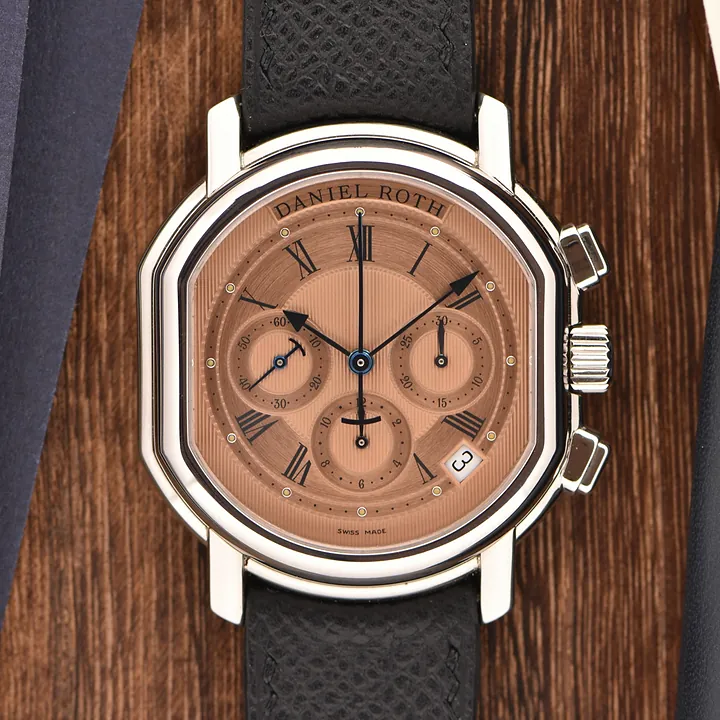
Daniel Roth Masters Chronograph Salmon, 2001
Huntington Company (dealer)
Wristwatches · 1990s
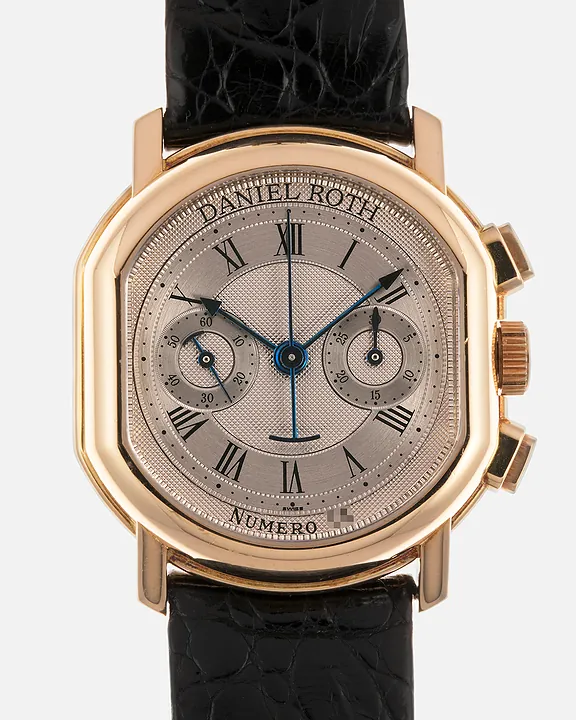
Daniel Roth Chronograph Lemania 2147 Clous De Paris, 1990s
S.Song Watches (dealer), Seattle
Wristwatches · 1990s
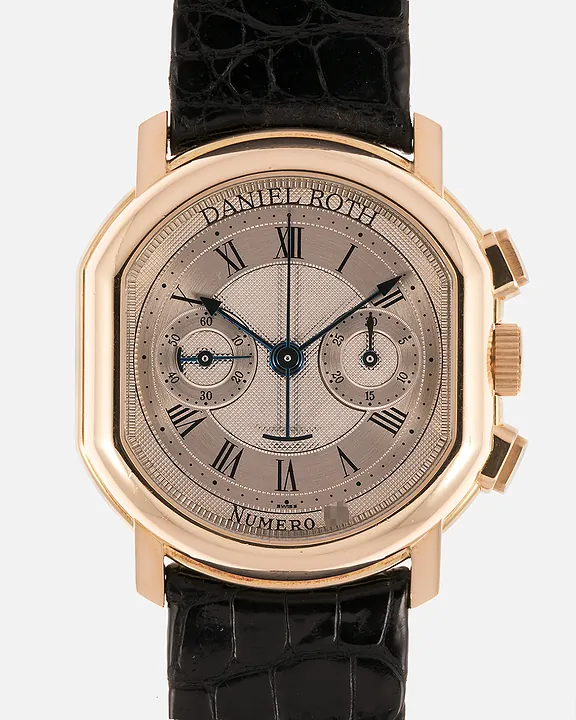
Daniel Roth Chronograph Lemania 2147 Clous De Paris, 1990s
S.Song Watches (dealer), Seattle
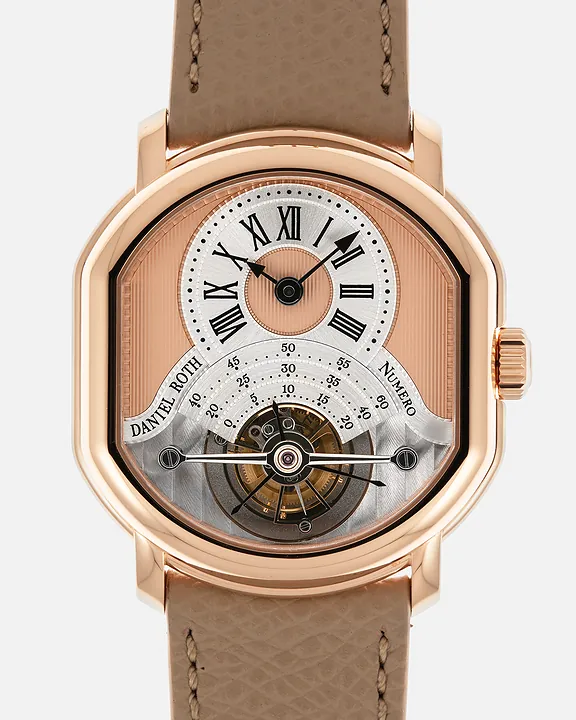
Wristwatches · 2025
Daniel Roth Tourbillon Rose Gold DR 001, 2025
S.Song Watches (dealer), Seattle

Wristwatches · 2008
Wristwatch by Breitling?, 2008
Museum Rotterdam

Wristwatches · c. 1990s
Audemars Piguet Bamboo, c. 1990s
Antiquorum auction archive, Geneva

Wristwatches · c. 1990
Audemars Piguet Huitieme Perpetual Calendar, ref. 25696PT, c. 1990
Antiquorum auction archive, Geneva

Wristwatches · c. 1990
Breitling Chronomat, ref. b13050.1, c. 1990
Antiquorum auction archive, Geneva