
Wristwatches · Wristwatch
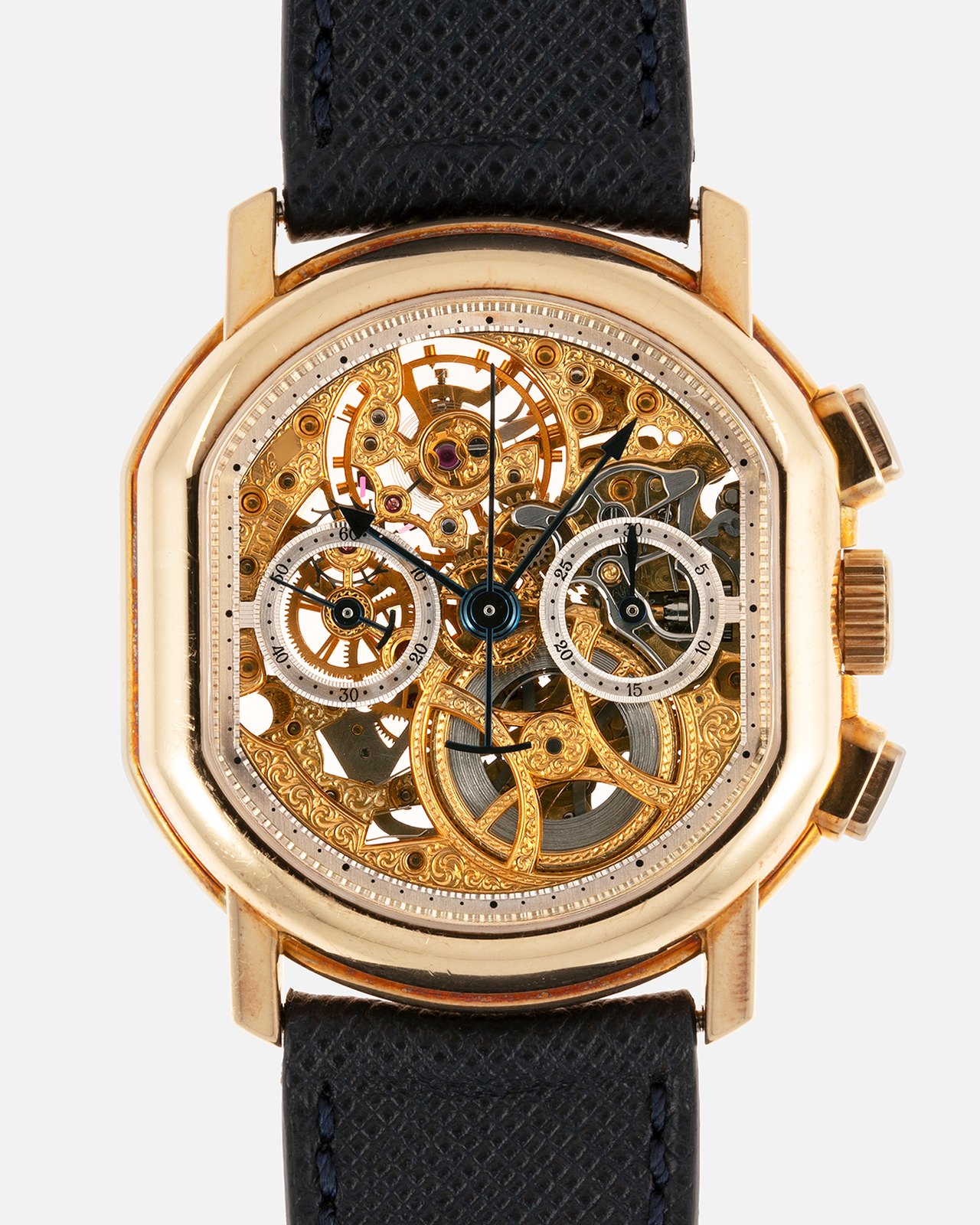
Daniel Roth Chronograph Skeleton Lemania 2147, 1990s
- Maker / attribution
- Daniel Roth (maker)
- Date
- 1990s
- Historical period
- Mechanical Renaissance (1990 – 2010)
- Country of origin
- Switzerland
- Object type
- Wristwatch
- Dimensions
- Case 38 mm
- Stock no.
- Product 6747208515671
- Credit line
- Dealer listing, S.Song Watches (product 6747208515671)
- Catalogue title (original)
- Daniel Roth Chronograph Skeleton Lemania 2147 (English)
View the source record (dealer listing) ↗ (opens another website in a new tab)Suggest a correction
Record summary
Catalogued by S.Song Watches (dealer), Seattle (stock number Product 6747208515671), this is a wristwatch by Daniel Roth, made in Switzerland, dated 1990s. The Atlas places it in the Mechanical Renaissance period (1990 – 2010) of its Wristwatches collection. Recorded dimensions: Case 38 mm. The record is illustrated with 6 photographs.
Assembled from the source record's structured fields. Dates and attributions are given as the source states them; where a field is missing the Atlas leaves it blank rather than estimating.
Catalogue description
Dealer description — S.Song Watches
When we think of the big independents today, names such as Voutilainen, Dufour, Journe, and Smith come to mind. In fact, there is such a huge appreciation for independents today that it has become somewhat mainstream within collecting circles to own at least one watch from an independent brand. Before all of this hype though, there was Daniel Roth. To be honest, in my opinion, the story of the Daniel Roth brand is a tragic one that could’ve worked out very differently. Daniel Roth the man came from a family of watchmakers and as such, was always destined to be one. Beginning his career at Audemars Piguet in Le Brassus, he worked there for 7 years before moving on to Breguet during the Chaumet era, where he really honed his skills. Without a doubt, Daniel Roth is one of the most talented watchmakers of his generation and was responsible for many things you see today but do not realize. At Breguet, he was a leading figure that established the design language of the Breguet dress watches that you see today. In the ’60s and ’70s, Breguet had become a below-average watch brand with no future, mainly supplying utilitarian Type 20 watches to the military. When they were acquired by the Chaumet brothers, they brought in Daniel Roth to lead the helm as technical director. The reference 3130 for example, with its guilloche dial and its straight lugged case, set the tone for Breguet and was created by Daniel Roth after studying the brand’s history and archives for over a year. Moreover, he played a significant role in producing complicated movements for Lemania who may I remind you up until recently still provided the likes of Patek Philippe and Vacheron Constantin with chronograph calibers. It wasn’t until the Chaumet brothers fell into scandal and had to sell Breguet, that Roth decided to pave his own path forward. Towards the end of the ’80s, Daniel Roth did the unthinkable by starting his own eponymous ‘independent’ brand. Back then, it was a crazy thing to do, especially as the industry was still reeling from the quartz crisis that decimated most brands. Without the constraints of big corporate hovering over him, he was free to create whatever he wanted and the results were some of the most original and beautiful watch designs of all time. You see, while no one can question the technical genius of Roth’s watchmaking, what many do not realize is that he is also a master in design, with an innate eye for proportion, texture, and depth. The most unique trait of the Daniel Roth brand is without a doubt the double ellipse case that underpinned the entire collection. It featured a three-piece case that was an amalgamation of a rectangular shape cut off by semi-circles at the top and bottom, resulting in a look that was truly unique. One of the more iconic early Roth models would have to be the chronograph you see here today and you can certainly see how working at Breguet influenced him. This watch features a fantastically elegant 35 X 38mm 18k yellow gold case that houses a high-quality Lemania 2320 movement- the same used by many during the era such as Patek Philippe, Vacheron Constantin, and Breguet. What makes this particular example extremely rare and special of course lies in the fact that it has been skeletonized. While standard early Daniel Roth’s are already considered very rare, it is even harder to find his skeletonized examples with this chronograph being beautifully decorated and finished up to the Master’s standards. It is sad that such a beautiful brand ended up this way, but perhaps as the first real independent brand, mistakes were bound to be made. What he did do was pave the way and show budding watchmakers like Journe and Dubuis what was possible and what to avoid.
Historical context
Mechanical Renaissance (1990 – 2010)
Mechanical watches return as cultural objects; independent watchmaking flourishes.
Mechanical watches returned as cultural and luxury objects. Complications, tourbillons and new materials proliferated; independent watchmakers such as George Daniels, F.P. Journe and Philippe Dufour revived artisanal watchmaking; collecting vintage watches became a major field.
Read the period in the timelineMore wristwatches from this periodEarlier: Quartz Revolution
Atlas type guide
Chronographs and split-seconds watches
A chronograph is a watch with an additional seconds hand that can be started, stopped and returned to zero independently of the timekeeping. Louis Moinet built an early example in 1816 and Nicolas Rieussec a recording 'chronographe' in 1821; Adolphe Nicole's heart-shaped reset cam (patented 1862) made the modern return-to-zero possible. Split-seconds (rattrapante) chronographs add a second hand that can be stopped for intermediate times; flyback chronographs restart instantly.
Chronographs were essential tools for doctors (pulsometer scales), artillery (telemeter), engineers and sport. In wristwatches, Valjoux, Venus, Lemania and later the automatic chronographs of 1969 (Zenith El Primero, the Chronomatic Calibre 11 group and Seiko 6139) are milestones.
What to look for
- Push-pieces on the case band or a single button in the crown (monopusher).
- Subsidiary registers for minutes and hours; tachymeter, telemeter or pulsometer scales.
- Column wheel versus cam control visible in the movement.
- Calibre markings of specialist makers (Valjoux, Lemania, Venus, Landeron).
Dating clues
- Pocket chronographs with heart cam reset: after 1862.
- Wrist chronographs: from c. 1910; two-button designs from the 1930s.
- Automatic chronographs: from 1969.
General guidance written by the Atlas editors about this kind of object. It is not a statement about this particular piece; for that, rely on the source record above and on physical examination.
Read next:Flyback chronographChronograph
Related records
Wristwatches · 2001
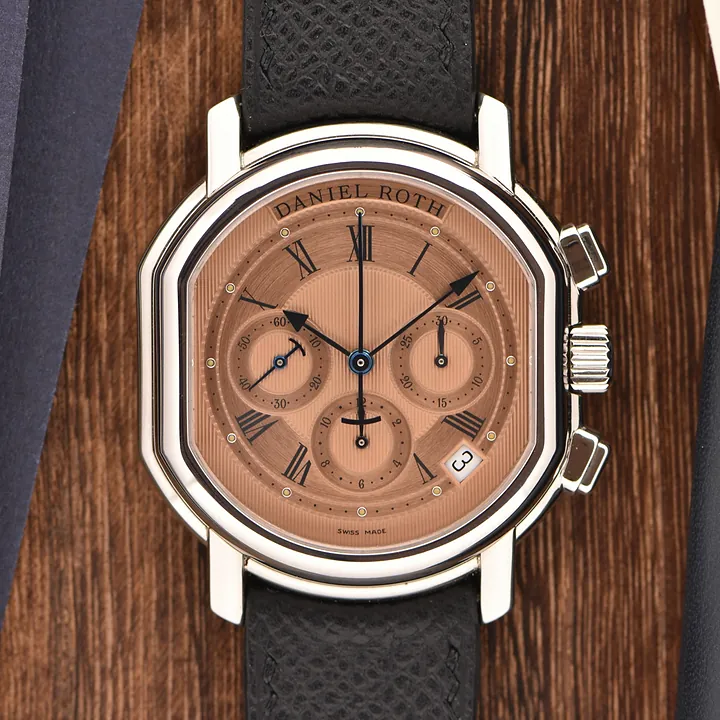
Daniel Roth Masters Chronograph Salmon, 2001
Huntington Company (dealer)
Wristwatches · 1990s
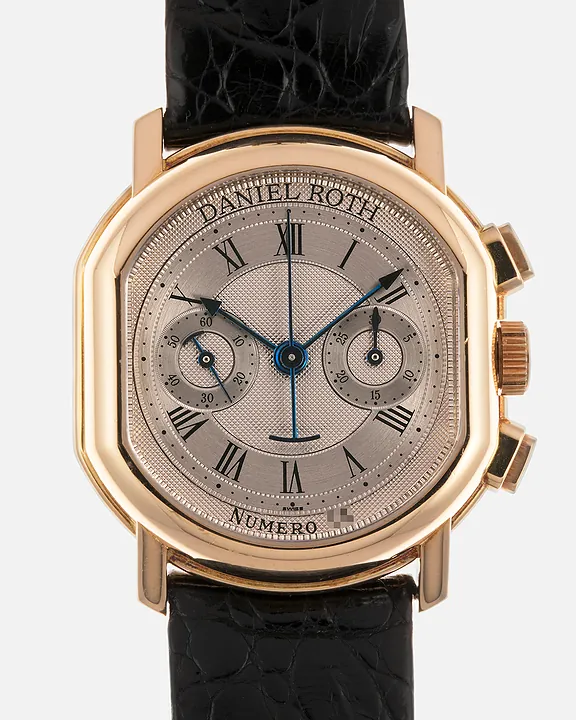
Daniel Roth Chronograph Lemania 2147 Clous De Paris, 1990s
S.Song Watches (dealer), Seattle
Wristwatches · 1990s
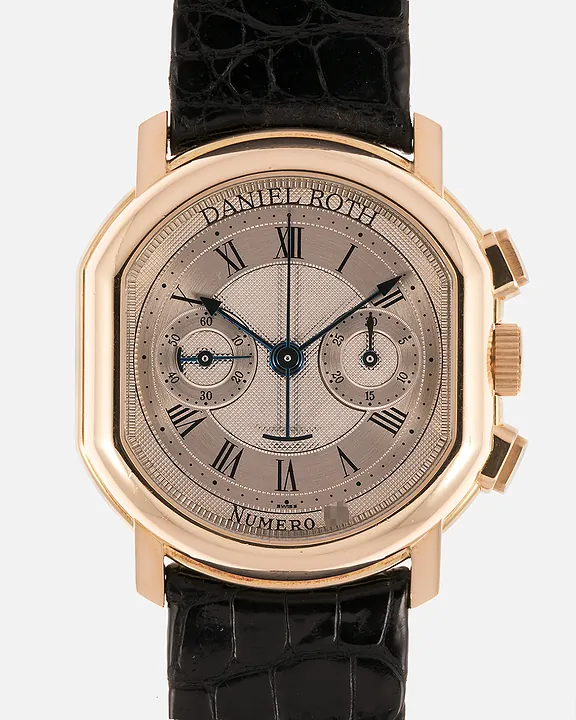
Daniel Roth Chronograph Lemania 2147 Clous De Paris, 1990s
S.Song Watches (dealer), Seattle
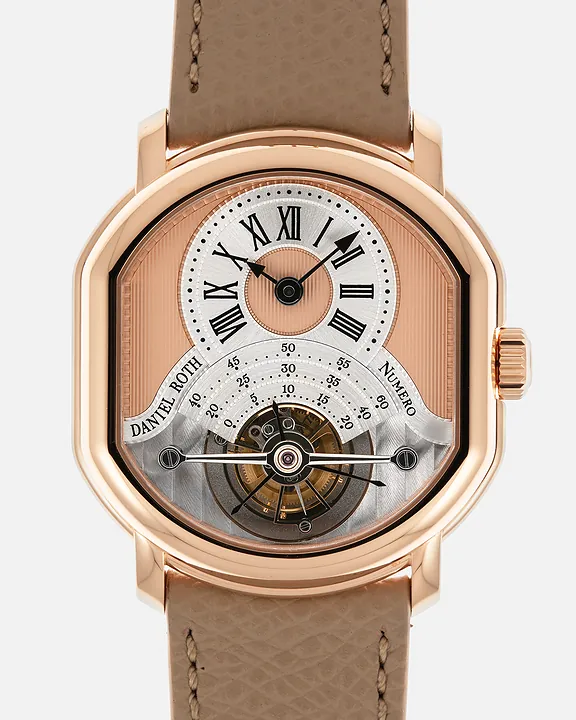
Wristwatches · 2025
Daniel Roth Tourbillon Rose Gold DR 001, 2025
S.Song Watches (dealer), Seattle

Wristwatches · 2008
Wristwatch by Breitling?, 2008
Museum Rotterdam

Wristwatches · c. 1990s
Audemars Piguet Bamboo, c. 1990s
Antiquorum auction archive, Geneva

Wristwatches · c. 1990
Audemars Piguet Huitieme Perpetual Calendar, ref. 25696PT, c. 1990
Antiquorum auction archive, Geneva

Wristwatches · c. 1990
Breitling Chronomat, ref. b13050.1, c. 1990
Antiquorum auction archive, Geneva