
Wristwatches · Wristwatch
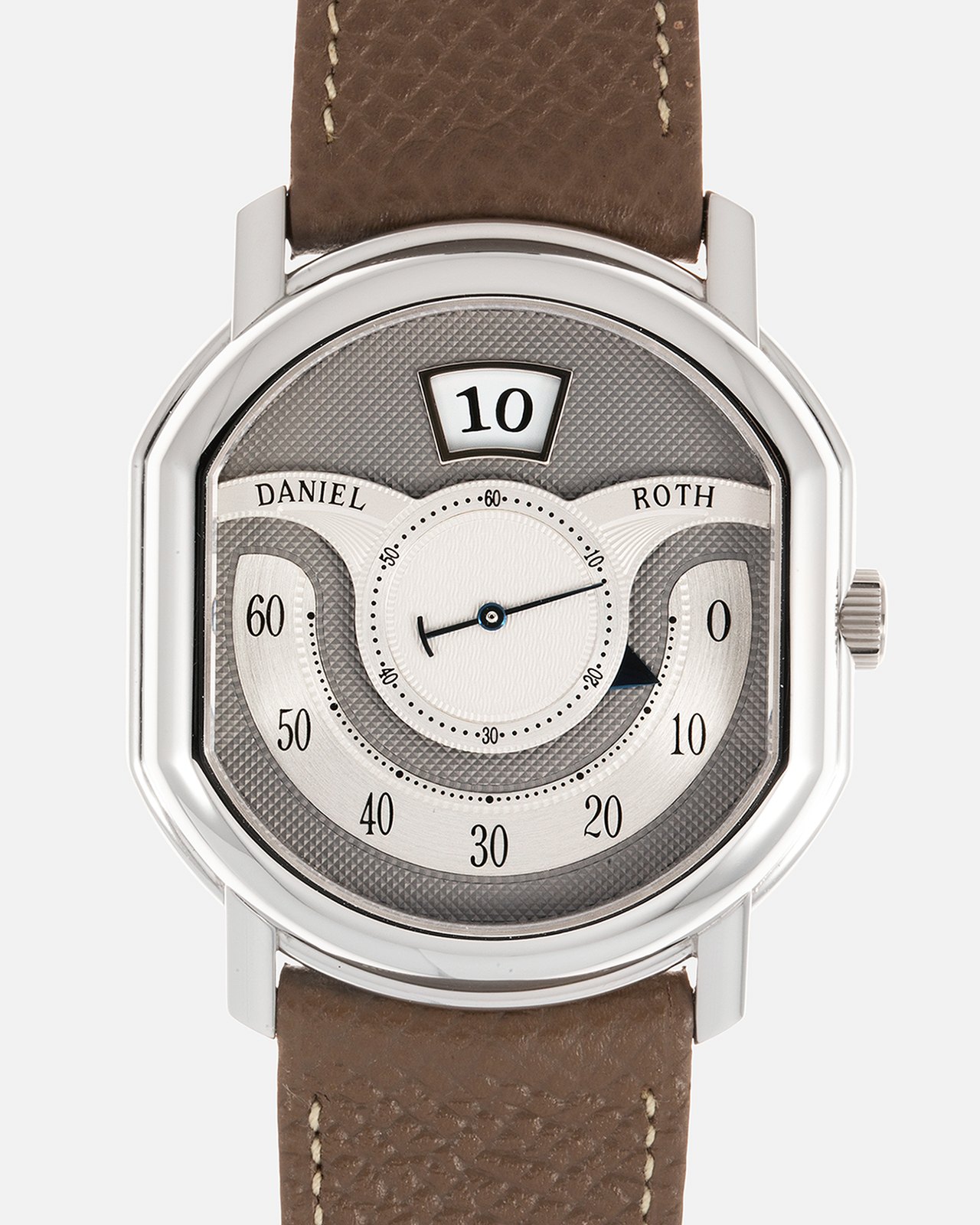
Daniel Roth 10th Anniversary Papillon Platinum, 1999
- Maker / attribution
- Daniel Roth (maker)
- Date
- 1999
- Historical period
- Mechanical Renaissance (1990 – 2010)
- Country of origin
- Switzerland
- Object type
- Wristwatch
- Materials / technique
- platinum
- Stock no.
- Product 6898667257943
- Credit line
- Dealer listing, S.Song Watches (product 6898667257943)
- Catalogue title (original)
- Daniel Roth 10th Anniversary Papillon Platinum (English)
View the source record (dealer listing) ↗ (opens another website in a new tab)Suggest a correction
Record summary
Catalogued by S.Song Watches (dealer), Seattle (stock number Product 6898667257943), this is a wristwatch by Daniel Roth, made in Switzerland, dated 1999. The Atlas places it in the Mechanical Renaissance period (1990 – 2010) of its Wristwatches collection. Materials and techniques recorded by the source: platinum. The record is illustrated with 6 photographs.
Assembled from the source record's structured fields. Dates and attributions are given as the source states them; where a field is missing the Atlas leaves it blank rather than estimating.
Catalogue description
Dealer description — S.Song Watches
When we think of the big independents today, names such as Kari Voutilainen, Philippe Dufour, F.P. Journe, and Roger Smith come to mind. In fact, there is such a huge appreciation for independents today that it has become somewhat mainstream within collecting circles to own at least one watch from an independent brand. Before all of this hype though, there was Daniel Roth, which in my opinion, sits right at the top of the pyramid amongst the very best when it comes to independent brands. To add some context, Daniel Roth was one of the most talented watchmakers of his generation and was responsible for many things you see today but do not realize. For one, he was a leading figure that established the design language of Breguet dress watches that you see today. In the ’60s and ’70s, Breguet had become a below-average watch brand with no future, until they were acquired by Chaumet, who in turn brought in Daniel Roth to lead the helm. The Ref. 3130, with its guilloche dial and its straight-lugged case, set the tone for Breguet and was created by Daniel Roth. Moreover, he played a significant role in producing complicated movements for Lemania who may I remind you up until recently still provided the likes of Patek Philippe and Vacheron Constantin with chronograph calibres. Following that period in Roth's life and with the arrival of the 1990s, the independent watch brand 'Daniel Roth' began to take shape. The Daniel Roth Papillon, which you see here today, is the pinnacle of this brand, created to commemorate its 10-year anniversary. It boasts a jumping hour complication and the brand's distinct "ellipso-curvex" case. Upon closer inspection, the Papillon exhibits remarkable attention to detail, with a guilloche dial reminiscent of Roth's time at Breguet and a stunning symmetrical design layout. The 12 o'clock aperture displays the jumping hour, while an oversized blued pointer on the bottom half of the dial indicates the minutes. At the centre of the dial, layered above the hour and minute displays, is a striking running seconds sub-dial with a distinct guilloche pattern and a large blued seconds hand. The depth of the dial achieved through the layering and use of various guilloche patterns is truly impressive. If you flip the watch over, you can see Roth's signature guilloche solid gold rotor and his meticulously finished calibre. What makes this particular example even more special is that it comes housed in a platinum case. The Papillon commemorative series was made in white gold, yellow gold, and platinum and while it is hard enough to find a Papillon in any metal, platinum reigns supreme as only 30 examples were made compared to the 110 in white and rose gold each. To differentiate the platinum example from the identical-looking white gold, the easiest way to tell is based on the sub-seconds in the middle of the dial. The white gold example is in grey, matching the rest of the dial, while the platinum version is in white, contrasting with the grey background. In the past, I’ve repeatedly expressed my utter disappointment in the direction and reality of Daniel Roth today which was taken over by Bvlgari, who absorbed his distinctive case design and branded it under their own. Oversized, gaudy, and inelegant – these reiterations were clearly a far cry from the original. But with the brand’s recent revival featuring the new Tourbillon Souscription, I am elated to see that Daniel Roth is finally getting the recognition it deserves, and is now one step closer to regaining its footing in the industry once again.
Historical context
Mechanical Renaissance (1990 – 2010)
Mechanical watches return as cultural objects; independent watchmaking flourishes.
Mechanical watches returned as cultural and luxury objects. Complications, tourbillons and new materials proliferated; independent watchmakers such as George Daniels, F.P. Journe and Philippe Dufour revived artisanal watchmaking; collecting vintage watches became a major field.
Read the period in the timelineMore wristwatches from this periodEarlier: Quartz Revolution
Atlas type guide
Wristwatches
Bracelet watches were worn by women from the early nineteenth century — Breguet made one for Caroline Murat, Queen of Naples, in 1810–12 — but the wristwatch only became a man's instrument with military use and aviation in the early twentieth century. Between the World Wars it overtook the pocket watch; the 1920s and 1930s brought rectangular Art Deco cases, water-resistant cases and the first automatic winding systems.
After 1945 the wristwatch became a carrier of identity — dress watches, sports and dive watches, chronographs, calendars — produced by Swiss, American, Japanese, German, Soviet and Chinese industries. The quartz revolution after 1969 and the mechanical renaissance since the 1990s, including the rise of independent watchmakers, complete the story.
What to look for
- The reference number (between the lugs or inside the case back) and serial number, the starting point for dating.
- The calibre: its maker and number are often stamped under the dial or on the bridge.
- Originality of dial, hands and crown — refinished ('redial') dials are common.
- Case material marks: 18K/750, 14K/585, stainless steel, gold-filled, plated.
Dating clues
- Wire-lug cases: before c. 1925.
- Water-resistant screw-down cases: from 1926.
- Quartz movements: from 1969; sapphire crystals widespread after c. 1980.
General guidance written by the Atlas editors about this kind of object. It is not a statement about this particular piece; for that, rely on the source record above and on physical examination.
Related records
Wristwatches · 2001
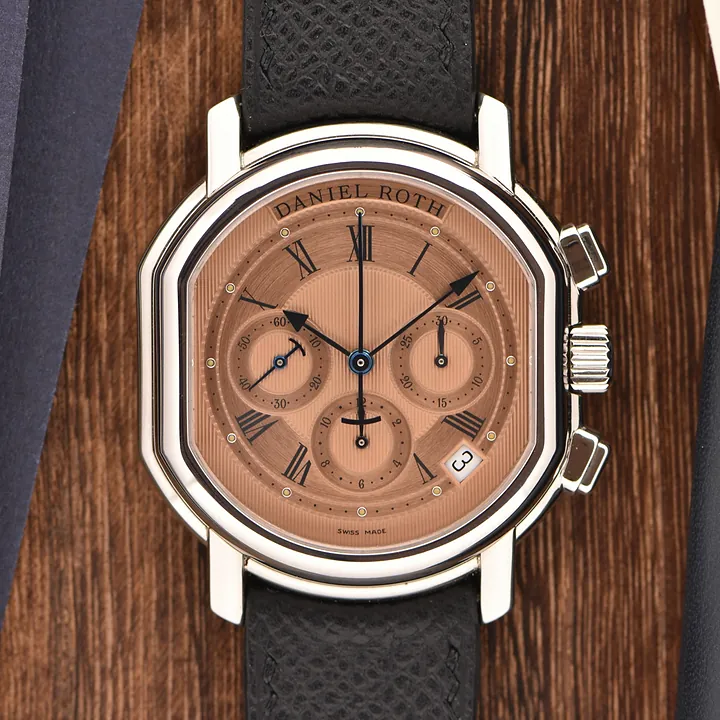
Daniel Roth Masters Chronograph Salmon, 2001
Huntington Company (dealer)
Wristwatches · 1990s
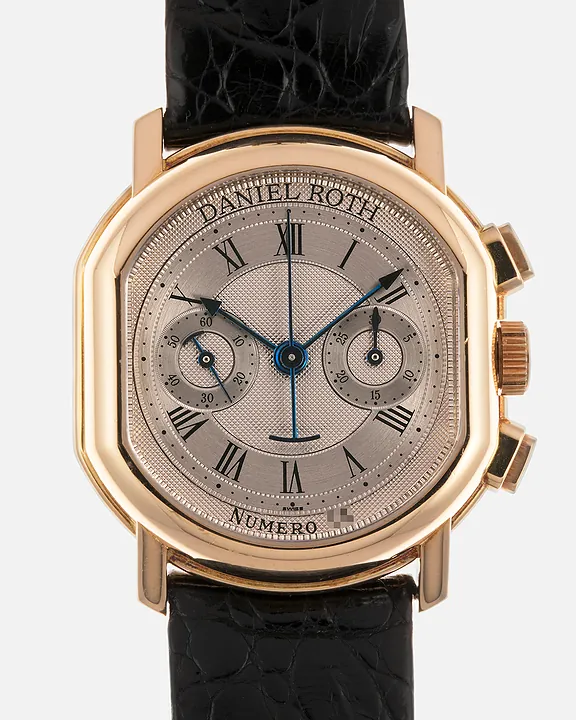
Daniel Roth Chronograph Lemania 2147 Clous De Paris, 1990s
S.Song Watches (dealer), Seattle
Wristwatches · 1990s
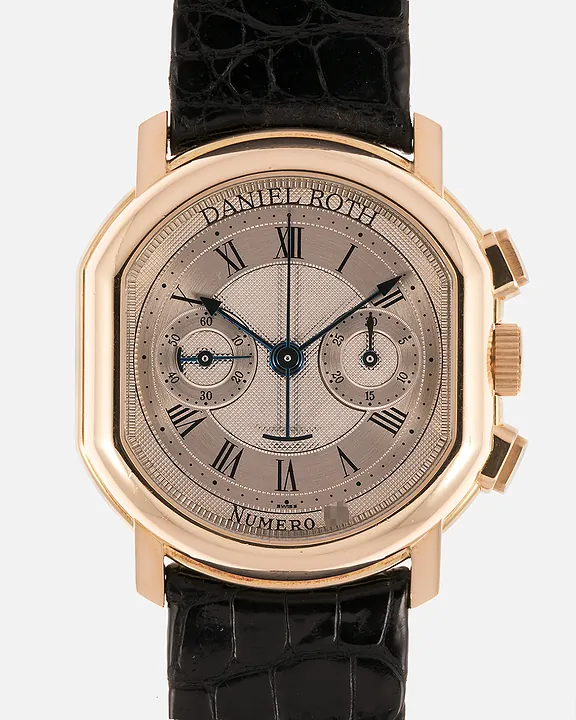
Daniel Roth Chronograph Lemania 2147 Clous De Paris, 1990s
S.Song Watches (dealer), Seattle
Wristwatches · 2025
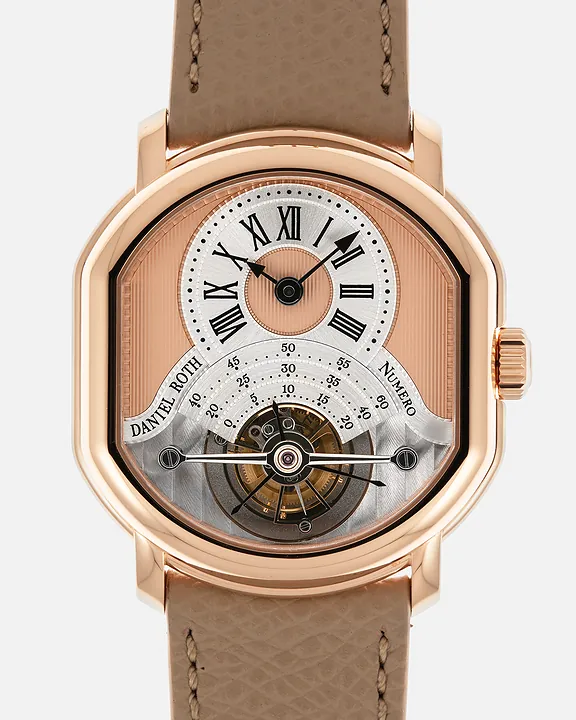
Daniel Roth Tourbillon Rose Gold DR 001, 2025
S.Song Watches (dealer), Seattle

Wristwatches · 2008
Wristwatch by Breitling?, 2008
Museum Rotterdam

Wristwatches · c. 1990s
Audemars Piguet Bamboo, c. 1990s
Antiquorum auction archive, Geneva

Wristwatches · c. 1990
Audemars Piguet Huitieme Perpetual Calendar, ref. 25696PT, c. 1990
Antiquorum auction archive, Geneva

Wristwatches · c. 1990
Breitling Chronomat, ref. b13050.1, c. 1990
Antiquorum auction archive, Geneva