
Wristwatches · Wristwatch
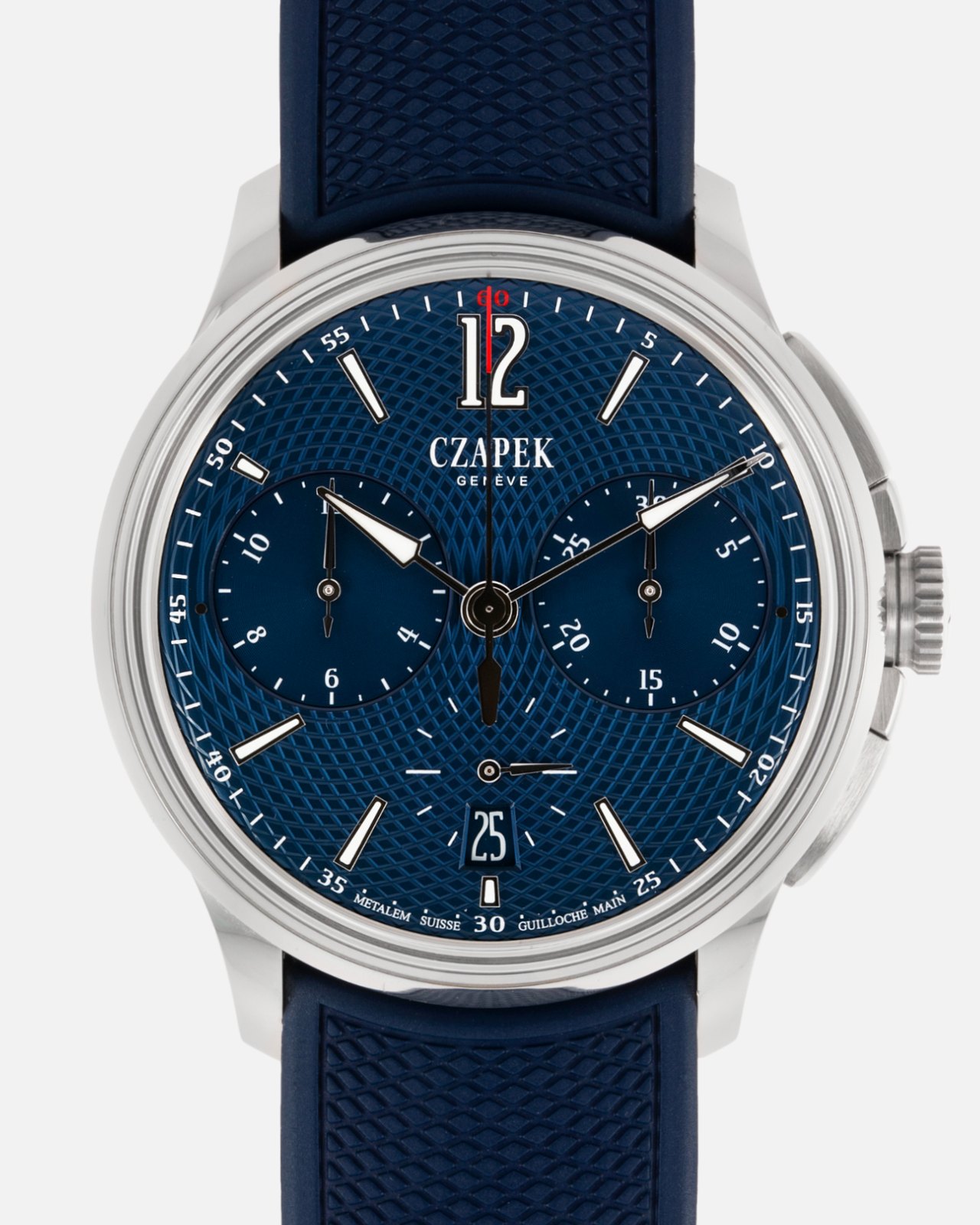
Czapek Faubourg de Cracovie L'Heure Bleu Chronograph, 2018
- Maker / attribution
- Czapek (maker)
- Date
- 2018
- Historical period
- Contemporary Horology (2010 – Present)
- Country of origin
- Switzerland
- Object type
- Wristwatch
- Dimensions
- Case 41.5 mm
- Stock no.
- Product 6743731830871
- Credit line
- Dealer listing, S.Song Watches (product 6743731830871)
- Catalogue title (original)
- Czapek Faubourg de Cracovie L'Heure Bleu Chronograph (English)
View the source record (dealer listing) ↗ (opens another website in a new tab)Suggest a correction
Record summary
Catalogued by S.Song Watches (dealer), Seattle (stock number Product 6743731830871), this is a wristwatch by Czapek, made in Switzerland, dated 2018. The Atlas places it in the Contemporary Horology period (2010 – Present) of its Wristwatches collection. Recorded dimensions: Case 41.5 mm. The record is illustrated with 6 photographs.
Assembled from the source record's structured fields. Dates and attributions are given as the source states them; where a field is missing the Atlas leaves it blank rather than estimating.
Catalogue description
Dealer description — S.Song Watches
Amongst the plethora of iconic brands within the watchmaking industry, few have the ability to create timepieces that evoke pure unadulterated emotion equal to that of Czapek. Founded in 1845 by one of Patek Philippe's original founders, Czapek's long heritage as a watchmaker for nobility and royals has ingrained a longstanding tradition within the brand to create some of the finest watches on the market, a tradition that still rings true to this day. Case in point is the Chronograph Faubourg de Cracovie L'Heure Bleu that I have here. Named after the brand's third boutique, which was opened in 1850 in Warsaw, Poland, the Faubourg de Cracovie collection symbolises a significant milestone in the brand's history. Launched in 2018 and even going on to win the Salon Exceptional Watches' 'Watch of the year' award in 2018, the Chronograph Faubourg de Cracovie L'Heure Bleu encompasses the very essence of Czapek's watchmaking heritage. Featuring an entirely polished 41.5mm stainless steel case, the Chronograph Faubourg de Cracovie L'Heure Bleu sports a deeply inset mid-case with a sandblasted finish that beautifully contrasts the polished steel that surrounds it. Within its stainless steel case, the Chronograph Faubourg de Cracovie L'Heure Bleu is powered by the Czapek’s COSC-certified automatic cal. SXH3. On view through an exhibition caseback, the cal. SXH3 is a high frequency (36,000vph/5Hz) column-wheel chronograph movement with a vertical clutch and a rather impressive 65 hours of power reserve. Finished to Czapek's infamously rigorous standards, the cal. SXH3 uses diamond-blasted anthracite bridges to provide a stunning backdrop for its 18kt gold winding rotor. In addition to its stunning movement, the Chronograph Faubourg de Cracovie L'Heure Bleu also features a beautiful dial, as its name so eloquently references. Reintroducing the fascinating handmade guilloché of the Quai des Bergues collection, the Chronograph Faubourg de Cracovie L'Heure Bleu sports a new design named “Résonance”. Using intersecting circular lines cut from a rose engine lathe, its dial features a pattern of bas-relief squares that turn into diamonds throughout the dial – a design that can trace its origins to François Czapek himself. Using rhodium-plated hour markers and hands, the Chronograph Faubourg de Cracovie L'Heure Bleu's stunning blue dial radiates a clean look that is simply breathtaking. Made in a limited series of 18 pieces, this is quite the rare piece.
Historical context
Contemporary Horology (2010 – Present)
Silicon components, connected watches, optical-lattice research clocks and a thriving independent scene.
Smartwatches became the world's best-selling watches, while mechanical watchmaking focuses on craft, innovation (silicon components, new escapements) and independent makers.
Read the period in the timelineMore wristwatches from this periodEarlier: Mechanical Renaissance
Atlas type guide
Chronographs and split-seconds watches
A chronograph is a watch with an additional seconds hand that can be started, stopped and returned to zero independently of the timekeeping. Louis Moinet built an early example in 1816 and Nicolas Rieussec a recording 'chronographe' in 1821; Adolphe Nicole's heart-shaped reset cam (patented 1862) made the modern return-to-zero possible. Split-seconds (rattrapante) chronographs add a second hand that can be stopped for intermediate times; flyback chronographs restart instantly.
Chronographs were essential tools for doctors (pulsometer scales), artillery (telemeter), engineers and sport. In wristwatches, Valjoux, Venus, Lemania and later the automatic chronographs of 1969 (Zenith El Primero, the Chronomatic Calibre 11 group and Seiko 6139) are milestones.
What to look for
- Push-pieces on the case band or a single button in the crown (monopusher).
- Subsidiary registers for minutes and hours; tachymeter, telemeter or pulsometer scales.
- Column wheel versus cam control visible in the movement.
- Calibre markings of specialist makers (Valjoux, Lemania, Venus, Landeron).
Dating clues
- Pocket chronographs with heart cam reset: after 1862.
- Wrist chronographs: from c. 1910; two-button designs from the 1930s.
- Automatic chronographs: from 1969.
General guidance written by the Atlas editors about this kind of object. It is not a statement about this particular piece; for that, rely on the source record above and on physical examination.
Read next:Flyback chronographChronograph
Related records
Wristwatches · 2022
Czapek & Cie Antarctique White Dial Monochrome Edition, 2022
Bulang & Sons (dealer), Copenhagen
Wristwatches · 2025
Czapek Antarctique Passage de Drake Sahara Night, 2025
Huntington Company (dealer)
Wristwatches · 2023
Czapek Antarctique P.04 Lanikai x Collective Horology, 2023
S.Song Watches (dealer), Seattle
Wristwatches · 2021
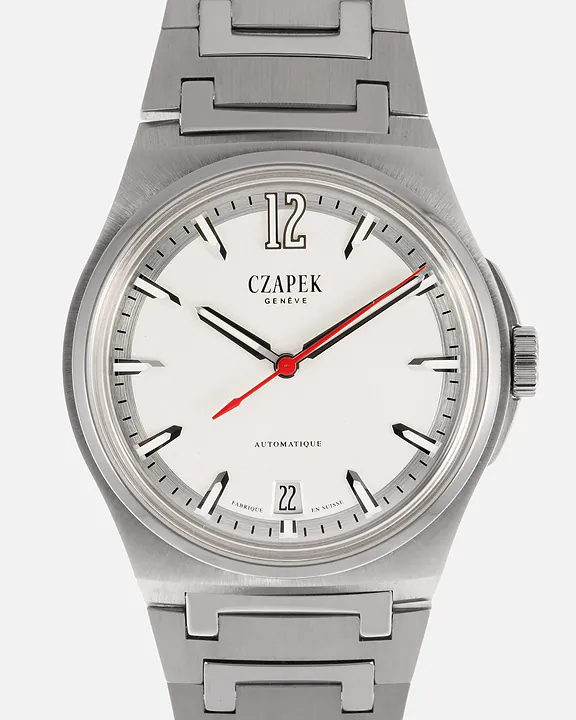
Czapek Antarctique Monochrome Montre De Souscription 2, 2021
S.Song Watches (dealer), Seattle

Wristwatches · c. 2010s
Breguet Type XXI, ref. 3810, c. 2010s (Antiquorum Lot 381-24)
Antiquorum auction archive, Geneva

Wristwatches · c. 2010s
Breguet Type XXI, ref. 3810, c. 2010s (Antiquorum Lot 386-229)
Antiquorum auction archive, Geneva

Wristwatches · Sold in September 2010
Breitling Cosmonaute, ref. A 22322, Sold in September 2010
Antiquorum auction archive, Geneva

Wristwatches · c. 2010
Corum Bubble Chrono, ref. 396.150.20, c. 2010
Antiquorum auction archive, Geneva