
Wristwatches · Wristwatch
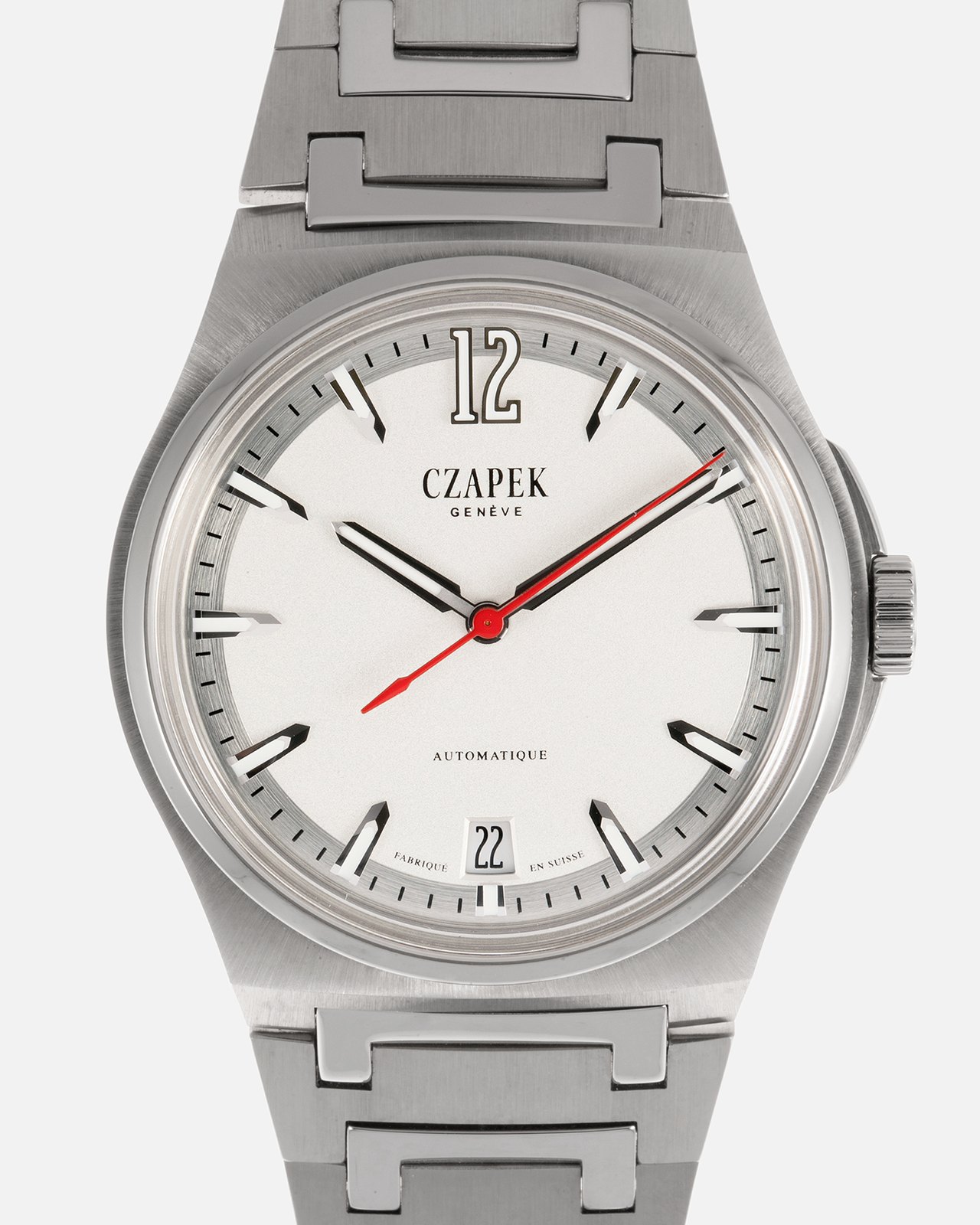
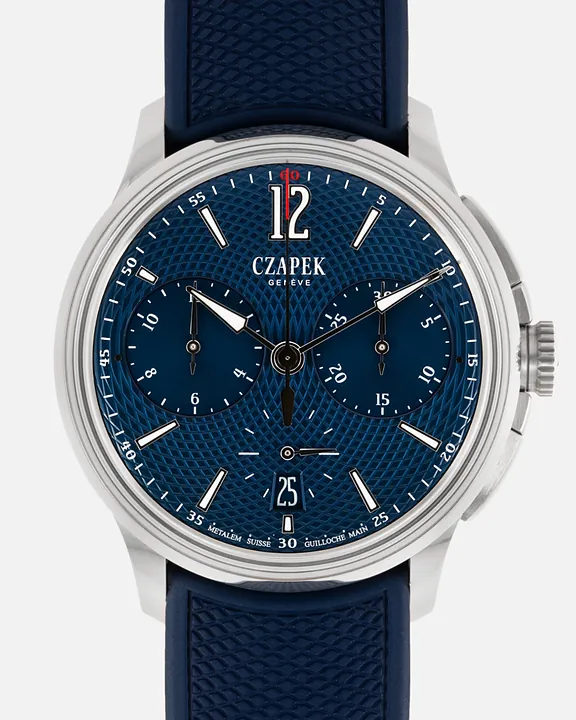
Czapek Antarctique Monochrome Montre De Souscription 2, 2021
- Maker / attribution
- Czapek (maker)
- Date
- 2021
- Historical period
- Contemporary Horology (2010 – Present)
- Country of origin
- Switzerland
- Object type
- Wristwatch
- Dimensions
- Case 40.5 mm
- Stock no.
- Product 6875177025623
- Credit line
- Dealer listing, S.Song Watches (product 6875177025623)
- Catalogue title (original)
- Czapek Antarctique Monochrome Montre De Souscription 2 (English)
View the source record (dealer listing) ↗ (opens another website in a new tab)Suggest a correction
Record summary
Catalogued by S.Song Watches (dealer), Seattle (stock number Product 6875177025623), this is a wristwatch by Czapek, made in Switzerland, dated 2021. The Atlas places it in the Contemporary Horology period (2010 – Present) of its Wristwatches collection. Recorded dimensions: Case 40.5 mm. The record is illustrated with 6 photographs.
Assembled from the source record's structured fields. Dates and attributions are given as the source states them; where a field is missing the Atlas leaves it blank rather than estimating.
Catalogue description
Dealer description — S.Song Watches
Amongst the plethora of iconic brands within the watchmaking industry, few have the ability to create timepieces that evoke pure unadulterated emotion equal to that of Czapek. Founded in 1845 by one of Patek Philippe's original founders, Czapek's long heritage as a watchmaker for nobility and royals has ingrained a longstanding tradition within the brand to create some of the finest watches on the market. As someone who has an interest in and has handled high-end timepieces from many independent brands, Czapek has always been somewhat of an exotic outlier for me. It doesn’t possess the allure of mega-popular independent brands like MB&F or Urwerk, or more classical Maisons like H. Moser & Cie, but ever since its revival in 2015, Czapek has managed to carve out their very own unique style, one that they can proudly call their own. Czapek designs have a particular and specific quality to them that I find quite difficult to explain in words, they can only be felt. Over the years, I have come to appreciate timepieces that possess a certain quality that is more than meets the eye, especially timepieces with a certain “sleeper” kind of appeal, if you will. What we have here today is one such timepiece that I personally find quite interesting, this is the Czapek Antarctique “Monochrome White” Limited Edition of 33 pieces in collaboration with world-renowned online watch publication Monochrome Watches from the Netherlands. Based on the design formula of Czapek’s Antarctique collection, the Antarctique “Monochrome White” may seem plain in comparison due to the choice of the dial color, especially since it is a sports watch at its very core, but I think that is precisely what makes this limited edition special. The overall design doesn’t attract much attention unless people know what it is or how rare it actually is. The appearance of the grained, silvery, two-tone dial has a very pure quality to it, which greatly contributes to legibility and clarity. Also, look closer and you will quickly realize that this particular model comes fitted with a customized seconds-hand in full red, as opposed to the standard variant with only a red tip. A custom detail within an already rare limited edition, how cool is that? The Antarctique Monochrome White exudes a delicate sense of preciousness, whilst still maintaining an appearance that is quite appropriate for everyday wear. Measuring a modest 40.5mm x 10.6mm in dimensions, the Antarctique Monochrome White is quite the elegant contemporary sports watch, and thin enough to slip comfortably under a shirt cuff. The integrated bracelet on the Antarctique Monochrome White is extremely well-made and meticulously finished with contrasting surface finishing techniques. It also features an “on-the-fly” micro-adjustment mechanism that is seamlessly incorporated at the clasp section with a spring-loaded mechanism that allows for ease of adjustment. Absolutely brilliant. When you turn the Antarctique Monochrome White over, you will be greeted by, what I think is the star of the show – the absolutely gorgeous in-house Cal. SXH5 movement in all of its glory. Featuring a distinctive architecture with impeccable finishing and decoration and topped off with a platinum micro-rotor and seven bridges, the Cal. SXH5 is also the very first movement developed and produced in-house by Czapek. It operates at 28,800 vph and holds an impressive power reserve of 60 hours. As an overall package, the Antarctique Monochrome White Limited Edition is as good as it gets. I love how discreet it is on the wrist. It flies right under the radar and doesn’t scream in your face. To me, the ultimate form of luxury is a discreet one, the world doesn’t have to know, but if they know, they know. That’s just the way I like it, but I digress.
Historical context
Contemporary Horology (2010 – Present)
Silicon components, connected watches, optical-lattice research clocks and a thriving independent scene.
Smartwatches became the world's best-selling watches, while mechanical watchmaking focuses on craft, innovation (silicon components, new escapements) and independent makers.
Read the period in the timelineMore wristwatches from this periodEarlier: Mechanical Renaissance
Atlas type guide
Wristwatches
Bracelet watches were worn by women from the early nineteenth century — Breguet made one for Caroline Murat, Queen of Naples, in 1810–12 — but the wristwatch only became a man's instrument with military use and aviation in the early twentieth century. Between the World Wars it overtook the pocket watch; the 1920s and 1930s brought rectangular Art Deco cases, water-resistant cases and the first automatic winding systems.
After 1945 the wristwatch became a carrier of identity — dress watches, sports and dive watches, chronographs, calendars — produced by Swiss, American, Japanese, German, Soviet and Chinese industries. The quartz revolution after 1969 and the mechanical renaissance since the 1990s, including the rise of independent watchmakers, complete the story.
What to look for
- The reference number (between the lugs or inside the case back) and serial number, the starting point for dating.
- The calibre: its maker and number are often stamped under the dial or on the bridge.
- Originality of dial, hands and crown — refinished ('redial') dials are common.
- Case material marks: 18K/750, 14K/585, stainless steel, gold-filled, plated.
Dating clues
- Wire-lug cases: before c. 1925.
- Water-resistant screw-down cases: from 1926.
- Quartz movements: from 1969; sapphire crystals widespread after c. 1980.
General guidance written by the Atlas editors about this kind of object. It is not a statement about this particular piece; for that, rely on the source record above and on physical examination.
Related records
Wristwatches · 2022
Czapek & Cie Antarctique White Dial Monochrome Edition, 2022
Bulang & Sons (dealer), Copenhagen
Wristwatches · 2025
Czapek Antarctique Passage de Drake Sahara Night, 2025
Huntington Company (dealer)
Wristwatches · 2023
Czapek Antarctique P.04 Lanikai x Collective Horology, 2023
S.Song Watches (dealer), Seattle
Wristwatches · 2018
Czapek Faubourg de Cracovie L'Heure Bleu Chronograph, 2018
S.Song Watches (dealer), Seattle

Wristwatches · c. 2010s
Breguet Type XXI, ref. 3810, c. 2010s (Antiquorum Lot 381-24)
Antiquorum auction archive, Geneva

Wristwatches · c. 2010s
Breguet Type XXI, ref. 3810, c. 2010s (Antiquorum Lot 386-229)
Antiquorum auction archive, Geneva

Wristwatches · Sold in September 2010
Breitling Cosmonaute, ref. A 22322, Sold in September 2010
Antiquorum auction archive, Geneva

Wristwatches · c. 2010
Corum Bubble Chrono, ref. 396.150.20, c. 2010
Antiquorum auction archive, Geneva