
Wristwatches · Wristwatch
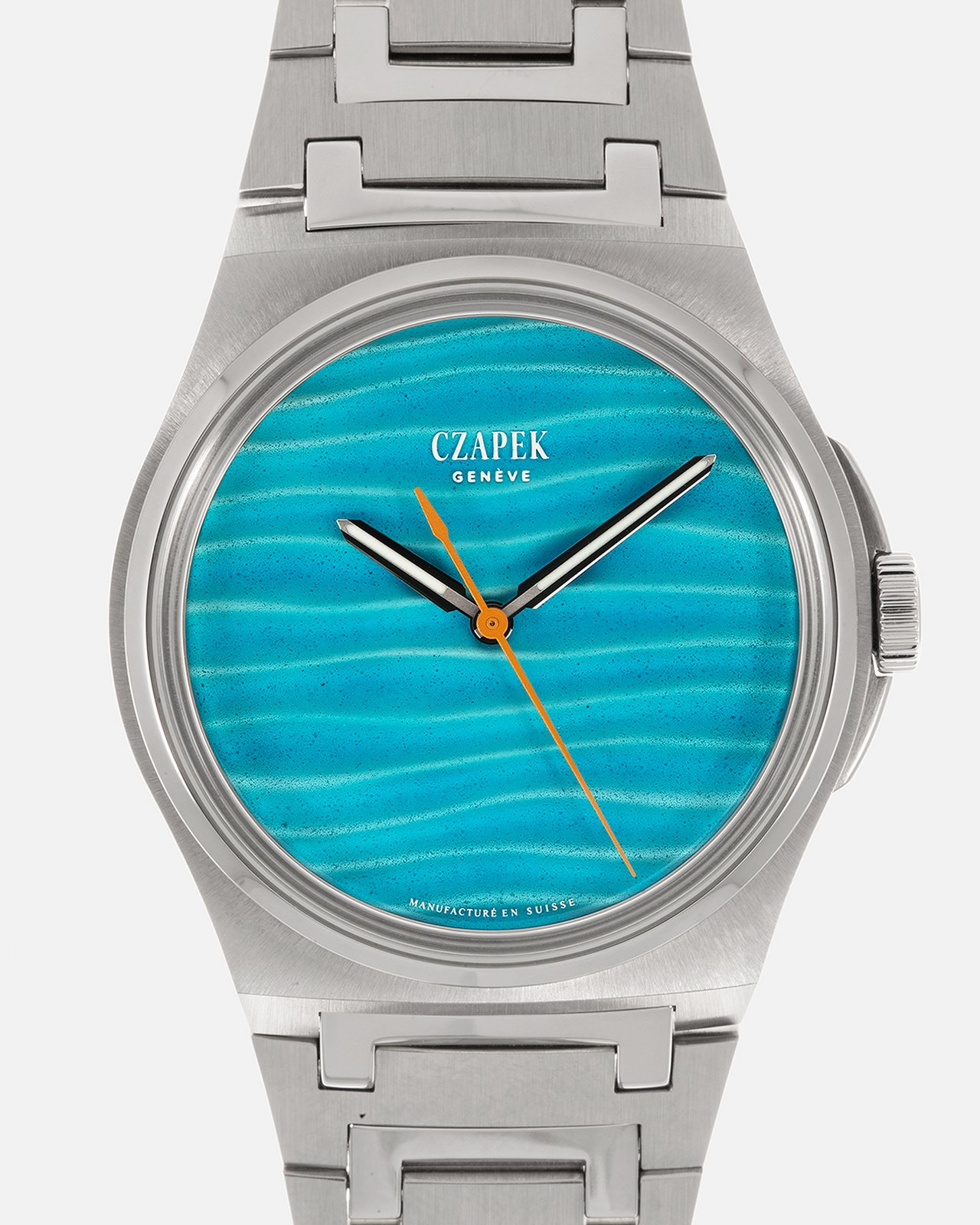
Czapek Antarctique P.04 Lanikai x Collective Horology, 2023
- Maker / attribution
- Czapek (maker)
- Date
- 2023
- Historical period
- Contemporary Horology (2010 – Present)
- Country of origin
- Switzerland
- Object type
- Wristwatch
- Dimensions
- Case 40.5 mm
- Stock no.
- Product 7208878866519
- Credit line
- Dealer listing, S.Song Watches (product 7208878866519)
- Catalogue title (original)
- Czapek Antarctique P.04 Lanikai x Collective Horology (English)
View the source record (dealer listing) ↗ (opens another website in a new tab)Suggest a correction
Record summary
Catalogued by S.Song Watches (dealer), Seattle (stock number Product 7208878866519), this is a wristwatch by Czapek, made in Switzerland, dated 2023. The Atlas places it in the Contemporary Horology period (2010 – Present) of its Wristwatches collection. Recorded dimensions: Case 40.5 mm. The record is illustrated with 6 photographs.
Assembled from the source record's structured fields. Dates and attributions are given as the source states them; where a field is missing the Atlas leaves it blank rather than estimating.
Catalogue description
Dealer description — S.Song Watches
Amongst the plethora of iconic brands within the watchmaking industry, few possess the ability to create timepieces that evoke pure unadulterated emotion equal to that of Czapek. Founded in 1845 by one of Patek Philippe's founders (François Czapek), Czapek's long heritage as a watchmaker for nobility and royals has ingrained a longstanding tradition within the brand to create some of the finest watches on the market. As someone who has an interest in and has handled high-end timepieces from many independent brands, Czapek has always been somewhat of an exotic outlier for me. It doesn’t possess the allure of mega-popular independent brands like MB&F or Urwerk, or more classical Maisons like H. Moser & Cie, but ever since its revival in 2015, Czapek has managed to carve out its very own unique style, one that they can proudly call their own. Czapek designs have a particular quality to them that I find quite difficult to explain in words, they can only be felt. I've always been drawn to timepieces with an understated charm, something that transcends mere aesthetics, akin to a "sleeper" type of quality, if you will. Nevertheless, there are instances where I make exceptions to this preference. I'm also drawn to unique features like stone or grand feu enamel dials, or unconventional design elements that you typically don’t see. What we have here today is a watch that falls into this specific category of exceptions and one that I find particularly interesting: the Czapek Antarctique Lanikai P.04, a limited edition of 50 pieces made in collaboration with Collective Horology, a prominent California-based enthusiast platform that creates some of the most interesting collaborations to date, as well as an authorized retailer that carries some of the most exclusive independent brands the horological world has to offer. Based on the design formula of Czapek’s Antarctique collection, the dial of the Antarctique P.04 Lanikai was crafted with a specific vision in mind. The goal was to capture the distinct aquamarine tones and sandy textures found in the waters encircling Lanikai Beach in Hawaii. This endeavor was particularly inspired by Gabe Reily, one of the co-founders of Collective Horology, who had studied at the University of Hawaii and sought to recreate that captivating visual experience. To achieve this, the dial blank undergoes a meticulous transformation process to achieve its unique aesthetic. Firstly, it is shaped into a concave form to create varying depths across its surface. Then, a wave texture is carefully stamped onto it using a hand-engraved mold, which seeks to replicate the natural irregularities of the seabed. Working with experts from Donzé Cadrans (a famous enamel dial manufacturer based in Le Locle), a specially sourced turquoise-colored enamel is then carefully applied onto the dial, followed by several rounds of firing in the kiln. This intricate process results in an artistic portrayal of a mesmerizing scene with light and shadows dancing amongst the pearly and wave-like textures, complemented by an aptly contrasting sand-colored seconds hand. I particularly appreciate the fact that there is no date window nor any applied indices, which allows the serene scenery of the dial to take center stage. Completing this, the dial also hosts a set of luminous sword-shaped hands to ensure legibility even in low light conditions. Despite its playful dial visuals, the P.04 Lanikai still retains a delicate sense of preciousness, whilst still maintaining an overall appearance that is quite appropriate for everyday wear. Measuring a modest 40.5mm x 10.6mm in case dimensions, the P.04 Lanikai is actually quite an elegant contemporary sports watch, and thin enough to slip comfortably under a shirt cuff. Like many of its Antarctique counterparts, the integrated bracelet on the P.04 Lanikai is extremely well-made and meticulously finished with contrasting surface finishing techniques. It also features an “on-the-fly” micro-adjustment mechanism that is seamlessly incorporated at the clasp section with a spring-loaded mechanism that allows for ease of adjustment. Absolutely brilliant. When you turn the watch over on its caseback, you will be greeted by the gorgeous in-house Cal. SXH5 movement in all of its glory. Featuring a distinctive architecture with impeccable finishing and decoration and topped off with a platinum micro-rotor and seven bridges, the Cal. SXH5 is also the very first movement developed and produced in-house by Czapek. It operates at 28,800 vph and holds an impressive power reserve of 60 hours when fully wound. As an overall package, the Antarctique P.04 Lanikai Limited Edition is a unique and visually evocative watch. Its understated case profile on the wrist is complemented by a dial that makes me feel like I am carrying a piece of the beach with me whenever I wear it. If I was its owner, I could picture wearing this watch as I eagerly count down the days to my next beach holiday. I’m sure you’d do the same, right?
Historical context
Contemporary Horology (2010 – Present)
Silicon components, connected watches, optical-lattice research clocks and a thriving independent scene.
Smartwatches became the world's best-selling watches, while mechanical watchmaking focuses on craft, innovation (silicon components, new escapements) and independent makers.
Read the period in the timelineMore wristwatches from this periodEarlier: Mechanical Renaissance
Atlas type guide
Wristwatches
Bracelet watches were worn by women from the early nineteenth century — Breguet made one for Caroline Murat, Queen of Naples, in 1810–12 — but the wristwatch only became a man's instrument with military use and aviation in the early twentieth century. Between the World Wars it overtook the pocket watch; the 1920s and 1930s brought rectangular Art Deco cases, water-resistant cases and the first automatic winding systems.
After 1945 the wristwatch became a carrier of identity — dress watches, sports and dive watches, chronographs, calendars — produced by Swiss, American, Japanese, German, Soviet and Chinese industries. The quartz revolution after 1969 and the mechanical renaissance since the 1990s, including the rise of independent watchmakers, complete the story.
What to look for
- The reference number (between the lugs or inside the case back) and serial number, the starting point for dating.
- The calibre: its maker and number are often stamped under the dial or on the bridge.
- Originality of dial, hands and crown — refinished ('redial') dials are common.
- Case material marks: 18K/750, 14K/585, stainless steel, gold-filled, plated.
Dating clues
- Wire-lug cases: before c. 1925.
- Water-resistant screw-down cases: from 1926.
- Quartz movements: from 1969; sapphire crystals widespread after c. 1980.
General guidance written by the Atlas editors about this kind of object. It is not a statement about this particular piece; for that, rely on the source record above and on physical examination.
Related records
Wristwatches · 2022
Czapek & Cie Antarctique White Dial Monochrome Edition, 2022
Bulang & Sons (dealer), Copenhagen
Wristwatches · 2025
Czapek Antarctique Passage de Drake Sahara Night, 2025
Huntington Company (dealer)
Wristwatches · 2021
Czapek Antarctique Monochrome Montre De Souscription 2, 2021
S.Song Watches (dealer), Seattle
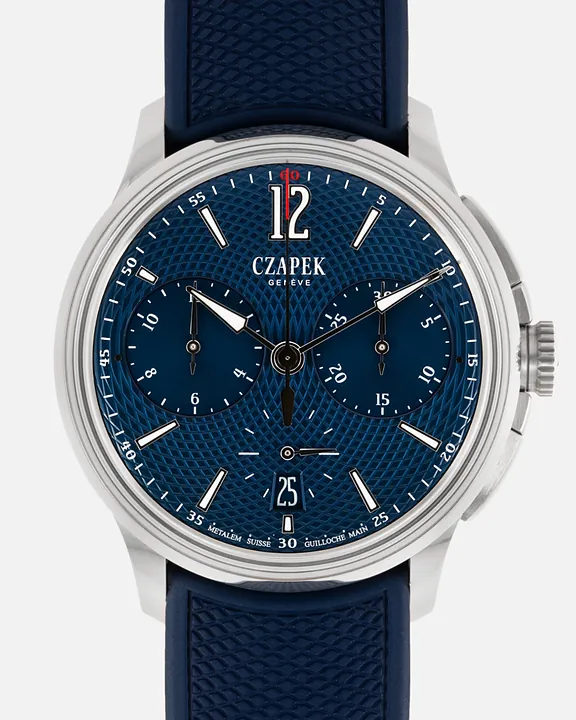
Wristwatches · 2018
Czapek Faubourg de Cracovie L'Heure Bleu Chronograph, 2018
S.Song Watches (dealer), Seattle

Wristwatches · c. 2010s
Breguet Type XXI, ref. 3810, c. 2010s (Antiquorum Lot 381-24)
Antiquorum auction archive, Geneva

Wristwatches · c. 2010s
Breguet Type XXI, ref. 3810, c. 2010s (Antiquorum Lot 386-229)
Antiquorum auction archive, Geneva

Wristwatches · Sold in September 2010
Breitling Cosmonaute, ref. A 22322, Sold in September 2010
Antiquorum auction archive, Geneva

Wristwatches · c. 2010
Corum Bubble Chrono, ref. 396.150.20, c. 2010
Antiquorum auction archive, Geneva