
Clocks · Clock
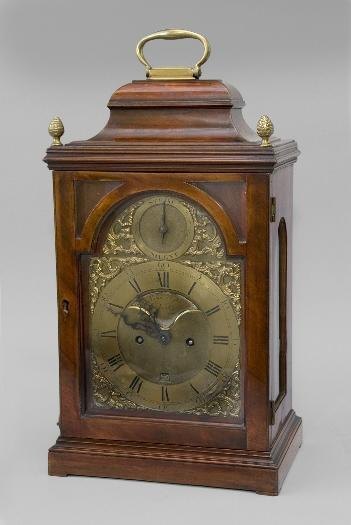
Clock by Ralph Gout, 1766–1800
- Maker / attribution
- Ralph Gout (Maker)
- Date
- 1766–1800
- Historical period
- Precision & Scientific Horology (1750 – 1850)
- Country of origin
- England
- Place
- Londres
- Object type
- Clock
- Materials / technique
- Bronce Vidrio Madera de palma de caoba (2) Esmalte Tripa Latón Acero Barniz
- Dimensions
- Altura = 52 cm Anchura = 26 cm Profundidad = 17,30 cmEsfera de reloj: Diámetro = 16,80 cm
- Holding institution
- National Museum of Decorative Arts
- Accession / object no.
- pages_Main_idt_5575_inventary_CE05566_table_FMUS_museum_MNAD
- Credit line
- National Museum of Decorative Arts
- Catalogue title (original)
- Reloj de sobremesa (Spanish)
View the source record ↗ (opens another website in a new tab)Suggest a correction
Record summary
Held and catalogued by National Museum of Decorative Arts (object number pages_Main_idt_5575_inventary_CE05566_table_FMUS_museum_MNAD), this is a clock by Ralph Gout, made in Londres, England, dated 1766–1800. The Atlas places it in the Precision & Scientific Horology period (1750 – 1850) of its Clocks collection. Materials and techniques recorded by the source: Bronce Vidrio Madera de palma de caoba (2) Esmalte Tripa Latón Acero Barniz. Recorded dimensions: Altura = 52 cm Anchura = 26 cm Profundidad = 17,30 cmEsfera de reloj: Diámetro = 16,80 cm. The record is illustrated with 1 photograph.
Assembled from the source record's structured fields. Dates and attributions are given as the source states them; where a field is missing the Atlas leaves it blank rather than estimating.
Catalogue description
Catalogue description from National Museum of Decorative Arts
Reloj de sobremesa de tipo bracket inglés con calendario mensual, sonería y cuerda. Posee una caja prismática rectangular, con forma de templete, de madera de caoba barnizada. Se sostiene a través de cuatro pies rectangulares de madera en cada uno de sus extremos sobre el que aparece un zócalo, también en madera, con diferentes alturas. La parte delantera está conformada por un vano rectangular de vidrio con un arco de medio punto en su zona superior, enmarcado en un bisel de madera barnizada. En las dos enjutas que deja el arco de medio punto a sus laterales se han añadido dos vidrios. Tiene el cierre mediante llave a la izquierda, dejando las dos bisagras a la derecha, sin embargo, se ha perdido dicho cierre en este caso. Su reverso tiene las mismas características, aunque la madera no está barnizada. Además, tiene otro pestillo en el lateral izquierdo de la pieza, a través del que se evita la apertura del vano -seguramente este cierre sea posterior-. La esfera es de bronce dorado con números arábigos grabados y pintados en negro para los minutos -que van del 5 al 60 en un intervalo de cada cinco-, junto a pequeñas rayas para el resto de números. Tras ello, se circunscribe otra esfera compuesta por números con las mismas características, pero esta vez romanos, para indicar las horas. Cuenta con dos bocallaves para los diferentes trenes -que se dan cuerda a través de una llave de tipo manivela-, un orificio sobre las VI a través del que se indica el calendario mensual y posee dos agujas de acero de tipo Luis XVI. En la zona superior, donde se encuentra el arco de medio punto, se ubica una esfera auxiliar lisa de bronce dorado, que sirve como silenciador para que haya sonería o no -arriba y abajo respectivamente-. Alrededor de ambas esferas, se ha dispuesto una decoración profusamente cincelada con motivos vegetales. Los laterales también poseen madera barnizada y presentan un vano de vidrio. Su parte trasera está conformada por otro vano de vidrio con marco de madera, cierre en su parte izquierda y dos bisagras en su derecha. Luego, se descubre la maquinaria, protegida por una platina de bronce dorado y con grabados de motivos florales y vegetales sobre su superficie. Está compuesto por escape de borde, péndulo corto en forma de pera, campana y mazo. En el interior de la maquinaria, se encuentra el sistema fusé, compuesto por cadenas, piñones y ruedas. La caja del reloj está finalizada por un remate en su parte superior, compuesto por un cuerpo central a modo de templete y entablamentos. Se corona el conjunto con una moldura de bronce en forma de asa y también hay molduras en forma de piña en los laterales, aunque solo se conservan las dos delanteras.
Shown in the original language of the source catalogue. An editor-reviewed English translation has not yet been published; we do not publish machine translations as authoritative text.
Historical context
Precision & Scientific Horology (1750 – 1850)
Harrison solves longitude; Mudge invents the lever; Breguet's Paris workshop defines the modern watch.
The age of the deadbeat escapement, compensated pendulums and observatory regulators. Domestic clocks spread through the middle classes: English longcase and bracket clocks, French gilt-bronze mantel clocks, Viennese Biedermeier wall clocks, Black Forest painted-shield clocks, and the first American shelf clocks.
Read the period in the timelineMore clocks from this periodEarlier: Early Modern Horology
Atlas type guide
Domestic clocks
A clock combines four systems: a source of power (falling weight, coiled spring, or later electricity), a gear train that divides time, an escapement and oscillator that regulate it (foliot, pendulum or balance), and an indicating system of dial and hands or a bell. Its history runs from the large iron weight-driven clocks of the late thirteenth century to Renaissance spring-driven table clocks, the pendulum revolution of 1656, the factory clocks of the nineteenth century and electric and quartz clocks of the twentieth.
Domestic clocks also reflect regional furniture and decorative traditions — English longcase and bracket clocks, French pendules, Viennese regulators, Black Forest and American shelf clocks — and therefore record changing tastes as much as technical progress.
What to look for
- How the clock is powered: weights, spring barrel, fusee, electric coil.
- The oscillator: foliot, short pendulum, long seconds pendulum or balance.
- Whether it strikes: hour only (count wheel) or hours and quarters (rack striking).
- The maker or retailer's name on dial and movement, and any factory trademarks.
- Signs of alteration — replaced dials, converted escapements, 'married' cases.
Dating clues
- Before 1656 clocks used foliots or balances; after, most domestic clocks have pendulums.
- Anchor escapements spread after c. 1670; minute hands became common at the same time.
- Factory production in America and Germany transformed prices after c. 1840.
General guidance written by the Atlas editors about this kind of object. It is not a statement about this particular piece; for that, rely on the source record above and on physical examination.
Related records
Pocket Watches · c. 1800
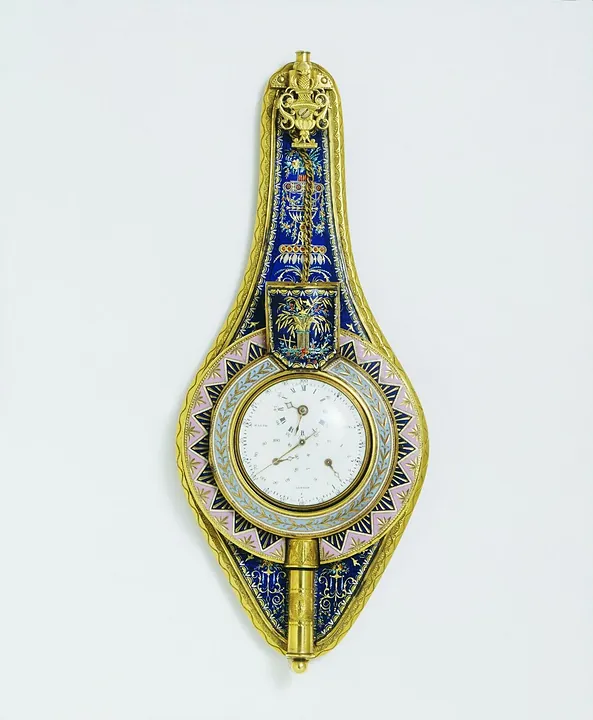
Saddle watch and pedometer, base metal, mechanism made by Ralph Gout in London, c. 1800
Victoria and Albert Museum, London
Pocket Watches · 19th century
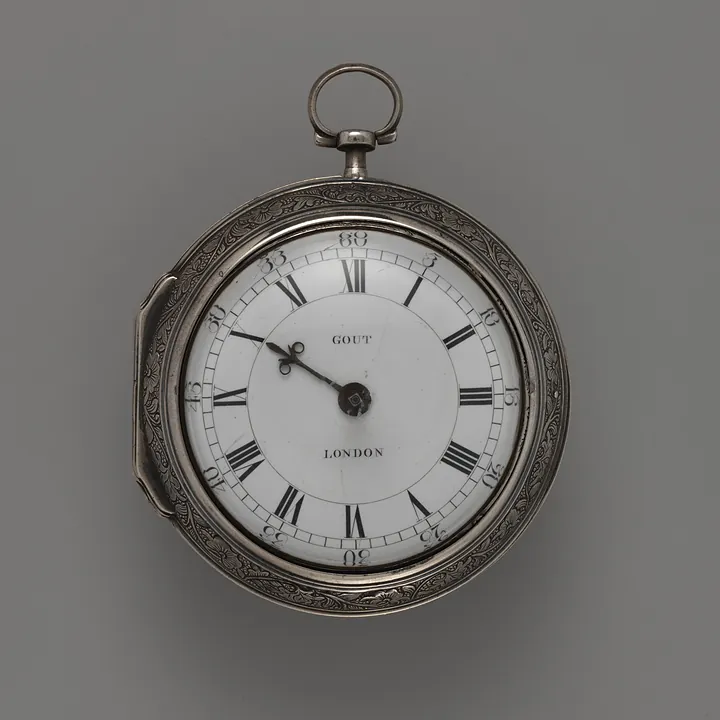
Watch by Ralph Gout, England, 19th century
The Metropolitan Museum of Art, New York
Pocket Watches · 1837 (hallmarked London)
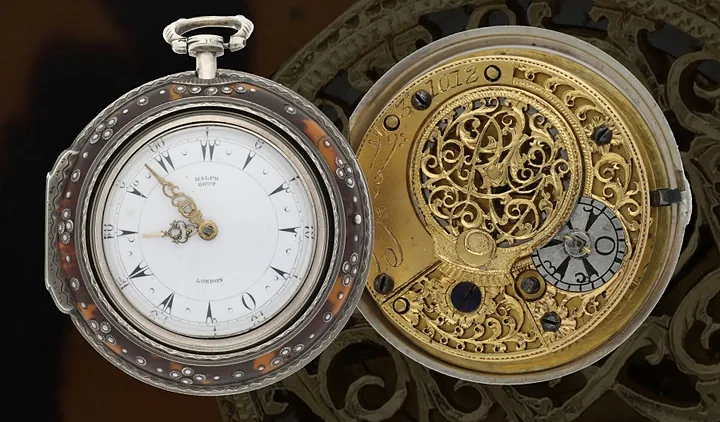
Early 19th century silver and tortoiseshell triple cased verge pocket watch by Ralph Gout, London, hallmarked London 1837
Gardiner Houlgate (auction house), Corsham
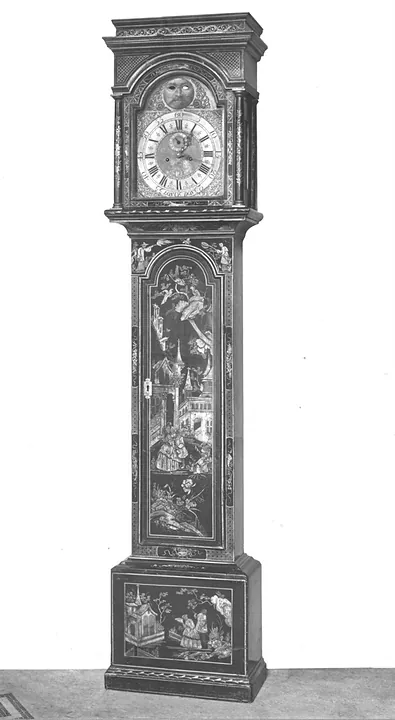
Clocks · 1740–1760
Longcase clock, English, 1740–1760, japanned wood, John Ellicott
Victoria and Albert Museum, London
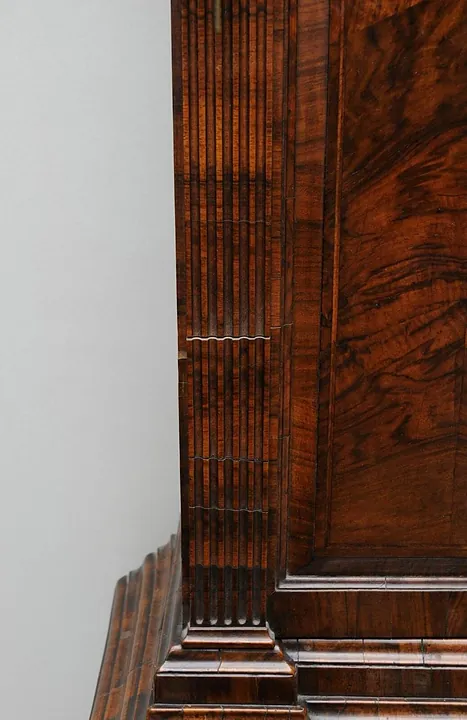
Clocks · c.1750
Long-case clock, English, ca. 1750, by Richard Peyton of Gloucester
Victoria and Albert Museum, London
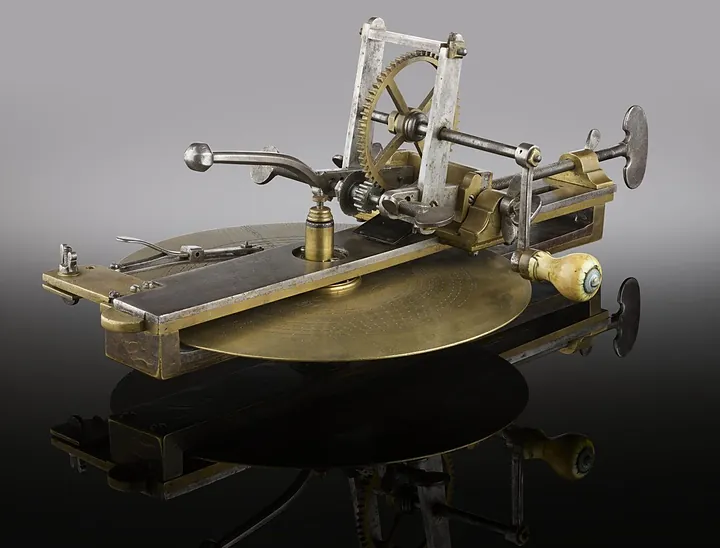
Clocks · 1751
Large wheel engine, signed and dated "John Tipping, Whildon Green, 1751".
Science Museum Group, London
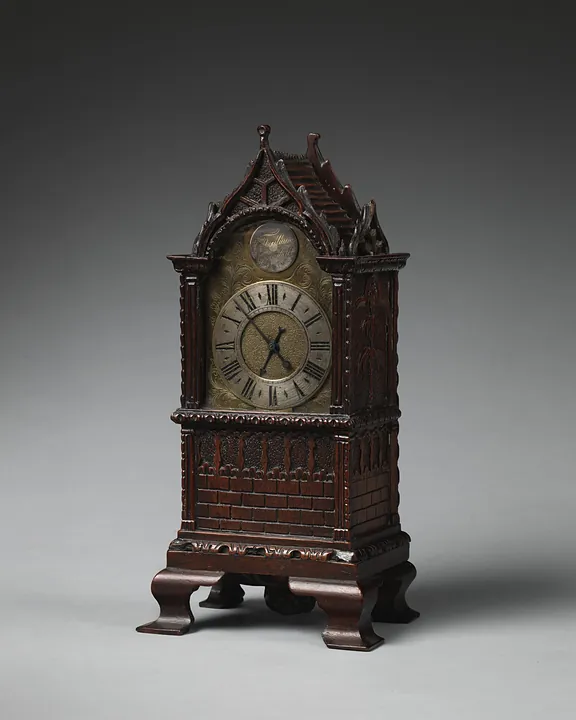
Clocks · 1755
Bracket clock by John Fordham, England, 1755
The Metropolitan Museum of Art, New York
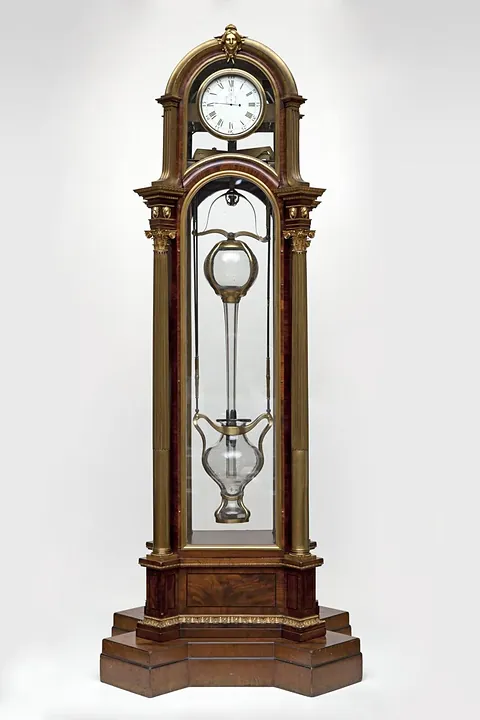
Clocks · c. 1760
Longcase clock by James Cox, England, c. 1760
Victoria and Albert Museum, London