
Clocks · Clock
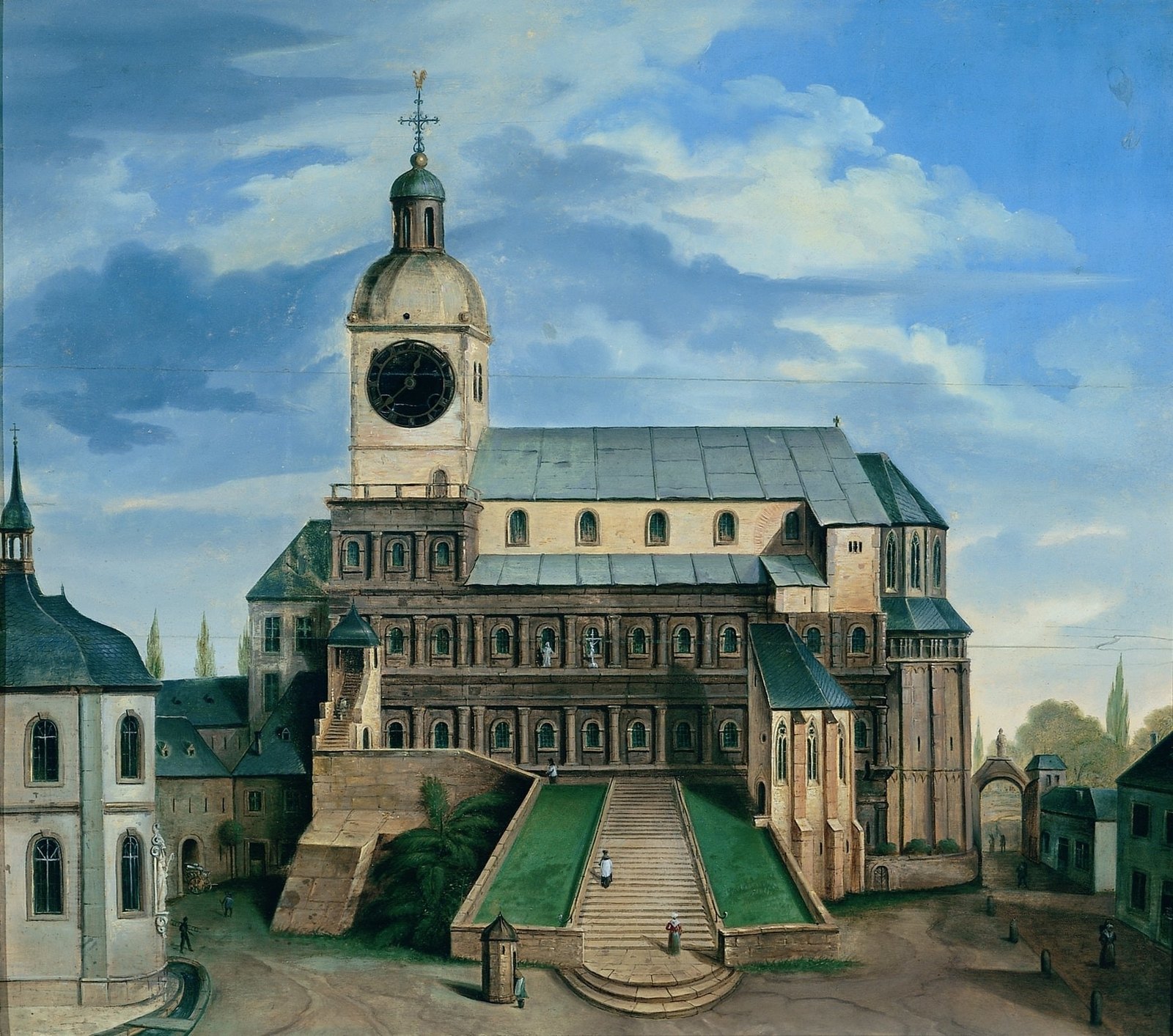
Clock by Japy frères, Switzerland, Before 1840
- Maker / attribution
- Japy frères (Created)
- Date
- Before 1840
- Historical period
- Precision & Scientific Horology (1750 – 1850)
- Country of origin
- Switzerland
- Place
- Switzerland
- Object type
- Clock
- Materials / technique
- Öl auf Holz
- Dimensions
- 76,5 x 88 cm
- Holding institution
- Stadtmuseum Simeonstift Trier
- Accession / object no.
- III 1347
- Credit line
- Stadtmuseum Simeonstift Trier
- Catalogue title (original)
- Die Porta Nigra in Trier als Simeonkirche (German)
View the source record ↗ (opens another website in a new tab)Suggest a correction
Record summary
Held and catalogued by Stadtmuseum Simeonstift Trier (object number III 1347), this is a clock by Japy frères, made in Switzerland, dated Before 1840. The Atlas places it in the Precision & Scientific Horology period (1750 – 1850) of its Clocks collection. Materials and techniques recorded by the source: Öl auf Holz. Recorded dimensions: 76,5 x 88 cm. The record is illustrated with 1 photograph.
Assembled from the source record's structured fields. Dates and attributions are given as the source states them; where a field is missing the Atlas leaves it blank rather than estimating.
Catalogue description
Catalogue description from Stadtmuseum Simeonstift Trier (German)
Die Bildtafel zeigt die Porta Nigra, das römische Stadttor am Nordeingang von Trier, umgewandelt zu einer Kirche. Zu Beginn des 11. Jahrhunderts ließ sich der Einsiedler Simeon aus Syrakus in der Porta Nigra einmauern. Nach seiner Heiligsprechung wurde das Stadttor zu einer Doppelkirche umgebaut, unten für das Volk, oben für die Geistlichen. Sie stand rund 800 Jahre. Dann kam Kaiser Napoleon und befahl den Abriss der Kirche und den Rückbau in den Zustand des römischen Stadttores (1804). Der Maler Ludwig Neureuter (1796-1871) hat den alten Zustand und den Abriss der St. Simeonskirche Kirche nur noch als Kind erlebt, konnte sich aber auf alte Abbildungen der St. Simeonskirche stützen. Bilderuhren waren eine beliebte Spielerei der Biedermeierzeit vor gut 150 Jahren. . Dazu taten sich Maler und Uhrmacher zusammen. Der Maler fertigte ein Gemälde, meist auf einer Holztafel, das einen wirklichen oder erfundenen Uhrenturm in einer Stadt oder auch oft eine Kapelle mit Turm an einem Flussufer zeigte. Der Uhrmacher baute dann an der „richtigen“ Stelle die Uhr ein, das Werk auf der Rückseite und das Zifferblatt auf der Vorderseite der Bildtafel und zwar genau auf den gemalten Turm. Oft gab man diesen Bilderuhren auch noch ein Schlagwerk oder ein Musikspielwerk mit, manchmal bewegten sich sogar Tiere und Menschen als Automaten.
Shown in the original language of the source catalogue. An editor-reviewed English translation has not yet been published; we do not publish machine translations as authoritative text.
Provenance
Literature: Ahrens, Dieter (Hg.): Malerei und Zeichnung - Beiträge zur Malerei- und Graphiksammlung des Städtischen Museums Simeonstift Trier (1992); Dühr, Elisabeth u.a. (Hg.): Stadtgeschichte im Stadtmuseum (2007)
Historical context
Precision & Scientific Horology (1750 – 1850)
Harrison solves longitude; Mudge invents the lever; Breguet's Paris workshop defines the modern watch.
The age of the deadbeat escapement, compensated pendulums and observatory regulators. Domestic clocks spread through the middle classes: English longcase and bracket clocks, French gilt-bronze mantel clocks, Viennese Biedermeier wall clocks, Black Forest painted-shield clocks, and the first American shelf clocks.
Read the period in the timelineMore clocks from this periodEarlier: Early Modern Horology
Atlas type guide
Domestic clocks
A clock combines four systems: a source of power (falling weight, coiled spring, or later electricity), a gear train that divides time, an escapement and oscillator that regulate it (foliot, pendulum or balance), and an indicating system of dial and hands or a bell. Its history runs from the large iron weight-driven clocks of the late thirteenth century to Renaissance spring-driven table clocks, the pendulum revolution of 1656, the factory clocks of the nineteenth century and electric and quartz clocks of the twentieth.
Domestic clocks also reflect regional furniture and decorative traditions — English longcase and bracket clocks, French pendules, Viennese regulators, Black Forest and American shelf clocks — and therefore record changing tastes as much as technical progress.
What to look for
- How the clock is powered: weights, spring barrel, fusee, electric coil.
- The oscillator: foliot, short pendulum, long seconds pendulum or balance.
- Whether it strikes: hour only (count wheel) or hours and quarters (rack striking).
- The maker or retailer's name on dial and movement, and any factory trademarks.
- Signs of alteration — replaced dials, converted escapements, 'married' cases.
Dating clues
- Before 1656 clocks used foliots or balances; after, most domestic clocks have pendulums.
- Anchor escapements spread after c. 1670; minute hands became common at the same time.
- Factory production in America and Germany transformed prices after c. 1840.
General guidance written by the Atlas editors about this kind of object. It is not a statement about this particular piece; for that, rely on the source record above and on physical examination.
Related records
Clocks · 1795–1805
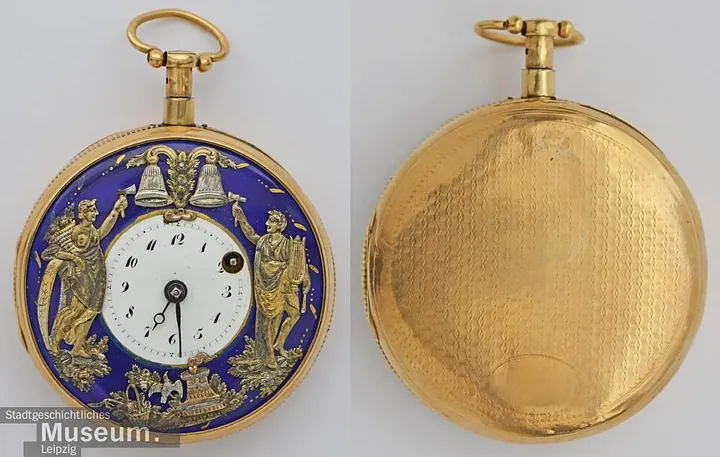
Clock, Switzerland, 1795–1805
Museum of City History Leipzig
Clocks · c. 1700 (Goldschmiedearbeit); second half of the 18th century(Uhrwerk)
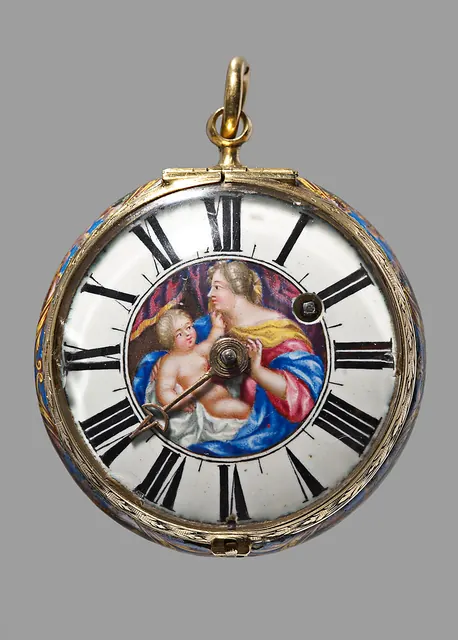
Clock by Jean-Pierre Huaut, Switzerland, c. 1700 (Goldschmiedearbeit); second hal
Fine Arts Museum Vienna
Clocks · 1760–1770
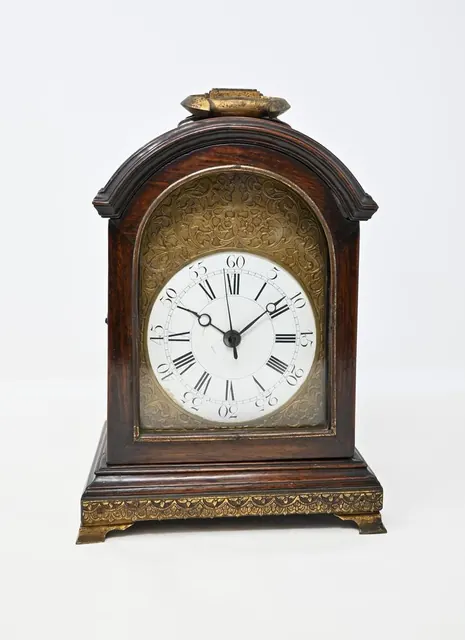
Small bracket clock, 1760–1770
British Museum
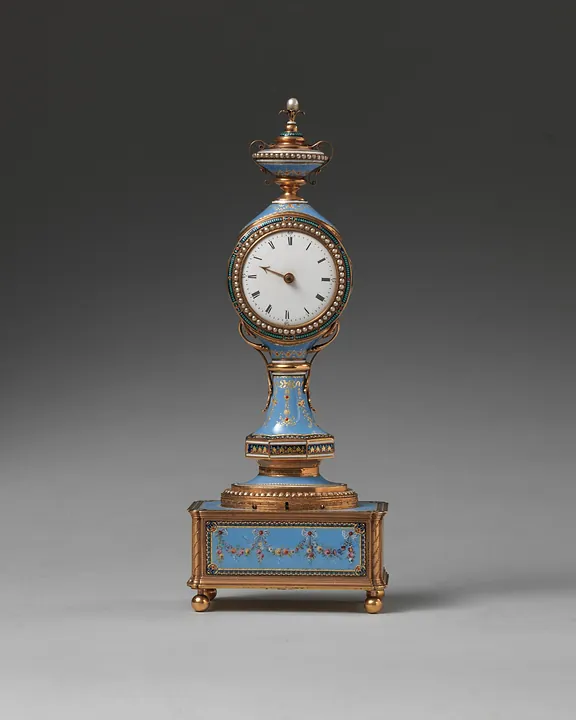
Clocks · c. 1784–91
Boudoir clock
The Metropolitan Museum of Art, New York
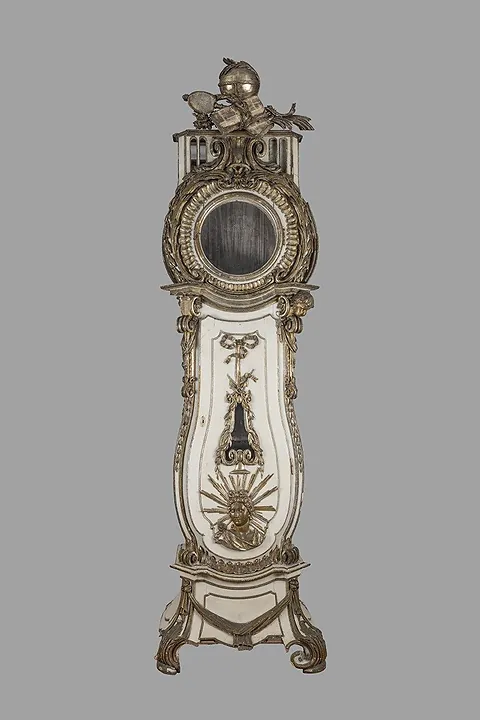
Clocks · c. 1780
Longcase clock by Louis George, Eberswalde, c. 1780
Museum Eberswalde
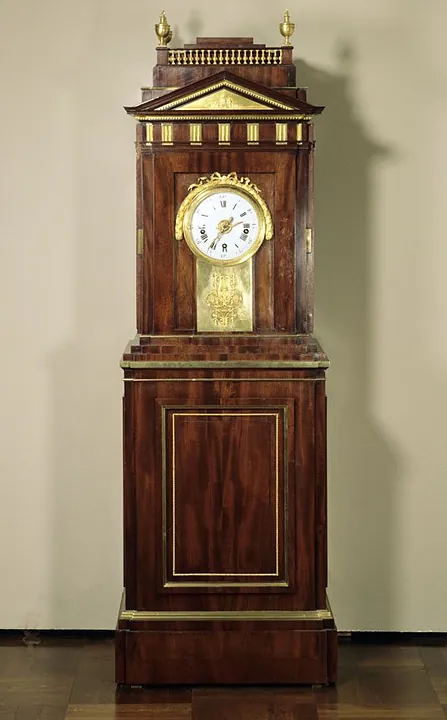
Clocks · 1780s (inferred: the museum dates the style to the 1780s and the music includes Gluck's Iphigénie en Tauride of 1779)
Musical longcase clock, Roentgen workshop, Neuwied, 1780s
Badisches Landesmuseum Karlsruhe
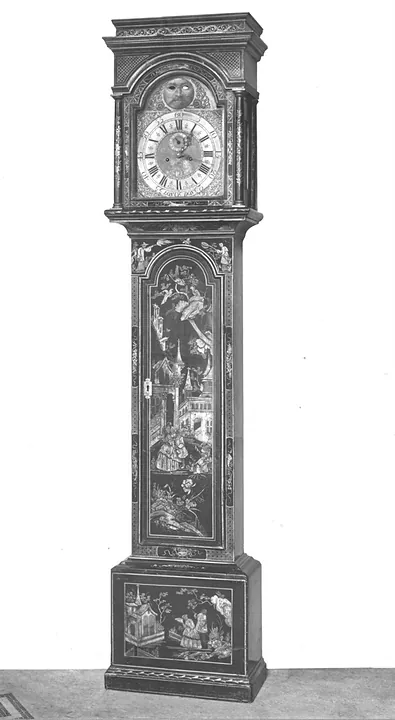
Clocks · 1740–1760
Longcase clock, English, 1740–1760, japanned wood, John Ellicott
Victoria and Albert Museum, London
Clocks · 1740–60
Tall clock by Samuel Bagnall, United States, 1740–60
The Metropolitan Museum of Art, New York